The world is witnessing a rapid rise in the number of victims of human trafficking and of migrants—voluntary and involuntary, internal and international, authorized and unauthorized. In the first two decades of this century alone, more than 65 million people have been forced to escape home into the unknown. The slow-motion disintegration of failing states with feeble institutions, war and terror, demographic imbalances, unchecked climate change, and cataclysmic environmental disruptions have contributed to the catastrophic migrations that are placing millions of human beings at grave risk.
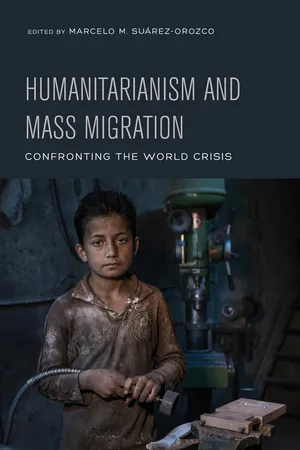
Humanitarianism and Mass Migration fills a scholarly gap by examining the uncharted contours of mass migration. Exceptionally curated, it contains contributions from Jacqueline Bhabha, Richard Mollica, Irina Bokova, Pedro Noguera, Hirokazu Yoshikawa, James A. Banks, Mary Waters, and many others. The volume’s interdisciplinary and comparative approach showcases new research that reveals how current structures of health, mental health, and education are anachronistic and out of touch with the new cartographies of mass migrations. Envisioning a hopeful and realistic future, this book provides clear and concrete recommendations for what must be done to mine the inherent agency, cultural resources, resilience, and capacity for self-healing that will help forcefully displaced populations.
- 416 pages
- English
- ePUB (mobile friendly)
- Available on iOS & Android
eBook - ePub
About this book
Information
PART ONE
THE NEW CARTOGRAPHY OF MASS MIGRATION
1
UNCHECKED CLIMATE CHANGE AND MASS MIGRATION
A Probabilistic Case for Urgent Action
Fonna Forman and Veerabhadran Ramanathan
Climate migration describes the voluntary and forced movement of people within and across habitats due to changes in climate. Climate change can act as a causal factor of migration or as a threat multiplier. With unchecked emissions of pollutants, global warming is projected to increase to 1.5°Celsius (C) within 15 years, to 2°C within 35 years, and to 4°C by 2100. These projections are central values with a small (less than 5 percent) probability that warming by 2100 can exceed 6°C, with potentially catastrophic impacts on every human being, living and yet unborn (Xu and Ramanathan 2017).
Climate is already changing in perceptible ways through floods, droughts, fires, heat waves, and sea level rise, displacing communities and catalyzing migration. Climate change and associated migratory shifts have also been statistically linked with civil conflict and political unrest. The decades-long drought in Syria, which has led in turn to agricultural failure, dramatic urbanization, and failed government response, is a powerful case in point. Reliable quantitative estimates of future climate migration are yet to be achieved. Reported estimates vary from 25 million to as many as one billion climate change migrants by 2050. Quantitative approaches for projecting mass migration face significant obstacles due to: (1) a wide range of projections for the degree of warming due to uncertainties in climate feedbacks; (2) the lack of a settled definition for climate migration; and (3) the causal complexity of migration due to variability in non-environmental factors such as bioregion, culture, economics, politics, and individual factors. It may take decades to arrive at reliable quantitative estimates. But this creates unacceptable ethical risks.
For this reason, we advocate a probabilistic approach to climate migration that accounts for both central and low probability warming projections as the only ethical response to the unfolding crisis. We conclude that in the absence of drastic mitigating actions, mass migration induced by climate change can become a major threat during the latter half of this century. For the poorest three billion, however, who still depend on thousand-year-old technologies for meeting basic needs such as cooking and obtaining drinking water, forced mass migration will be a reality much sooner. Climate justice demands an urgent global response for the well-being of us all.
CLIMATE CHANGE: HOW SOON AND HOW LARGE?
Climate change has already begun to change our lives through droughts, megafloods, heat waves, intense hurricanes, glacial melting, forest fires, and other severe weather phenomena. There are also other dramatic changes, such as the melting of the glaciers in Greenland and the west Antarctic, the retreat of the Arctic sea ice, the acidification of the oceans, the disappearance of coral reefs, and rising sea levels.
Massive amounts of data provide compelling, if not convincing, evidence that much of the climate change we are experiencing is caused by the buildup of carbon dioxide and other greenhouse gases produced by human activities. The major human activity warming the climate is the burning of fossil fuels for energy access. Others include deforestation; the release of superwarming pollutants, such as halocarbons (CFCS, HFCs) used for refrigeration and air conditioning; the massive release of the superpollutant methane from the use of natural gas, the growing cattle population, and the dumping of food and other organic waste into landfills; the release of the greenhouse gas nitrous oxide from agriculture; and the release of black carbon (another superwarming pollutant) from diesel combustion and residential biomass burning.
The planet has already warmed by 1°C (from preindustrial temperatures).1 In about thirteen years, the warming will exceed 1.5°C, largely from the warming pollutants that are already in the air. If current emissions of CO2 and the superpollutants continue unabated until 2030, the warming is likely to exceed 2°C in another thirty-three years (by 2050). The potential warming of 1.5°C to 2°C during the coming decades is a source of major concern for many reasons, including the following:
• The last time the planet was this warm was about 130,000 years ago. But those earlier warm epochs evolved over thousands of years. Human-induced warming will happen 30 to 100 times faster in a matter of decades from now, raising questions about the ability of ecosystems as well as social systems to adapt.
• The planet undergoes warm (interglacial) to cold (glacial) epochs and is currently in a warm epoch called the Holocene. The last glacial epoch peaked about 20,000 years ago, when the planet was colder by about 5°C. The human-induced warming is occurring on top of the already warm Holocene climate.
If the emissions continue unabated until 2050, it is likely that the twenty-first century will witness warming of 4°C or greater by 2100 (see fig. 1.1). These projected warming estimates represent at least a 50 percent probability. In our understanding of the climate system, there is a wide distribution of plausible warming values around the central value of 4°C. For example, there is a 5 percent probability that the warming will be only half as great, an outcome that would be good for society. But the problem is that there is an equal 5 percent probability that the warming could be more than 6°C, an outcome that is likely to be catastrophic for most human beings, rich or poor. In short, there is a one-in-twenty chance that our current fossil fuel use will result in catastrophic consequences for our children and grandchildren. Would we put our children on a plane if the pilot informed us that the aircraft had a one-in-twenty chance of falling from the sky?

FIGURE 1.1. Variations in Earth’s surface temperature: years 1000 to 2100. Deviation in degrees Celsius (in relation to 1990 value). Source: UNEP & GRID/Arendal, Vital Climate Graphics update, 2005 (see UNEP 2009, 27).
It is within this probabilistic context that we must assess the impacts of climate change on migration. It would be misleading to focus only on the central value of about 2°C for 2050 and 4°C for 2100 since there is a 50 percent probability that such warming estimates will be exceeded. Also, by focusing only on the central values, policy makers would be making an implicit value judgment that a one-in-twenty chance of catastrophic events happening to their children and grandchildren is an acceptable policy choice.
CLIMATE CHANGE AND MASS MIGRATION: WHAT’S AT STAKE?
Climate change is projected to cause widespread and serious harm to public health and the environment on which life depends, threatening to unravel many of the public health advances of the last century (UNEP 2009)(see fig. 1.2). The brunt of the harm will fall disproportionately on the poorest communities, which have the least capacity and fewest resources to adapt to changing environmental conditions, raising urgent issues of climate justice (Forman et al. 2016).

FIGURE 1.2. Impacts associated with global temperature change. Source: UNEP 2009. Original color graphics reproduced in black and white.
According to the Centre for Research on the Epidemiology of Disasters (CRED) Emergency Events Database (as cited in WMO 2013), 226 million people each year are impacted by natural disasters. In the first decade of the twenty-first century, 1 million people died in natural disasters, 88 percent of which were weather related. In that same decade, 370,000 people died as a direct result of extreme climate conditions, an outcome that amounts to a 20 percent increase over the death rate of the prior decade, primarily as a result of the increased incidence of heat waves (WMO 2013). A Lancet Commission report (2015) concluded that without adequate mitigation and adaptation, climate change poses unacceptable risks to global public health.
United Nations High Commissioner for Refugees (UNHCR) Chief António Guterres predicted in 2009 that climate change would become the largest driver of population displacements, both inside and across national borders. Current estimates of climate migration vary widely, from a low of 25 million to a high of 1 billion migrants by 2050. The most commonly cited estimate is 200 million displaced by 2050 (International Organization for Migration 2008, 11–12; Myers 2005). According to recent estimates, between 2008 and 2014, natural disasters—primarily atmospheric storms and floods—annually displaced an average of 26.4 million individuals (NRC/IDMI 2015, 20). The rate of displacement has more than doubled since 1970, from fewer than 2,000 persons per million to more than 4,000 persons per million in 2014 (NRC/IDMI 2015, 22). These displacements, even if temporary, have a profound impact on individuals’ lives, often involving the loss of a home or crops, and particularly harming individuals at the bottom of the socioeconomic ladder who lack the resources to adapt to the impacts of a rapidly changing climate.
Climate-related displacement disproportionately impacts Asia and Latin America. Annually, between 2006 and 2014, East Asia had more than 6,000 people per million inhabitants displaced, Latin America had approximately 5,700, and South Asia had 4,500. In absolute terms, Asia accounted for 82.0 percent of all climate-displaced individuals, or 21.5 million (NRCI/DMI 2015, 30–31). Consequently, not only are the most vulnerable individuals impacted heavily, but so too are the more vulnerable developing countries, which typically lack the resources to manage large-scale displacements.
In addition to extreme weather events, which often cause sudden mass displacements and are increasing in frequency, slower progressive factors like drought, soil erosion, and forest loss seem to have a stronger predictive effect on the likelihood of climate migration (McLeman 2014; Gutmann and Field 2010). The main geographic impacts are already being felt in Asia, Africa, Latin America, and the small island states, which also have the largest populations at risk of becoming climate refugees (Biermann and Boas 2008).
Rising sea levels around the world will have a disproportionate impact on already vulnerable demographics. Since the mid-nineteenth century, the rate of sea-level rise has been greater than the average rate during the previous two thousand years, and it continues to accelerate (IPCC 2013b). Research suggests that by 2100, average sea levels could rise by one meter or more (IPCC 2013a; Neumann et al. 2015). Globally, the most populous areas vulnerable to increased sea level and coast loss include China, India, Bangladesh, Indonesia, and Vietnam, although rapid population growth and urbanization in coastal zones in Africa (especially in Egypt and sub-Saharan countries in Western and Eastern Africa) are also of concern (Neumann et al. 2015). It is estimated that by 2060, between 729 and 983 million people will be living in low-elevation coastal zones in Asia, accounting for 70 percent of all those who live in such regions globally (Neumann et al. 2015). It is also estimated that approximately 280 million of the world’s inhabitants will be underwater if the global temperature increase stays below 2°C and that approximately 630 million will be underwater at 4°C. Seventy-four percent of the impacted population is in Asia (which itself comprises 59 percent of the global population).
At the macro level, regions with fragile ecosystems and vulnerable geographies, such as the low-lying megadeltas in Asia and the Sah...
Table of contents
- Imprint
- Subvention
- Title
- Copyright
- Contents
- List of Illustrations
- Acknowledgments
- Introduction: Catastrophic Migrations
- Part One. The New Cartography of Mass Migration
- Part Two. Frames on Children and Youth on the Move
- Part Three. Catastrophic Migrant Lives at the Margins
- Part Four. The Work of Education in the Transitions of Immigrant and Refugee Youth
- Epilogue: Pope Francis on Migration
- Contributors
- Index
Trusted by 375,005 students
Access to over 1.5 million titles for a fair monthly price.
Study more efficiently using our study tools.
Frequently asked questions
Yes, you can cancel anytime from the Subscription tab in your account settings on the Perlego website. Your subscription will stay active until the end of your current billing period. Learn how to cancel your subscription
No, books cannot be downloaded as external files, such as PDFs, for use outside of Perlego. However, you can download books within the Perlego app for offline reading on mobile or tablet. Learn how to download books offline
Perlego offers two plans: Essential and Complete
- Essential is ideal for learners and professionals who enjoy exploring a wide range of subjects. Access the Essential Library with 800,000+ trusted titles and best-sellers across business, personal growth, and the humanities. Includes unlimited reading time and Standard Read Aloud voice.
- Complete: Perfect for advanced learners and researchers needing full, unrestricted access. Unlock 1.5M+ books across hundreds of subjects, including academic and specialized titles. The Complete Plan also includes advanced features like Premium Read Aloud and Research Assistant.
We are an online textbook subscription service, where you can get access to an entire online library for less than the price of a single book per month. With over 1.5 million books across 990+ topics, we’ve got you covered! Learn about our mission
Look out for the read-aloud symbol on your next book to see if you can listen to it. The read-aloud tool reads text aloud for you, highlighting the text as it is being read. You can pause it, speed it up and slow it down. Learn more about Read Aloud
Yes! You can use the Perlego app on both iOS and Android devices to read anytime, anywhere — even offline. Perfect for commutes or when you’re on the go.
Please note we cannot support devices running on iOS 13 and Android 7 or earlier. Learn more about using the app
Please note we cannot support devices running on iOS 13 and Android 7 or earlier. Learn more about using the app
Yes, you can access Humanitarianism and Mass Migration by Marcelo Suarez-Orozco in PDF and/or ePUB format, as well as other popular books in Scienze sociali & Antropologia culturale e sociale. We have over 1.5 million books available in our catalogue for you to explore.