The definitive bibliography of Canada's Governor General's Literary Awards
Alice Munro, Michael Ondaatje, Margaret Atwood, Antonine Maillet, Carol Shields, Marie-Claire Blais, Gilles Vigneault…
For over three quarters of a century, the Governor General's Literary Awards have been instrumental in recognizing many of Canada's best authors, illustrators and translators. The result is impressive: between 1936 and 2017, 705 titles have been recognized with this prestigious award.
With careful attention to detail, Andrew Irvine presents the history and evolution of the Awards and extols their importance for the careers of authors, illustrators and translators, as well as for the development of Canada's national literature.
The heart of the book contains the first comprehensive bibliography of the awards, including the first list of winning books organized according to their historically correct award categories; information about five books wrongly omitted from previous lists of winning titles; detailed information about award ceremonies, film adaptations and jury members; and other key information.
This is a seminal work that belongs on the shelf of every scholar and every lover of Canadian literature.
This book is published in English.
-
Une bibliographie incontournable des Prix littéraires du Gouverneur général du Canada
Alice Munro, Margaret Atwood, Antonine Maillet, Carol Shields, Marie-Claire Blais, Michael Ondaatje, Gilles Vigneault…
Les écrivains canadiens sont depuis longtemps encensés sur la scène nationale comme à l'échelle mondiale, et les Prix du Gouverneur général jouent un rôle clé dans la reconnaissance de certains de nos meilleurs auteurs, illustrateurs et traducteurs. La liste est impressionnante: ce prestigieux prix a récompensé 705 oeuvres entre 1936 et 2017.
Avec un souci minutieux au détail, Andrew Irvine présente l'histoire et l'évolution des Prix et vante leurs vertus indispensables à la carrière des écrivains et des traducteurs ainsi que dans l'élaboration d'une littérature nationale au Canada.
Cette bibliographie est la toute première recension complète des Prix littéraires du Gouverneur général et donne des renseignements détaillés au sujet des cérémonies, des adaptations cinématographiques, des membres des jurys ainsi que d'autres informations clés. Le livre présente aussi une copie exhaustive et exacte de données bibliographiques tirées d'archives, une première dans le monde de l'édition.
En somme, une référence incontournable.
Ce livre est publié en anglais.
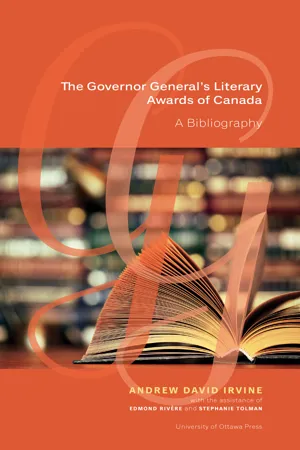
eBook - ePub
The Governor General's Literary Awards of Canada
A Bibliography
- 460 pages
- English
- ePUB (mobile friendly)
- Available on iOS & Android
eBook - ePub
The Governor General's Literary Awards of Canada
A Bibliography
About this book

AWARD CATEGORIES
Excitement reached its peak with a tie in the Academic Non-fiction division between Ross Munro’s Gauntlet to Overlord, and Joy Tranter’s Plowing the Arctic. A special subcommittee of the Awards Board, appointed for the purpose, broke the tie in favour of Mr Munro.
William Arthur Deacon1
Since their creation in 1936, Canada’s Governor General’s Literary Awards have been conferred in a variety of continuously evolving categories. Originally, it was planned that the awards would be given for books in both French and English in each of three divisions: Fiction, Poetry and General Literature.2 However, in the first year, no volume of English-language poetry was found to be of sufficiently high standard to merit an award.3 In addition, due to a variety of organizational challenges, it turned out to be over twenty years before awards were able to be offered in French. Despite this slow start, the awards were an immediate success with the reading public.
Over the decades, award categories also began to evolve. To recognize the difference between academic and more popular non-fiction writing, the General Literature division was split in 1942 into two divisions: Academic Non-fiction and Creative Non-fiction.4 Four years later, a Juvenile division was added for citation, although no award was made in this division during its first two years of operation.5 The award was “enlarged” to that of a medal in 1949.6
The largest single development occurred in 1959, when awards began to be offered for books published in French as well as English.7 As part of the accompanying reorganization, two new juries were formed. One was responsible for all the English-language awards, the other for all the French. A new distinction was also introduced between judging divisions (which determined a book’s eligibility and established the relevant comparison class for each book) and award categories (in which awards were given). In English, the three new judging divisions were Fiction and Drama, Non-fiction, and Poetry and Drama.8 In French, the corresponding divisions were Romans et nouvelles and Théâtre, Autres genres littéraires, and Poésie and Théâtre. As J.G. Sylvestre reports, “Drama appears twice so that an award could be made for a play which, in the opinion of the committee, is a better literary achievement than either the best book of verse or the best work of fiction of the year.”9 Thus, although books in Drama were to be judged in comparison to books in both Fiction and Poetry, the awards themselves (to a maximum of three in each official language) were to be given in the individual categories of Fiction, Non-fiction, Poetry, Drama, Romans et nouvelles, Autres genres littéraires, Poésie and Théâtre.
Following the 1959 reorganization, Canada Council of the Arts press releases did not always distinguish clearly between judging divisions and award categories. For example, in 1959 it was announced that, under the new structure, awards would be given in the three categories of Fiction and Drama, Non-fiction, and Poetry and Drama in both English and French.10 However, once the awards began to be conferred it became clear that they were instead being granted in the eight categories listed above, with a maximum of three awards being given in each official language.11
Discovering which award categories were being used is also complicated by the fact that during the 1960s several Canada Council award announcements reported the categories differently in English and French. For example, in the 1962 award year, the English-language press release announced that Marshall McLuhan’s book The Gutenberg Galaxy had won in the apparently new category of “critical and expository prose.”12 In contrast, the French-language press release that same year placed the book in the traditional category of Autres genres littéraires, using the phrase “prose critique” simply as an explanatory gloss.13 Similar discrepancies occurred the same year with regard to Kildare Dobbs’ book Running to Paradise, and the following year with regard to Hugh Garner’s Best Stories.14 In all such cases, it is safe to conclude that the new wording was merely expository. Had such glosses been meant to refer to genuinely new categories, they almost certainly would have been announced in the relevant French-language press releases as well as in the English. Almost certainly, too, there would have been a formal announcement describing the re-organization, just as there was in 1959,15 197116 and other years.
The inaccurate reporting of award categories has also led to the circulation of numerous unreliable lists, often produced by government agencies, claiming, for example, that dramatic works were eligible for awards in a “Poetry or Drama” category as early as 1937. In fact, no dramatic...
Table of contents
- Cover
- Title Page
- Copyright
- Contents
- Introduction
- List of Tables
- Note to Reader
- The Governor General’s Literary Awards of Canada
- Acknowledgements
- Endnotes
- Index of Names
- Index of Titles
- Photos
Trusted by 375,005 students
Access to over 1.5 million titles for a fair monthly price.
Study more efficiently using our study tools.