Dental implants are an amazing innovation of dentistry. This book, written by an expert dentist gives you the basics in simple, easy to read and understand language.Forget the research and reading lengthy books. If you are looking for a fast and cheap way to get the answers you need, it's all in here and MADE SIMPLE.In less then an hour of reading you will get the basic answers to all your questions about dental implants.Before you spend lots of time and money, find out from Dr. Penchas:Are dental implants what you need?
Are you or your loved one candidates?
Where and what type of implants to get?These and many more answers made simple.
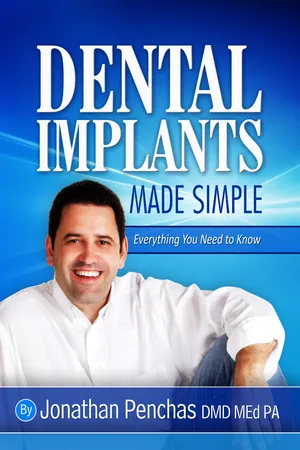
- 35 pages
- English
- ePUB (mobile friendly)
- Available on iOS & Android
eBook - ePub
Dental Implants Made Simple
About this book
Information
Subtopic
Salud bucal y cirugíaQ&A

Why are implant posts made of titanium?
The surgical-grade titanium used to create the implant posts is biocompatible. Bone tissue readily bonds with it and integrates it as it would a natural tooth root. Additionally, the strength and durability of titanium makes it ideal for dental implants.
Is everyone a candidate for All-on-4 dental implants?
Each patient’s needs, concerns, and expectations are different. Luckily, there’s an implant dentistry solution for almost everyone! The All-on-4 dental implants method involves placing implant posts in the jawbone and attaching replacement teeth the same day – a process called immediate load. It’s not the right solution for everyone.
Your doctor will discuss your specific situation to determine if All-on-4 is the best solution for you.
Is It True That I Can Get Dental Implants Finished in a Week?
There are some types of dental implants which can be immediately functional, and which can be used within a week or even the same day. They usually have temporary teeth put on them, until permanent teeth can be made a few months later. studies have shown that these implants have a similar success rate to conventional implants which cannot be loaded until a healing period of between three and six months has elapsed. That’s the good news, but the reality is that only a small percentage of patients are suitable for this procedure, and that most would benefit from using the more conventional implant procedure as the results are much more predictable and safer.
The benefits of having implants that are functional within a week are pretty obvious in that it gives a much better patient experience and can be less traumatic. However there must be sufficient bone to support the dental implants and the patients must be in very good general health and cannot be smokers or suffer from any systemic diseases such as HIV or diabetes that could compromise their immune system.
This system is also unsuitable for anybody who has severe grinding or bruxism as this would place too much pressure on the implants. They also need to be prepared to take extremely good care over their oral hygiene. In addition people having this procedure may need to follow a soft diet for between eight and twelve weeks after the surgery. The dentist must do a thorough assessment of someone’s suitability for this procedure to ensure it is really the best course of treatment.
Immediate load implants require the tooth that needs to be removed to be removed effectively without removing any bone after which the implant can be placed in the extraction hole and its stability tested by the application of suitable force using a torque wrench. After this an immediate abutment and temporary tooth can be placed. The temporary tooth is purely for cosmetic purposes and is adjusted to ensure no load can be applied to the implant under normal circumstances. This is to enable Osseo integration to take place over the next two or three months. After the process is completed an x-ray is taken to confirm the implant is successful.
Once the implant has fully integrated then a permanent crown can be fitted. While one advantage of this type of implant is the convenience of not being without teeth or having uncomfortable temporary fitted, and another advantage is that the tissues and gum surrounding the tooth are less likely to recede. In traditional implant surgery the gum is allowed to heal for several months before the implant is placed and there is always the risk that delayed placement can allow the gums to recede which may affect the gum line on the finished restoration.
Is the implant process painful?
The dental examination and pre-treatment diagnostics are comfortable and non-invasive. Sedation administered during the surgical procedure to place the implants into jawbone tissue ensures your complete physical and mental relaxation. Following dental implant surgery, most patients report little or no discomfort. Your doctor may recommend taking an over-the-counter analgesic or prescription pain medicine if you experience any tenderness or swelling at the site of your implant placement.
What’s a bone graft, and why would I need one?
A bone graft involves the use of artificial or donor bone to increase bone mass. Bone quality is a key component contributing to implant success. If the doctor determines that you have a shallow jawbone, because of your unique physical makeup or resulting from bone diminishment following tooth loss, a bone graft will augment your natural bone tissue to provide adequate depth to hold implant posts in place. A bone graft may be performed prior to or at the same time as dental implant placement.
How long do implants last?
Studies point to implants lasting as long as 40 years. Depending on your age and the care you take of your implants, they may last your entire lifetime.
These factors include a person’s medical health and also their daily oral hygiene routine. If there is a question mark over either of these aspects then an implant could fail at some later date. It also depends on how good the quality of the bone was at time of placement. Most implants have a very high rate of success and should last a considerable amount of time, especially as the materials and expertise have increased.
Avoiding periodontal disease
Periodontal disease can affect the gums and the site of the implants in the same way that it affects the gums around natural teeth, so it’s important to ensure that any signs of the disease are eliminated before implant placement, and that care is taken to avoid periodontal disease in the future. The best way to ensure this is to visit the dentist regularly and to schedule cleanings with the hygienist at least every six months. The hygienist is the best person to clean the implants thoroughly which will lessen the chance of gum disease. They will also check that you are cleaning your teeth correctly.
Good oral hygiene helps prolong the life of implants
Anyone who has had implants should be prepared to take extra care of them, and this includes having regular dental check-ups as well as following an oral hygiene routine.
Teeth should be brushed after every meal, and a small toothbrush or interdental brush used to clean the abutments. Floss can also be used to clean around the gums and abutments and prosthetic teeth. Removable prosthesis should be taken out of the mouth so that the abutments can be cleaned and flossed thoroughly, while fixed prosthesis should be cleaned as thoroughly as natural teeth, and the interdental brush and floss can be used to clean in between and around the abutments.
I’ve been told I can get Mini Implants for my denture – is it permanent?
Mini dental implants are sometimes recommended by dentists as a permanent solution for loose dentures. This sounds good because the cost is low, and the procedure fast and easy.
For the dentist recommending this, it’s an easy and profitable procedure. The dentist...
Table of contents
- eBook Cover
- Title Page
- Overview
- The Problem(s) with Missing Teeth
- Causes of Adult Tooth Loss
- Conventional Options to Replace Missing Teeth: They Often Miss the Mark
- Why Dental Implants?
- Types of Implant Solutions
- Are You a Candidate for Dental Implants?
- Choosing the Right Implant Dentistry Solution
- Treatment Stages & What to Expect
- Ensuring Implant Success
- The Cost of Dental Implants
- Selecting an Implant Dentist
- Caring for Your Dental Implants
- Q&A
- Make the Call!
- Learn More
- ABOUT THE AUTHOR
Trusted by 375,005 students
Access to over 1.5 million titles for a fair monthly price.
Study more efficiently using our study tools.
Frequently asked questions
Yes, you can cancel anytime from the Subscription tab in your account settings on the Perlego website. Your subscription will stay active until the end of your current billing period. Learn how to cancel your subscription
No, books cannot be downloaded as external files, such as PDFs, for use outside of Perlego. However, you can download books within the Perlego app for offline reading on mobile or tablet. Learn how to download books offline
Perlego offers two plans: Essential and Complete
- Essential is ideal for learners and professionals who enjoy exploring a wide range of subjects. Access the Essential Library with 800,000+ trusted titles and best-sellers across business, personal growth, and the humanities. Includes unlimited reading time and Standard Read Aloud voice.
- Complete: Perfect for advanced learners and researchers needing full, unrestricted access. Unlock 1.5M+ books across hundreds of subjects, including academic and specialized titles. The Complete Plan also includes advanced features like Premium Read Aloud and Research Assistant.
We are an online textbook subscription service, where you can get access to an entire online library for less than the price of a single book per month. With over 1.5 million books across 990+ topics, we’ve got you covered! Learn about our mission
Look out for the read-aloud symbol on your next book to see if you can listen to it. The read-aloud tool reads text aloud for you, highlighting the text as it is being read. You can pause it, speed it up and slow it down. Learn more about Read Aloud
Yes! You can use the Perlego app on both iOS and Android devices to read anytime, anywhere — even offline. Perfect for commutes or when you’re on the go.
Please note we cannot support devices running on iOS 13 and Android 7 or earlier. Learn more about using the app
Please note we cannot support devices running on iOS 13 and Android 7 or earlier. Learn more about using the app
Yes, you can access Dental Implants Made Simple by Jonathan Penchas in PDF and/or ePUB format, as well as other popular books in Medicina & Salud bucal y cirugía. We have over 1.5 million books available in our catalogue for you to explore.