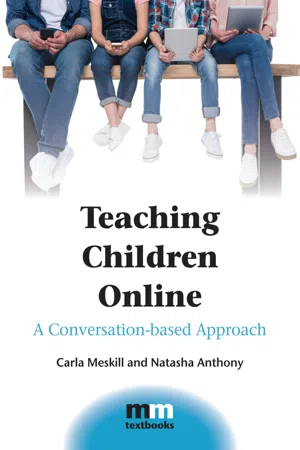
What does best practice in online education look like? How can educators make use of the affordances offered by online environments to bring out the best in the children they teach? These questions are answered in this new textbook, written with experienced teachers, novice educators and teacher educators in mind. Meskill and Anthony offer a wealth of examples of what successful online teaching looks like, and provide a rich source of practical, conversation-based strategies for optimizing online learning. This book will inspire anyone teaching or planning to teach fully online, or in a blended or hybrid format, by demonstrating how well constructed online conversations constitute powerful teaching.
- English
- ePUB (mobile friendly)
- Available on iOS & Android
eBook - ePub
About this book
Information
Subtopic
Lehrmethoden1
Teaching online: a conversational approach
In this chapter you will learn:
- the nature of online instructional conversations and the specifics of their functioning in a range of online environments;
- how instructional conversations work when Teaching with Voice, Teaching with Text and Teaching in Real Time;
- how each environment’s affordances can be optimized to support and amplify these conversations;
- the role of playfulness and humor in online teaching.
Introduction
Why online?
Why instructional conversations?
Perspective-taking
Identity/identification
Context and mind
Affinities
Strategies
Teaching with voice
Teaching with text
Teaching in real time
Playfulness and humor in online teaching
End-of-chapter notes
End-of-chapter activities
Further reading
References
Introduction
To truly teach, one must converse; to truly converse is to teach. (Tharp and Gallimore, 1991: 4)
This chapter introduces a conversational approach to online teaching and learning, the main focus of this text. Throughout subsequent chapters, we discuss and illustrate how and why online instructional conversations can be effective for young students and rewarding for you, the instructor. In this first chapter, the rationale behind the approach and the fundamentals of online activity design and active teaching via instructional conversations are presented as they align with the goals and processes of contemporary education. We begin the chapter with an overview of the potential pedagogical merits of online and blended learning.
Why online?
At the tremendously rapid rate at which online teaching and learning are being embraced worldwide, the question Why online? may soon be obsolete. For the moment, however, educators around the United States and worldwide are posing this question and considering carefully the rationale for offering online educational opportunities to their students.1
Why the rush to move learners online? This expanding migration makes good sense for a number of important reasons:
(1) Opportunity
Where there is no critical mass, as with
■ less commonly taught school subjects;
■ schools with small enrollments;
and for
■ students whose homes are far from bricks-and-mortar schools;
■ students who have physical or psychological challenges too great for bricks-and-mortar environments.
(2) Fit
Whereby
■ most school-age students are accustomed to and comfortable with digital literacy through informal recreational practices;
■ online instruction can be rendered developmentally appropriate, tailored and responsive to individual learners;
■ the range of at-hand materials and the ways learners can interact with them to learn is limitless online.
(3) Pedagogical affordances
Where there is growing empirical evidence of
■ convenience;
■ connectivity;
■ membership (playing field is leveled);
■ authentic audiences;
■ tailored audiences;
■ strategies to compensate for lack of non-verbal information;
■ richness of information (links, multimedia);
■ time to focus and review;
■ time to compose, resources to compose;
■ time and opportunity to reflect;
■ opportunity to witness and track learning;
■ opportunity to demonstrate learning.
In short, online teaching and learning represent both excellent opportunities and fit for many learners and, as is the emphasis throughout this text, an abundance of opportunities for educators to exploit the pedagogical affordances of multidimensional online venues. The chapters that follow intend to model and guide educators as they develop and implement online learning activities in ways that complement and amplify their professional beliefs and practices, especially as these are instantiated through instructional conversations with learners.
Why instructional conversations?
Computers, especially when they serve as they most often serve nowadays – to facilitate communication between people – are highly social machines. Our preferred uses of computers overwhelmingly involve connecting with others: to play games, to chat, to compare notes, to cooperate, to agitate, to commiserate, to antagonize – activities that are very similar to those we most enjoy offline. Our current online soc...
Table of contents
- Cover-Page
- Half-Title
- series
- Title
- Copyright
- Contents
- Introduction
- 1: Teaching online: a conversational approach
- 2: Saturating and modeling in online teaching
- 3: Corralling student learning in online teaching
- 4: Orchestrating interactions and scaffolding synthetic thinking
- 5: Providing feedback in online teaching
- 6: Elements of effective online instructional conversations
- 7: Future directions for online teaching and learning
- Glossary of terms
- Index
Trusted by 375,005 students
Access to over 1.5 million titles for a fair monthly price.
Study more efficiently using our study tools.
Frequently asked questions
Yes, you can cancel anytime from the Subscription tab in your account settings on the Perlego website. Your subscription will stay active until the end of your current billing period. Learn how to cancel your subscription
No, books cannot be downloaded as external files, such as PDFs, for use outside of Perlego. However, you can download books within the Perlego app for offline reading on mobile or tablet. Learn how to download books offline
Perlego offers two plans: Essential and Complete
- Essential is ideal for learners and professionals who enjoy exploring a wide range of subjects. Access the Essential Library with 800,000+ trusted titles and best-sellers across business, personal growth, and the humanities. Includes unlimited reading time and Standard Read Aloud voice.
- Complete: Perfect for advanced learners and researchers needing full, unrestricted access. Unlock 1.5M+ books across hundreds of subjects, including academic and specialized titles. The Complete Plan also includes advanced features like Premium Read Aloud and Research Assistant.
We are an online textbook subscription service, where you can get access to an entire online library for less than the price of a single book per month. With over 1.5 million books across 990+ topics, we’ve got you covered! Learn about our mission
Look out for the read-aloud symbol on your next book to see if you can listen to it. The read-aloud tool reads text aloud for you, highlighting the text as it is being read. You can pause it, speed it up and slow it down. Learn more about Read Aloud
Yes! You can use the Perlego app on both iOS and Android devices to read anytime, anywhere — even offline. Perfect for commutes or when you’re on the go.
Please note we cannot support devices running on iOS 13 and Android 7 or earlier. Learn more about using the app
Please note we cannot support devices running on iOS 13 and Android 7 or earlier. Learn more about using the app
Yes, you can access Teaching Children Online by Carla Meskill,Natasha Anthony in PDF and/or ePUB format, as well as other popular books in Sprachen & Linguistik & Lehrmethoden. We have over 1.5 million books available in our catalogue for you to explore.