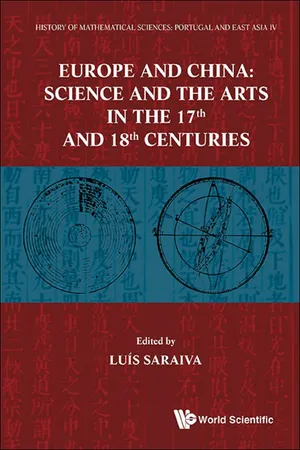
Missionaries, and in particular the Portuguese Assistancy of the Society of Jesus, played a fundamental role in the dissemination of Western scientific knowledge in East Asia. They also brought to Europe a deeper knowledge of Asian countries. This volume brings together a series of essays analyzing important new data on this significant scientific and cultural exchange, including several in-depth discussions of new sources relevant to Jesuit scientific activities at the Chinese Emperor's Court. It includes major contributions examining various case studies that range from the work of some individual missionaries (Karel Slavíček, Guillaume Bonjour) in Beijing during the reigns of Kangxi and Yongzheng to the cultural exchange between a Korean envoy and the Beijing Jesuits during the early 18th century. Focusing in particular on the relationship between science and the arts, this volume also features articles pertaining to the historical contributions made by Tomás Pereira and Jean-Joseph-Marie Amiot, to the exchange of musical knowledge between China and Europe.
Contents:
Foreword (Luís SARAIVA)
Portugal and the Jesuit Missions in Asia:
Portugal and the Jesuit Mission to China: Trends in Historiography (Rui MAGONE)
Evangelization, Politics, and Technology Transfer in the 17 th -Century Cochinchina: the Case of João da Cruz (Alexei VOLKOV)
The Jesuits and the Knowledge of China in Europe:
The Jesuits and Their Study of Chinese Astronomy and Chronology in the Seventeenth and Eighteenth Centuries (HAN Qi)
The Jesuit Jean-Joseph-Marie Amiot and Chinese Music in the Eighteenth Century (NII Yoko)
Tomás Pereira (1646–1708):
Some Data on Tomás Pereira's (Xu Risheng 徐日昇) Biography and Manuscripts (Isabel PINA)
Pereira's Trip to Tartary in 1685 (Davor ANTONUCCI)
Thomas Pereira and the Knowledge of Western Music in the 17 th and the 18 th Centuries in China (WANG Bing and Manuel SERRANO PINTO)
Pereira's Musical Heritage as Context for His Contributions in China (Joyce LINDORFF)
New Sources on Western Science at the Chinese Emperor's Court:
Verbiest's Manuscripts on Astronomy and Mechanics (1676): From Beijing to Moscow and Constantinople (Noël GOLVERS and Efthymios NICOLAIDIS)
Manchu Manuscripts on Mathematics in the Tôyô Bunko, the State Library of Inner Mongolia and the Bibliothèque Nationale de France (Junsei WATANABE)
The New Thermometer and a Slice of Experimental Philosophy in the Early Qing Court (SHI Yunli)
Missionaries in Beijing During the Reigns of Kangxi and Yongzheng:
Karel Slavíček and His Scientific Works in China (LIU Dun)
Guillaume Bonjour (1670–1714): Chronologist, Linguist, and “Casual” Scientist (Ugo BALDINI)
K“Western Astronomy vs. Korean Geography” Intellectual Exchanges Between a Korean and the Jesuits as Seen From Yi Kiji's 1720 Beijing Travelogue (LIM Jongtae)
Readership: Researchers and academics in history of science; educated readers interested in cultural problems of knowledge transmission, in particular in China, Japan and European countries together with the corresponding audiences in Portugese and Spanish speaking countries.
Trusted by 375,005 students
Access to over 1.5 million titles for a fair monthly price.
V. Missionaries in Beijing During the Reigns of Kangxi and Yongzheng
KAREL SLAVÍ
EK AND HIS SCIENTIFIC WORKS IN CHINA
LIU DUN
Institute for the History of Natural Science, Chinese Academy of Sciences, 55 Zhong Guan Cun East Road, Beijing 100190, P. R. China
Due to his profound knowledge of astronomy, mathematics, machinery and musicology, Karel Slaví
ek, a Jesuit born in seventeenth-century Moravia, was highly favored by the Emperor Kangxi, and consequently Slaví
ek lived continuously in Beijing for 19 years. In the immediate aftermath of the Chinese Rites Controversy, his arrival in China happened at a time when the activities of western missionaries had been subject to tremendous limitations in China. There is evidence suggesting that Slaví
ek was involved in writing many works on astronomy. While in China, he carried out a number of scientific activities, including drawing a map of Beijing, measuring the geographical altitude at his residence (the height of the tower of the Southern Catholic Church in Beijing), observing the motion and location of the Moon, drawing a map of the lunar surface, analyzing the Chinese records of solar eclipses and researching the Chinese calendar, musical tones and chronology. All of these works are mentioned in his letters to his Catholic colleagues and other European correspondents. In addition, his work on determining geographical latitudes was recorded and given account by a Chinese scholar in a work entitled “Method of the Western Scholar Yan Jia-le”.1
1. Karel Slaví
ek’s Life and Works: Brief Introduction
Karel Slaví
ek (1678–1735) was born in a small village in Moravia on December 24, 1678. He attended middle school at Brno, at the time the capital of Moravia and a city associated with a number of world-known scientists and scholars.2 On October 9, 1694, he joined the Society of Jesus and in 1706, he became a priest. When he was young, he studied philosophy and theology at Olomouc University3 and the University of Prague, among other places. Later he became a teacher of literature in a high school. Beginning in 1710, he taught mathematics and Hebrew in various colleges. During 1714 and 1715 he worked with Jakub Kresa (1648–1715), a professor of mathematics at Olomouc, Prague and Madrid, helping the latter to sort out his mathematical handouts.4
Thanks to his proficient knowledge of mathematics and music, Slaví
ek swore allegiance to the Jesuits in 1712, and was subsequently dispatched to China at the approval of the Society of Jesus in 1714. Along with the Bavarian Jesuit Ignace Kögler (
, 1680–1746), who later served as Director of the Imperial Observatory in Beijing, and the Portuguese Jesuit André Pereira (
, 1689–1743), Slaví
ek set out from Lisbon on March 13, 1716, and sailed on the high seas for five-and-a-half months, reaching Macao on August 30. There he was given the Chinese name Yan Jia-le (
), with an alias Xian-hou (
).5
Departing from Guangdong on December 9, 1716, Slaví
ek continued his journey by land until he arrived in Beijing on January 2, 1717, when Emperor Kangxi (
, 1661–1722) happened to be on a hunting trip to the north of the Great Wall. The Emperor sent his third son, Yinzhi (
), to greet the new missionaries from Europe, and to discuss academic matters with them. On February 3, 1717, Karel Slaví
ek, along with others, paid homage to the Emperor at the latter’s watering-place with all due ceremonious formalities. On February 7, Kangxi again summoned those missionaries living in Beijing. Fortunately, Slaví
ek’s knowledge of mathematics and music made it possible for him to stay in Beijing, despite the suspicion caused by the Chinese Rites Controversy when most foreigners were expelled from China. After Kangxi passed away, Slaví
e and a few other foreigners who had been allowed to stay in the service of the court were called upon on many occasions by Kangxi’s successor, the Emperor Yongzheng (
, 1678–1735).
Karel Slaví
ek’s residence in Beijing was Nantang (
, the Southern Catholic Church) owned by Portuguese Jesuits. Also living there were Josef Suarez (
, 1656–1736), an old Portuguese expert on the telescope; Ehrenbert Xaver Fridelli (
,1673–1743), an Austrian who specialized in measurement; and Ignace Köglerand and André Pereira, two accompanying passengers on the voyage to China. Apparently, there was a kind of division of labor among those missionaries, and Karel Slaví
ek identified himself by saying: “I am also here and I specialize in music.”
Karel Slaví
ek mainly lived in Beijing during his stay in China, although he made two short trips to southern China (one to Guangdong in 1721; the other to Jiangxi between 1722 and 1723). It appears that he was poor in health. In letters to his friends, Slaví
ek often complained of poor eyesight, so often that the Jesuits in Europe mistook him for a very old man. In 1734 Antonin Gaubil (
, 1689–1759) wrote from Beijing to a friend reporting that “Priest Slaví
ek is so poor in health that I wonder if he can complete his work on the study of the Moon”. One year later, on August 24, 1735, Slaví
ek died in Beijing at the age of 57. He had lived in China for a total of 19 years. Like most of those Jesuit colleagues who died in Beijing at that time, he was buried at the cemetery in Tenggong shanlan (
).
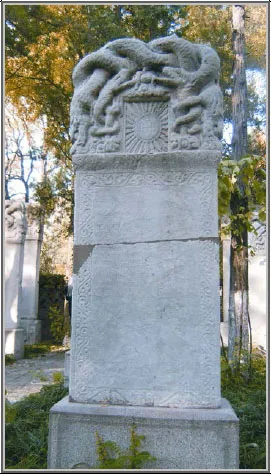
Figure 1. Slaví
ek’s tombstone, now located in Beijing Administrative College.
Research on Karel Slaví
ek, when compared to his depth of knowledge and the prestige he enjoyed in scientific and cultural exchanges between the East and West, is surprisingly scarce. The reason for this is chiefly due largely to the lack of access to Jesuit literature by most Chinese scholars, while some experts, who are able to access and read first-hand archives, have not paid much attention to this reclusive missionary coming from a small place.6 Moreover, Slaví
ek did not acquire a high position in the Qing Court, and lived more like a hermit, without many social ties, so that not enough attention has been paid to him. Louis Pfister, in his Biography and Bibliography, described Slaví
ek as follows: “malheureusement, il était d’un caractère un peu trop porté à la mélancolie et à la tristesse”.7
Slaví
ek’s reputation should be acknowledged by his European colleagues, and indeed he deserved a reward for his knowledge and extraordinary efforts made in China. In a letter dated December 18, 1730, Slaví
ek mentioned his works to Father Étienne Souciet (1671–1744), a French Jesuit who was then in charge of collecting correspondence from his colleagues in China, and who published the first volume of the famous Observations in Paris the year before,8 stating “I have some theses on mathematics, music and harmonics, which I often came across in my research when I was in the service of the past Emperor.9 I have the intention to annotate and transcribe these, and would send them to you through Father Gaubil, or maybe to a friend of yours at the Académie des Sciences, for revision.” In the same letter, he also mentioned his works on the Chinese calendar and chronology, his production of a map of Beijing, and his computation of the local latitude.10
Slaví
ek’s scientific works, as mentioned in Pfister’s Biography and Bibliography, include the following:
—
Astronomy (with Ignace Kögler, 1723);
—
Astronomical Observations (of another kind, 1768);
—
Observations of the Lunar Eclipse;
—
Calculation Table (1735);
—
A Simplified Method of Measuring Geographical Latitude;
—
A Map of Beijing (inner and outer city);
—
Measurement of the Libration of the Moon (1737);
—
Chinese Music (1737).
In addition, Pfister also mentions seven stacks of Letters from China to Europe.
However, Pfister’s book is only a preliminary compilation, based on original material from different sources. The literature he referred to may not necessarily be literature in book form, but in the form of manuscripts or simply deduced from relevant writings. Therefore, the letters that Slaví
ek sent to Europe from China are the most valuable source for his life and work in China. Fortunately, some of these letters were collected and published by Josef Stőklein (1676–1733) and others. In 1935, the Czech Jesuit Josef Vrašti (1878–1944) edited eight letters of Slaví
ek and ...
Table of contents
Cover
Halftitle
Title
Copyright
History
Acknowledgements
Foreword
Contents
Photographs of conference participants
I. Portugal and the Jesuit missions in Asia
II. The Jesuits and the knowledge of China in Europe
III. Tomás Pereira (1646–1708)
IV. New sources on Western science at the Chinese Emperor’s Court
V. Missionaries in Beijing during the reigns of Kangxi and Yongzheng
Frequently asked questions
Yes, you can cancel anytime from the Subscription tab in your account settings on the Perlego website. Your subscription will stay active until the end of your current billing period. Learn how to cancel your subscription
No, books cannot be downloaded as external files, such as PDFs, for use outside of Perlego. However, you can download books within the Perlego app for offline reading on mobile or tablet. Learn how to download books offline
Perlego offers two plans: Essential and Complete
Essential is ideal for learners and professionals who enjoy exploring a wide range of subjects. Access the Essential Library with 800,000+ trusted titles and best-sellers across business, personal growth, and the humanities. Includes unlimited reading time and Standard Read Aloud voice.
Complete: Perfect for advanced learners and researchers needing full, unrestricted access. Unlock 1.5M+ books across hundreds of subjects, including academic and specialized titles. The Complete Plan also includes advanced features like Premium Read Aloud and Research Assistant.
Both plans are available with monthly, semester, or annual billing cycles.
We are an online textbook subscription service, where you can get access to an entire online library for less than the price of a single book per month. With over 1.5 million books across 990+ topics, we’ve got you covered! Learn about our mission
Look out for the read-aloud symbol on your next book to see if you can listen to it. The read-aloud tool reads text aloud for you, highlighting the text as it is being read. You can pause it, speed it up and slow it down. Learn more about Read Aloud
Yes! You can use the Perlego app on both iOS and Android devices to read anytime, anywhere — even offline. Perfect for commutes or when you’re on the go. Please note we cannot support devices running on iOS 13 and Android 7 or earlier. Learn more about using the app
Yes, you can access History Of Mathematical Sciences: Portugal And East Asia Iv - Europe And China: Science And The Arts In The 17th And 18th Centuries by Luís Saraiva in PDF and/or ePUB format, as well as other popular books in Scienze biologiche & Scienza generale. We have over 1.5 million books available in our catalogue for you to explore.