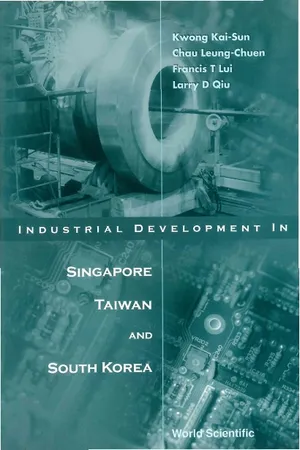
Economic analysis of the industrial experiences of the newly industrialized economies in Asia is generally lacking in the literature. This study attempts to fill that void by providing an in-depth discussion on the economic impact of the industrial policies of Singapore, Taiwan, and South Korea in the three-and-a-half decades after 1960.Throughout the study, a broad perspective of macroeconomic development is maintained. It is highly critical of the narrow-minded objective of certain governments in maximizing the pace of industrialization at the expense of general economic well-being.A comparative analysis of the industrial experiences of the three economies also shows a diversity of constraints and processes. Singapore relied on multinational corporations, Taiwan on returned engineers, and South Korea on chaebols. There appears to be no Asian formula for industrialization.In Hong Kong, there is an ongoing debate on whether some form of industrial policy should be introduced, in view of the perception that Hong Kong is lagging behind the other economies in terms of technology. Drawing on the experiences of the other economies, the concluding chapter of the book provides an informed and balanced answer to this question.
eBook - PDF
Industrial Development In Singapore, Taiwan, & South Korea
- 287 pages
- English
- PDF
- Available on iOS & Android
eBook - PDF
Industrial Development In Singapore, Taiwan, & South Korea
About this book
Trusted by 375,005 students
Access to over 1.5 million titles for a fair monthly price.
Study more efficiently using our study tools.
Information
Subtopic
IndustriemanagementTable of contents
- CONTENTS
- PREFACE
- 1. SINGAPORE: DOMINANCE OF MULTINATIONAL CORPORATIONS
- 2. TAIWAN: THRIVING HIGH-TECHNOLOGY INDUSTRIES AND SMES
- 3. SOUTH KOREA: GOVERNMENT-LED DEVELOPMENT AND THE DOMINANCE OF GIANT CORPORATIONS
- 4. COMPARISON AMONG SINGAPORE TAIWAN AND SOUTH KOREA
- 5. STRATEGIC CONSIDERATIONS IN THE HONG KONG CONTEXT
- 6. INDEX
Frequently asked questions
Yes, you can cancel anytime from the Subscription tab in your account settings on the Perlego website. Your subscription will stay active until the end of your current billing period. Learn how to cancel your subscription
No, books cannot be downloaded as external files, such as PDFs, for use outside of Perlego. However, you can download books within the Perlego app for offline reading on mobile or tablet. Learn how to download books offline
We are an online textbook subscription service, where you can get access to an entire online library for less than the price of a single book per month. With over 1.5 million books across 990+ topics, we’ve got you covered! Learn about our mission
Look out for the read-aloud symbol on your next book to see if you can listen to it. The read-aloud tool reads text aloud for you, highlighting the text as it is being read. You can pause it, speed it up and slow it down. Learn more about Read Aloud
Yes! You can use the Perlego app on both iOS and Android devices to read anytime, anywhere — even offline. Perfect for commutes or when you’re on the go.
Please note we cannot support devices running on iOS 13 and Android 7 or earlier. Learn more about using the app
Please note we cannot support devices running on iOS 13 and Android 7 or earlier. Learn more about using the app
Yes, you can access Industrial Development In Singapore, Taiwan, & South Korea by Leung-chuen Chau, Francis T Lui, Kai Sun Kwong in PDF and/or ePUB format, as well as other popular books in Volkswirtschaftslehre & Industriemanagement. We have over 1.5 million books available in our catalogue for you to explore.