Combinatorial Identities For Stirling Numbers: The Unpublished Notes Of H W Gould
eBook - ePub

Combinatorial Identities For Stirling Numbers: The Unpublished Notes Of H W Gould

The Unpublished Notes of H W Gould

  1. 276 pages
  2. English
  3. ePUB (mobile friendly)
  4. Available on iOS & Android
eBook - ePub

Combinatorial Identities For Stirling Numbers: The Unpublished Notes Of H W Gould

The Unpublished Notes of H W Gould

About this book

This book is a unique work which provides an in-depth exploration into the mathematical expertise, philosophy, and knowledge of H W Gould. It is written in a style that is accessible to the reader with basic mathematical knowledge, and yet contains material that will be of interest to the specialist in enumerative combinatorics. This book begins with exposition on the combinatorial and algebraic techniques that Professor Gould uses for proving binomial identities. These techniques are then applied to develop formulas which relate Stirling numbers of the second kind to Stirling numbers of the first kind. Professor Gould's techniques also provide connections between both types of Stirling numbers and Bernoulli numbers. Professor Gould believes his research success comes from his intuition on how to discover combinatorial identities.

This book will appeal to a wide audience and may be used either as lecture notes for a beginning graduate level combinatorics class, or as a research supplement for the specialist in enumerative combinatorics.

This book is a unique work which provides an in-depth exploration into the mathematical expertise, philosophy, and knowledge of H W Gould. It is written in a style that is accessible to the reader with basic mathematical knowledge, and yet contains material that will be of interest to the specialist in enumerative combinatorics. This book begins with exposition on the combinatorial and algebraic techniques that Professor Gould uses for proving binomial identities. These techniques are then applied to develop formulas which relate Stirling numbers of the second kind to Stirling numbers of the first kind. Professor Gould's techniques also provide connections between both types of Stirling numbers and Bernoulli numbers. Professor Gould believes his research success comes from his intuition on how to discover combinatorial identities.

This book will appeal to a wide audience and may be used either as lecture notes for a beginning graduate level combinatorics class, or as a research supplement for the specialist in enumerative combinatorics.

Readership: Undergraduates, graduates and researchers interested in combinatorial and algebraic techniques.
Key Features:

  • Professor Gould is an acknowledged expert in the field of Stirling number identities
  • For the first time in print, this book collects Professor's Gould's vast knowledge on this subject in one accessible location
  • This book contains Professor Gould's unique approaches to discovering and proving binomial identities
  • This book contains many fully-worked detailed proofs of the identities found in H W Gould's "Combinatorial Identities: A Standardized Set of Tables Listing 500 Binomial Coefficient Summations"
Trusted by 375,005 students

Access to over 1.5 million titles for a fair monthly price.

Study more efficiently using our study tools.

Information

Publisher
WSPC
Year
2015
eBook ISBN
9789814725293

Chapter 1

Basic Properties of Series

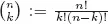
The purpose of this book is to develop Professor Gould’s formulas for relating Stirling numbers of the second kind to Stirling numbers of the first kind via Bernoulli numbers. Many of these relationships rely on Professor Gould’s techniques for evaluating series whose summands are binomial coefficients. Therefore, the first eight chapters of this book will be a primer on these various techniques. Assume n and k are nonnegative integers with kn. Define n! to be the product of the first n positive integers and
figure
with 0! := 1. Combinatorially
figure
counts the number of subsets of size k made from a set with n elements. We say
figure
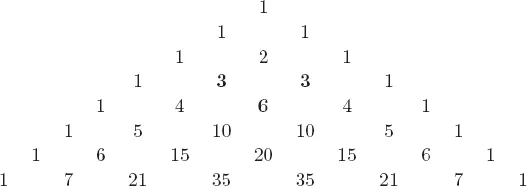
is a binomial coefficient. The binomial coefficients are often displayed in Pascal’s triangle. Pascal’s triangle begins with
figure
, and for row i, with i ≥ 2, the jth entry from the left is
figure
. Each row of the Pascal’s triangle contains only a finite number of entries since
figure
whenever k > n.
figure
Table 1.1: A portion of Pascal’s triangle
There is an inductive way to construct the rows of Pascal’s triangle which is known as Pascal’s identity.
Pascal’s Identity: Let n and k be nonnegative integers, with 0 ≤ kn. Define
figure
if k is a negative integer. Then
figure
Here is a combinatorial proof of Pascal’s identity. In this and other combinatorial arguments we show both sides of a given equation count the same quantity. Suppose S = {1, 2, 3, …, n + 1}. The left side of Equation (1.1) counts the number of subsets of S with size k. Call such a subset a k-subset of S. We claim the right side of Equation (1.1) also counts the k-subsets of S. There are two distinct types of k-subsets. The first type of k-subset contains n + 1. To complete such a subset, we must choose k − 1 elements from {1, 2, …, n} in
figure
possible ways. The second type of k-subset does not contain n + 1, and we must select k elements from {1, 2, …, n} in
figure
possible. Adding the two possibilities together counts all the k-subsets of S without repetition and produces Equation (1.1).
Mathematicians often generalize definitions, and the binomial coefficients are no exceptions. The typical way to generalize
figure
is to let n be an arbitrary complex number. We will always assume, unless otherwise specified, that k is a nonnegative integer, and x is a complex number. Define
figure
and
figure
We say
figure
is a general binomial coefficient. Whenever x = n, Equation (1.2) corresponds to the traditional combinatorial definition of a binomial coefficient.
It is important to note that
figure
is a polynomial in x of degree k. This observation, along the with Fundament...

Table of contents

  1. Cover Page
  2. Title Page
  3. Copyright
  4. Dedication
  5. Foreword
  6. Preface
  7. Acknowledgments
  8. Contents
  9. 1. Basic Properties of Series
  10. 2. The Binomial Theorem
  11. 3. Iterative Series
  12. 4. Two of Professor Gould’s Favorite Algebraic Techniques
  13. 5. Vandermonde Convolution
  14. 6. The nth Difference Operator and Euler’s Finite Difference Theorem
  15. 7. Melzak’s Formula
  16. 8. Generalized Derivative Formulas
  17. 9. Stirling Numbers of the Second Kind S(n, k)
  18. 10. Eulerian Numbers
  19. 11. Worpitzky Numbers
  20. 12. Stirling Numbers of the First Kind s(n, k)
  21. 13. Explicit Formulas for s(n, n − k)
  22. 14. Number Theoretic Definitions of Stirling Numbers
  23. 15. Bernoulli Numbers
  24. Appendix A Newton-Gregory Expansions
  25. Appendix B Generalized Bernoulli and Euler Polynomials
  26. Bibliography
  27. Index

Frequently asked questions

Yes, you can cancel anytime from the Subscription tab in your account settings on the Perlego website. Your subscription will stay active until the end of your current billing period. Learn how to cancel your subscription
No, books cannot be downloaded as external files, such as PDFs, for use outside of Perlego. However, you can download books within the Perlego app for offline reading on mobile or tablet. Learn how to download books offline
Perlego offers two plans: Essential and Complete
  • Essential is ideal for learners and professionals who enjoy exploring a wide range of subjects. Access the Essential Library with 800,000+ trusted titles and best-sellers across business, personal growth, and the humanities. Includes unlimited reading time and Standard Read Aloud voice.
  • Complete: Perfect for advanced learners and researchers needing full, unrestricted access. Unlock 1.5M+ books across hundreds of subjects, including academic and specialized titles. The Complete Plan also includes advanced features like Premium Read Aloud and Research Assistant.
Both plans are available with monthly, semester, or annual billing cycles.
We are an online textbook subscription service, where you can get access to an entire online library for less than the price of a single book per month. With over 1.5 million books across 990+ topics, we’ve got you covered! Learn about our mission
Look out for the read-aloud symbol on your next book to see if you can listen to it. The read-aloud tool reads text aloud for you, highlighting the text as it is being read. You can pause it, speed it up and slow it down. Learn more about Read Aloud
Yes! You can use the Perlego app on both iOS and Android devices to read anytime, anywhere — even offline. Perfect for commutes or when you’re on the go.
Please note we cannot support devices running on iOS 13 and Android 7 or earlier. Learn more about using the app
Yes, you can access Combinatorial Identities For Stirling Numbers: The Unpublished Notes Of H W Gould by Jocelyn Quaintance, H W Gould in PDF and/or ePUB format, as well as other popular books in Biological Sciences & Science General. We have over 1.5 million books available in our catalogue for you to explore.