This bilingual edition of Descartes' Meditations on First Philosophy is aimed both specifically at serious students and professors of philosophy, and generally at anyone motivated by a strong philosophical interest.
eBook - ePub
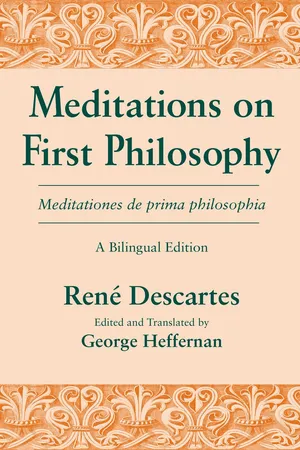
Meditations on First Philosophy/ Meditationes de prima philosophia
A Bilingual Edition
- 264 pages
- English
- ePUB (mobile friendly)
- Available on iOS & Android
eBook - ePub
Meditations on First Philosophy/ Meditationes de prima philosophia
A Bilingual Edition
About this book
Information
Publisher
University of Notre Dame PressYear
1990Print ISBN
9780268013813
9780268013806
eBook ISBN
9780268161118
Topic
PhilosophySubtopic
Mind & Body in PhilosophyINDEX
The index that appeared in the print version of this title was intentionally removed from the eBook. Please use the search function on your eReading device to search for terms of interest. For your reference, the terms that appear in the print index are listed below.
Instructions: “G” = Descartes’ ‘Greetings to the Men of the Theological Faculty of the Sorbonne’; “P” = Praefatio ad lectorem; “S” = Synopsis sex sequentium Meditationum; “I”-“VI” = Meditationes I–VI; Arabic numbers refer to the numbered paragraphs within the individual meditations; numbers in parentheses give the frequency of occurrence of the terms in the paragraphs. Thus, e.g., “Deus … III … 25 (3) …” indicates that God is mentioned three times in § 25 of Meditation III.
abduco, -duxi, -ductum, -ere (to lead away from)
aberro, -avi, -atum, -are (to aberr)
absolutus, -a, -um (absolute)
abstineo, -tinui, -tentum, -ere (to abstain)
abstractus, -a, -um (abstract)
acceptio, -onis, f. (meaning)
accidens, -dentis, n. (accidents)
accurate (accurately)
—accuratius (more accurately)
accuratus, -a, -um (accurate)
—accuratior, -ius (more accurate)
—accuratissimus, -a, -um (most, very accurate)
acies, -ei, f. (vision)
actio, -onis, f. (action)
activus, -a, -um (active)
actualis, -e (actual)
actus, -us, m. (act)
acumen, -minis, n. (sharpness of wit)
adventitius, -a, -um (adventicious)
aegroto, -are (to be sick)
aegrotus, -a, -um (sick)
aequivocatio, -onis, f. (equivocation)
aër, aëris, m. (air)
aeternum, -i, n. (the eternal, eternity)
aeternus, -a, -um (eternal)
aether, -eris, m. (ether)
affectus, -us, m. (emotion)
afficio, -feci, -fectum, -ere (to affect)
affingo, -finxi, -fictum, -ere (to feign)
affinitas, -atis, f. (affinity)
affirmo, -avi, -atum, -are (to affirm)
agnosco, -novi, -nitum, -ere (to recognize)
albedo, -dinis, f. (whiteness)
aliquid (something)
amentes (the mindless)
Angelus, -i, m. (angel)
anima, -ae, f. (soul)
animadverto, -verti, -versum, -ere (to notice)
animal, -alis, n. (animal)
animus, -i, m. (animus)
aperte (openly)
apertus, -a, -um (open)
—apertior, -ius (more open)
Apollonius, -i, m.
appetitus, -us, m. (appetite)
appeto, -ivi and -ii, -itum, -ere (to desire)
applicatio, -onis, f. (application)
applico, -avi, -atum, and -ui, -itum, -are (to apply)
apprehendo, -prehendi, -prehensum, -ere (to apprehend)
arbitrium, -i, n. (choice)
archetypum, -i, n. (archetype)
Archimedes, -is, m.
arcte (closely)
—arctissime (most, very closely)
argumentum, -i, n. (argument)
ariditas, -atis, f. (dryness)
Arithmetica, -ae, f. (arithmetic)
Arithmeticus, -a, -um (arithmetical)
artifex, -ficis, c. (artificer)
artificium, -i, n. (objectivum) ([objective] artifice)
assensio, -onis, f. (assent)
assentio, -sensi, -sensum, -sentire, and assentior, -sensus sum, -sentiri (to assent)
Astronomia, -ae, f. (astronomy)
astrum, -i, n. (star)
Atheus, -i, m. (atheist)
attendo, -tendi, -tentum, -ere (to attend [to])
attentius (more attentively)
attentus, -a, -um (attentive)
attributum, -i, n. (Dei) (attribute [of God])
auditus, -us, m. (hearing)
augeo, auxi, auctum, -ere (to grow, to increase)
auris, -is, f. (ear)
author, -oris, c. (author)
authoritas, -atis, f. (authority)
automatum, -i, n. (automaton)
bene (well)
bilis, -is, f. (bile)
bonitas, -atis, f. (goodness)
bonum, -i, n. (the good)
bonus, -a, -um (good)
—optimus, -a, -um (best)
brachium, -i, n. (arm)
cadaver, -eris, n. (cadaver, corpse)
caecus, -a, -um (blind)
callidus, -a, -um (cunning)
calor, -oris, m. (heat, warmth)
capra, -ae, f. (goat)
captivus, -i, m. (prisoner)
captus, -us, m. (omnium) (capacity [of all people])
caput, -pitis, n. (head)
carentia, -ae, f. (lack)
caro, carnis, f. (flesh)
casus, -us, m. (chance)
Catholicus, -a, -um (Catholic)
causa, -ae, f. (cause)
cera, -ae, f. (wax)
cerebellum, -i, n. (brain [dim.])
cerebrum, -i, n. (brain)
certe (certainly)
—certius (more certainly)
certitudo, -inis, f. (certainty)
certo (certainly)
certum, -i, n. (the certain)
certus, -a, -um (certain)
—certissimus, -a, -um (most, very certain)
charta, -ae, f. (paper)
...Table of contents
- Cover
- Title Page
- Copyright
- Dedication
- Contents
- Introduction to this Edition
- Meditationes de prima philosophia
- Meditations on First Philosophy
- Sapientissimis clarissimisque viris …
- To those most wise and distinguished men …
- Praefatio ad lectorem
- Preface to the reader
- Synopsis sex sequentium Meditationum
- Synopsis of the following six Meditations
- Meditatio I. De iis quae in dubium revocari possunt
- Meditation I. Concerning the things that can be called into doubt
- Meditatio II. De natura mentis humanae: quòd ipsa sit notior quàm corpus
- Meditation II. Concerning the nature of the human mind: that it be more known than [the] body
- Meditatio III. De Deo, quòd existat
- Meditation III. Concerning God, that he exist
- Meditatio IV. De vero & falso
- Meditation IV. Concerning the true and the false
- Meditatio V. De essentiâ rerum materialium; & iterum de Deo, quòd existat
- Meditation V. Concerning the essence of material things; and again concerning God, that he exist
- Meditatio VI. De rerum materialium existentiâ, & reali mentis a corpore distinctione
- Meditation VI. Concerning the existence of material things, and the real distinction of the mind from the body
- Index
- Selected Bibliography
- About the Editor/Translator
Trusted by 375,005 students
Access to over 1.5 million titles for a fair monthly price.
Study more efficiently using our study tools.
Frequently asked questions
Yes, you can cancel anytime from the Subscription tab in your account settings on the Perlego website. Your subscription will stay active until the end of your current billing period. Learn how to cancel your subscription
No, books cannot be downloaded as external files, such as PDFs, for use outside of Perlego. However, you can download books within the Perlego app for offline reading on mobile or tablet. Learn how to download books offline
We are an online textbook subscription service, where you can get access to an entire online library for less than the price of a single book per month. With over 1.5 million books across 990+ topics, we’ve got you covered! Learn about our mission
Look out for the read-aloud symbol on your next book to see if you can listen to it. The read-aloud tool reads text aloud for you, highlighting the text as it is being read. You can pause it, speed it up and slow it down. Learn more about Read Aloud
Yes! You can use the Perlego app on both iOS and Android devices to read anytime, anywhere — even offline. Perfect for commutes or when you’re on the go.
Please note we cannot support devices running on iOS 13 and Android 7 or earlier. Learn more about using the app
Please note we cannot support devices running on iOS 13 and Android 7 or earlier. Learn more about using the app
Yes, you can access Meditations on First Philosophy/ Meditationes de prima philosophia by René Descartes, George Heffernan in PDF and/or ePUB format, as well as other popular books in Philosophy & Mind & Body in Philosophy. We have over 1.5 million books available in our catalogue for you to explore.