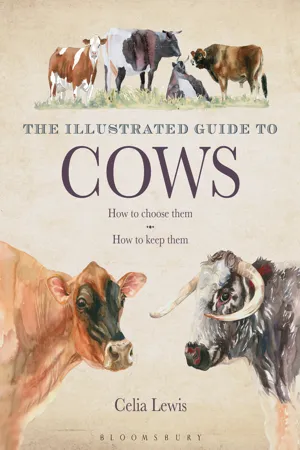
The Illustrated Guide to Cows covers the 60 most familiar breeds of cow worldwide with concise text about each, all illustrated with delightful watercolour paintings by the author.
Keeping cattle as a smallholder can be a rewarding enterprise, supplying you with food and milk and helping with the management of grassland on your property. This delightfully illustrated and informative ebook is ideal for anyone interested in keeping a cow or two, who would like to choose the best breed for their circumstances.
Introductory sections contain practical advice on all elements of rearing calves and keeping cattle, including what to consider about land, housing and fencing, whether to choose beef or dairy cows, tips on buying, moving and handling your stock, and guidance on feeding and breeding.
Breed profiles are written in engaging text that covers the history of each breed, its main characteristics and how to look after them, and each one has been beautifully illustrated by the author.
- 160 pages
- English
- ePUB (mobile friendly)
- Available on iOS & Android
eBook - ePub
About this book
Trusted by 375,005 students
Access to over 1.5 million titles for a fair monthly price.
Study more efficiently using our study tools.
Information
BREED PROFILES

Aberdeen Angus
A tough producer of tender beef

Black hornless cattle have existed in north-east Scotland since the 18th century and were known colloquially as doddies and hummlies. The originator of the true Aberdeen Angus is thought to have been Hugh Watson of Angus in the early 1800s. His favourite bull, Old Jock, and best cow, Old Granny, supposedly gave birth to 29 calves, and the pedigrees of most Angus cattle alive today can be traced to them. Old Jock was given the number one in the Scottish Herd Book when it was founded. Another important breeder was Sir George Macpherson-Grant of Ballindalloch, on the River Spey, who spent his life refining the breed. The original animals were rather short in the leg and became more so until the mid-20th century, when breeders began to select for height.
This is a tough breed that is well suited to harsh northern winters and has a reputation for producing good-natured and straightforward animals. The cows’ stayability, or ability to go on bearing calves, is legendary, and it is not unusual for cows to continue calving until up to 14 years of age.
Aberdeen Angus are one of the foremost beef animals in the world, producing well-marbled meat. They are used widely in cross-breeding as they mature early, calve easily and pass on the polled gene.
ORIGIN
UK
TYPE
Beef
SIZE
Medium to large
HORNED OR POLLED
Polled
COLOUR AND APPEARANCE
Predominantly black, but a dark red version does occasionally occur. Stocky appearance.

Aberdeen Angus calf (left) and Aberdeen Angus cow (right)
Ankole-Watusi
The horns have it
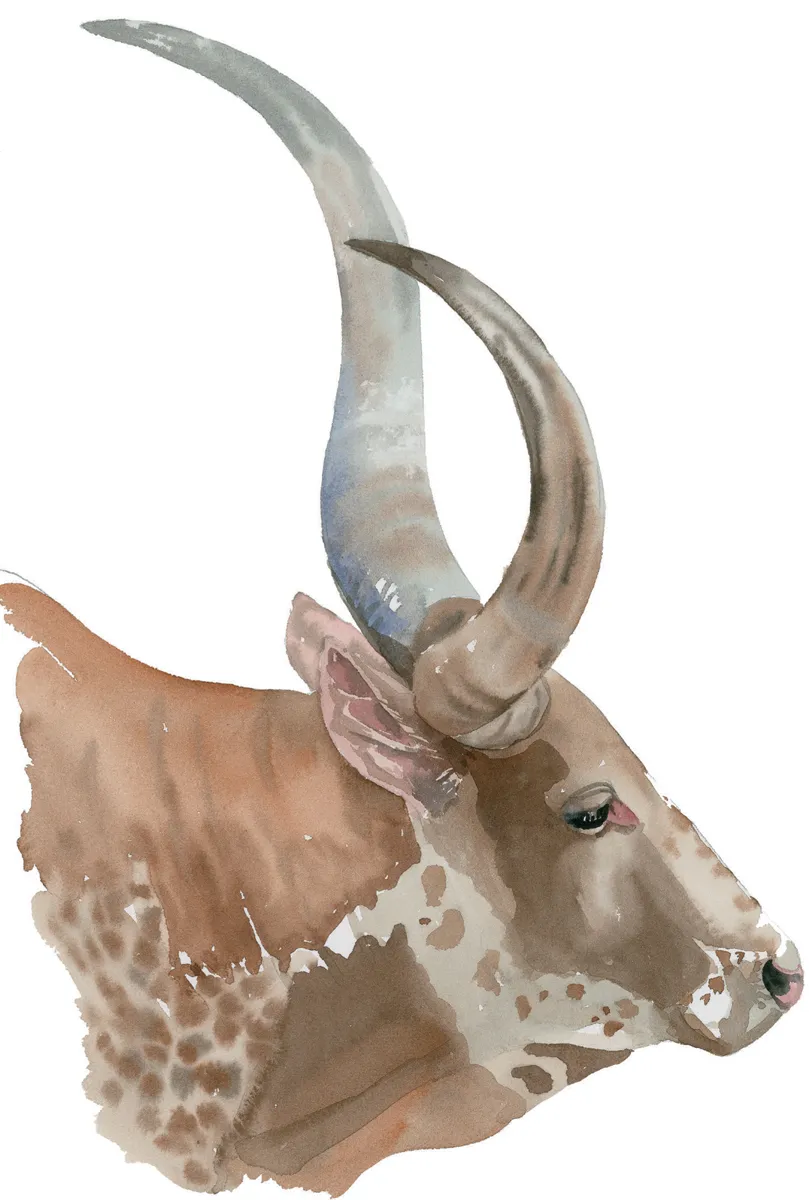
You can see the ancestors of the Ankole breed carved onto the pyramids in Egypt, and East African tribes have always prized these animals with their immense horns. They were kept for their milk and as a sign of their owners’ wealth, but were very seldom used for meat. Typically, a cow was grazed all day then brought home to her calf, which was allowed a brief suckle before the cow was milked by her owner. Mother and calf were then separated until morning, when the calf was allowed another suckle.
Ankole cattle were originally imported to European zoos during the late 19th and early 20th centuries for their curiosity value. Some were exported to American zoos, and when a few surplus animals became available to the public a few enterprising farmers started to produce herds. The Ankole Watusi International Registry was formed in 1983.
Beautiful lyre-shaped horns as long as 150 cm (60 in) are typical in the breed. It may be any colour, and either plain or spotted. The animals retain their own herd instincts. During the day the calves stay together with an ‘aunt’ cow looking after them, and at night the herd sleeps with the calves in the middle. Ankole milk is about 10 per cent butterfat and farmers utilize this by cross-breeding to boost fat levels. The breed tolerates huge ranges of temperature, with the horns acting either as radiators or for cooling as blood circulates through them.
I could dance with you till the cows come home. Better still, I’ll dance with the cows and you come home.
Groucho Marx
ORIGIN
Africa
TYPE
Beef
SIZE
Medium to large
HORNED OR POLLED
Enormous horns
COLOUR AND APPEARANCE
Many varied colours and patterns. Rather angular and overshadowed by the horns.

Ankole-Watusi steer
Aubrac
A mountain dweller from central France

Developed by Benedictine monks at Aubrac Abbey high up in the Massif Central, cattle of this breed spent the summer up in the mountains and walked to their pasturing ground on 25 May. They returned on 13 October to spend the winter under cover, and this tradition still continues today. At the fête de la transhumance, which takes place at the end of May, the cows are decorated with flags, bells and flowers, and paraded through the town of Aubrac. Up in the mountains the animals were formerly tended by shepherds who lived in basic huts called burons. They milked ...
Table of contents
- Cover
- Title Page
- Contents
- Introduction
- What to consider
- Feeding
- A bull or artificial insemination
- Rules and regulations
- Acquiring stock
- Handling
- Calving
- Organic farming
- Common ailments
- Breed profiles
- How to milk a cow
- Dairy products
- Finishing
- Cow-horn bugle
- Tanning a hide
- Useful websites
- Acknowledgements
- eCopyright
Frequently asked questions
Yes, you can cancel anytime from the Subscription tab in your account settings on the Perlego website. Your subscription will stay active until the end of your current billing period. Learn how to cancel your subscription
No, books cannot be downloaded as external files, such as PDFs, for use outside of Perlego. However, you can download books within the Perlego app for offline reading on mobile or tablet. Learn how to download books offline
Perlego offers two plans: Essential and Complete
- Essential is ideal for learners and professionals who enjoy exploring a wide range of subjects. Access the Essential Library with 800,000+ trusted titles and best-sellers across business, personal growth, and the humanities. Includes unlimited reading time and Standard Read Aloud voice.
- Complete: Perfect for advanced learners and researchers needing full, unrestricted access. Unlock 1.5M+ books across hundreds of subjects, including academic and specialized titles. The Complete Plan also includes advanced features like Premium Read Aloud and Research Assistant.
We are an online textbook subscription service, where you can get access to an entire online library for less than the price of a single book per month. With over 1.5 million books across 990+ topics, we’ve got you covered! Learn about our mission
Look out for the read-aloud symbol on your next book to see if you can listen to it. The read-aloud tool reads text aloud for you, highlighting the text as it is being read. You can pause it, speed it up and slow it down. Learn more about Read Aloud
Yes! You can use the Perlego app on both iOS and Android devices to read anytime, anywhere — even offline. Perfect for commutes or when you’re on the go.
Please note we cannot support devices running on iOS 13 and Android 7 or earlier. Learn more about using the app
Please note we cannot support devices running on iOS 13 and Android 7 or earlier. Learn more about using the app
Yes, you can access The Illustrated Guide to Cows by Celia Lewis in PDF and/or ePUB format, as well as other popular books in Technology & Engineering & Zoology. We have over 1.5 million books available in our catalogue for you to explore.