A clear and comprehensive guide to beekeeping.
The number of people interested and active in keeping bees at an amateur level has continued to increase over the past few years in both rural and urban situations. This guide, aimed at beginning beekeepers, and the only one to be endorsed by the BBKA provides an authoritative text, along with clear photographs and illustrations.
The book introduces the reader to beekeeping, including such areas as the workings of the colony, the structure of a hive, how to acquire bees and keep them healthy and what happens in each month in a beekeeping year. Each chapter is accompanied by anecdotes, answers to frequently asked questions and fascinating facts about bees and honey.
The new edition includes new step-by-step sequences to illustrate procedures such as containing a swarm, identifying the queen, using a smoker and cleaning a hive as well as more information on different kinds of hives, disease management and many other key areas.
- 224 pages
- English
- ePUB (mobile friendly)
- Available on iOS & Android
eBook - ePub
The BBKA Guide to Beekeeping, Second Edition
About this book
Trusted by 375,005 students
Access to over 1 million titles for a fair monthly price.
Study more efficiently using our study tools.
Information
1 Bees and beekeeping
Keeping bees has become very popular in recent years with the number of beekeepers in the UK increasing rapidly over the last five years. In 2007 the British Beekeepers’ Association had 13,000 members; by 2014 this had increased to nearly 25,000. Beekeeping suppliers have all seen a rapid increase in the sales of equipment and all this has happened alongside press stories about the plight of the honey bee with major losses occurring across the world.

Sealed honey stores surrounding cells of pollen, maturing larvae and sealed workers awaiting emergence.
We now realise that all bees are vitally important to the environment. If humans do not care for them by conserving their habitats and protecting them from the effects of modern living, we will suffer in the long term.
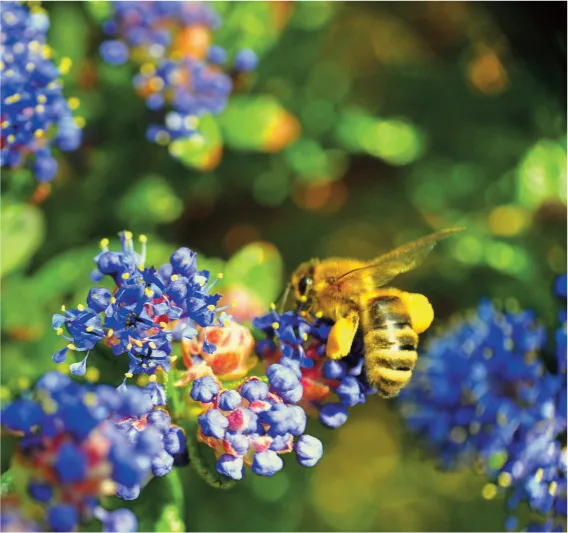
Almost a full load of pollen, being collected from a Ceanothus (Ceanothus cordulatus) before returning to the hive.
The essential insect
It has been suggested that Einstein predicted that if all the bees in the world disappeared then mankind would follow in four years. This quote is wrongly attributed to him but life would be much poorer without the vast army of pollinators of which honey bees are crucial members.
Worldwide the honey bee is extremely important as a pollinator of many crops. In California for example, the honey bee is critical to the production of almonds and over recent years, there has been concern that there may simply not be enough honey bees in the USA to pollinate the crop. If the almond blossom is not adequately pollinated the tree will be unable to produce almonds!
In the UK it has been estimated that all insect pollinators contribute more than £400 million to the agricultural economy at farm gate prices. This probably represents in excess of £1.5 billion, once the food reaches supermarkets. Honey bees are a significant contributor to this figure and it has been suggested that this one species could contribute up to 50 per cent of the pollination value. In fact, it is fair to assume that most flowering plants need a pollinator in order to propagate. There are some exceptions, but life would not be as pleasant – or as productive – without the vast army of insects that pollinate our flowers.

Hedgerow flowers – here Red Campion (Silene dioica), require the services of pollinators in order to flourish.
Most species of bees are in decline and the most effective way to reverse this trend is to improve their habitat, in large part by not practising agriculture in such an intensive way that all wild flowers and hedgerows are destroyed. These are the countryside features that favour the pollination force. Urban areas tend to be very good sources of food for bees because the variety of plants in gardens and parks provide an extended season for bees to collect food and provide a varied diet.
Colony losses
Colony losses have devastated bees and beekeepers around the world in recent years, a phenomenon that many people have tied to the use of insecticides widely used in agriculture. However, records show that over many decades there have been similar incidences of major losses and it cannot be assumed that current agricultural practices are the only reason for large losses. Indeed, bee populations vary from year to year and are closely related to weather.
Some European and US scientists suggest that losses of biodiversity and food resources, due to climate change, have intensified the problem.
Others believe that a rise in single-crop farming and the modification of landscapes, as well as pathogens causing diseases like foulbrood, nosemosis and Varroosis are responsible for the problem.
Honey bees are just one species in a vast range of bees. Most people know that bees produce honey, live in colonies and are pretty furry animals with a sting in the tail. In fact there are about 250 species of bee living in the UK. There are about 225 solitary bees that do not have a colony but tend a few larvae each year to produce a new generation and then die. Together they provide a major pollination force and, although they are wild and not tended or managed by us, are very important to the agricultural economy and the environment. In addition there are about 24 species of bumblebees; these are our furry friends that are seen working hard collecting pollen and nectar from a wide range of plants. Most are wild and survive by producing small nests each year. Whilst they collect nectar and store it in the nest the amount is very small and not harvested by us. However they provide an important pollination force and are bred to supply small colonies that remain in glasshouses to pollinate crops, mainly tomatoes. In these circumstances honey bees would not survive and be capable of providing an effective pollination force.
Colony Collapse Disorder
While so called Colony Collapse disorder (CCd) appears to have multiple interacting causes, some evidence points to pathogens and sub-lethal pesticide exposures as important contributing factors.
Laboratory studies show that some insecticides and fungicides can act together to be many times more toxic to bees than they would be if used alone. They can also affect the sense of direction, memory and brain metabolism, while herbicides may reduce the availability of plants bees need for food.
Agricultural and horticultural chemicals need to be used with care but should not always be blamed for bee losses.
Then there is just one species of honey bee in this country and throughout Europe, America and Australasia (Apis mellifera). There are other species of honey bee living in Asia but this book will not deal with them in any detail. The honey bee is different from other bees in that it lives in a large colony and has strategies to survive through winter and periods when there is no food by storing excess when times are good. Whilst no one bee lives for long the colony can survive for many years. They are a bit like the old adage about the axe that has been in the family for many years and has had a number of heads and handles. Given the right conditions the colony can replace every component over time and continue to thrive.
Honey bees and humans
The honey bee is a special case. Like all other bees it is a wild animal, but humans have found it an advantage to work with colonies of bees. Although beekeeping has been practised for many thousands of years worldwide, recently honey bees have suffered major losses of numbers of colonies. New diseases have devastated colonies while modern farming practices may have exacerbated the situation.
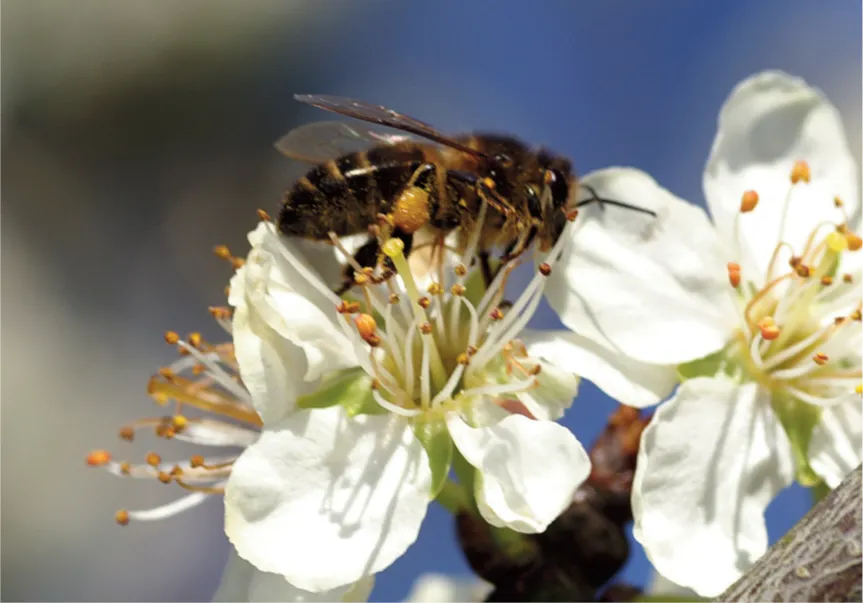
Honey bee collecting pollen from Greengage (prunus) blossom in the authors’ garden.
Of particular note is the Varroa mite (Varroa destructor). This pest has infested virtually all honey bee colonies across the world. Untreated colonies seem to succumb to the mite and die out within two to three years. There is no simple solution to the problem and, whilst some strains of honey bee are more resistant to the Varroa mite, it continues to be a major cause of colony death. The mite has also survived human attempts to eradicate it. It may be that in a couple of hundred years the honey bee will be able to coexist with this new parasite but in the meantime we need to help the bees to survive. The effect of the mite has been a dramatic decline in naturally occurring (feral) colonies and in general all honey bee colonies are now managed by beekeepers. Today’s honey bee needs more humans to...
Table of contents
- Cover
- Title Page
- Preface
- Foreword
- Contents
- Chapter 1: Bees and beekeeping
- Chapter 2: The colony
- Chapter 3: The hive
- Chapter 4: The history of bees
- Chapter 5: The beekeeping year
- Chapter 6: Queens and drones
- Chapter 7: Swarms
- Chapter 8: Bee and colony health
- Chapter 9: Plants and hive products
- Chapter 10: Getting started
- Contacts
- Glossary
- Acknowledgements
- eCopyright
Frequently asked questions
Yes, you can cancel anytime from the Subscription tab in your account settings on the Perlego website. Your subscription will stay active until the end of your current billing period. Learn how to cancel your subscription
No, books cannot be downloaded as external files, such as PDFs, for use outside of Perlego. However, you can download books within the Perlego app for offline reading on mobile or tablet. Learn how to download books offline
Perlego offers two plans: Essential and Complete
- Essential is ideal for learners and professionals who enjoy exploring a wide range of subjects. Access the Essential Library with 800,000+ trusted titles and best-sellers across business, personal growth, and the humanities. Includes unlimited reading time and Standard Read Aloud voice.
- Complete: Perfect for advanced learners and researchers needing full, unrestricted access. Unlock 1.4M+ books across hundreds of subjects, including academic and specialized titles. The Complete Plan also includes advanced features like Premium Read Aloud and Research Assistant.
We are an online textbook subscription service, where you can get access to an entire online library for less than the price of a single book per month. With over 1 million books across 990+ topics, we’ve got you covered! Learn about our mission
Look out for the read-aloud symbol on your next book to see if you can listen to it. The read-aloud tool reads text aloud for you, highlighting the text as it is being read. You can pause it, speed it up and slow it down. Learn more about Read Aloud
Yes! You can use the Perlego app on both iOS and Android devices to read anytime, anywhere — even offline. Perfect for commutes or when you’re on the go.
Please note we cannot support devices running on iOS 13 and Android 7 or earlier. Learn more about using the app
Please note we cannot support devices running on iOS 13 and Android 7 or earlier. Learn more about using the app
Yes, you can access The BBKA Guide to Beekeeping, Second Edition by Ivor Davis,Roger Cullum-Kenyon in PDF and/or ePUB format, as well as other popular books in Technology & Engineering & Entomology. We have over one million books available in our catalogue for you to explore.