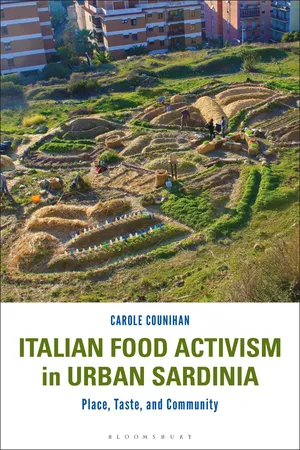
With her new book, Italian Food Activism in Urban Sardinia, cultural anthropologist Carole Counihan makes a significant contribution to understanding the growing global movement for food democracy.
Providing a detailed ethnographic case study from Cagliari, the capital of the Italian island-region of Sardinia, she draws upon Sardinians' own descriptions of their actions and motivations to change their food as they pursue grassroots alternatives to the agro-industrial food system through GAS (Gruppi di Acquisito Solidale or solidarity-based purchase groups), organic and urban agriculture, alternative restaurants, and farm-to-school programs. They link their activism to the sensory and emotional resonance of food and its nostalgic connections to place, tradition, and culture. They stress the importance of education through experience, and they build relationships and networks through workshops, farm visits, and commensality.
The book focuses on three key themes to emerge in interviews with Cagliari food activists: the significance of territorio (or place), the importance of taste, and the role of education. By exploring these areas of concern, Counihan uncovers key tensions in consumption as a force for change, in individual vs. group actions, and in political and economic power relations, which are of crucial importance to wider global efforts to promote food democracy.
- 192 pages
- English
- ePUB (mobile friendly)
- Available on iOS & Android
eBook - ePub
About this book
Trusted by 375,005 students
Access to over 1.5 million titles for a fair monthly price.
Study more efficiently using our study tools.
Information
Chapter 1
ETHNOGRAPHY OF ITALIAN FOOD ACTIVISM
Introduction
This book centers on food activism—people’s efforts to promote social and economic justice by transforming food habits—in the city of Cagliari, capital of the Italian island-region of Sardinia. In Cagliari, as all over Italy, food has enormous cultural and emotional as well as economic significance, which makes it a compelling pathway to activism. In the 2010s, diverse initiatives were arising to challenge the dominant agro-industrial food system that had swept Sardinia since the 1980s. Cagliaritani showed some strategies, challenges, and successes in their specific cultural context, which I believe have relevance to food activism elsewhere.
Cagliari food activists chose different strategies such as farming organically, forming solidarity purchase groups, shopping at farmers’ markets, participating in urban gardens, joining a Slow Food chapter, and running an organic business. I studied these through ethnographic research based on interviews and observations, which revealed heavy investment of emotions in local culinary culture, engagement of the body and the senses in actions, and desire to build justice through the food system. Three themes emerged throughout Cagliari food activism: the significance of place, or territorio, the appeal of taste as a strategy for action, and the goal of forging community. The book hopes to show the broader significance of these foci to global efforts to transform the food system. But first, I want to describe Sardinia, explain my research, and define food activism.
Context: Cagliari and Sardinia
Cagliari was a good place to study food activism because there was a lot of it going on. Sardinia, commonly defined as part of the under-developed “South and Islands,” or Mezzogiorno, has always had an important agro-pastoral economy, which has struggled against competition from increasingly globalized foodways manifest in expanding distribution networks and a high density of supermarkets (see Chapter 8). As the regional and provincial capital, Cagliari has been the center of Sardinian history, politics, and commerce.1 In 2010, over two-fifths of the island’s 9,275 small food stores were concentrated in Cagliari (Floris 2010: 43). With a population of 156,000 in the city and 563,000 in the metropolitan area, one-third of the island’s total population of 1,675,000 (ISTAT 2011), its provisioning is central to the island’s food system. Today, Cagliari’s alternative food practitioners—those seeking democratic, high-quality, and sustainable food—are flourishing.

Figure 1.1 The author and Cagliari, photo by Jim Taggart
In the period of study, 2011 to 2015, Sardinians were struggling, particularly since the recession started in 2008.2 Sardinian GDP per capita decreased 10 percent between 2008 and 2014, and at € 19,791 was significantly lower than the Italian (€ 26,548) and European (€ 27,400) averages. Sardinia’s unemployment rate has been higher than the Italian average throughout the twenty-first century, and reached 18.6 percent in 2014. At that time, 75 percent of the workforce was in the service sector, many working seasonally in tourism, 19 percent in industry, and 6 percent in agriculture (European Commission 2016). Almost four-fifths of Sardinian agricultural lands were pasture, mainly for sheep, with the rest used for crops: wheat and other cereals, fava beans and other legumes, olives, grapes, citrus fruits, and vegetables, especially artichokes and tomatoes (Floris 2010). But Sardinia’s longstanding agro-pastoral economy was hurting in the 2010s because of difficult labor conditions, poor transportation, and global competition.3
Newspaper reports indicated that the island imported 80–85 percent of its food,4 surprising given the island’s agro-pastoral pursuits, the quality of its products, and the fact that Sardinians preferred their own local food. An article in the major island newspaper L’Unione Sarda (April 11, 2015) reported on a survey by the Ministry of Agricultural Politics with the headline: “Ready to Pay More for Sardinian and Italian Products.” Of those surveyed, 82 percent were willing to pay a premium for a guarantee of Italian provenance, 54 percent cared about products being “typical,” 45 percent cared about DOP and IGP geographical certifications,5 and 30 percent sought organic products. Luca Saba, the director of the Coldiretti Sardinia farmers’ union, was quoted as saying, “‘Eat healthy, eat Sardinian’ is not just a slogan for us but the leitmotif of what we work for every day.” This preference for local food—rooted in the history of tending gardens and vineyards, exchanging with neighbor-producers, and eating fresh products imbued with familiar tastes—provided a fertile ground for the alternative food movement, which was gaining traction in Sardinia. Food activism in Cagliari was representative of initiatives underway in Italy, but it also had its own Sardinian cast, expressed by one Slow Food member who told me, “we have Sardinianized Slow Food”—“abbiamo sardizzato Slow Food.”6
Food activism
This book follows Valeria Siniscalchi’s and my broad conceptualization of food activism as consisting of public efforts to promote social and economic justice through food—the struggle for food democracy (Siniscalchi and Counihan 2014). Food democracy, according to Tim Lang (1999), consists of universal access to good, affordable, nutritious, culturally appropriate food. For Neva Hassanein (2003: 84), food democracy also means representing “all the voices of the food system.” Food activism merits examination because it is growing all over the world in diverse forms and sites (Agyeman and Alkon 2011, Counihan and Siniscalchi 2014).7 I aim to enrich understanding of food activism through my ethnographic research in Cagliari. I use observations and interviews with participants to describe actions, attitudes, and implications for food democracy.
Throughout this book, I’ll discuss “food activists,” “food advocates,” and “food rebels”8—people who were promoting tasty, healthy, and sustainable alternatives to the global agro-industrial food system. In my conceptualization, food activists were more militant, oppositional, and organized; food advocates worked for food system change within existing institutions; and food rebels more sporadically and haphazardly pushed for change. But food activists, advocates, and rebels fell on a continuum, and I use the terms somewhat interchangeably.
What they had in common was a desire to resist the agro-industrial food system that increasingly has dominated food provisioning around the globe (Pratt 2007). That system aims to maximize profits through large-scale production based on machine labor, chemical inputs, monocropping, far-flung markets, and transnational corporations controlling food from seeds to sales. The agro-industrial food system has fostered increased consumption of meat, fat, salt, and processed foods.
Many diverse forms of resistance to the agro-industrial food system come together under the umbrella of food activism, whose proponents aim for fairly remunerated local production and dispersed control of inputs. They promote small-scale mixed farming with crop rotation and natural fertilizers, short distribution chains, and innovative food acquisition outlets like farmers’ markets and solidarity purchase groups. They favor artisanal food processing and diets high in local vegetables, fruits, and legumes with modest amounts of local meats. Cagliari activists pursued these aims through what Lucy Jarosz (2008: 231) and others have called Alternative Food Networks, or AFNs, which aimed for social, economic, and environmental sustainability.
Methods and subjects
I studied the experiences of a range of men and women who were engaged in organized alternative food practices between 2011 and 2015 in Cagliari and the nearby agricultural areas of the Sarrabus, Sulcis, and Campidano. The research project was approved by the Millersville University Institutional Review Board. I conducted and transcribed twenty-six recorded semi-structured interviews, took fieldnotes on twice that many non-recorded interviews, and did many hours of observation and photography in farmers’ markets, restaurants, fields, wineries, shellfish and tomato packing plants, and other sites. I conducted all interviews in Italian and translated them into English. My husband, anthropologist Jim Taggart, accompanied me in the fieldwork, and his questions and insights have been invaluable. Transcribed interviews, fieldnotes, and photographs form the raw material for the book, which relies on case studies and verbatim quotations from the study participants, who were eager to tell their stories.
In this book, they speak about what they did, how they did it, and why—telling stories that were both personal and political.9 Foregrounding subjects’ own words and perspectives fulfills Antonio Gramsci’s call for “living theory” born of specific people’s real-life experiences and their “dialogues of transformation” (Pizza 2003: 36).10 Cagliari food advocates constructed such dialogues in the interviews, and together created a living theory of Cagliari food activism based on their beliefs and practices.
This book represents diverse voices from alternative food networks—consumers as well as producers and distributors. Most informants were middle class and employed in the service sector—active or retired office and government workers, teachers, consultants, entrepreneurs, merchants, chefs, restaurateurs, a newspaper kiosk owner, a butcher, a nurse—but several were small farmers, and a few were upper middle class: a doctor, a professor, a business owner, and a retired mine director. Several were under-employed—working part-time, scrambling from one consulting job to another, earning too little, or temporarily unemployed. All were native Italians, and almost all were native Sardinians with generational ties to rural agro-pastoral culture. Few were wealthy, but most could put a little extra into their food purchases. They ranged from food and wine connoisseurs in search of wonderful tastes to activists seeking quality local food for overarching political motivations. This book uses their narratives to fill a gap in the literature by describing a range of alternative food participants and initiatives in an urban setting.11
I found people to interview through friends, websites, visits to markets and restaurants, attendance at Slow Food events, and the snowball method—whereby one study participant suggested others. Friends and colleagues furnished leads and help. Slow Food Cagliari and its head Anna Cossu provided many contacts. Interviewees varied in age from twenty-nine to sixty-eight and there were slightly more males than females. They were farmers’ markets vendors and employees, chefs and restaurant proprietors, Slow Food members, farm-to-school and urban garden participants, organic farmers, and members of Cagliari “Open Circle” solidarity buying group, or GAS (gruppo d’acquisto solidale). Some fit Gramsci’s definition of the “new intellectual”—“builder, organizer, permanent persuader” (Gramsci 1955b: 7, my translation).
Many knew each other, forming a loose network of alternative food practitioners. Some had full-time jobs in the food sector, and others were volunteers or had part-time food jobs, with males somewhat higher among the former and females among the latter. Almost all of them lived in Cagliari, though many had been born in rural villages, and most had parents or grandparents who had worked in agriculture or pastoralism. All of them chose to use their real names.
Gender in Cagliari food activism
Both men and women participated enthusiastically in Cagliari food activism. Knowing how significant gender is in Italian foodways, I was attentive to gender roles and relations in my research. But I did not often find an explicit gender perspective. This accords with Allen and Sachs’s (2007) finding that there is a scarcity of feminism in food activism in general, although women predominate in numbers and influence.12 In Cagliari, gender rarely came up, and people did not often evoke feminist or other gender-centered approaches—though they sometimes did, particularly women. There were no big gender battles, and I witnessed little overt sexism. Women occasionally complained about male bias in the workplace—one said, “There is a male hierarchy (una gerarchia maschile) in the world of work.” But in food activism, there were gender differences in roles but not necessarily in power.
Moreover, men and women had a common food culture even as they had different positions within it. They shared a commitment to home-cooked, tasty meals from fresh, seasonal, local, and traditional ingredients; however, women were more likely to do the quotidian work of home cooking, and men were more likely to create and judge taste in the public sphere by being chefs, vintners, sommeliers, and experts. Both men and women accepted a food culture built on a dichotomy of production/reproduction and male/female where women did most domestic work and often were under-employed outside the home. Their labor force participation lagged well behind men’s—45.3 percent for women versus 69.7 percent for men—and Lombardo and Sangiuliano (2009, n.p.) claimed that “the situation of women and work in Italy is one of the worst in Europe in terms o...
Table of contents
- Cover
- Half-Title Page
- Series Page
- Title Page
- Dedication
- Contents
- List of illustrations
- Preface
- Chapter 1 Ethnography of Italian Food Activism
- Chapter 2 Food, Slow Food, and Middle-Class Activism
- Chapter 3 Food and Territorio: Place, Identity, and Activism
- Chapter 4 Resistance Farming and Multifunctionality
- Chapter 5 Taste Activism and the Emotional Power of Food
- Chapter 6 Restaurants: Sites of Activism, Local Food, and Taste-Making
- Chapter 7 Critical Food Education: Place, Taste, and Community
- Chapter 8 Commerce and Activism: Compromises and Challenges
- Chapter 9 Conclusion: Italian Food Activism and Global Democracy
- Notes
- References
- Index
- Copyright
Frequently asked questions
Yes, you can cancel anytime from the Subscription tab in your account settings on the Perlego website. Your subscription will stay active until the end of your current billing period. Learn how to cancel your subscription
No, books cannot be downloaded as external files, such as PDFs, for use outside of Perlego. However, you can download books within the Perlego app for offline reading on mobile or tablet. Learn how to download books offline
Perlego offers two plans: Essential and Complete
- Essential is ideal for learners and professionals who enjoy exploring a wide range of subjects. Access the Essential Library with 800,000+ trusted titles and best-sellers across business, personal growth, and the humanities. Includes unlimited reading time and Standard Read Aloud voice.
- Complete: Perfect for advanced learners and researchers needing full, unrestricted access. Unlock 1.5M+ books across hundreds of subjects, including academic and specialized titles. The Complete Plan also includes advanced features like Premium Read Aloud and Research Assistant.
We are an online textbook subscription service, where you can get access to an entire online library for less than the price of a single book per month. With over 1.5 million books across 990+ topics, we’ve got you covered! Learn about our mission
Look out for the read-aloud symbol on your next book to see if you can listen to it. The read-aloud tool reads text aloud for you, highlighting the text as it is being read. You can pause it, speed it up and slow it down. Learn more about Read Aloud
Yes! You can use the Perlego app on both iOS and Android devices to read anytime, anywhere — even offline. Perfect for commutes or when you’re on the go.
Please note we cannot support devices running on iOS 13 and Android 7 or earlier. Learn more about using the app
Please note we cannot support devices running on iOS 13 and Android 7 or earlier. Learn more about using the app
Yes, you can access Italian Food Activism in Urban Sardinia by Carole Counihan in PDF and/or ePUB format, as well as other popular books in Politics & International Relations & Italian History. We have over 1.5 million books available in our catalogue for you to explore.