
eBook - ePub
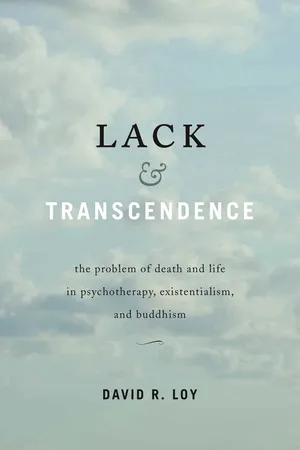
Lack & Transcendence
The Problem of Death and Life in Psychotherapy, Existentialism, and Buddhism
- 312 pages
- English
- ePUB (mobile friendly)
- Available on iOS & Android
eBook - ePub
Lack & Transcendence
The Problem of Death and Life in Psychotherapy, Existentialism, and Buddhism
About this book
Loy draws from giants of psychotherapy and existentialism, from Nietzsche to Kierkegaard to Sartre, to explore the fundamental issues of life, death, and what motivates us.
Whatever the differences in their methods and goals, psychotherapy, existentialism, and Buddhism are all concerned with the same fundamental issues of life and death—and death-in-life. In Lack and Transcendence (originally published by Humanities Press in 1996), David R. Loy brings all three traditions together, casting new light on each. Written in clear, jargon-free style that does not assume prior familiarity, this book will appeal to a wide variety of readers including psychotherapists and psychoanalysts, scholars of religion, Continental philosophers, and readers seeking clarity on the Great Matter itself. Loy draws from giants of psychotherapy, particularly Freud, Rollo May, Irvin Yalom, and Otto Rank; great existentialist thinkers, particularly Nietzsche, Kierkegaard, Heidegger, and Sartre; and the teachings Buddhism, particularly as interpreted by Nagarjuna, Huineng and Dogen. This is the definitive edition of Loy’s seminal classic.
Frequently asked questions
Yes, you can cancel anytime from the Subscription tab in your account settings on the Perlego website. Your subscription will stay active until the end of your current billing period. Learn how to cancel your subscription.
At the moment all of our mobile-responsive ePub books are available to download via the app. Most of our PDFs are also available to download and we're working on making the final remaining ones downloadable now. Learn more here.
Perlego offers two plans: Essential and Complete
- Essential is ideal for learners and professionals who enjoy exploring a wide range of subjects. Access the Essential Library with 800,000+ trusted titles and best-sellers across business, personal growth, and the humanities. Includes unlimited reading time and Standard Read Aloud voice.
- Complete: Perfect for advanced learners and researchers needing full, unrestricted access. Unlock 1.4M+ books across hundreds of subjects, including academic and specialized titles. The Complete Plan also includes advanced features like Premium Read Aloud and Research Assistant.
We are an online textbook subscription service, where you can get access to an entire online library for less than the price of a single book per month. With over 1 million books across 1000+ topics, we’ve got you covered! Learn more here.
Look out for the read-aloud symbol on your next book to see if you can listen to it. The read-aloud tool reads text aloud for you, highlighting the text as it is being read. You can pause it, speed it up and slow it down. Learn more here.
Yes! You can use the Perlego app on both iOS or Android devices to read anytime, anywhere — even offline. Perfect for commutes or when you’re on the go.
Please note we cannot support devices running on iOS 13 and Android 7 or earlier. Learn more about using the app.
Yes, you can access Lack & Transcendence by David R. Loy in PDF and/or ePUB format, as well as other popular books in Teologia e religione & Filosofia orientale. We have over one million books available in our catalogue for you to explore.
Information
1
THE NONDUALITY OF LIFE AND DEATH

All of life is but keeping away the thoughts of death.
— SAMUEL JOHNSON
THE CONCERN of this chapter is not death but death-in-life: how and why we make the easiest thing of all into the most difficult, and the effects of that denial upon our lives. Today any serious discussion of this issue must take account of psychoanalysis, and that means beginning with Freud. Freud’s life and work demonstrate how inevitably the two dimensions of this issue are linked. We seek to understand, as clearly and objectively as possible, the psychological impact of human mortality on human vitality, yet this concern is inescapably colored by the need that each of us has to come to terms with our own personal fate. A psychotherapeutic understanding can help us cope with our own mortality, but Freud’s life demonstrates the reverse as well: that the problem of accepting one’s own death cannot help affecting one’s scientific inquiries in this direction. Along with his contributions to our understanding of the mind, Freud’s difficulties in this regard reverberate through the subsequent history of psychoanalysis. We set the stage by recounting Freud’s own struggles with our heaviest demon.
Freud. Freud’s writings still have the power to shock, and none more than his theoretical discussions of death, which employ some of his hastier generalizations and more dubious arguments. Freud was rightly suspicious of his attraction to philosophy, yet no attempt to explain the structure of the mind can avoid the ultimate questions, which is why the most important problems raised by psychology inevitably become philosophical and religious as well. A science of the mind that attempts to avoid these issues will have them sneaking in the back door, by remaining oblivious to its own metaphysical presuppositions. Freud was not afraid to explore the philosophical implications of his discoveries, but in doing so he was not able to escape his own time. Even the most revolutionary thinkers cannot stand on their own shoulders:
The attempt to understand Freud’s theoretical system, or that of any creative systematic thinker, cannot be successful unless we recognize that, and why, every system as it is developed and presented by its author is necessarily erroneous. . . . [T]he creative thinker must think in the terms of the logic, the thought patterns, the expressible concepts of his culture. That means he has not yet the proper words to express the creative, the new, the liberating idea. He is forced to solve an insoluble problem: to express the new thought in concepts and words that do not yet exist in his language. . . . The consequence is that the new thought as he formulated it is a blend of what is truly new and the conventional thought which it transcends. The thinker, however, is not conscious of this contradiction.1
Otto Rank, originally a member of Freud’s inner circle, came to a similar conclusion. “Freud, without knowing it, interpreted the analytic situation in terms of his world-view and did not, as he thought, analyze the individual’s unconscious objectively.”2 A century later we have more perspective on that worldview molded in nineteenth-century Vienna, with its bourgeois character structure of self-discipline and sexual inhibition, in which scientific positivism contended with a pessimistic Schopenhauerian voluntarism. Both are found in the two aspects of Freud’s character. On the one side there is the mechanistic, deterministic Neo-Kantianism of Helmholtz (“one of my idols”), encountered mainly through his stern psychology professor, Brucke (“the greatest authority who affected me more than any other in my whole life”), and evident in Freud’s never-abandoned hope to ground his theories in physiology. On the other side are the tragic conclusions about human nature that his instinct theories finally brought him to, for Freud’s concept of libido bears more than a passing resemblance to Schopenhauer’s will which can resolve its predicament only by negating itself.
Freud’s life and character have been scrutinized as carefully as anyone’s. One feature that stands out is that he admitted to being haunted by death anxiety, to the point of thinking about death every day.
As far back as we know anything of his life he seems to have been prepossessed by thoughts about death, more so than any other man I can think of except perhaps Sir Thomas Browne and Montaigne. Even in the early years of our acquaintance he had the disconcerting habit of parting with the words, “Goodbye; you may never see me again.” There were the repeated attacks of what he called Todesangst (dread of death). He hated growing old, even as early as his forties, and as he did so the thoughts of death became increasingly clamorous. (Ernest Jones)3
This characteristic has been analyzed by Ernest Becker and Irvin Yalom, among many others.4 Yalom points to Freud’s compensatory need to be famous, and Becker shows how the psychoanalytic movement became Freud’s own “immortality project,” his unconscious way of surmounting death symbolically. The problem with such immortality projects (a phrase coined by Otto Rank) is the problem with unconscious motivation generally: when our conscious concerns only re-present what really drives us, they become symptoms and we become compulsive. This supports Fromm’s conclusion that Freud’s self-analysis was in important respects a failure — something that has serious ramifications for psychoanalysis, especially for those analysts who trace their lineage and credentials back to those analyzed by him. But once fear of death has been uncovered, what can be done with it except sublimate it in some way, as Freud did?
One can reveal the role that death anxiety and death denial play in life. The problem with Freud, finally, is that he did not discover that, in his theory or in his life. Death always occupied an awkward place in the development of his ideas, contorted one way and then another, in an attempt to fit it in which never quite worked and never could work as long as there was something Freud did not want to see. In Studies in Hysteria, his first book, “death so pervades the clinical histories of these patients that only by a supreme effort of inattention could Freud have omitted it from his discussion of precipitating traumas.”5 But the fear of death as an explanatory factor was hardly new — it can be traced all the way back to the epic of Gilgamesh — whereas the theory of sexual libido repression might be a pathway to fame. So Freud had both personal and theoretical reasons for denying death in his early works, and there it languishes without an independent representation in the mind. “The unconscious seems to contain nothing that could give any content to our concept of the annihilation of life.” Instead, he inclined to view the fear of death “as analogous to the fear of castration and that the situation to which the ego is reacting is one of being abandoned by the protecting super-ego.”6 These supposedly deeper fears are rooted in the conflicts of Oedipal and pre-Oedipal stages of development, according to the hydraulics of id, ego, and superego that direct the cathexis of libido. Not for the last time, “postulated strivings must take theoretical precedence over observed phenomena.”7 Having severed any direct connection between anxiety and death, Freud never rejoined them. Although he soon reversed himself and concluded that repression does not produce anxiety but vice versa, even his later death drive had no theoretical connection with anxiety; the farthest he went was to state, vaguely, that what the ego fears in anxiety “is in the nature of an overthrow or an extinction.”8
Most of Freud’s followers followed him on this. Otto Fenichel, summarizing the conclusions of psychoanalytic literature before World War I, echoed Freud in doubting whether there is such a thing as a normal fear of death: the idea of one’s own death is subjectively inconceivable, and therefore it must cover other unconscious ideas. The outbreak of hostilities turned Freud’s mind more to the problem of human destructiveness. He could see motivations beyond those accounted for in his earlier theories — “I can no longer understand how we could have overlooked the universality of non-erotic aggression and destruction” — and he concluded that “the tendency to aggression is an innate, independent, instinctual disposition in man,” one which he was later to describe as “the derivative and main representative of the death-instinct.”9
In “Timely Thoughts on War and Death” (1915), Freud noticed that at bottom “nobody believes in his own death. Or, and this is the same: in his unconscious, every one of us is convinced of his immortality.” On this matter, at least, Jung agreed:
On the whole, I was astonished to see how little ado the unconscious psyche makes of death. It would seem as though death were something relatively unimportant, or perhaps our psyche does not bother about what happens to the individual. But it does seem that the unconscious is all the more interested in how one does it; that is, whether the attitude of consciousness is adjusted to dying or not.10
From this lack of concern, however, one can draw opposite conclusions, by regarding it either as a revelation about the immortality of the collective unconscious or as a costly delusion. In another short essay at the end of the war, Freud recommended more consciousness of death. “Would it not be better to give death the place in actuality and in our thoughts which is its due, and to yield a little more prominence to that unconscious attitude towards death which we have hitherto so carefully suppressed? . . . Si vis vitam, para mortem. If you would endure life, be prepared for death.”11
Soon after this, however, Freud found another role for death in attempting to patch up his instinct theory. Beyond the Pleasure Principle (1920) contrasts the pleasure principle, which naturally seeks repetition, with the more perplexing repetition compulsion found in fixations on traumatic experiences, which bring repeated suffering upon oneself. Freud put this fixation in the same category as a homeostatic tendency (“the Nirvana-principle”) to recede to an earlier state of things, and concluded that life necessarily seeks death. “If we are to take it as a truth that knows no exception that everything dies for internal reasons — becomes inorganic once again — then we shall be compelled to say that ‘the aim of all life is death.’”12 In accordance with a dualistic predisposition, perhaps inherited from Brucke (who reduced all forces to attraction and repulsion), Freud postulated two antagonistic instincts: the anabolic, which contributes to growth and development, and the catabolic, which expends energy. The Ego and the Id (1923) adds aggression, which may be projected outward (sadism) or harnessed by the superego and turned inward (masochism) in order to pacify one’s own guilt. Putting these three phenomena together in his last major work, An Outline of Psychoanalysis (1938), Freud ended up with a basic and admittedly speculative dichotomy between two cosmic tendencies, the life drive that tends toward greater unities and the death drive that tends to undo these unities and destroy. Eros and Thanatos are doomed to perpetual conflict or, at best, uneasy and temporary compromise.
One need not be a philosopher to marvel at the breathtaking leap from these three psychological patterns to such a metaphysical conclusion. The logic is hard to follow, unless one is already committed to an instinctual libido theory that must be patched up if it is one’s claim to immortality. The rest of us may harbor doubts, as did many of Freud’s own followers.
Jung, no longer one of them, criticized this cosmological duality, which he believed to reflect the attitude of the conscious mind more than the dynamics of the unconscious. For Jung, the logical opposite of love/eros is hate, but the psychological opposite of love is a will-to-power, for when one predominates the other will be lacking. From his understanding of the collective unconscious (a monism that Freud’s dualism was a self-conscious attempt to avoid), Jung viewed Freud’s theory as a psychological prejudice: Eros is not the same as life, but someone who thinks so will naturally oppose Eros to death, confronting the highest principle of good with the evil of destruction.
From that perspective, Freud’s final, Manichaean dualism amounts to another version of our oldest psychological tendency, here extrapolated into humankind’s most basic psychic forces. If aggression in particular is grounded in a biological drive, the result can only be his tragic attitude toward the human condition: a pessimistic view of therapeutic possibilities leading to grim conclusions about the future of humanity. Is this an objective view of our situation, or a projection of Freud’s own death fears? Freud jumped from one extreme to the other. First death was not an important element in mental functioning, then it became one of our two primordial instincts. Despite Freud’s awareness of his own death anxiety, neither approach allows an independent role for death fear. Making death a drive reduces death anxiety almost to an epiphenomenon, an effect rather than a significant determinant of human behavior. As Robert Jay Lifton concluded about Freud’s libido theory, this “de-deathifies death.” So Freud courageously endured his own death anxiety without analyzing its effects on his life and his work. His blindness here is too remarkable to be anything other than a willful inattention, a not wanting to see, which is of course the definition of repression.
Life and death do require each other insofar as awareness of one implies awareness of the other. We can fear death (which is not the same as resisting dying) only if we know — or believe — ourselves to be alive. There cannot be life without death, whether they are antagonistic instincts or, more humbly, a dualistic way of thinking. This raises another therapeutic possibility. Rather than antagonistic forces that batter the ego, might Eros and Thanatos be the two tendencies of the ego itself, which is mentally constituted only to find itself in the tragic situation of contemplating its inevitable demise? For Freud, the death-instinct never reveals itself directly but insinuates itself inside the manifestations of Eros. Then perhaps the death-instinct is really the equal-but-opposite force of Eros: tails to its head, but one coin, not two. That would mean, on one side, the life fear that existentialists and psychoanalysts have described so well, and, on the other side, a death wish which intuits the meaninglessness of the whole struggle and wearies of it. If, however, this situation is not a war of instincts but a way of thinking — a life-versus-death game that one unwittingly plays with oneself — there may be an alternative. If the ego is constituted by that game, what happens if that game ends?
This chapter will explore that possibility, which is suggested by Buddhism. It is not a perspective that Freud would have been sympathetic to. Rather than seeing through the dualism, he exhorts us to fight on the side of life. In spite of his reference to a Nirvana principle, Freud’s few references to Buddhism are hostile and uncomprehending. His last works repeat his contemptuous rejection of the consolations of religion. We should fight the good fight as long as we can. There is no place in Freud’s thought for coming to terms with the death principle by finding a meaning for death.
Repression. However unsatisfactory Freud’s final understanding of death may finally be, that does not reduce the importance of what he discovered, and that is first and foremost repression, which for him is the foundation-stone of psychoanalysis. “The essence of repression lies simply in the function of rejecting and keeping something out of consciousness.” Something (a mental wish, according to Freud) makes me uncomfortable, and since I do not want to cope with it consciously I ignore or “forget” it. This clears the way for me to co...
Table of contents
- Cover Page
- Title Page
- Dedication
- Contents
- Preface to the Wisdom Edition
- Acknowledgments
- Introduction
- Prologue
- 1 The Nonduality of Life and Death
- 2 The Moving Image of Eternity
- 3 The Pain of Being Human
- 4 The Meaning of It All
- 5 Trying to Become Real
- Conclusion: Transcendence East and West
- Notes
- Index
- About the Author
- About Wisdom Publications
- Copyright