eBook - ePub
A Fertility Program for Growing Vegetables - With Information on Soil, Manures and Use of Chemicals
- 48 pages
- English
- ePUB (mobile friendly)
- Available on iOS & Android
eBook - ePub
A Fertility Program for Growing Vegetables - With Information on Soil, Manures and Use of Chemicals
About this book
"A Fertility Program for Growing Vegetables" is a classic guide to growing vegetables focusing on fertilisers. It looks at what fertilisers should be used in which circumstances, offering advice and scientific information for the farmer or Gardner. Although old, this volume contains timeless information that will be of considerable utility to anyone with a practical interest in vegetable production. Contents include: "Soil Science", "Fertility Program", "Soil Organic Matter", "Animal Manures", "Green Manure", "Use Of Lime", "Fertilizer Materials", "Functions Of Fertilizers", "Complete Fertilizers", "Typical Fertility Programs", "Applying Fertilizers", etc. Many vintage books such as this are increasingly scarce and expensive. It is with this in mind that we are republishing this volume now in an affordable, modern, high-quality edition complete with a specially-commissioned new introduction on soil science.
Information
GREEN MANURES
Extent and economy.—Through necessity, wherever animal manures cannot be secured, and through choice, on account of lower cost, the growing of green crops for manurial purposes has become general practice. There is no question concerning the effectiveness of a definitely planned and well executed program of green manuring as a basis for maintaining productive soil. This has been demonstrated by skillful growers over a term of years. The problem, however, is more difficult in very light soils, and it may be necessary at relatively frequent intervals to devote a full season to soil improving crops. Vegetable growers, whose activities are not restricted by limited acreage, have come to recognize green manuring as the most effective and economical means of replenishing the supply of organic matter. Another advantage of green manure is lower cost of weed control than with stable manures.
Effects of green manures.—In addition to securing the various important benefits that follow incorporation of organic matter into the soil, the practice of green manuring brings about several other definitely advantageous effects. One of the more important is that the green manure, serving as a cover crop, reduces losses from leaching by utilizing soluble plant food materials that may not have been taken up by the preceding crop or that have developed later. In turn the green manure is plowed under and, by decay of its substance, releases the salvaged nutrients in convenient rates and forms for the use of the cash crop.
The roots of green manurial crops perform valuable service by penetrating into the subsoil and all parts of the topsoil in search of nutrient substances. These accumulate in the manurial crop and later become easily available for the cash crop that follows. Roots of some green manurial crops, sweet clover for example, are particularly effective in penetrating hard, impervious subsoils. A further advantage accrues when decay of such roots opens countless channels that improve drainage.
Green manures, as cover crops, effectively check erosion. Their presence, in strips or bands across steep slopes and in solid plantings at all possible times, will limit the washing that progressively carries away the best soil. On very light soils in exposed locations, green manures may avert disastrous wind erosion during periods when the land is not occupied by cash crops.
In the case of legumes, green manures are of additional advantage in adding nitrogen to the soil. The quantities of nitrogen which they obtain from the atmosphere under favorable conditions are very substantial—sufficient to warrant reduction and, in some cases, elimination of nitrogen in the fertilizer mixture, which means considerable economy.
When incorporated into the soil in a succulent condition, green manures are remarkably efficient in furnishing a continuous supply of nitrogen for the growth of the crop that follows. This is accomplished from their own decomposition and by activation of the soil nitrogen. They also release directly important supplies of other nutrients and promote availability of the mineral constituents of the soil. Green manures, when plowed under at the succulent stage, may decay more rapidly and support the growing crop more effectively than an equal tonnage of ordinary barnyard manure.
The depression of growth that sometimes occurs when heavy and especially strawy green manures have been plowed under is usually due to a temporary decrease in the supply of available nitrogen (p. 75). It is generally considered that decaying green manures do not cause notable toxicity or acidity, and that such a reaction is very transitory in properly managed soil.
Choice of green manure crops.—In general, legumes are preferable wherever conditions and available time assure satisfactory amount of growth. When conditions are unfavorable for starting a legume, as in October plantings in the North, it is certainly more, advantageous to plant a non-legume, such as rye, that is sure to produce a large tonnage of material to plow under. Furthermore, with summer seedings in intensive gardening, the quick, heavy growth made by sudan grass, oats, barley, or rye grass, when planted at proper times and in favorable localities, may be more valuable in conserving the nitrogen remaining from heavy fertilization of a preceding crop than a slower starting, lighter-feeding legume would be in securing atmospheric nitrogen. Indeed the gross feeding and rank growing non-legumes are most effective in utilizing soil nitrogen that might be lost and in producing maximum tonnage of organic matter in short periods of time. Although the extensive truck farmer often may find greater advantage in the legumes, because they add both organic matter and nitrogen, the market gardener or intensive trucker may find it cheaper to buy nitrogen and plant the green manurial crop that will make the most growth in the least time.
The discussion which follows includes only plants that are most generally employed for soil improvement on vegetable farms. An order of importance cannot be assigned, as relative usefulness depends upon circumstances of management and conditions for growth.
Leguminous green manure crops may require inoculation (p. 89). As a rule legumes do not succeed well on acid soils but soils which are sufficiently well limed to produce satisfactory vegetable crops usually will grow thrifty leguminous green manure crops. Heavy, leguminous green manures plowed under in a succulent state have resulted in just as large yields as were secured with 20 tons of stable manure to the acre. On account of certain disease, relationships, some of the legumes may be objectionable in a rotation where many peas or beans are grown.
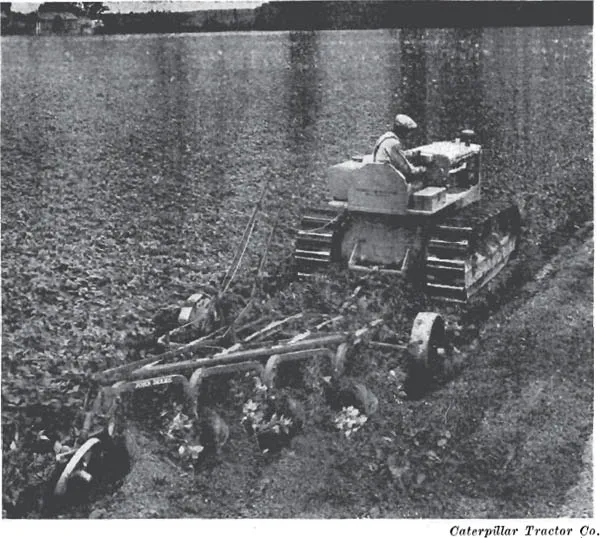
FIG. 31.—Plowing soybeans, a leguminous green manure. Legumes are preferred where conditions of soil and season are favorable.
Red clover is an excellent crop to sow in the North when grain has a place in the rotation. It usually is broadcast in March. Sometimes it is sown just before the last shallow cultivation of crops that mature by midsummer and do not cover the ground too densely. Where it is not likely that moisture in late summer will be too deficient, red clover may be sown in July or early in August on a fine, firm seed bed prepared after harvesting early vegetables. In a few cases it can be sown at the last cultivation of row crops. Seeding rates are 10 to 15 pounds to the acre. Covering for most of the clovers is from one-half inch to one or two inches, depending on soil, moisture, and season.
Alsike clover is more tolerant of acid soil and poor drainage than is red clover and is desirable in mixtures for variable lands. The seeds are very small but germinate well. Six to eight pounds to the acre are seeded alone and proportionate amounts in mixtures.
Crimson clover is adapted best to sandy soils where winters are not severe, particularly along the Atlantic Coast from New Jersey southward. It is commonly sown before the last cultivation of tomatoes, sweet corn, and some other truck crops, or after vegetables that release the land in late July or during August. Seeding rates are about 15 to 20 pounds to the acre.
Sweet clover, either white or yellow, has a wide range of usefulness as a soil improving crop. It succeeds well in hot and in cold climates, and on poor land where the soil is not deficient in lime. It is a sturdy grower and produces large tap roots which effectively penetrate the hardest soils. Sweet clover may be sown alone or in grain in late winter or early spring; sometimes in peas or other early crops. Or it may be sown about midsummer, or slightly later, either at the last cultivation of certain crops or on specially prepared firm seed beds. It is important to note that sweet clover, which is plowed under before the new tops have made a strong start in the spring, is certain to sprout from the tap roots and become a nuisance. It is easily killed, however, by plowing after the new growth is well started and it is especially effective then in supplying nitrogen to the crops that follow. Sweet clover is a biennial plant, which dies naturally after the second summer of growth. Seeding rates range from 15 to 20 pounds to the acre.
Alfalfa is not grown to a great extent for the specific purpose of green manuring vegetable lands but its common culture for forage incidentally serves as an excellent preparation for truck crops. Some growers, however, make very advantageous use of alfalfa solely as a green manure although the seed is usually expensive. Lime requirement, seeding rate, and methods of planting are similar to those for sweet clover but somewhat more exacting.
Hairy vetch which is of outstanding value as an over-winter leguminous green manure is used successfully over a wide territory. It is very hardy and an excellent gatherer of nitrogen. When well established in the fall, it is active during mild periods in winter and makes rapid and voluminous growth very early in the spring. The soil under a heavy growth of vetch does not dry out so quickly and cause so much difficulty in plowing as it does under some other crops, such as rye for example. The comparatively large seeds of vetch often germinate and produce good stands under conditions that prove very difficult for the clovers. Hairy vetch often is used in mixtures with rye, timothy, or clover, or with several species together. In seeding alone, rates vary from 20 to 40 pounds to the acre. The chief disadvantage with vetch is the usually high cost of the seed. That, however, is commonly outweighed by its advantages. Seeding time is late summer and fall.
Common vetch is a different species and is adapted only to regions having mild winters. Seeding rates are higher than those for hairy vetch.
Canada field peas, when grown in mixtures of a bushel of peas to two or three bushels of oats to the acre, are desirable as a green manure for starting very early in the spring. Field peas alone are planted at the rate of 3 or 4 bushels to the acre. Cool climatic conditions are required for best results and the crops must be plowed before they become unmanageable. Very few growers, however, find it advantageous to utilize their land or time for planting green manures in early spring.
Cowpeas are a valuable soil improving crop in the South. They require a large amount of heat and no attempt should be made to grow cowpeas in the cooler parts of the North. Under favorable conditions the plants produce a large amount of highly nitrogen...
Table of contents
- Cover
- Title
- Copyright
- Contents
- Soil Organic Matter
- Animal Manures
- Green Manures
- Use of Lime
- Functions of Fertilizers
- Fertilizer Materials
- Complete Fertilizers
- Applying Fertilizers
- Typical Fertility Programs
Trusted by 375,005 students
Access to over 1.5 million titles for a fair monthly price.
Study more efficiently using our study tools.
Frequently asked questions
Yes, you can cancel anytime from the Subscription tab in your account settings on the Perlego website. Your subscription will stay active until the end of your current billing period. Learn how to cancel your subscription
No, books cannot be downloaded as external files, such as PDFs, for use outside of Perlego. However, you can download books within the Perlego app for offline reading on mobile or tablet. Learn how to download books offline
Perlego offers two plans: Essential and Complete
- Essential is ideal for learners and professionals who enjoy exploring a wide range of subjects. Access the Essential Library with 800,000+ trusted titles and best-sellers across business, personal growth, and the humanities. Includes unlimited reading time and Standard Read Aloud voice.
- Complete: Perfect for advanced learners and researchers needing full, unrestricted access. Unlock 1.5M+ books across hundreds of subjects, including academic and specialized titles. The Complete Plan also includes advanced features like Premium Read Aloud and Research Assistant.
We are an online textbook subscription service, where you can get access to an entire online library for less than the price of a single book per month. With over 1.5 million books across 990+ topics, we’ve got you covered! Learn about our mission
Look out for the read-aloud symbol on your next book to see if you can listen to it. The read-aloud tool reads text aloud for you, highlighting the text as it is being read. You can pause it, speed it up and slow it down. Learn more about Read Aloud
Yes! You can use the Perlego app on both iOS and Android devices to read anytime, anywhere — even offline. Perfect for commutes or when you’re on the go.
Please note we cannot support devices running on iOS 13 and Android 7 or earlier. Learn more about using the app
Please note we cannot support devices running on iOS 13 and Android 7 or earlier. Learn more about using the app
Yes, you can access A Fertility Program for Growing Vegetables - With Information on Soil, Manures and Use of Chemicals by Ralph L. Watts in PDF and/or ePUB format, as well as other popular books in Technology & Engineering & Horticulture. We have over 1.5 million books available in our catalogue for you to explore.