- 304 pages
- English
- ePUB (mobile friendly)
- Available on iOS & Android
eBook - ePub
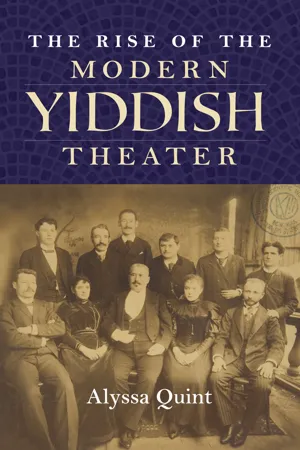
The Rise of the Modern Yiddish Theater
About this book
Jewish Book Award Finalist: "Turns the fascinating life of Avrom Goldfaden into a multi-dimensional history of the Yiddish theater's formative years." —Jeffery Veidinger, author of
Jewish Public Culture in the Late Russian Empire
In this book, Alyssa Quint focuses on the early years of the modern Yiddish theater, from roughly 1876 to 1883, through the works of one of its best-known and most colorful figures, Avrom Goldfaden. Goldfaden (né Goldenfaden, 1840-1908) was one of the first playwrights to stage a commercially viable Yiddish-language theater, first in Romania and then in Russia. Goldfaden's work was rapidly disseminated in print and his plays were performed frequently for Jewish audiences. Sholem Aleichem considered him as a forger of a new language that "breathed the European spirit into our old jargon."
Quint uses Goldfaden's theatrical works as a way to understand the social life of Jewish theater in Imperial Russia. Through a study of his libretti, she looks at the experiences of Russian Jewish actors, male and female, to explore connections between culture as artistic production and culture in the sense of broader social structures. Quint explores how Jewish actors who played Goldfaden's work on stage absorbed the theater into their everyday lives. Goldfaden's theater gives a rich view into the conduct, ideology, religion, and politics of Jews during an important moment in the history of late Imperial Russia.
In this book, Alyssa Quint focuses on the early years of the modern Yiddish theater, from roughly 1876 to 1883, through the works of one of its best-known and most colorful figures, Avrom Goldfaden. Goldfaden (né Goldenfaden, 1840-1908) was one of the first playwrights to stage a commercially viable Yiddish-language theater, first in Romania and then in Russia. Goldfaden's work was rapidly disseminated in print and his plays were performed frequently for Jewish audiences. Sholem Aleichem considered him as a forger of a new language that "breathed the European spirit into our old jargon."
Quint uses Goldfaden's theatrical works as a way to understand the social life of Jewish theater in Imperial Russia. Through a study of his libretti, she looks at the experiences of Russian Jewish actors, male and female, to explore connections between culture as artistic production and culture in the sense of broader social structures. Quint explores how Jewish actors who played Goldfaden's work on stage absorbed the theater into their everyday lives. Goldfaden's theater gives a rich view into the conduct, ideology, religion, and politics of Jews during an important moment in the history of late Imperial Russia.
Trusted by 375,005 students
Access to over 1 million titles for a fair monthly price.
Study more efficiently using our study tools.
Information
1Goldfaden, Elite (1876–1883)
Introduction
In 1875 Avrom Goldfaden was comfortably ensconced in the best room at the Black Eagle, one of the most fashionable hotels in Czernovitz, then a city in the Austro-Hungarian Empire (now Chernivtsi, Ukraine). Goldfaden would travel to Iași a year later and establish Yiddish theater, but even before this trip he had grown into a writer of considerable reputation with three published books of poetry.1 He certainly acted the part. Granted, his fame only extended to a circumscribed constellation of Hebrew and Yiddish poets and other members of the East European Jewish intelligentsia—a group of hundreds, maybe thousands. His Yiddish songs, sung by Jewish singers in taverns, amplified this celebrity. Goldfaden luxuriated in the attention he commanded, attracting admirers who sought him out for a polite exchange of ideas or to bask in the warm glow of his relative renown. One such admirer was the Hebrew poet David Yeshayahu Zilberbusch (1854–1936), just shy of twenty, who had recently made his way from the pious pews of the study house to experiment with modern ideas and Hebrew verse. In his memoirs, Zilberbusch recounts how ill-prepared he felt for the visit—but not out of a sense of intellectual inferiority. Instead, the young man, schooled in the Bible and the Talmud, worried about lapses of etiquette. Zilberbusch had seldom been in the company of such a refined man as Goldfaden. As he tells it, he was nervous, still “innocent to the correct way one receives visitors.” Goldfaden’s aura was grand. Zilberbusch recalls:
He had a large sitting room, with an alcove for a bed and wash-basin, the doorway was hung with blue velvet drapes. A thick carpet covered the floor. There was a sofa, a polished dark wood table, with leather-upholstered chairs around it. In a corner, near a window, stood a piano and a writing desk.
When I arrived at about eleven o’clock he had, I think, been sitting at the desk. He was wearing a gray dressing gown with blue stripes at the collar, and embroidered velvet slippers. On his nose, highly polished, gold-framed glasses. . . . What impressed me were the golden frames and the expansive style of living of a Jewish author.2
Never mind that, as most biographers rightly point out, Goldfaden had declared bankruptcy two years earlier in Odessa and left the Russian Empire for Lemberg (Lviv, Ukraine) for fear of debtor’s prison, only to start a Yiddish newspaper that failed. But Goldfaden’s precarious financial situation did not figure in the conversation with Zilberbusch. Instead, Zilberbusch raised what he thought to be the burning question of their day, that of “Haskala,” of bringing the Enlightenment to their benighted Jewish brethren of Russia. Remarkably, Goldfaden was dismissive of this idea and casually explained to the budding intellectual, “I get what I need from my little Jew,” with both the language and air more evocative of a Polish nobleman than someone invested in the enfranchisement of his fellow Jews.3 Thus Goldfaden allowed Zilberbusch to approach him, but only to demonstrate how unapproachable he was. This would be Goldfaden’s way. His mystique was evident in the clothes he wore, the expensive things surrounding him, and the subtle blend of formality and casualness that informed his demeanor and speech.
Although scholars uniformly portray Goldfaden as a magnanimous generator of Yiddish culture for the poor and uneducated, Zilberbusch’s record of his visit to Goldfaden calls attention to his preoccupation with social status and performance. Historians point to Goldfaden’s devotion to cultivating Yiddish theater (as opposed to, say, Hebrew poetry) as proof enough of his populism. Indeed, aspects of his work and career seem to corroborate such a paradigm. Driven by song and, often, by comedy or melodrama, Goldfaden’s theater struck historians as lowbrow, especially relative to the Yiddish prose generated during the same period. His contemporaries were the first to publicly dismiss the quality of his work. Goldfaden’s friend, the writer Jacob Dineson, writes in his memoirs based on his first experience with Yiddish theater as he saw it in Warsaw: “With regards to the newborn Yiddish theater, the audience [alongside the theater itself] was practically childish and played with theater as one child plays with another.”4 Goldfaden’s own complaints about the need to dilute his work to reach uneducated viewers and his reluctant dependence on folk singers to mediate his work seemed to confirm the theater’s uncultivated “wide audience” (braytern oylem), as scholars would later call it. Goldfaden describes his early audiences as “cobblers and tailors and raw craftsmen” who would never have understood the sophisticated works he wished he could stage.5 Theater critics and historians in the 1920s and 1930s turned Goldfaden’s reliance on the uneducated into his theater’s greatest virtue and referred to “a wide audience” as Goldfaden’s creative source. Taking his cue from Goldfaden, the historian Jacob Shatzky insists that Goldfaden’s audience was untutored and working class: “It is very important to understand Goldfaden’s approach to theater. Goldfaden wanted to create a theater like other national theaters. But other nations had differentiated audiences (diferentsirter oylem) who satisfied their tastes each according to their own taste and education. At that time, however, the Yiddish theater had only one type of audience member—the common Jew (dem folk mentsh), the worker, the storekeeper, the petit-bourgeois element.”6
In a number of works on this early period of the theater, Soviet critics Nusyinov and Y. Riminik argued that the contempt and anxiety expressed for Goldfaden’s work by some was representative of the Jewish bourgeois “assimilated” class.7 While “the bourgeoisie” voice controlled the press and they became the “enemy” of Goldfaden’s theater, the folk organically participated in the theater as audience and actors. In fact, Goldfaden’s continuous recruitment of new actors for his troupes “reinvigorated the folk element” of his theater.8 Finally, the ubiquity of Goldfaden’s work in shtetls throughout the Pale of Settlement by the turn of the century—the growth of his theatrical work into something of a mass commercial sensation—all but confirmed the theater’s folkist orientation and popular reach.9
In this chapter, I take a markedly different perspective from that of my predecessors, both with regard to Goldfaden’s intended audience and to the audience his troupe actually commanded during his first years (before the ban in October 1883). I push to the side the idea that with Yiddish theater Goldfaden sought to educate the benighted masses of shtetl-bound Jews. Although he was drawn to a form of folk culture, the idea of Goldfaden as a mediator of folk art has been overemphasized in the scholarship. I frame my discussion of Goldfaden with his strong identification with Russia’s urban-based cultural intelligentsia, a social grouping distinguished by its education and affinity with Western culture and whose members were from the professional class, the enlightened gentry, and the bourgeoisie.10 Though he never achieved its financial stability, Goldfaden came to identify with a Jewish middle class that grew up particularly in newer cities with merchant-heavy populations under the liberal rule of Alexander II (1855–1881): a Jewish middle class, it should be added, with attitude and behavior associated with the Russian aristocracy.11 During the period under discussion, he played the part both of a member of the Russian Jewish elite, with an utter indifference to work, and a consumer and producer of art, who showed attentiveness to appearance and dress and who casually invoked the word “aristocratic” to describe himself. Goldfaden’s attendance at the exclusive Russian Jewish teacher’s seminary in Zhitomir was a vital ingredient of his manner of high self-regard: he emerged steeped in classic Russian literature as well as the social conventions of leisure activity with the self-presentation of the urban-dwelling merchant class. A self-fashioner of great resourcefulness, Goldfaden sought the attention and patronage of Russia’s “middle classes” (Jew and Gentile, alike) even as he inflected his behavior with the more exaggerated habits of the nobility.
Thus, I marshal evidence from newspapers, memoirs, and biographical sources to assess the cultural project of the two (and at times as many as three) troupes under his stewardship from 1876 to 1883. I distinguish the first period of modern Yiddish theater (“Goldfaden elite”) from the popular spread of Goldfaden’s works that took place after 1883. While Odessa became the resident city of the modern Yiddish theater, the movement of Goldfaden’s primary troupe from 1878 to 1883 reveals that Goldfaden favored theatrical venues in the cities with newer, more affluent, and more modern Jewish communities in which he sought an audience of his peers. I attempt to understand the genealogy of the playwright’s refined demeanor and shift attention to how his preoccupation with self-presentation fueled a brand of urban and modern Yiddish performance imitated, most conspicuously, by his actors (explored in chap. 2). For many previous scholars, a writer’s commitment to Yiddish letters is itself evidence of a populist commitment. By contrast, I believe that Goldfaden’s aristocratic public persona begs articulation and analysis, as it is not simply ornamental or incidental to his theater but is rather the very substance of the life that he and many around him pursued.
Goldfaden’s First Years (1840–1876)
Notwithstanding the variegated nature of Russia’s bourgeoisie, Goldfaden barely qualified as a member, at least according to financial merit. Born July 12, 1840, in Old Constatine (Starokonstantinov, Volhynia province), Goldfaden grew up the son of Khane Rivke and Khayim Lipe Goldenfodem. His father was a clockmaker and, according to Avrom, the only craftsman in the shtetl of Old Constantine to organize a supplementary curriculum for his son.12 Goldfaden writes, “When I arrived home from the gemora teacher, I would meet with a teacher who tutored me in German, Russian, and Tanakh [the Pentateuch] with German translation.”13 Among his tutors was Abraham Ber Gottlober, who by 1855 was already a prominent voice of the Russian Haskala and who composed poetry and song in Yiddish. Goldfaden’s father considered his son to have extraordinary mental abilities, and he trained Goldfaden in Jewish and non-Jewish sources. Even as a boy, however, Goldfaden was also drawn to performance, something his father considered unserious, silly:
It is hard for me to recall when I showed the penchant for rhyme-making. When I was about 6 or 7 already a student of gemora and knew by heart most of the two first books of the Torah, my mother took me along to a neighbor’s wedding. There was a rotund man with a trimmed beard, with the visor of his hat askew who tucked his thumb in his belt and kicked his feet up like a scamp as he “sang to the bride” before the wedding canopy. . . . Everything he sang and said that night rhymed artfully. I observed his singing and his declamations with great attention. Later, when I went home with my mother, I pulled my cap askew, kicked my right foot before me and whatever I needed to tell my mother I did so in rhyme. My mother was in stitches. Overhearing, my father smiled beneath his moustache. He called me Avremle the Badkhn but soon his face grew serious and he said: It is not nice for a gemora-boy to be silly!14
Finkel and Oyslender point out that the two volumes of poetry that Goldfaden would later publish exhibit the abiding respect and admiration he had for his traditional parents in the dedications he wrote to them. He did not wage rebellion against them, nor was he “banished from their table” as were some progressive intellectuals of his generation. By the time Goldfaden was eleven years old, he had written poetic verse in Hebrew that his father would prod him to recite before guests in their home.

Figure 1.1. Goldfaden in hat with tassel, c. 1882. Courtesy of the YIVO Institute for Jewish Research.
Goldfaden remained close with his family throughout his career, though rifts occurred later between himself and his brothers, Naftoli and Wolf. Apparently, his younger brothers did not receive the extensive tutoring and schooling Avrom enjoyed, but they did achieve success in the theater alongside...
Table of contents
- Cover
- Title Page
- Copyright
- Dedication
- Contents
- Acknowledgments
- Note on Transliteration
- The Social Life of Jewish Theater in the Russian Empire: An Introduction
- 1. Goldfaden, Elite (1876–1883)
- 2. The Rise of the Yiddish Actor
- 3. The Rise of the Yiddish Theater Audience
- 4. The Rise of the Yiddish Playwright
- 5. The Rise of the Female Yiddish Actor
- 6. The Ban, Cultural Momentum, and the Modern Yiddish Theater
- Afterword: Modern Yiddish Theater and the Extravernacular
- Appendix I: Synopses of Goldfaden’s Operettas
- Appendix II: The Sorceress
- Appendix III: Excerpt from the Memoirs of Avrom Fishzon
- Bibliography
- Index
- About the Author
Frequently asked questions
Yes, you can cancel anytime from the Subscription tab in your account settings on the Perlego website. Your subscription will stay active until the end of your current billing period. Learn how to cancel your subscription
No, books cannot be downloaded as external files, such as PDFs, for use outside of Perlego. However, you can download books within the Perlego app for offline reading on mobile or tablet. Learn how to download books offline
Perlego offers two plans: Essential and Complete
- Essential is ideal for learners and professionals who enjoy exploring a wide range of subjects. Access the Essential Library with 800,000+ trusted titles and best-sellers across business, personal growth, and the humanities. Includes unlimited reading time and Standard Read Aloud voice.
- Complete: Perfect for advanced learners and researchers needing full, unrestricted access. Unlock 1.4M+ books across hundreds of subjects, including academic and specialized titles. The Complete Plan also includes advanced features like Premium Read Aloud and Research Assistant.
We are an online textbook subscription service, where you can get access to an entire online library for less than the price of a single book per month. With over 1 million books across 990+ topics, we’ve got you covered! Learn about our mission
Look out for the read-aloud symbol on your next book to see if you can listen to it. The read-aloud tool reads text aloud for you, highlighting the text as it is being read. You can pause it, speed it up and slow it down. Learn more about Read Aloud
Yes! You can use the Perlego app on both iOS and Android devices to read anytime, anywhere — even offline. Perfect for commutes or when you’re on the go.
Please note we cannot support devices running on iOS 13 and Android 7 or earlier. Learn more about using the app
Please note we cannot support devices running on iOS 13 and Android 7 or earlier. Learn more about using the app
Yes, you can access The Rise of the Modern Yiddish Theater by Alyssa Quint in PDF and/or ePUB format, as well as other popular books in Medios de comunicación y artes escénicas & Biografías religiosas. We have over one million books available in our catalogue for you to explore.