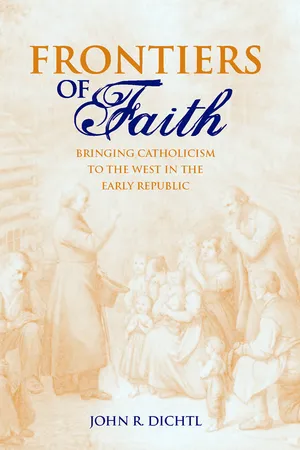
American religious histories have often focused on the poisoned relations between Catholics and Protestants during the colonial period or on the virulent anti-Catholicism and nativism of the mid- to late nineteenth century. Between these periods, however, lies an important era of close, peaceable, and significant interaction between these discordant factions. Frontiers of Faith: Bringing Catholicism to the West in the Early Republic examines how Catholics in the early nineteenth-century Ohio Valley expanded their church and strengthened their connections to Rome alongside the rapid development of the Protestant Second Great Awakening. In competition with clergy of evangelical Protestant denominations, priests and bishops aggressively established congregations, constructed church buildings, ministered to the faithful, and sought converts. Catholic clergy also displayed the distinctive features of Catholicism that would inspire Catholics and, hopefully, impress others. The clerics' optimism grew from the opportunities presented by the western frontier and the presence of non-Catholic neighbors. The fruit of these efforts was a European church translated to the American West. In spite of the relative harmony with Protestants and pressures to Americanize, Catholics relied on standard techniques of establishing the authority, institutions, and activities of their faith. By the time Protestant denominations began to resent the Catholic presence in the 1830s, they also had reason to resent Catholic successes—and the many manifestations of that success—in conveying the faith to others. Using extensive correspondence, reports, diaries, court documents, apologetical works, and other records of the Catholic clergy, John R. Dichtl shows how Catholic leadership successfully pursued strategies of growth in frontier regions while continually weighing major decisions against what it perceived to be Protestant opinion. Frontiers of Faith helps restore Catholicism to the story of religious development in the early republic and emphasizes the importance of clerical and lay efforts to make sacred the landscape of the New West.
- 250 pages
- English
- ePUB (mobile friendly)
- Available on iOS & Android
eBook - ePub
About this book
Trusted by 375,005 students
Access to over 1.5 million titles for a fair monthly price.
Study more efficiently using our study tools.
Information
Chapter 1
The View to the West
Moving away from the east coast to find opportunity, some Catholics settled in or immediately across the Appalachians in the southwest part of Pennsylvania, near Pittsburgh. Others traveled down the Ohio River to Kentucky, where new lands were opening up in the 1780s. Few settled in between, preferring the company of their fellow religionists at either the eastern or the western end of the Ohio River valley. Although they tended to group together, Catholics in the trans-Appalachian frontier found themselves in the midst of Presbyterians, Baptists, Methodists, nonbelievers, and others.
Careful Beginnings
The climate of public opinion during the 1780s was uncertain, requiring Father John Carroll, superior of the American missions, to keep an eye on what he called the Protestants’ “extreme circumspection” toward Catholicism in America. He would continue to do so throughout his episcopacy. Assessing Catholic/non-Catholic relations at the time he assumed command of the church in 1784, Carroll’s conclusion was somewhat sobering: “To dissipate these prejudices will take time.” The clergy, he believed, should be attentive to not giving “pretexts to the enemies of Religion to deprive us of our actual rights.” Carroll believed Catholics should treat the Protestants’ “circumspection” by proceeding cautiously, or else face a legal and political backlash. Given their minority position, American Catholics also were in danger of being overrun. During his first sermon as bishop (December 12, 1790), Carroll outlined his own obligations as prelate in this regard, emphasizing his role in preserving the faith “untainted amidst the contagion of error surrounding” Catholics “on all sides,” and amid the “fatal and prevailing indifference” toward the dissimilarities among religions. Nevertheless, Carroll remained assured about sectarian relations. In the same inaugural sermon the new bishop pledged to help Catholics “preserve in their hearts a warm charity and forbearance toward every other denomination of Christians.”1
Still, by the mid-1790s, Bishop Carroll perceived a broader spectrum within which the Catholic Church could operate with regard to non-Catholic opinion. This range extended from a cautious sensitivity to not offend on the one hand, to a commitment of directly engaging Protestants and other non-Catholics on the other.
In 1793 Carroll wrote to Cardinal Leonardo Antonelli, prefect of the Congregation for the Propaganda of the Faith, seeking permission to change the words in the oath used when consecrating new bishops in the United States. Carroll’s duties had burgeoned in the Baltimore diocese, and he wanted to share the burden by appointing Lawrence Graesl or Leonard Neale to be his coadjutator (a co-bishop who would become his successor). Specifically, he wanted to discard any reference in the text of the bishop’s oath to the word “heretics, etc.” Otherwise, Carroll thought, “the heterodox” non-Catholics would probably use it “to arouse ill will towards our religion,” since they tended to “decry” it “as so opposed to the religious liberty to which we Catholics in the United States are so indebted.” American Protestants, he asserted, should not be given any reason to think that Catholics were a threat. Being outspoken about a new bishop’s responsibility to counter heresy would be counterproductive in America. So Carroll asked that the reference to heretics be dropped as it had been in consecration oaths in other countries, such as Ireland. Otherwise, “without a doubt,” explained Carroll, “non-Catholics in great numbers will witness the ceremony of episcopal consecration; they will weigh everything, and they are apt to interpret unfavorably.” As one historian has put it, “Carroll and his co-religionists understood that the very survival and growth of the Catholic Church in the United States depended upon its ability to accept and become a part of the American way of life.”2 Carroll realized blending in was essential.
Finding the optimal point between avoiding unnecessary conflict and maintaining open channels of contact with non-Catholics would be difficult, however. Carroll and his mainly European clergy had no models to follow in a post-revolutionary nation trying to build itself anew in contradistinction to Europe. In 1795 Carroll wrote to the new prefect of the Congregation for the Propaganda of the Faith thanking him for the Congregation’s willingness to be flexible and for approving efforts to deal with the special conditions in America. “The peculiar form” of the U.S. government, “the frequent contacts of Catholics with sectaries in the discharge of public duties, the contacts too in private affairs, the need to conform with others whenever it is possible without detriment to the faith and the precepts of the Church”—these, wrote the bishop, required “care, watchfulness, and prudence.” A bishop’s responsibility, moreover, as Carroll characterized it, was not simply to avoid offending Protestant opinion, but to interact with non-Catholics, and to do so in a manner that preserved Catholic faith and orthodoxy while laying a foundation for harmonious relations. The church could not simply hope to withdraw and to isolate itself. Catholics would have to engage while insulating themselves only as necessary. Catholic Americans “must be on guard lest the faithful be gradually infected with the so-called prevailing indifference of this country,” said Carroll; “but they must likewise take care lest unnecessary withdrawal from non-Catholics alienate” those outside the church “from our doctrine and rites.” Such caution was warranted. Non-Catholics, said Carroll, “outnumber us and are more influential, [and] they may, at some time, be inclined to renew the iniquitous laws against us.”3 The trick was to remain cautious while not withdrawing so far from view that Catholic doctrine, ritual, and display would ever appear foreign to American Protestants.
Errands into the Wilderness
Other than John Carroll of Maryland, who would lead the church as its first bishop and archbishop, the most visible characters in this story of westward movement and constant negotiation with Protestant America were European priests. Their journals, letters, and reports provide a wealth of information about how they perceived their duties in the frontier region and how they felt Catholic and non-Catholic settlers perceived them. From Maryland and Pennsylvania westward to Ohio, Kentucky, and beyond, certain early priests stood out in their work because they embodied an assertiveness, optimism, and conservative traditionalism elicited by the trans-Appalachian frontier.
The French émigré Father Stephen Theodore Badin, the first priest ordained in the United States, floated down the Ohio River on a flatboat from Pittsburgh to the shores of Kentucky to establish a mission church in 1793. He was beginning a long career of traversing the open wilds like other missionaries and circuit riders, covering hundreds of miles a week, caring for small groupings of the scattered faithful. And Catholic communities were spread over huge distances. In 1789, the diocese that Bishop Carroll maintained and in which Badin traveled was the size of the entire American nation. It included thirty thousand to thirty-five thousand Catholics intermixed with almost four million others. Like Carroll, Badin understood that Protestant America had been unforgiving soil for the seeds of Catholicism. Through overt persecution, by siphoning off church members, and by more subtle forms of influence, Protestant denominations had stunted the growth of Catholicism in the British colonies. Although Catholic leaders at the time were not aware of the actual numbers involved, it has since been estimated that there were 240,000 Irish, German, Dutch, French, and English Americans of Catholic ancestry in 1790 who had fallen from the faith.4 Badin would always be uneasy about the influence of Protestantism on his flocks. The way to protect them was by emphasizing religious orthodoxy, his own priestly authority and that of the bishop, and the sacramental basis of Catholic life.
Father Demetrius Augustus Gallitzin, the son of a Russian prince, and the second priest ever ordained in the United States, worried even more than Badin or Carroll about the effects of Protestantism on Catholics, and particularly about its more subtle and insidious influences. On the lookout for signs of declension, he emphasized orthodoxy and submission to his authority among parishioners. But Gallitzin also relished the economic opportunities of the frontier. In 1799 he settled at a small community in the Allegheny Mountains, optimistic about the church’s future in the region. Soon after arriving in western Pennsylvania, Gallitzin wrote to Bishop Carroll that the “country is amazing fertile, almost entirely inhabited by Roman-Catholics”; and, he noted, its economic prospects were so propitious that it would certainly become an important Catholic refuge. Over the years he purchased twenty thousand acres for resale to worthy parishioners and used thousands of dollars of his own money to encourage economic development. He hoped to establish a purely Catholic community in which his parishioners would not be adversely influenced by what he considered the laxities and heresies of the Presbyterians, Baptists, Methodists, Lutherans, and German Reformed groups in the area.5
Father Gallitzin had cause for concern. Catholics had an early foothold in Pennsylvania and were moving westward rapidly, but they remained vastly outnumbered in the late eighteenth and early nineteenth centuries. European settlers had begun trickling into this region after October 1784 when the Iroquois, Wyandots, and Delawares gave up their remaining lands in the western part of the state. Settlement started in earnest after the defeat of the Indian alliance at the Battle of Fallen Timbers in 1794. Catholics began arriving primarily from the missions of Goshenhoppen near Philadelphia and from Conewago, both of which had been established in the 1740s. The major Protestant denominations each had at least one church in the western reaches of the state prior to the first Catholic one at Sportsman’s Hall in 1790, for a total of ninety Protestant buildings before the Catholics constructed their first sacred place. In 1800, the Pennsylvania counties west of the Appalachian divide were home to 174 Protestant and only three Catholic churches and three permanent priests. When construction of the Pennsylvania Canal (Philadelphia to Pittsburgh) started in 1826, immigrant Catholics flooded into the state and across the mountains. Still, Catholics remained a minority among denominations, with the Presbyterians being the predominant Protestant group. Gallitzin’s relationship with his Protestant neighbors, particularly the Presbyterians, would remain chilly throughout his tenure in Cambria County. Occasionally he counted a few of them his friends when factions within his own congregations opposed him.6
Meanwhile, at Gallipolis in southern Ohio there landed in 1790 a faltering colony of French settlers, which included the first Catholic presence in the state since the Jesuits abandoned their missions in the aftermath of the French and Indian War. Father Badin and Vicar-General Michael Bernard Barrieres visited in 1793, en route to Kentucky, and baptized approximately forty children. According to Badin, “The entire village revived at the sight of these two priests, their fellow countrymen, at the singing of the sacred canticles, and the celebration of the Holy Mysteries.” Badin’s reinvigorated Catholics were the remnants of the failed Scioto Colony, victims of a poorly administered speculative land scheme. Their own priest, Father Peter Joseph Didier, had moved to St. Louis, reportedly on finding the majority of the settlers bitter about their losses and cold toward religion. European American settlement across the rest of Ohio remained hampered by the struggle among Native Americans, the British, and the United States around the Great Lakes until the mid-1790s, when General Anthony Wayne’s victory at Fallen Timbers and the British withdrawal to Canada in 1796 opened the region. Father Edmund Burke arrived in 1794 but returned to Canada with the British two years later. When Father Badin visited the area again a few years later, he “found still a spark of faith,” although the French colony had “much declined” since he had last visited.7
In 1805, Catholicism in Ohio received new energy when thirty Catholics near Lancaster began petitioning Bishop John Carroll for the services of a resident or at least a visiting priest. The cleric they ultimately would receive, Father Edward Fenwick, first passed through in 1808, on his way from Kentucky to Maryland, and then made regular visits as an itinerant missionary once or twice a year until he was permanently transferred to Ohio in 1816. Fenwick’s charges in Ohio were more scattered than Catholics were in Kentucky. Rather than settling as groups and as whole communities, the faithful in Ohio dispersed themselves as individuals and families.8
Despite its slow start, Ohio became a populous state within two decades, and this increased Father Fenwick’s burden. For the five hundred thousand inhabitants in 1818, noted Fenwick, there was not a single priest other than himself, “travers[ing] vast and inhospitable forests.” By 1819, there were three churches erected (Somerset, Lancaster, and Cincinnati), for close to three thousand Catholics spread across the state. In 1821 Cincinnati would become an episcopal see and Edward Fenwick would be consecrated its first bishop by Kentucky’s Bishop Benedict Joseph Flaget, with responsibilities stretching from Ohio to Michigan and the rest of the Northwest Territory.9
During these same decades, downstream along the Ohio River grew a larger garden of Catholicism in north-central Kentucky. Individual Catholics first entered the area in the 1770s to take up residence. A group from Maryland made a major settlement in nelson county in 1785 and grew into a strong, conspicuous presence in twelve central counties by 1807. In 1788 Father Charles Maurice Whelan, an Irish friar, was the first missionary sent to assist Catholics in the region and to establish the first parish. Whelan was replaced by Vicar-General Barrieres and Father Badin, who arrived in 1793 to care for approximately three hundred Catholic families, the majority of whom had migrated from Catholic settlements in Maryland and Pennsylvania. These pioneers were of English descent, and they were joined by increasing numbers of Irish and Germans. Catholics tended to cluster together in Nelson and Washington counties at the center of the state. This served their religious needs by situating them near church and priest, but left the impression that they had settled for “2d & 3d rate-lands,” while non-Catholics, it was believed, bought up the best properties because they were more willing to put economic concerns ahead of settlement patterns along denominational lines. Wherever they laid down roots, Catholics were arriving in ever greater numbers, too often ending up far from the nearest priest. In 1807, Badin wrote to a colleague about a journey from Kentucky back to Baltimore: “Almost every day and in every settlement through which I passed, I have found catholic families of every nationality—French, Italian, Irish, German, and American. . . . Nothing but catholics all along the road! God only knows how many live in the backwoods, and not one priest!”10
Like many of the clergymen who would join him in Kentucky, Badin was a European émigré, pitched on American shores by the turmoil of the French Revolution. He and his fellow priests were joined by Trappist monks from France in 1805, Dominican priests from England in 1806, and, in 1811, by the Frenchman Benedict Joseph Flaget—first bishop of the American West—whose expansive new diocese of Bardstown swept from the Appalachian Mountains to the Mississippi.
By 1815 there were more than ten thousand Catholics and nineteen church structures in Kentucky alone, and two orders of nuns had established themselves there: the Sisters of Loretto in Marion County and the Sisters of Charity of Nazareth in Nelson County. A third order, the Dominican Sisters, was founded in Washington County in 1822. Upon his arrival, Bishop Flaget had the help of eight priests to minister to more than a thousand Catholic families spread throughout thirty congregations. By 1818 Kentucky boasted eighteen priests, only three of whom were American by birth. As Father Charles Nerinckx reported to Catholic patrons in the Netherlands in 1815, the western states “expand unbelievably every year to such a degree—through immigration from other regions and through their own natural growth—that it can be said with truth that the work [for the church] increases every year by at least one priest.”11
In 1821, Badin announced there were twenty-five priests, thirty-five churches or chapels, and forty thousand Catholics out of a population of two million in the whole diocese. In addition, Catholics had opened a number of fine schools in the state that served non-Catholics as well as members of the faith. Soon after building a church near Springfield, Kentucky, Dominican fathers established St. Thomas Aquinas College, the first Catholic institution of higher education in the West and a school open to Protestant and Catholic students alike. The Sisters of Loretto and the Sisters of Charity were dedicated to educating children, including orphans, and by 1824 the former group ran six schools. By 1830 there were five Catholic academies for young women in Kentucky. Catholics were expanding in numbers and in resources with which to propagate their faith.12
This growth was rapid growth for Catholics, who were relative latecomers to the region. Presbyterian and Baptist clergy were ministering already to their congregants in K...
Table of contents
- Cover
- Title
- Copyright
- Contents
- Acknowledgments
- Introduction
- 1 The View to the West
- 2 A Central Role for Priests
- 3 “Presumptuous Renegades”: Controlling Priests and Congregations
- 4 Making Sacred Place: Churches and Religious Goods
- 5 The Promise and Risks of Proximity on the Frontier
- 6 Emphatic Persuasion: Teaching, Processions, Preaching, and Polemics
- Conclusion
- Notes
- Works Cited
- Index
Frequently asked questions
Yes, you can cancel anytime from the Subscription tab in your account settings on the Perlego website. Your subscription will stay active until the end of your current billing period. Learn how to cancel your subscription
No, books cannot be downloaded as external files, such as PDFs, for use outside of Perlego. However, you can download books within the Perlego app for offline reading on mobile or tablet. Learn how to download books offline
Perlego offers two plans: Essential and Complete
- Essential is ideal for learners and professionals who enjoy exploring a wide range of subjects. Access the Essential Library with 800,000+ trusted titles and best-sellers across business, personal growth, and the humanities. Includes unlimited reading time and Standard Read Aloud voice.
- Complete: Perfect for advanced learners and researchers needing full, unrestricted access. Unlock 1.5M+ books across hundreds of subjects, including academic and specialized titles. The Complete Plan also includes advanced features like Premium Read Aloud and Research Assistant.
We are an online textbook subscription service, where you can get access to an entire online library for less than the price of a single book per month. With over 1.5 million books across 990+ topics, we’ve got you covered! Learn about our mission
Look out for the read-aloud symbol on your next book to see if you can listen to it. The read-aloud tool reads text aloud for you, highlighting the text as it is being read. You can pause it, speed it up and slow it down. Learn more about Read Aloud
Yes! You can use the Perlego app on both iOS and Android devices to read anytime, anywhere — even offline. Perfect for commutes or when you’re on the go.
Please note we cannot support devices running on iOS 13 and Android 7 or earlier. Learn more about using the app
Please note we cannot support devices running on iOS 13 and Android 7 or earlier. Learn more about using the app
Yes, you can access Frontiers of Faith by John R. Dichtl in PDF and/or ePUB format, as well as other popular books in History & North American History. We have over 1.5 million books available in our catalogue for you to explore.