- 380 pages
- English
- ePUB (mobile friendly)
- Available on iOS & Android
eBook - ePub
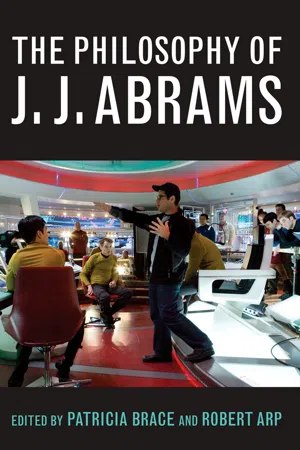
The Philosophy of J.J. Abrams
Trusted by 375,005 students
Access to over 1.5 million titles for a fair monthly price.
Study more efficiently using our study tools.
Information
Topic
PhilosophySubtopic
Film & VideoScene 1
IDENTITY ISSUES
“GREY MATTERS”
Personal Identity in the Fringe Universe(s)
When you open your mind to the impossible, sometimes you find the truth.
—Walter Bishop
J. J. Abrams’s other hit sci-fi series, Fringe, presents the viewer with a central philosophical puzzle: in the Fringe universe “there’s more than one of everything.” That includes people. In the mythology of the show, duplicate characters from two alternate universes square off in a showdown. In each universe there are copies of the main characters; they look, speak, and think much the same as their doubles. How would a friend or loved one know whether you had been replaced by a physically identical doppelganger? What is it that makes you, you? That is, what makes you the same person today that you were yesterday? Or, for that matter, what makes you the same person who experienced losing your first tooth as a child? Certainly, something makes you you over time. So what is it? Are we each identical to some body, or some mind, or some brain, or some conjunction of all of these things? Or are we something else entirely? Philosophers have asked these questions for generations. The philosophical study of such questions is called the theory of personal identity. It is these questions that form the basis of this chapter.1
Upon first inspection, it appears that different events in the Fringe universe suggest different answers to this question of what we are. For instance, FBI special agent Olivia Dunham is for a time able to communicate with her deceased FBI partner and lover, John Scott, whose memories and personality become temporarily stored in Olivia’s consciousness (season 1, “Pilot” and “The Dreamscape”). This appears to imply either that John is not a person or that in the Fringe universe(s) other, numerically distinct persons can somehow live within our bodies (which in turn suggests that they could survive the loss of their bodies). In contrast, other events suggest that persons are, at least in part, identical with bodies. For instance, the show depicts “shape-shifters,” seemingly evil foot soldiers from an alternate universe that are capable of becoming other people, like FBI agent Charlie Parker, complete with their host’s memories and mannerisms, by somehow assimilating their physiology. Moreover, other events suggest that persons are essentially either heads or brains. In one episode the foot soldiers are charged with stealing cryogenically preserved heads while in search of the head of their leader, Thomas Newton. Once they find his head, they successfully reanimate Newton, who is presumably a person, by grafting his head onto what we later learn is a partially robotic humanoid body (season 2, “Momentum Deferred”; season 3, “Do Shapeshifters Dream of Electric Sheep?”). These and many other events suggest that determining what persons are in the Fringe universe(s) will be quite challenging or maybe even that there is not a unified theory of persons underlying the show’s mythology.
Even so, encouraged by the fact that the Fringe Division team often attempts the unimaginable and succeeds, we will forge on. It is surely imaginable that we could answer the question of what persons are in the Fringe universe(s). Moreover, it appears that Fringe presents us with many physically and psychologically traumatic events that reveal a way to determine an answer to the question of what we, persons, are. By analyzing the things that people in Fringe can endure, we can attempt to determine what persons are by process of elimination. For example, if we determined that persons can survive losing a limb, like Nina Sharp for instance, this would imply that having the particular limbs we each have is unessential to being the persons that we are. That is, we can each imagine maintaining self-consciousness prior to, during, and after the loss of a limb. By considering which of our parts we could survive losing in this manner, we should be able to discover which of our parts are vital to our continued existence as persons. By analyzing the traumatic events that people survive in the show, we can also attempt to determine which, if any, theory of persons appears to be true in the Fringe universe(s). For every particular event under consideration, we should each ask ourself, “Could I survive that if I were in a Fringe universe?” That is, according to what happens in the show, could you, for example, survive your bodily death and communicate with Olivia, like John Scott? Alternatively, could you survive having your head severed, cryogenically frozen, and grafted onto a borrowed human body, like Newton?
As we have said, each of the distinct events of Fringe may at first seem suggestive of a different answer to the question of what we are. Still, given that there is an overall trend of connecting the events of Fringe to provide the viewer with an ever more coherent explanation for what occurs, we assume that there is a coherent theory of persons underlying the Fringe mythology. Thus, by considering the answers to the question of what we could survive, identifying the account of persons the answer suggests, and then considering whether that account can explain all other known events of the show, we set out to determine what account of persons must be assumed true to allow for the happenings of Fringe. Although whether that theory is true of our universe will depend on the degree to which the actual universe resembles the universe(s) of Fringe, our examination should also shed some light on which theory of the nature of persons is most plausible in general.
The Animal Theory: Our Biological Traits
Fringe is often characterized, even by its own creators, as the story of a mad scientist. Accordingly, the show strives to capture cutting-edge scientific thought while pushing it forward into the realm of fiction. Because the show maintains a certain calculated level of scientific plausibility, we should start our search for the theory of persons that underlies the Fringe mythology by considering those that are scientifically plausible. Many contemporary philosophers working on theories of personal identity strive for such scientific plausibility in their theorizing. These thinkers are often inclined to look for naturalistic explanations of phenomena and to shun what they see as supernatural explanation. An explanation is naturalistic in the relevant sense if it involves only those entities, properties, and relations that scientists could verify in the laboratory.
If, for example, you were to throw a baseball as far as you could, as many times as you wished, we know that each time it would eventually fall to Earth. One could explain this phenomenon in a nonnaturalistic way; for instance, by speculating that angels abhor the sight of baseballs flying through the air. Thus, every time you throw the baseball, an angry angel grabs it and pulls it to the ground. This explanation is nonnaturalistic because its plausibility requires the existence of angels, which science has yet to confirm. Alternatively, one could explain the baseballs falling in a more naturalistic way. The enormous mass of Earth causes a warping or bending of the spacetime surrounding it, and since the ball is in that surrounding space-time, it gets caught in the “groove” and pulled uniformly toward Earth. This latter explanation relies on entities (e.g., Earth, the ball, space-time), properties (e.g., having mass), and relations (e.g., warping) that scientists have confirmed for us. Thus, in the case of the baseball, a philosopher who wishes to establish his or her scientific and naturalistic bona fides will doubtless reject the first sort of explanation (involving angels) and prefer the second.
What, then, does a naturalistic theory of personal identity look like? At the very least it will be one that uses only those sorts of entities confirmed by science. It will not, for instance, follow Descartes in supposing that each person is his or her immaterial soul, because scientists cannot empirically verify the existence of immaterial things.2 One contemporary theory of persons that fits the bill for being scientifically plausible is the animal theory, or animalism (for short). Put simply, animalism is the view that a human person is identical to a particular human animal (a member of the species Homo sapiens).3 The intuitive argument in favor of this theory is quite strong. Whenever you look in the mirror, you see a human animal looking back at you. Whenever you are alone in a room, there will be a human animal in that room, right where you are. Whenever the animal body you associate yourself with is wounded, you, and nobody else, feel the pain from that wound. Furthermore, the view has scientific merit insofar as it entails the claim that persons are an entity familiar to science, namely a certain sort of mammalian organism.4
Despite its intuitive and scientific appeal, however, animalism has its drawbacks. These drawbacks stem from the core animalist claim that each person is identical with his or her animal body. By reducing personal identity to the identity of the human organism in this manner, the theory constrains the ways in which human persons can conceivably survive. To explain by point of contrast, consider the Cartesian theory that we are souls for a moment. As mentioned above, according to Descartes, each person is an immaterial being, a soul, separable from any physical body. Consequently, if the Cartesian view is true, the destruction of the physical body need not necessitate the destruction of the person associated with that body. Alternatively, if, as the animalist tells us, we are merely human organisms and are thus inseparable from our bodies, it follows that the destruction of the human organism that is you would entail the destruction of the person that is you.
Although animalism is scientifically plausible, this implication of the view suggests that it is not the theory underlying the Fringe mythology. Rather, many events of the show suggest that animalism is false in the universe(s) of Fringe. For one thing, as mentioned, John Scott survives the destruction of his physical body, cohabitating Olivia’s mind (or brain). She experiences his memories and feelings, recalls things only he knew, and even speaks to him during her LSD-fueled sessions in Walter’s sensory deprivation tank. If animalism were true in the Fringe universe(s), John would have died when the human organism he was identical with died. Moreover, what happens between Olivia and John does not stand as the only counterexample to animalism. Rather, the troubles go further for the theory as we are presented with other events that echo fictional brain-transplant puzzles of which many contemporary philosophers are quite fond.
The generic version of the relevant philosophical puzzle goes like this: imagine that medicine were to progress to the level where it is possible to remove a human brain from one head and place it the head of a donor with no loss of functionality whatsoever. Now imagine further that you have a twin and that you and your twin both suffer a horrific accident. As a result, your twin’s brain is destroyed but her body is undamaged, while your body is catastrophically injured but your brain is fully functional. The doctor, seeing a chance to save at least one of you, opts for a transplant. Your brain is placed in the head of your twin. Now, when your family walks into the ICU, whom do you suppose they are going to find awake in the hospital bed? Most of us have the strong intuition that they are going to find you. Accordingly, many philosophers conclude that you go with your psychology, and not your body. Assuming that your psychology goes where your brain goes, it follows that you are the person who wakes in the hospital bed after the operation.
In the Fringe universe(s), this intuition regarding brain transplants is echoed in the story of Thomas Newton, the leader from the Other Side. Much like in our transplant case, his soldiers frantically search to find his cryogenically frozen head, believing that when that head is placed on a donor body, the resulting person will be Newton. Of course, they are proven correct when Newton’s head is indeed grafted onto a donor body and the resulting person is indeed Newton (season 2, “Momentum Deferred”). This too suggests that animalism is not true in the Fringe universe(s), because animalists have a different answer to the transplant case. Since they believe that a human person is identical to a human animal, not a brain or a psychology, they conclude that in the transplant case you remain the now-brainless organism. The animalist denies that you go with your psychology. Rather, according to animalism, losing a brain is no different from losing an arm in terms of its effect on identity, if animalism is true.
The opponents of animalism take our strongly held intuitions about brain transplants as very strong evidence against that theory. Equally, it seems that the writers of Fringe also have a different theory of personal identity in mind, given the success of Newton’s head transplant. Though we could each conceivably survive the loss of an arm and each remain the person that we are, like Nina Sharpe, intuitively we could not survive the loss of our psychology. That is, even if we could survive the loss of our brains by having our psychology stored on a hard drive or in a synthetic robot brain, it seems that we could not survive the loss of our psychology. In line with these intuitions, contemporary philosopher Derek Parfit, for instance, famously argues that personal identity is not what we care about when considering questions of survival in cases such as transplants.5
Parfit contends that what we are really concerned with is some other relation, psychological continuity or connectedness. Thus he suggests that persons are just a continuous psychology. If this is true, then it needs only to be the case that you have the same psychology in order to remain yourself when you awake in your twin’s body. Similarly, if this is true, then the revived Newton needs only to be psychologically continuous with the predecapitated and cryogenically frozen Newton to be the same person. Historically speaking, Parfit’s sort of theory derives from the philosopher John Locke’s (1632–1704) conception of our respective personal identities consisting in our own personal psychologies. As animalism a...
Table of contents
- Cover
- Half title
- Title
- Copyright
- Contents
- Introduction
- Scene 1: Identity Issues
- Scene 2: Memento Mori
- Scene 3: Moral Matters
- Scene 4: Friends and Family
- Scene 5: Metaphysically Speaking
- Scene 6: Your Logic Is Flawless
- Scene 7: Considering Cloverfield
- Scene 8: Talkin’ ’Bout a Revolution
- Acknowledgments
- List of Contributors
- Index
Frequently asked questions
Yes, you can cancel anytime from the Subscription tab in your account settings on the Perlego website. Your subscription will stay active until the end of your current billing period. Learn how to cancel your subscription
No, books cannot be downloaded as external files, such as PDFs, for use outside of Perlego. However, you can download books within the Perlego app for offline reading on mobile or tablet. Learn how to download books offline
Perlego offers two plans: Essential and Complete
- Essential is ideal for learners and professionals who enjoy exploring a wide range of subjects. Access the Essential Library with 800,000+ trusted titles and best-sellers across business, personal growth, and the humanities. Includes unlimited reading time and Standard Read Aloud voice.
- Complete: Perfect for advanced learners and researchers needing full, unrestricted access. Unlock 1.5M+ books across hundreds of subjects, including academic and specialized titles. The Complete Plan also includes advanced features like Premium Read Aloud and Research Assistant.
We are an online textbook subscription service, where you can get access to an entire online library for less than the price of a single book per month. With over 1.5 million books across 990+ topics, we’ve got you covered! Learn about our mission
Look out for the read-aloud symbol on your next book to see if you can listen to it. The read-aloud tool reads text aloud for you, highlighting the text as it is being read. You can pause it, speed it up and slow it down. Learn more about Read Aloud
Yes! You can use the Perlego app on both iOS and Android devices to read anytime, anywhere — even offline. Perfect for commutes or when you’re on the go.
Please note we cannot support devices running on iOS 13 and Android 7 or earlier. Learn more about using the app
Please note we cannot support devices running on iOS 13 and Android 7 or earlier. Learn more about using the app
Yes, you can access The Philosophy of J.J. Abrams by Patricia Brace, Robert Arp, Patricia Brace,Robert Arp in PDF and/or ePUB format, as well as other popular books in Philosophy & Film & Video. We have over 1.5 million books available in our catalogue for you to explore.