eBook - ePub
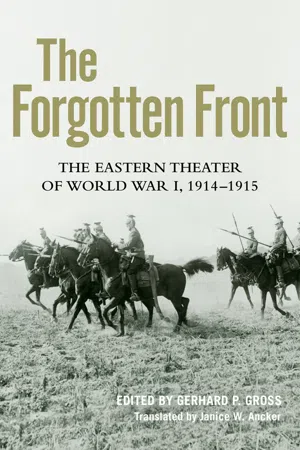
The Forgotten Front
The Eastern Theater of World War I, 1914 - 1915
- 404 pages
- English
- ePUB (mobile friendly)
- Available on iOS & Android
eBook - ePub
The Forgotten Front
The Eastern Theater of World War I, 1914 - 1915
Trusted by 375,005 students
Access to over 1.5 million titles for a fair monthly price.
Study more efficiently using our study tools.
Information
1
The Eastern Front
Geopolitics, Geography, and Operations
Hew Strachan
Just over one hundred years ago, on 25 January 1904, Halford Mackinder delivered a lecture at the Royal Geographical Society in London that geographers in Britain regard as the founding moment of geopolitics. Mackinder, who had read natural sciences and history at Oxford before qualifying as a lawyer, was the pivotal figure in the establishment of modern geographical studies in British universities. A serial pluralist, he was never happy doing one job when he could be doing several. In 1904 he was reader in geography at Oxford University, a student (that is, fellow) of Christchurch, and director of the London School of Economics. He would later become a member of Parliament, and he was the British high commissioner in south Russia in 1919.1
His 1904 lecture, which was attended by Spenser Wilkinson, appointed Oxford’s first professor of military history in 1909, and Leo Amery, the strongest advocate of Britain’s war aims in the Middle East in 1917–1918, was called “the geographical pivot of history.” Mackinder sought “a formula which shall express certain aspects … of geographical causation in universal history. If we are fortunate, the formula should have a practical value as setting into perspective some of the competing forces in current international politics.”2 As the leaders of the European Union today struggle to define their continent and wonder whether to draw a line at the Bosphorus or the Caucasus, it is worth remembering that for Mackinder Europe and Asia were not two continents but one. He called it Euro-Asia. A continuous landmass of 21 million square miles, it embraced, he calculated, half the world’s land surface if the deserts of Arabia and the Sahara were excluded. He defined Euro-Asia as the world’s “heartland” and Russia, placed at its center, as the “pivot state.” “The most remarkable contrast in the political map of modern Europe,” he declared, “is that presented by the vast area of Russia occupying half the continent and the group of smaller territories tenanted by the Western Powers.”3
Mackinder drew attention to the succession of invaders who had moved from east to west, the horse-mounted warriors of the steppes—Mongols, Tatars, and Cossacks. He argued that thus far in the world’s history Russia’s latent potential had been restrained by the problems of communication: road building across such a vast area had been too challenging a task. Instead, sea power had provided the basis for global economic links. Although his own country, Britain, a landmass on the periphery of Euro-Asia, had been the most conspicuous beneficiary of sea power, Mackinder reckoned that era was now drawing to a close. Alfred Thayer Mahan’s theory of maritime supremacy drew on evidence from the eighteenth and early nineteenth centuries; it would not prove applicable to the twentieth. “Trans-continental railways are now transmuting the conditions of land-power, and nowhere can they have such effect as in the closed heart-land of Euro-Asia.”4
In 1904 Mackinder feared an alliance between Russia and Germany. Such a relationship would give the pivot state of the Eurasian heartland direct access to the oceans in the west. It would place the divide between east and west not on the Bug or the Vistula but on the Atlantic seaboard. Britain’s maritime supremacy would be directly challenged by a state whose eastern extremities would also abut the Pacific. After the First World War, in 1919, when Mackinder wrote a text designed to influence the peacemakers at Versailles, Democratic Ideals and Reality, he was more explicit about geopolitical probabilities and their likely impact on immediate policy. “Who rules East Europe commands the Heartland: who rules the Heartland commands the World Island: who rules the World Island commands the World.”5 He feared that Russia, after the Bolshevik Revolution of 1917, would be too weak to resist German penetration, and that Germany would therefore dominate eastern Europe and also—following his own logic—the world.
The consequence for a geopolitician like Mackinder was that the eastern front could never be “the forgotten front.” Geopolitics implied exactly the opposite—that it was the front from which all other outcomes would flow. Moreover, he was quite clear that, although the democratic powers of the west, Britain and the United States, did not think geographically, Germany did. “We have had for a byword in these times the German war map,” he wrote in Democratic Ideals and Reality. “It may be questioned, however, whether most people in Britain and America have fully realised the part played by the map in German education in the past three generations. Maps are the essential apparatus of Kultur, and every educated German is a geographer in the sense that is true of very few Englishmen or Americans. He has been taught to see in maps not merely the conventional boundaries created by scraps of paper, but permanent physical opportunities—‘ways and means’ in the literal sense of the words. His Realpolitik lives in his mind upon a mental map.”6
What Mackinder was doing with geography when he developed his ideas about geopolitics was using it as a basis for what in the 1920s British thinkers like J. F. C. Fuller and Basil Liddell Hart would call grand strategy, the incorporation of social, political, economic, and military means in one allencompassing approach to national policy. For Mackinder geography was the determinant of strategy, and he believed that that conviction also shaped the outlook of Germany. However, he was not quite right, because Realpolitik, as Mackinder called German policy, could also expose problems and obstacles as well as “ways and means.”
Mackinder’s sense of the opportunities and tensions in the relationship between Germany and Russia before 1914 was hardly new to the Germans in general or to the German General Staff in particular. On the one hand, the possibility of cooperation flickered in 1904 itself. In October Germany offered Russia a defensive alliance, and in July 1905 the kaiser and the czar reached an agreement at Björkö. It was the Russians, not the Germans, who broke off these contacts. The belief that a Russo-German pact made sense continued to fuel the long-term designs of many Germans, including Erich von Falkenhayn, the chief of the General Staff in 1914–1916.7 On the other hand, the awareness of latent conflict took a number of forms. Racially it was characterized by the clash between Teuton and Slav. Culturally—and consequently—Germany saw itself as the outer bastion defending European civilization against Asiatic backwardness. The rapidity of Germany’s modernization in the decades after unification made it more aware both of progress as a force in its own right and of the contrast between itself and a neighbor that was medieval and even primitive. Politically, Germany in this context was not a monarchy dogged by arrested constitutional development but the representative of political enlightenment. Possessed of universal male suffrage and the largest Socialist party in Europe, it was the very opposite of Russia, an autocracy and a police state that sent its Socialists to Siberia or into exile.
However, Germany could not afford to be self-confident in its superiority. Mackinder’s views were widely shared: given its landmass, its natural resources, and its population, Russia had the potential to dominate not only Germany but all Europe. Germans, like others, saw Russia as the coming power. Its gross domestic product before 1914 was greater than that of any other European state, including both Germany and Britain, and its annual growth rate between 1908 and 1913 ran at 3.25 percent. Over the same period its output from its metal industries rose 88.9 percent.8 This was the key sector of the economy in terms of raw military power. In 1914 the Russian Army mustered 1.4 million men before mobilization, as opposed to 800,000 men in the German Army. Russia’s so-called grand program of 1913 aimed to increase the army’s annual recruit contingent from 455,000 to 585,000. By 1917 the Russian Army would be three times the size of Germany’s.9
To successive chiefs of the German General Staff between 1871 and 1914, therefore, Mackinder’s insight was hardly novel. Moltke the Elder was convinced of Russia’s potential as a result of his visit there in 1856. In 1871, even before the war with France was concluded, he turned his thoughts to Russia, identifying between it and his own country “an unmistakable mutual aversion in faith and custom, a conflict in material interest.”10 Schlieffen told his sister in 1892 that Russia was “our special enemy.”11 Moltke the Younger shaped his own attitude to preventive war around the growth of the Russian threat. Although it was Britain that prompted the kaiser to convene the notorious “war council” of 8 December 1912, it was Russia that caused Moltke the Younger to declare at that meeting that the sooner the war came the better.12
It was not just the nature of the threat that made Germany’s eastern front so central to German policy. It was also the nature of Germany’s response. Both the elder and younger Moltkes reckoned that, if war came in Europe, it would be long, and the one reason for this was it would be a war fought by coalitions. In 1866 and 1870 single campaigns had won wars in short order because they were fought by single powers. But in 1914 no power stood alone: each, if defeated, could be rescued by an ally. In Germany’s case that ally was Austria-Hungary.
This was the second geopolitical or grand strategic reason why the eastern front was so pivotal to Germany. The First World War began in the Balkans, and it was triggered by Austria-Hungary’s need to reassert itself as a Balkan power. The state that could deter it from doing so was Russia, and it was to bolster Austria-Hungary’s resolve against Russia that Germany issued the so-called blank check at the beginning of July 1914. Germany entered the war as a consequence of its alliance obligations. Moreover, it was on the eastern front, not the western, that the German-Austrian alliance was played out. Vienna had no interest in what happened in France and Belgium.
In the days of Moltke the Elder, he and his Austrian counterpart as chief of the Great General Staff, Friedrich von Beck-Rzikowsky, had reflected these geopolitical and grand strategic assumptions in an operational solution. The German Army from the north and the Austro-Hungarian Army from the south, the one moving from East Prussia and the other from Galicia, would aim to envelop a portion of the Russian Army by converging east of Warsaw in what is today Poland.13 But, extraordinarily, in February 1913, with war being fought in the Balkans, Moltke the Younger told his Austrian counterpart, Franz Conrad von Hötzendorf, “The main impact of the entire European war, as well as the fate of Austria, will not be decided on the Bug, but ultimately on the Seine.”14 Thus by the eve of the First World War the operational solution was out of step with the geopolitical, grand strategic, and alliance imperatives. It was so above all for geographical reasons—and herein is the relevance of Mackinder.
Moltke the Elder had planned an offensive into Russian Poland, but Schlieffen progressively abandoned such thinking. He set little store by the Austro-Hungarian Army and so let the two armies’ joint planning fall into abeyance. He focused his attention on the northern sector of Germany’s eastern front, on East Prussia rather than the middle Vistula. If the Germans advanced at all, their axis was more likely to be due east rather than southeast. Instead of staying close to the Austro-German frontier, they would move away from it, lengthening their lines of communication as they did so. Russia’s ability to trade space for time by withdrawing into Asia would increase the danger of overextension. When the German advance passed beyond Warsaw and entered Russia proper, it would be shouldered north once more. The Pripet marshes divided the front at its center, forcing any army deployed on a broad front in two divergent directions. The Pripet River, into which the marshes drained, flowed eastward to the Dnieper. The latter was one of a series of rivers, running north-south, that seemed to form natural lines of defense. Schlieffen concluded in 1894: “The expanse of the country, the great distances of Russia, cannot be defeated.”15
A British military commentator, Colonel A. C. Macdonnell, in The Outlines of Military Geography, published in 1911, itemized the waterways of the Nemen, the Augustów canal, the Vistula, the Wartha, and the Prosna as natural defenses in west Russia, and those of the Pruth, Dniester, Bug, and Pripet in southwest Russia. He characterized Warsaw and Novo Georgievsk as “one huge entrenched camp.” Furthermore, he appreciated, as Schlieffen had done, that getting to Warsaw was only the beginning; from there to Petrograd or Moscow was still 650 to 700 miles. “This long distance over difficult and inhospitable regions,” Macdonnell warned, “still presents as formidable an obstacle to the advance of the invader as it did in the time of Napoleon.”16 However, Macdonnell then added a rider to his historical analogy: “if we exclude the increase to railway communications.” Here was the rub. Mackinder had reckoned that railways were transforming the geopolitics of Euro-Asia.17
There is no reason to imagine that Schlieffen or the younger Moltke read Mackinder’s 1904 lecture. It is more probable, even if by no means certain, that they were familiar wi...
Table of contents
- Cover
- Half title
- Title
- Copyright
- Contents
- Foreword
- Translator’s Note
- Introduction
- 1. The Eastern Front: Geopolitics, Geography, and Operations
- Part 1. The Battles on the Eastern Front, 1914–1915
- Part 2. The Battlefields of Concepts / Concepts of the Battlefields: The Eastern Front of the First World War and Perceptions of the Enemy
- Part 3. The Culture of Remembrance of the First World War
- List of Contributors
- Index
Frequently asked questions
Yes, you can cancel anytime from the Subscription tab in your account settings on the Perlego website. Your subscription will stay active until the end of your current billing period. Learn how to cancel your subscription
No, books cannot be downloaded as external files, such as PDFs, for use outside of Perlego. However, you can download books within the Perlego app for offline reading on mobile or tablet. Learn how to download books offline
Perlego offers two plans: Essential and Complete
- Essential is ideal for learners and professionals who enjoy exploring a wide range of subjects. Access the Essential Library with 800,000+ trusted titles and best-sellers across business, personal growth, and the humanities. Includes unlimited reading time and Standard Read Aloud voice.
- Complete: Perfect for advanced learners and researchers needing full, unrestricted access. Unlock 1.5M+ books across hundreds of subjects, including academic and specialized titles. The Complete Plan also includes advanced features like Premium Read Aloud and Research Assistant.
We are an online textbook subscription service, where you can get access to an entire online library for less than the price of a single book per month. With over 1.5 million books across 990+ topics, we’ve got you covered! Learn about our mission
Look out for the read-aloud symbol on your next book to see if you can listen to it. The read-aloud tool reads text aloud for you, highlighting the text as it is being read. You can pause it, speed it up and slow it down. Learn more about Read Aloud
Yes! You can use the Perlego app on both iOS and Android devices to read anytime, anywhere — even offline. Perfect for commutes or when you’re on the go.
Please note we cannot support devices running on iOS 13 and Android 7 or earlier. Learn more about using the app
Please note we cannot support devices running on iOS 13 and Android 7 or earlier. Learn more about using the app
Yes, you can access The Forgotten Front by Gerhard P. Gross, Janice W. Ancker in PDF and/or ePUB format, as well as other popular books in History & Eastern European History. We have over 1.5 million books available in our catalogue for you to explore.