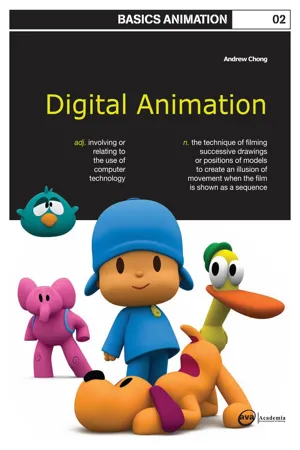
Basics Animation 02: Digital Animation takes a comprehensive look at the history of the medium, its growth and development over the last 50 years. This book features exciting contributions from innovators and pioneers in the medium as well as present day practitioners in the cinema, game, and television industries.
- 176 pages
- English
- ePUB (mobile friendly)
- Available on iOS & Android
eBook - ePub
Digital Animation
About this book
Trusted by 375,005 students
Access to over 1 million titles for a fair monthly price.
Study more efficiently using our study tools.
Information
Integration 2000–2007
The impact of digital technology at the beginning of the twenty-first century has made the production and delivery of animation easier than ever before. A general adherence to Moore’s Law means the tools available to animators are increasingly sophisticated and powerful, producing spectacular and extraordinary imagery. Concurrently, embedded technology and standardisation allow novice animators a simple path into the field. Digitisation has democratised the making of media; digital cameras, digital music and the Internet mean the tools of production are now available at a domestic level.
With the complexity of computer systems discreetly embedded behind simple graphic user interfaces and friendly control panels, digital animation can be an intuitive process that is accessible to the non-technical and even the non-animator. Digitisation in diverse fields also means diversification for animation – from flashing LEDs on a microwave oven to a surgical training simulator. Digital animation is not only reaching new peaks of achievement, but broadening in its application.
Digital tools for all
At the start of the 21st century, the personal computer had become a fact of everyday life. In creative fields it had become ubiquitous. Graphic design, music and animation were made with, or adjusted by, digital tools. Computers were now able to rival broadcast standard video equipment. The increased efficiency of video compression tools and the gradual convergence of PC standards meant it was possible to custom build PCs with enough power to handle video editing, compositing and streaming duties. Studio equipment would be recognisable to the average domestic PC user.
As a result, the look of animation had changed accordingly. Not only did the use of digital tools result in a more stable, consistent and variable image – the movement of cameras and objects on screen could also be controlled by computer. With footage and still imagery in the same digital palette, the complexity and depth of combined media was only restricted by imagination, and video aesthetic had to evolve. Audiences were now used to complex computer games, live and animated television graphics, graphical screens for domestic appliances and mobile phones.
Historically, the production of animation has been conducted by patient people. The requirement for specialist equipment and media, the delay between shooting frames and processing film, even the laborious pre-roll, post-roll and cueing of analogue video tape recording, meant patience was always an important quality for animators. Digitisation has removed many time-consuming hurdles and hardware obstacles.
Social networking platforms
Pushed by the demand for accessibility, PC operating systems have become less technical and more stable allowing integration with the growing number of digital consumer electronic devices. The personal computer has left the office and laboratory, and become a central piece of domestic equipment, communication and entertainment.
The advent of popular networking for social and casual interaction through services like MSN and MySpace has also empowered individuals with access to a broadcast medium. YouTube has provided the missing component for many amateur and semiprofessional film-makers and animators. Sites like these can be accessed for little or no financial outlay, and without the need to learn coding languages or design skills.
iStopMotion represents a dream come true for many a jaded animator and is a gift for anyone embarking on their first steps into animation. By linking a digital camera to a Mac, iStopMotion allows the capture of single frames of video with a simple key press. Changes between subsequent frames are immediately apparent, thanks to the ‘onionskin’ feature. A recorded series of images can be played back directly from the timeline to assess the animation as it is being recorded.

title
iStopMotion
creator
Boinx Software
Tools like iStopMotion represent the democratisation of computer technology and the benefits of digitisation for amateur and professional animators. The simplicity of the interface allows the user to ignore the technology and concentrate on the animation.
Microsoft Network (MSN) the digital communication network offered by Microsoft providing its users with e-mail, messaging and news amongst other electronic media services.
MySpace website owned by News Corporation with the majority of its pages created by a network of individual contributors; a free stage for social networking and personal expression.
YouTube Google-owned website offering users an Internet facility for uploading and video-sharing. YouTube uses Flash technology to display the material from a searchable database to all Web users.
iStopMotion a digital animation tool offering animators a computer-based method of creating animation using traditional methodologies.
Fan films
Fan films are those made by enthusiasts in tribute to, or as a parody of, existing commercial releases that have been made since the availability of domestic film-making equipment. The concurrence of digitisation, affordable equipment and a distribution medium – the World Wide Web – resulted in the fan film migrating from conventions and festivals into the public domain.
Armed with Mini DV cameras, Apple Macs and a suite of imaging software, Dave Macomber and Mark Thomas – The Crew of Two – were able to produce a six-minute short film that contained imagery and effects, which would only have been available to professional studios a decade previously.
Combining skills in design, martial arts and landscape painting, a pair of novice filmmakers were able to create a convincing homage to the Star Wars saga. Duality emphatically demonstrates the dissemination of digital imaging technology and techniques into the wider public realm.
Highly intuitive tools such as Electric Image, Adobe After Effects and Final Cut Pro have allowed film-makers and animators to accomplish increasingly ambitious results through simplifying the technical process, and shortening the distance between the concept and outcome.
Adobe After Effects a software package from Adobe, which provides visual effects and motion graphics.
Final Cut Pro a digital non-linear editing software developed by Apple Inc.

title
Duality
director
Dave Macomber, Mark Thomas (The Crew of Two)
The Crew of Two were able to employ the same chroma-key compositing and digital animation techniques used in mainstream cinema and television production, with only a basic knowledge of special effects. The result, Duality, is testament to the empowering force of digitisation and its ability to allow artists a route to realise their visions without the inhibition of restrictive technologies.
Digital feature films
Already proven by the accomplishments of various special effects sequences in mainstream feature films, digital technology had matured enough to be considered a medium for full-content production. Capitalising on the breakthroughs in CGI tools and the successful creation and reception of the first digitally animated feature, studios and production companies began to recognise the potential of computer animation as a viable form.
Imaging and animation computers were no longer just equipment added to the extende...
Table of contents
- Cover
- Title Page
- Contents
- Introduction
- How to get the most out of this book
- Foundations < 1960
- Pioneers 1960–1980
- Development 1980–1990
- Maturity 1990–2000
- Integration 2000–2007
- Predictions 2007 >
- Glossary
- A timeline of digital animation
- Conclusion
- References and bibliography
- Further resources
- Picture credits
- Acknowledgements
- eCopyright
Frequently asked questions
Yes, you can cancel anytime from the Subscription tab in your account settings on the Perlego website. Your subscription will stay active until the end of your current billing period. Learn how to cancel your subscription
No, books cannot be downloaded as external files, such as PDFs, for use outside of Perlego. However, you can download books within the Perlego app for offline reading on mobile or tablet. Learn how to download books offline
Perlego offers two plans: Essential and Complete
- Essential is ideal for learners and professionals who enjoy exploring a wide range of subjects. Access the Essential Library with 800,000+ trusted titles and best-sellers across business, personal growth, and the humanities. Includes unlimited reading time and Standard Read Aloud voice.
- Complete: Perfect for advanced learners and researchers needing full, unrestricted access. Unlock 1.4M+ books across hundreds of subjects, including academic and specialized titles. The Complete Plan also includes advanced features like Premium Read Aloud and Research Assistant.
We are an online textbook subscription service, where you can get access to an entire online library for less than the price of a single book per month. With over 1 million books across 990+ topics, we’ve got you covered! Learn about our mission
Look out for the read-aloud symbol on your next book to see if you can listen to it. The read-aloud tool reads text aloud for you, highlighting the text as it is being read. You can pause it, speed it up and slow it down. Learn more about Read Aloud
Yes! You can use the Perlego app on both iOS and Android devices to read anytime, anywhere — even offline. Perfect for commutes or when you’re on the go.
Please note we cannot support devices running on iOS 13 and Android 7 or earlier. Learn more about using the app
Please note we cannot support devices running on iOS 13 and Android 7 or earlier. Learn more about using the app
Yes, you can access Digital Animation by Andrew Chong in PDF and/or ePUB format, as well as other popular books in Media & Performing Arts & Animation. We have over one million books available in our catalogue for you to explore.