Ranging over depression-era politics, the failures of the League of Nations, popular journalism and the Modernist culture exemplified by such writers as James Joyce and T.S. Eliot, this is a comprehensive exploration of the historical contexts of Djuna Barnes's masterpiece, Nightwood.
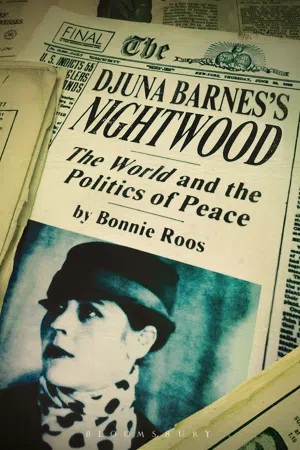
In Djuna Barnes's Nightwood: 'The World' and the Politics of Peace, Bonnie Roos reads Barnes's novel against the backdrop of Herbert Bayard Swope's popular New York newspaper The World to demonstrate the ways in which the novel wrestles with such contemporaneous issues as the Great Depression and its political fallout, the failures of the League of Nations and the collapse of peace between the two World Wars. Roos argues that Nightwood allegorizes the role of liberal newspapers - epitomised by the sensationalism of The World - in driving a US policy that hastened the arrival of war.
- 240 pages
- English
- ePUB (mobile friendly)
- Available on iOS & Android
eBook - ePub
About this book
Trusted by 375,005 students
Access to over 1 million titles for a fair monthly price.
Study more efficiently using our study tools.
Information
1
History Lessons: Woodrow Wilson’s Idealism and the Rise of the League of Nations
Among the indigenous princes, the number one enemy of Italian freedom was and is Charles Albert. The Italians should bear in mind and repeat every hour the old saying: ‘God watch over my friends, so that I can watch over my enemies.’ From Ferdinand [II of Two Sicilies] of the House of Bourbon, there is nothing to fear; he has for a long time been discredited. Charles Albert on the other hand calls himself pompously the ‘liberator of Italy’ while on the very people he is supposed to be liberating he imposes as a condition the yoke of his rule.
—Karl Marx, 1848
France took America deep into its heart yesterday. Paris was France and Wilson was America. It was a pageant of peace that greeted the American President, not one of war. . . .
The President’s coming renewed the outburst of happiness that attended the armistice. The visit seemed to be the seal of confirmation on the truths which shall be finally translated into terms of peace that within the next thirty days will be written in this capital. . . . Men who know Paris say that never in the many comings of Emperors and Kings, of dignitaries great and little, has there ever been the like in the City’s history to compare with this coming of Wilson.
—Herbert Bayard Swope, New York World, 1919
[The] mission was to bring the world to peace on Wilson’s terms: not peace for a time but the millennial peace for all time, not an alliance of victors, but an organization of nations based on honor, rectitude, and law. [Wilson’s goal] was to carry America’s light into the dark world.
—Elmer Bendiner, A Time for Angels, 1975
As Barnes’s Nightwood seeks to remind us, history repeats itself—not because it must, but because, failing to learn from it, we reenact it. This argument is the point of Barnes’s first chapter, “Bow Down,” which sets the pattern in motion for the novel’s structure . . . which, in due course, becomes typological, repeated. “Bow Down” often seems the easiest to read among her bizarre conglomeration of events, though like many of her other chapters, it is initially unclear what defines and limits it—why it includes so many details about the dead Guido’s pretense and the doctor’s stories, for example, and so little about the childhood or sentiments of its main character, Felix Volkbein. Barnes introduces us to Felix, who is born, is quickly orphaned, and then appears in Paris in 1920 at the age of about 40. In the first part of the chapter, we learn mostly of Felix’s parents’ history. Felix is the son of Guido and Hedvig Volkbein. Felix’s father Guido was a Jew of Italian descent who pretended to the aristocracy until his death, 6 months before Felix’s birth. He wore royal ribbons, bought “old masters” (p. 5), led a life of diminished but substantial luxury, and defended his version of history with two portraits of questionable provenance. Felix’s soldierly mother Hedvig, an Austrian, dies in the opening paragraph just after giving birth to Felix. After a review of his parentage, the chapter moves rather abruptly to Felix’s 1920 present, which is revealed especially through Felix’s conversations with Dr O’Connor: Felix continues his father’s pretense to nobility and is befriended by circus performers. One of these friends, Frau Mann, invites Felix to a party where he meets Dr O’Connor, a man who tells rambling, bawdy, and seemingly meaningless stories. When the party is disbanded, Felix briefly joins the doctor and Frau Mann for a drink and walks home. Soon after Felix’s departure, the doctor leaves Frau Mann, passed out, with the check.
This chapter becomes more coherent when understood as a satirical retelling of the inception of the League of Nations, an international caucus that sought to prevent a second world war. In this reading, Barnes’s chapter works as two parts. The first—Felix’s family past, which is based upon Austrian and Italian royal families, two branches of the Holy Roman Empire (see Figure 1)—is an explanation of what caused World War I. The second part, Felix’s 1920 present, is about the efforts to prevent a second world war through the creation of a League of Nations. In Barnes’s critique of this historical event in “Bow Down,” the biggest problem with the League is its hopes to end war forever, rather than establishing a sustainable peace for the time being. This effort led to contradictions between Woodrow Wilson’s use of the Romantic Christian rhetoric of justice even for the vanquished Germany, for example, and his need to withdraw such principles in the face of unexpected, uncharitable, and popular Allied demands for vengeance. In other words, Barnes points out the flaws in idealism like Wilson’s: he wants to be the heroic rescuer who might create a system of justice and equality to prevent war “for all time” as Elmer Bendiner puts it in his A Time For Angels: A Tragicomic History of the League of Nations (p. 3), but in order to see his League included in the Treaty of Versailles, Wilson was forced to withdraw such goals, derailing sustainable peace in the short term. Wilson’s exchange of generosity to the defeated for establishment of the League is one example in Barnes’s story of beneficent leadership. Wilson is a reminder that even when we try to behave nobly, capitalist, sentimental, and patriarchal structures make us complicit in inadvertently perpetuating rather than resolving injustices.

Figure 1 Lineages of the Holy Roman Empire (Italy and Austria’s leadership in bold).
The dates that Barnes gives us throughout Nightwood are crucial starting points in deciphering her text. The ages of Felix’s parents connect the Volkbeins with the Italian Savoy Royal family in the case of Guido, and the Austrian Hapsburg Royal family1 in the case of Hedvig.2 I should, perhaps, make clear here that I believe what Barnes describes as Guido’s “pretense” to nobility is not false on the basis of Guido’s lineage, for Guido is Savoy House royalty, just as Hedvig is Hapsburg royalty; it is false because any claim to nobility—to be a master over others, to command more money, more status, more rights, more privileges than anyone else—is from Barnes’s perspective inherently false. I include the stories and lineages here for two reasons. First, I argue that the structure of Barnes’s writing is modeled on the successions of this royal family, so that Barnes can demonstrate the way the US in her moment repeats Europe’s nineteenth-century monarchical history. Second, even though these royal figures were as well known to Europe’s populations of the moment as Hollywood royalty is to the public today, they may not be as well known to many of today’s readers. But Barnes’s academic readership would have recognized these figures, as Rebecca West’s Black Lamb and Grey Falcon (1941) illustrates; the lineages told a history that this readership, including Joyce and Eliot,3 understood to mean something. That the same families remain in power, that they intermarry and name sons and daughters after themselves and thereby repeat history, that they rule not only by military might but also by a claim to be God’s chosen “highnesses,” are all instructive to the structure Barnes critiques. Guido and Hedvig’s histories, I argue, reflect human histories; they demonstrate how absurd the versions of history and art promoted by those in power are, and urge us to question their legitimacy and recover the stories of the marginalized within them.
We are perhaps apt to forget in our day and age that until recently, royal houses maintained their power through intermarrying and, when deemed necessary, by defending their political and economic status by bringing their countries to war. This was arguably the case in World War I, which involved the (Austrian) Hapsburgs fighting against the (“Italian”) Savoys. In Barnes’s Nightwood, Felix’s father, Italian Guido, dies at the age of 59, 6 months before Felix’s birth in 1880. Thus, Guido was born in 1820, the same year that Victor Emmanuel II of the Italian House of Savoy was born. And indeed, Victor Emmanuel II’s history roughly corresponds to Guido’s life, reflecting Italy’s rising strength as the gentle but privileged man of the “marriage” between Italy and Austria. As the genealogies confirm, such marriages were commonplace between the Hapsburg and Savoy branches of the Holy Roman Empire, so that even when they were at war, in 1848 or later in 1859 over Austria’s control of Piedmont, these wars were fought between ruling houses who were by marriage first cousins.
Victor Emmanuel II was notable for succeeding where his father, Carlos Alberto, had failed.4 Victor Emmanuel II mimicked his father’s tactics, exploiting worker uprisings to usurp territory from the Austrian Hapsburg monarchy for himself. But unlike his father, Victor Emmanuel II was so successful in accumulating territories, that he was able to unify Italy for the first time as one nation.5 Upon unification, a moment many people thought fitting for a democratic republic led by the people, Victor Emmanuel II instead insisted upon a monarchy, repeating the history to which he was heir.6 As we will see, part of Barnes’s point in Nightwood is that every person, no matter how great, is a victim of romantic thrall. For Victor Emmanuel II, the price of his refusal to abdicate to the people’s authority and change his family history was paid through the life of his son, Umberto I, who was assassinated by an anarchist.7 Meanwhile, despite his decision to maintain the monarchy, Italy’s people viewed Victor Emmanuel II as heroic for his unification of the country. In other words, because he had freed them from the Austrians, the people welcomed the man who had simply replaced the Austrian monarchy with his own—just as Karl Marx had feared with respect to Victor Emmanuel II’s father.8 The people’s patriotism meant that they, too, repeated history and were trained to follow their leaders instead of thinking for themselves—conditioned to subjugation to the point of preferring it. But like their leader, Victor Emmanuel II’s people suffered for their conditioning, their allegiance to nationalism over freedom. For when Victor Emmanuel II’s grandson, Victor Emmanuel III became king9, he overrode the people’s will10 and joined World War I against Austria,11 on the side of the Allies—sacrificing over 450,000 of Italy’s young men for a war his people did not approve. For Barnes, no group is immune to romantic conditioning within a capitalist world, and therefore, no group can avoid its victimization.
Given this history, it is not surprising that an unquestioning obedience to a system that enslaves him is precisely Barnes’s criticism of Guido Volkbein, who is, by the dates of his birth and death, Victor Emmanuel II. Guido’s Jewish background should have taught him the human cost of dedication to romantic ideals like divine right. For example, on his “exquisite handkerchief of yellow and black linen” was the “ordinance of 1468, issued by one Pietro Barbo” (p. 2), which condemned Jews to torture and sometimes death as they ran between two piazzas at the beginning of Rome’s carnival season. Pietro Barbo, who writes the 1468 ordinance that would condemn Guido’s people, later becomes Pope Paul II,12 a man who exploits Jews by “divine right.”13 As Guido holds this yellow and black badge, an emblem of his religious persecution, he is “black with the pain of a participation that, four centuries later, made him a victim, as he felt the echo in his own throat of that cry running the Piazza Montanara long ago, ‘Roba vecchia! ’—the degradation by which his people had survived” (p. 2). Given this history, Guido knows that religious idealism, unquestioned obedience to a pope for example, results in and perpetuates injustice. As a Jew, Guido knows that the pope is a man, albeit an influential one. And yet Guido fails to see that his own idealism, when it comes to “divine right”—to his aspirations for monarchy and its corresponding wealth—amounts to the same thing. And so Guido’s memory of his Jewish past becomes ambivalent. His racial memory is passed down to him through an “exquisite . . . linen” handkerchief, an object of luxury and refinement, that makes unclear with which “people” Guido identifies and how precisely he is a “victim.” Guido may be “black with the pain of a participation” of “his people,” because he sympathizes with the history of the Jews who were forced to participate in this event; or he may instead suffer because he knows the nobility and clergy, the people Guido more commonly identifies with as “his people,” survive through their degradation of others, including the Jews of Guido’s heritage, and is ashamed because he “participates” in this exploitation. Guido’s loyalties are uncertain because, portly from wealth and alcoholic excess—the “heavy rounds of burgundy, schlagsahne and beer” (p. 1)—he drinks. He uses alcohol to forget his history—the violence that he, as a member of the royalty, perpetuates against people like himself—a history inevitably written by winners, and one skewed to privilege a singular, “monocular” perspective. Having learned nothing from the history to which he is heir, it is appropriate that Barnes has Guido die from an 1879 “fever”—a possible reference to the 1879 creation of the violently anti-Semitic, anti-Catholic, anti-Slavic Pan-German Party of Georg von Schönerer,14 which later became philosophically influential to Adolf Hitler.15 Thus, Guido’s death comes at the cost of his refusal to acknowledge his history; he dies for his adherence to a system that in the end, as it had with Victor Emmanuel II, works against him—and as we will see, the son he inducts into it.
Significantly, Guido is not only one of the players, but also one of the people who perpetuates this elitist version of history, this “truth,” or at least, he is empowered to invent it through purchases of art that confirm the history he prefers. His version of history is “false,” even absurd to thoughtful people—indeed the “whole conception might have been a Mardi Gras whim” (p. 7)—but Guido’s people, like Victor Emmanuel II’s people, are so conditioned to sentimentalism that they accept even the ludicrous as “truth.” Emulating the nobility in general, Guido is able to prove his connection to royal bloodlines through two apparently conventional portraits,16 a woman in elegant dress and a man on a horse, Guido’s claim to a mother and father:
The lady was a sumptuous Florentine with bright sly eyes and overt mouth. Great puffed and pearled sleeves rose to the pricked-eared pointings of the stiff lace about the head, conical and braided. The deep accumulation of dress fell about her in groined shadows; the train, rambling though a vista of primitive trees, was carpet-thick. She seemed to be expecting a bird. The gentleman was seated precariously on a charger. He seemed not so much to have mounted the animal as to be about to descend upon him. The blue of an Italian sky lay between the saddle and the buff of the tightened rump of the rider. The charger had been caught by the painter in the execution of a falling arc, the mane lifted away in a dying swell, the tail forward and in between thin bevelled legs. The gentleman’s dress was a baffling mixture of the Romantic and the Religious, and in the cradling crook of his left arm he carried a plumed hat, crown out. (pp. 6–7)
Based on her portrait, Guido’s Italian mother’s dress is rich and luxurious, with its “deep accumulation,” its “groined shadows” reminiscent of Italy’s luxurious, wealthy cathedrals. Her “conical and braided” head su...
Table of contents
- Cover-Page
- Half-Title
- Series
- Dedication
- Title
- Contents
- List of Illustrations
- Acknowledgments
- Introduction
- 1 History Lessons: Woodrow Wilson’s Idealism and the Rise of the League of Nations
- 2 On Sleepwalkers and Alcoholism: Government Corruption and the Secret of Room ’29
- 3 Circus Animals and Trainers: Marxist Lessons and the Truth about The World
- 4 The “Seductions” of Capitalism: Fortune Telling, Ponzi Schemes, and the Magnificent Marthe Hanau
- 5 On Matthew O’Connor’s Neurasthenia and the Wolf in Grandma’s Clothes
- 6 The Fall of the League of Nations: Bad Loans, Bank Closures, and Felix’s “Old Masters”
- 7 Déjà vu: The Gold Standard, the “New Deal,” and the Audacity of Swope
- 8 Herbert Bayard Swope and the End of The World
- Conclusion
- Bibliography
- Index
- Copyright
Frequently asked questions
Yes, you can cancel anytime from the Subscription tab in your account settings on the Perlego website. Your subscription will stay active until the end of your current billing period. Learn how to cancel your subscription
No, books cannot be downloaded as external files, such as PDFs, for use outside of Perlego. However, you can download books within the Perlego app for offline reading on mobile or tablet. Learn how to download books offline
Perlego offers two plans: Essential and Complete
- Essential is ideal for learners and professionals who enjoy exploring a wide range of subjects. Access the Essential Library with 800,000+ trusted titles and best-sellers across business, personal growth, and the humanities. Includes unlimited reading time and Standard Read Aloud voice.
- Complete: Perfect for advanced learners and researchers needing full, unrestricted access. Unlock 1.4M+ books across hundreds of subjects, including academic and specialized titles. The Complete Plan also includes advanced features like Premium Read Aloud and Research Assistant.
We are an online textbook subscription service, where you can get access to an entire online library for less than the price of a single book per month. With over 1 million books across 990+ topics, we’ve got you covered! Learn about our mission
Look out for the read-aloud symbol on your next book to see if you can listen to it. The read-aloud tool reads text aloud for you, highlighting the text as it is being read. You can pause it, speed it up and slow it down. Learn more about Read Aloud
Yes! You can use the Perlego app on both iOS and Android devices to read anytime, anywhere — even offline. Perfect for commutes or when you’re on the go.
Please note we cannot support devices running on iOS 13 and Android 7 or earlier. Learn more about using the app
Please note we cannot support devices running on iOS 13 and Android 7 or earlier. Learn more about using the app
Yes, you can access Djuna Barnes's Nightwood by Bonnie Roos in PDF and/or ePUB format, as well as other popular books in Literature & Literary Criticism. We have over one million books available in our catalogue for you to explore.