eBook - ePub
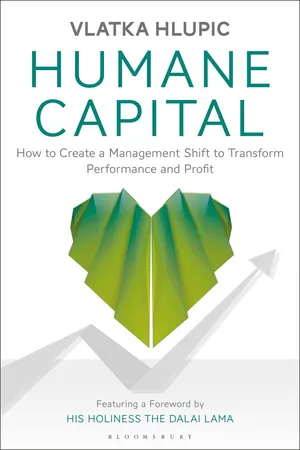
Humane Capital
How to Create a Management Shift to Transform Performance and Profit
- 320 pages
- English
- ePUB (mobile friendly)
- Available on iOS & Android
eBook - ePub
About this book
Featuring a foreword by His Holiness the Dalai Lama.
Despite decades of research and evidence, there is still extreme scepticism that businesses can combine a more humane style of management with superior shareholder returns, or that busy managers can be guided effectively by both their heads and their hearts. Vlatka Hlupic has spent 20 years investigating this paradox, developing an insightful critique of why such strong evidence has had limited impact and providing an alternative, practical approach that any employer can implement in order to overcome the unique challenges faced by their organizations.
A clear correlation exists between companies that do well and companies that are good – that is to say, organizations that promote goodwill internally and externally, and work proactively with stakeholders, employees, society and customers to achieve those goals. A 'bad' company, on the other hand, may do well but its success is unlikely to be sustainable. Humane Capital explores the steps that businesses need to take in order to become a 'good' organization that can achieve long-term results.
Supported by insights from interviews with 58 leading thinkers and practitioners in the field, Humane Capital argues for a radical reassessment of current business models. Using stories of managers from both the private and public sectors who have been effective in making the transition, Hlupic shows how successful leaders have moved their organizations from controlled and orderly to enthusiastic and collaborative – and shows how current leaders and managers can do the same.
Despite decades of research and evidence, there is still extreme scepticism that businesses can combine a more humane style of management with superior shareholder returns, or that busy managers can be guided effectively by both their heads and their hearts. Vlatka Hlupic has spent 20 years investigating this paradox, developing an insightful critique of why such strong evidence has had limited impact and providing an alternative, practical approach that any employer can implement in order to overcome the unique challenges faced by their organizations.
A clear correlation exists between companies that do well and companies that are good – that is to say, organizations that promote goodwill internally and externally, and work proactively with stakeholders, employees, society and customers to achieve those goals. A 'bad' company, on the other hand, may do well but its success is unlikely to be sustainable. Humane Capital explores the steps that businesses need to take in order to become a 'good' organization that can achieve long-term results.
Supported by insights from interviews with 58 leading thinkers and practitioners in the field, Humane Capital argues for a radical reassessment of current business models. Using stories of managers from both the private and public sectors who have been effective in making the transition, Hlupic shows how successful leaders have moved their organizations from controlled and orderly to enthusiastic and collaborative – and shows how current leaders and managers can do the same.
Tools to learn more effectively

Saving Books

Keyword Search

Annotating Text

Listen to it instead
Information
PART I
WHY DO WE NEED TO HUMANIZE ORGANIZATIONS
1
The traditional business model is broken!
KEY INSIGHTS FROM THIS CHAPTER
•A dehumanizing approach to management based on a static concept of deploying people as resources is no longer fit for purpose.
•The need to update each company’s business model is made more acute in this volatile world with its rapid technological and demographic changes. Changes must be made so as to provide for the expectations of the millennial generation.
•Research now strongly supports empowering leadership styles, encompassing all aspects of business strategies and processes, as well as innovation and design.
•Presently, only a minority of workplaces can be categorized as being passionate and high-performance, and they have a significant competitive advantage.
•Shifting to a high-performance culture means a comprehensive cultural change for some organizations, not just an incremental increase in employee engagement.
•There is a practical, proven approach for shifting to higher levels of performance.
Business as usual is not an option anymore
Although the evidence for a high-engagement, high-performance workplace is strong, sometimes it still feels as if striving for this enviable state of affairs is an optional extra that need not be introduced. As noted in the preface to this book, it isn’t easy to implement the required improvements. In my recent work I have come across powerful trends which suggest that many organizations have little choice but to reform and adapt. If they do not become more nimble, adaptable, equitable and empowering they will lose out in the competitive struggle. I shall discuss some of these trends in this chapter, and I shall also refer to technological and demographic changes.
This is not simply about a war for talent, it is a fundamental shift. The dehumanizing business model that many of us grew up with in the late twentieth century, which always had limitations, has become increasingly unviable in today’s business environment. Management involves choice. If you choose not to prioritize the empowerment and motivation of those people who report to you, then you are choosing to disempower and demotivate them, and this can be done at the subconscious level. So the question that arises is, how does pursuing sub-optimal empowerment and motivation for the teams that deliver your services help you achieve your objectives? In a competitive marketplace your customers will be better served by employees who are energized in the delivery of their products and services, and these are continually developed and updated by a highly innovative team.
In my earlier book, The Management Shift,1 I described the concept of different levels of individual mindset and the corresponding organizational culture in an Emergent Leadership Model. These levels start at Level 1, which is negative and seriously dysfunctional, through to Level 5, which is unbounded and passionate. (See Figure 1.1 and Table 1.1) Each level is characterized by specific thinking patterns, behaviour, language used, leadership style and organizational outcomes. For example, Level 1 is characterized by apathy or destructive behaviour while Level 2 is characterized by the reluctant behaviour of employees who only do the minimum necessary to be paid. There is a particularly significant shift from Level 3, which is ordered and bureaucratic, to Level 4, which is where highly-engaged and inventive performance begins. The keywords and phrases at this level are: trust, transparency, purpose, collaboration, passion, giving back to society and having fun when working. Level 5 is where passionate people combine creatively to make that difference.
As described in the preface, the upward move to Levels 4 and 5 is uneven, but what is emerging is a cadre of high-performing businesses that operate at Levels 4 and 5 who are pulling away from the rest of the economy. A report by Deloitte found that only twelve per cent of the US workforce operates at a passionate level and it is they who meet or exceed performance expectations. The report also notes that the remaining eighty-eight per cent of the working population operates at the sub-optimal level, though many exhibit some elements of passion and engagement.2 However, a more recent Gallup international survey, which provided a comparison with my earlier studies, revealed a slight increase in worker passion and a drop in the level of disengagement.
The United States and Canada scored best of all in the poll, recording twenty-nine per cent of employees as being highly-engaged.3 Another study revealed a similar picture, with twenty-eight per cent of the North American workforce being identified as purpose-driven. The benefits that these motivated workforces bring to their organizations include, inter alia, a twenty per cent increase in the probability of an employee staying with their employer for two years or more, while fifty-four per cent are more likely to feel that their work has had some impact.4 The overall picture that emerged was that, in most economies, a minority of the workforce was responsible for the majority of passion, innovation and added economic value. This is a finding that ought to awake the interest of policy makers as well as business managers.

FIGURE 1.1 Five Levels of the Emergent Leadership Model.
TABLE 1.1 A description of the five Levels of the Emergent Leadership Model


Source: Vlatka Hlupic (2014), The Management Shift – How to Harness the Power of People and Transform Your Organisation for Sustainable Success, Palgrave Macmillan
Organizations face unprecedented challenges
Life has never been predictable, but, arguably, the level of volatility facing modern organizations is increasing. This instability has been the subject of much research and has become known by the acronym VUCA. This stands for Volatility, Uncertainty, Complexity and Ambiguity. These helpful distinctions, made between the different dimensions of external risk, help management teams prepare.5 A succinct summary appears in Table 1.2
In the early twenty-first century we experienced the rapid industrialization of emerging economies and the deepening and widening of global trade. This was facilitated and accelerated by the use of the internet. Yet these largely positive, benign forces were followed by the great banking and financial crash of 2008 to 2009, the aftermath of which still persists. This aftermath featured the introduction of unprecedented financial stimuli such as quantitative easing, ultra-low interest rates, high government debt, austerity programmes and, in some regions, resurgent nationalism and conflict.
TABLE 1.2 A definition of VUCA world
| Volatility | This refers to a known external variable with a significant impact on a business that is highly unpredictable and beyond the control of a single enterprise. A recent example is the price of oil, which fell from in excess of $100 per barrel to around $30 in the period 2014 to 2016. |
| Uncertainty | This refers to a situation when the event’s basic cause and effect are not known. Change might be possible but it is not certain. An example might be the launch of the new product by competitor, where its impact on the business and market is not certain. |
| Complexity | This situation has multiple variable factors that affect outcomes. An example would be trading a complex service internationally, but under different regulatory regimes. |
| Ambiguity | Causal effects are all but impossible to ascertain – the context is wholly new and there are no precedents. An example is entering a new market with a new technology that is potentially disruptive and untested in that market. |
Source: https//hbr.org/2014/01/what-vuca-really-means-for-you
One thing is clear, however, a rigid, rules-based, dehumanized workplace is ill-suited to react positively to any dimension of the VUCA world. In a VUCA world, where technology and customer preferences chang...
Table of contents
- Cover
- Half-Title Page
- Praise for Humane Capital
- Dedication
- Title Page
- Contents
- List of Tables
- List of Figures
- Foreword
- Preface
- Acknowledgements
- PART I Why do we ne ed to humanize organizations
- 1 The traditional business model is broken!
- PART II Humane capital interviews: What are the best practices that emerge from humanized organizations
- 2 Winning strategies: how the public sector achieves more with less
- 3 Profit and principle combined: Inspirational stories from the private sector
- 4 Entrepreneurial rising stars getting it right: Inspirational stories from SMEs
- 5 Humanized and humane: Winning strategies from the non-profit sector
- PART III How to leverage humane capital in your organization and transform workplace performance and profit
- 6 What the evidence tells us: Data patterns from interviewees show how the best-led organizations succeed
- 7 Creating positive ripples: The few affect the whole
- Appendix 1. Interview questions
- Appendix 2. List of interviewees
- Appendix 3. Demographic data for interviewees and their organizations
- Appendix 4. Research methodology underpinning the Humane Capital project
- Appendix 5. Level 4 companies identified by interviewees
- Appendix 6. The Management Shift Consulting Ltd services and tools
- Notes
- The Humane Capital® Board Game
- Index
- Copyright
Frequently asked questions
Yes, you can cancel anytime from the Subscription tab in your account settings on the Perlego website. Your subscription will stay active until the end of your current billing period. Learn how to cancel your subscription
No, books cannot be downloaded as external files, such as PDFs, for use outside of Perlego. However, you can download books within the Perlego app for offline reading on mobile or tablet. Learn how to download books offline
Perlego offers two plans: Essential and Complete
- Essential is ideal for learners and professionals who enjoy exploring a wide range of subjects. Access the Essential Library with 800,000+ trusted titles and best-sellers across business, personal growth, and the humanities. Includes unlimited reading time and Standard Read Aloud voice.
- Complete: Perfect for advanced learners and researchers needing full, unrestricted access. Unlock 1.4M+ books across hundreds of subjects, including academic and specialized titles. The Complete Plan also includes advanced features like Premium Read Aloud and Research Assistant.
We are an online textbook subscription service, where you can get access to an entire online library for less than the price of a single book per month. With over 1 million books across 990+ topics, we’ve got you covered! Learn about our mission
Look out for the read-aloud symbol on your next book to see if you can listen to it. The read-aloud tool reads text aloud for you, highlighting the text as it is being read. You can pause it, speed it up and slow it down. Learn more about Read Aloud
Yes! You can use the Perlego app on both iOS and Android devices to read anytime, anywhere — even offline. Perfect for commutes or when you’re on the go.
Please note we cannot support devices running on iOS 13 and Android 7 or earlier. Learn more about using the app
Please note we cannot support devices running on iOS 13 and Android 7 or earlier. Learn more about using the app
Yes, you can access Humane Capital by Vlatka Hlupic in PDF and/or ePUB format, as well as other popular books in Business & Business Strategy. We have over one million books available in our catalogue for you to explore.