- 296 pages
- English
- ePUB (mobile friendly)
- Available on iOS & Android
eBook - ePub
About this book
"Meticulously researched and beautifully produced." Times Literary Supplement
"A big and beautiful book." Journal of British Studies
"A definitive history of the sports shoe." Amber Butchart, fashion historian
"A necessary book [and] a great read." Samuel Smallidge, Archivist, Converse
"Both educational and entertaining." Scene Point Blank
The story of the sneaker's rise from the first Victorian tennis shoes to the Nike Air Max and beyond.
Moving from the athletic field to the shopping mall, Thomas Turner tells a fresh story of the evolution of the sports shoe against the changing landscape of society, sport, fashion, industry, and technology. The Sports Shoe takes us on a journey from the first Victorian tennis shoes to the sneaker of today, to the adidas Superstar and the innovative technologies of Nike Air Max. Featuring newly uncovered archival material and historic images showcasing key personalities, vintage marketing and common perceptions of this hugely desirable product, this book is a must-have for any sneaker collector, historian of popular culture, or anyone interested in the place of athletic footwear in our lives today.
"A big and beautiful book." Journal of British Studies
"A definitive history of the sports shoe." Amber Butchart, fashion historian
"A necessary book [and] a great read." Samuel Smallidge, Archivist, Converse
"Both educational and entertaining." Scene Point Blank
The story of the sneaker's rise from the first Victorian tennis shoes to the Nike Air Max and beyond.
Moving from the athletic field to the shopping mall, Thomas Turner tells a fresh story of the evolution of the sports shoe against the changing landscape of society, sport, fashion, industry, and technology. The Sports Shoe takes us on a journey from the first Victorian tennis shoes to the sneaker of today, to the adidas Superstar and the innovative technologies of Nike Air Max. Featuring newly uncovered archival material and historic images showcasing key personalities, vintage marketing and common perceptions of this hugely desirable product, this book is a must-have for any sneaker collector, historian of popular culture, or anyone interested in the place of athletic footwear in our lives today.
Trusted by 375,005 students
Access to over 1 million titles for a fair monthly price.
Study more efficiently using our study tools.
Information
1
Lawn tennis and the origins of modern sports shoes
In spring 1889, a reporter from the London sports weekly, Pastime, toured the “huge warehouse” of William Hickson and Sons, a Northamptonshire shoe manufacturer. There he was shown “lawn-tennis shoes in endless variety ready for the coming season.” This was not unusual. The following year, at Manfield and Sons, he was almost overwhelmed: a “descriptive catalogue of all the varieties of lawn-tennis shoes to be found at the showrooms of this firm would more than exhaust the space at disposal,” he wrote. “Every kind of rubber sole is united with canvas, buckskin, calf, and Russia [leather], in combinations innumerable, ranging in price from under three shillings to nearly ten times that amount.” Competition between manufacturers was fierce. As Pastime had noted in 1888, “[y]ear by year the task of visiting show-rooms and manufactories becomes more laborious, owing to the great number of makers that are continually entering the field.”1 Rival firms fought for consumers’ business, driving sports shoemaking to new heights.

1.1 Men’s lawn tennis shoes, William Hickson and Sons, c. 1890.
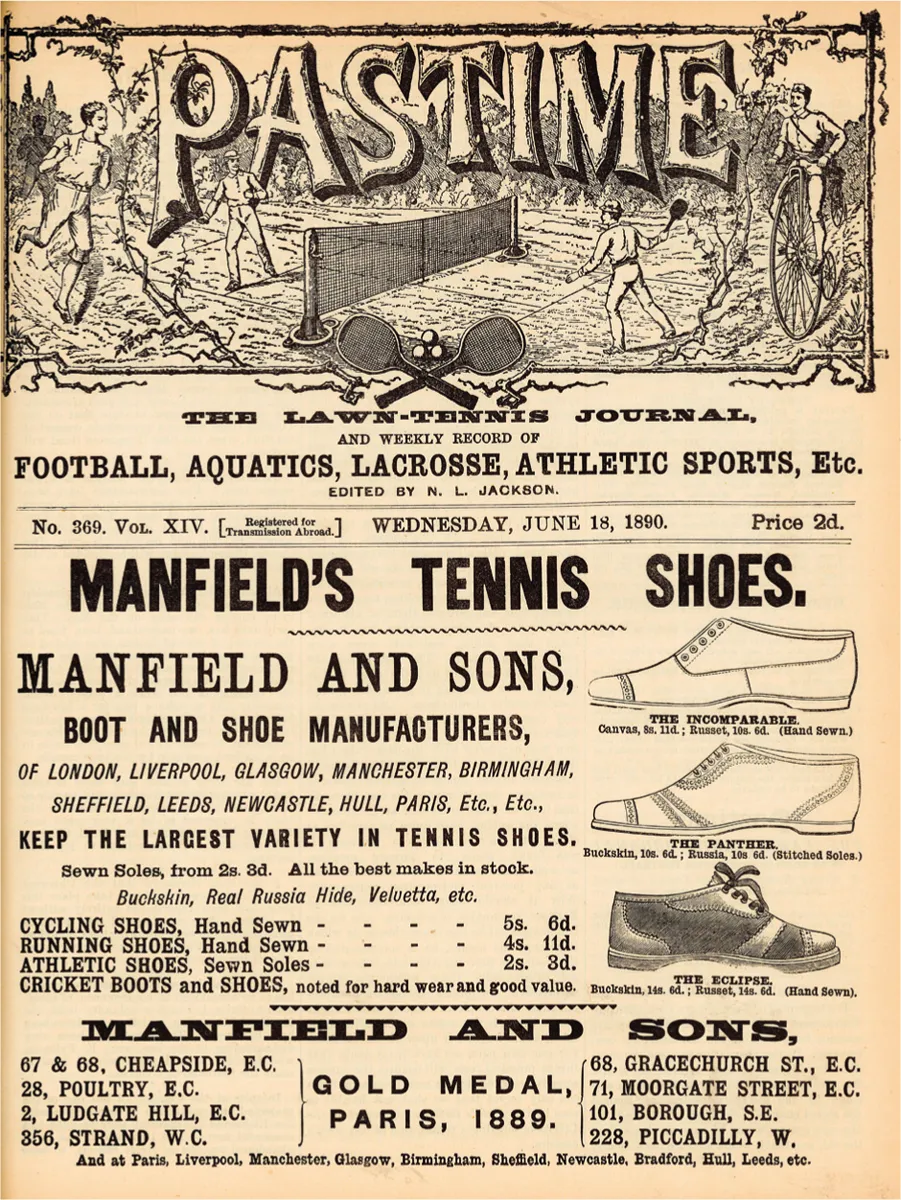
1.2 Manfield and Sons advertisement, 1890.
The modern sports shoe was born in the final decades of the nineteenth century. Social, industrial, and commercial changes in Britain prompted widespread enthusiasm for a variety of games and athletic activities. Sports created physical and social needs that were answered by a newly industrialized shoe industry. In seeking to cater to the demands of sportsmen and sportswomen, shoemakers drew on ideas of how footwear would be used within sporting practice, and exploited modern manufacturing and commercial processes. Special shoes used new materials and production techniques and were a category in which producers could experiment and innovate. They were sold in department stores, sports outfitters, and shoe shops and were marketed heavily, displayed prominently in windows and advertised in the popular, sporting, and trade press. This wide availability led to them being incorporated into the everyday wardrobe, both overtly, in the sense that they were worn for everyday use, and more covertly, in the sense that innovations associated with and introduced for sports were quickly adapted for other types of footwear. Sports shoes and clothing were associated with informality, youthful vigor, and—most especially—modern masculinity, and contrasted with more sober visions of frock-coated Victorian manhood. By the end of the century, sports shoes were closely linked to youth styles, but had also begun to seep into mainstream popular fashion.

Lawn tennis was one of several sports to emerge in the latter half of the nineteenth century. In Britain and the United States, the period was marked by the growth of new forms of physical recreation. Traditional folk games like football and cricket were developed into their modern forms, while entrepreneurial manufacturers produced a raft of inventions that sought to capture the imagination of a consuming public with time and money to spend on leisure.2 Lawn tennis developed in the late 1860s as an informal, outdoor adaptation of older bat and ball games, most obviously royal tennis.3 Credit for its invention is usually given to Major Walter Clopton Wingfield, a well-connected retired army officer who in 1874 launched its first commercially successful version. Boxed sets of rackets, rubber balls, court markers, a net, support poles, and an instruction booklet were sold by Wingfield’s agent, the sporting goods supplier French and Co., in Pimlico, London. They cost between five and ten guineas, a price that made them accessible only to the very wealthiest in society. Nevertheless, through canny promotion and his unwillingness to challenge rival manufacturers who launched their own versions of the game, Wingfield succeeded in creating an upper-middle-class fad. The Illustrated London News noted in summer 1880 that “[t]his popular and fashionable game, which is readily organised in small family parties, or at social visits wherever there is a good-sized piece of open turf, players being from two to eight in number, ladies and gentlemen together if they please, seems likely to hold its place in public favour.” Their predictions were correct. The author of the almanac Lawn Tennis for 1883 observed that lawn tennis was “followed with ardour by those that move in the highest social circles,” and by “any thousands of well-conditioned households that can boast sufficient garden space around their country house or suburban villa to afford the luxury of a ‘court.’” Within a few years of its launch, the game was well established within the fabric of middle class society.4

1.3 George Norris advertisement, 1888.
Late-Victorian lawn tennis encompassed more than the game defined by Wingfield and others. It blended physical movement with commodities, environments, and systems of social display and interaction. The rules, court, and implements of the game, as well as the social implications, conventions of behavior, and ways of thinking that surrounded it, constituted lawn tennis as a social practice. During its infancy, physical and competitive play were of less significance than sociability. For most Victorian players, it was an entertaining outdoor party game redolent of lazy afternoons and comfortable, bourgeois leisure. In new upper-middle-class suburbs, the relaxed tennis party was a key part of the summer season. It was, as one devotee claimed in 1881, best played on “a well-kept lawn [with] a bright warm sun overhead, and just sufficient breeze whispering through the trees and stirring the petals of the flowers to prevent the day from being sultry.” Arthur Balfour, later Prime Minister, was an early enthusiast. Looking back, he wrote that it was “not easy . . . to exaggerate the importance” of the tennis party, which, he thought, “profoundly affected the social life of the period.” Yet informality masked an event heavy with symbolic meaning. Participation in this new ritual required an array of costly implements, sufficient space, carefully maintained playing surfaces, and often membership of exclusive clubs. Participation was a demonstration of considerable resources—an example of what the American sociologist Thorstein Veblen identified in 1899 as “conspicuous consumption” and “conspicuous leisure.” Social interaction and codified displays of wealth and status were integral elements of the Victorian game.5

1.4 Lawn tennis party, c. 1900.

1.5 Jan Van Beers, A Love Match, c. 1890.

1.6 Lawn-Tennis magazine masthead, 1886.
In an era of strict gender segregation, lawn tennis was also significant in that it enabled middle class men and women to play with and against one another. It was welcomed by The Sporting Gazette for adding “another to that too limited list of pastimes in which ladies and gentlemen can join.” The journal thought it ideal for “ordinary loungers of both sexes, who care only for something which will . . . enable them to enjoy fresh air and flirtation in agreeable combination.” By bringing the sexes together, lawn tennis had a social culture distinct from sports like football and cricket. It introduced a new form of courtship, and the possibility of romance was a recognized—and frequently satirized—feature of the late-Victorian game. The Graphic claimed women played in “the hope of finding opportunities . . . of exhibiting their social charms, of posing in graceful attitudes, and indulging in the intervals of the game in flirtation with their partners.” The Bristol Mercury and Daily Post suggested “the chance of hearing ‘love’ from pretty lips” was part of its appeal for men. Even the masthead of the sports journal Lawn-Tennis showed two young couples breaking from a game of mixed doubles, gazing coyly at one another. It was in this form that the game was most commonly played; although the sports press focused on the competitive men’s game, garden parties often revolved around the social institution of the mixed double.6
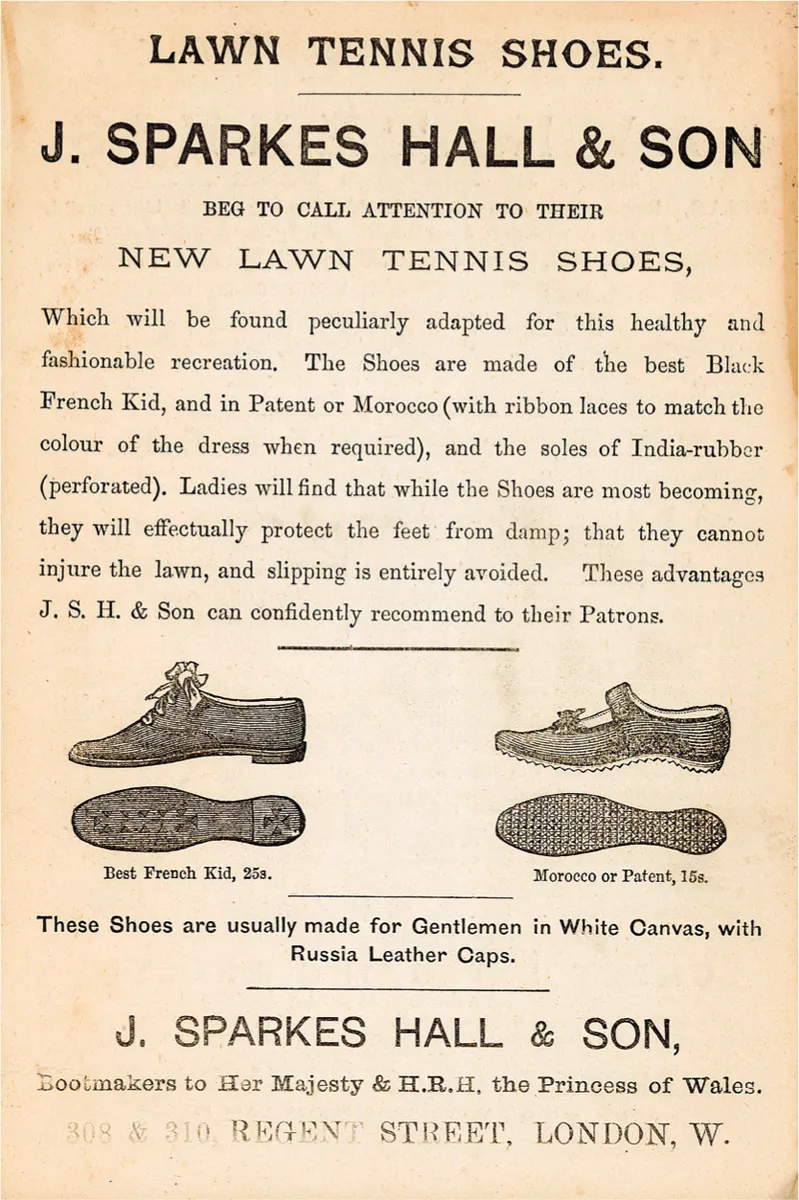
1.7 J. Sparkes Hall and Son advertisement, 1882.
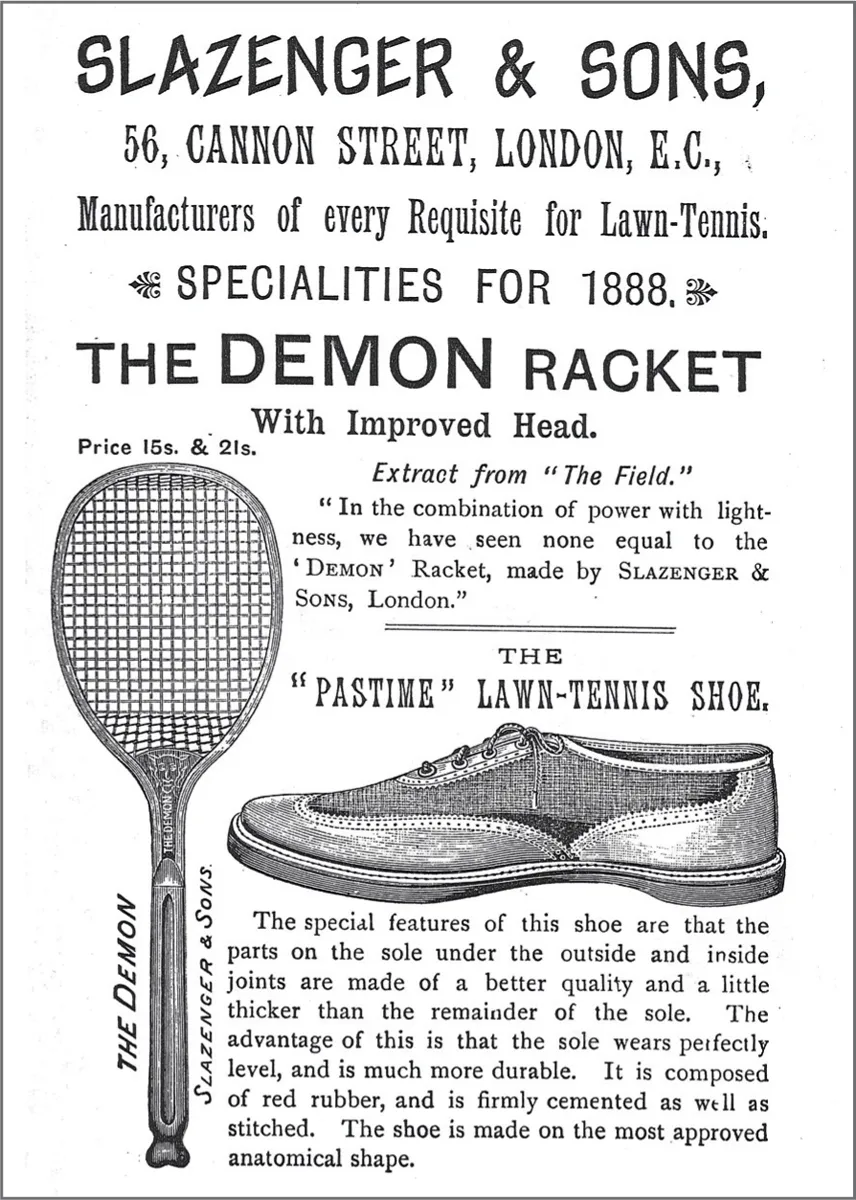
1.8 The Pastime lawn tennis shoe, Slazenger and Sons advertisement, 1888.
The advent of lawn tennis created a need for suitable footwear. The game was usually played on large, flat grass courts. These were expensive to install, and for the ball to bounce consistently, had to be regularly mown and rolled with costly machinery. To play properly and avoid embarrassment, participants had to run, turn, and stop relatively quickly without falling or slipping. Tennis shoes had to allow players to move effectively while also preserving the integrity of the court. The uppers were therefore made of lightweight, flexible materials, usually soft leathers or canvas, but the spiked or studded soles that provided grip in other grass sports like cricket and football were unsuitable as they damaged the surface. Flat soles of soft leather, although they were easier on the turf, were slippery and liable to become soaked with moisture. Shoemakers instead looked to vulcanized rubber (also known as India rubber and red rubber), a material that had only recently become available. Durable, moldable, heat- and water-resistant, it was ideally suited to players’ nee...
Table of contents
- Cover
- Title Page
- Contents
- Introduction
- Chapter 1 Lawn tennis and the origins of modern sports shoes
- Chapter 2 Sports style, youth, and modernity
- Chapter 3 Sports shoes reborn
- Chapter 4 Skateboarding and reimagining sports shoes
- Chapter 5 Sneakers, basketball, and hip hop
- Chapter 6 Trainers on the soccer terraces
- Chapter 7 Athleisure, global production, and the postmodern sports shoe
- Conclusion
- Notes
- List of illustrations
- Selected bibliography
- Acknowledgments
- Index
- eCopyright
Frequently asked questions
Yes, you can cancel anytime from the Subscription tab in your account settings on the Perlego website. Your subscription will stay active until the end of your current billing period. Learn how to cancel your subscription
No, books cannot be downloaded as external files, such as PDFs, for use outside of Perlego. However, you can download books within the Perlego app for offline reading on mobile or tablet. Learn how to download books offline
Perlego offers two plans: Essential and Complete
- Essential is ideal for learners and professionals who enjoy exploring a wide range of subjects. Access the Essential Library with 800,000+ trusted titles and best-sellers across business, personal growth, and the humanities. Includes unlimited reading time and Standard Read Aloud voice.
- Complete: Perfect for advanced learners and researchers needing full, unrestricted access. Unlock 1.4M+ books across hundreds of subjects, including academic and specialized titles. The Complete Plan also includes advanced features like Premium Read Aloud and Research Assistant.
We are an online textbook subscription service, where you can get access to an entire online library for less than the price of a single book per month. With over 1 million books across 990+ topics, we’ve got you covered! Learn about our mission
Look out for the read-aloud symbol on your next book to see if you can listen to it. The read-aloud tool reads text aloud for you, highlighting the text as it is being read. You can pause it, speed it up and slow it down. Learn more about Read Aloud
Yes! You can use the Perlego app on both iOS and Android devices to read anytime, anywhere — even offline. Perfect for commutes or when you’re on the go.
Please note we cannot support devices running on iOS 13 and Android 7 or earlier. Learn more about using the app
Please note we cannot support devices running on iOS 13 and Android 7 or earlier. Learn more about using the app
Yes, you can access The Sports Shoe by Thomas Turner in PDF and/or ePUB format, as well as other popular books in Art & Fashion Design. We have over one million books available in our catalogue for you to explore.