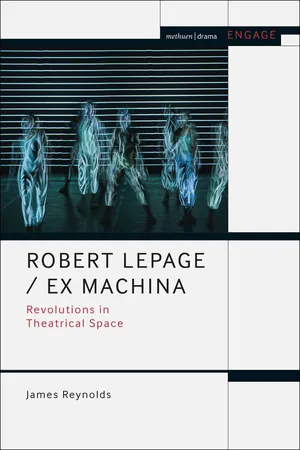
eBook - ePub
Robert Lepage / Ex Machina
Revolutions in Theatrical Space
- 256 pages
- English
- ePUB (mobile friendly)
- Available on iOS & Android
eBook - ePub
Robert Lepage / Ex Machina
Revolutions in Theatrical Space
About this book
Robert Lepage/Ex Machina: Revolutions in Theatrical Space provides an ideal introduction to one of our most innovative companies – and a much-needed and timely reappraisal of Lepage's oeuvre. International, interdisciplinary and intercultural to the core, Ex Machina have negotiated some of the most complex creative and cultural challenges of our time. This book maps the story of that journey by analysing the full spectrum of their richly varied work. Through a comprehensive historiography of productions since 1994, Robert Lepage/Ex Machina offers a detailed picture of the relationship between director and company, while connecting Ex Machina to culturally specific features of Québec, and its theatre. This book reveals for the first time how overlooked aspects of creativity and culture shaped the company's early work, while installing a dynamic interplay between director and company that would spark a unique and ongoing evolution of praxis. Central to this re-evaluation of practice is the book's identification of an architectural aesthetic at the heart of Ex Machina's work, an aesthetic which provides its artistic and political centres of gravity. Moreover, this architectural aesthetic powers the emergence of concrete narrative as a new and distinctive mode of theatrical storytelling – uniting story and space, body and technology, content and form – and demanding that we discover the politics of these performances in the energetic gestures of theatre design, and space itself. Drawing on extensive interviews with Lepage, Ex Machina personnel and collaborative partners, Robert Lepage/Ex Machina calls upon us to revise both our creative and critical perceptions of this vital and distinctive practice.
Trusted by 375,005 students
Access to over 1.5 million titles for a fair monthly price.
Study more efficiently using our study tools.
Information
Part One
Foundations and stepping stones (1994–9)
Introduction
The three chapters in this section introduce the relatively difficult birth of Ex Machina, and productions during that period, including The Seven Streams of the River Ota, A Dream Play, The Geometry of Miracles, La Celestine and The Damnation of Faust. Among the company’s successes within this rapid change of context would be a number of high-profile critical and technical problems.
Chapter 1, ‘Lepagean aesthetics’, explores the ways in which Lepage brought his deep-seated passions and principles into Ex Machina’s practice, from the outset. It is crucial in understanding Ex Machina that we recognize Lepage’s choice to engage with Japan’s geo-poetry and culture in Ota – a piece that must be thought of as a flagship project for the company, and a statement of intention. The emphasis Lepage places on direct interaction with culture, and his use of this to inform theatre making, is fundamental in setting Ex Machina on track towards continuous innovation in the use of theatrical space. Although Ex Machina are not ultimately limited by this early engagement with Japan, it nonetheless provides an aesthetic key to understanding their practice – doing so by exploring the idea of contradiction in depth. In contrast to this artistic freedom is Lepage’s experience of directing A Dream Play in Stockholm. Although industry models of practice do not suit Lepage’s way of working, this counterpoint would help confirm Ex Machina’s early sense of direction – and develop an important collaborative relationship with dramaturg Peder Bjurman.
Chapter 2, ‘Making concrete narratives’, explores productions following on from this very first wave of work, examining The Geometry of Miracles and Elsinore. These projects are shown to develop new and existing trajectories, and allow Lepage to take his ideas about narrative and theatrical form a step further. The idea of concrete narrative is explored here as a lens through which to understand the interaction of a number of principles of practice, particularly the bringing together of story and space, and an emphasis on architecture. Reading these works shows how Lepage’s evolving architectural aesthetic makes unique demands on Ex Machina collaborators – particularly performers – and, predictably, questions surrounding body, technology and collaboration arise from these productions. However, while we see that the new types of narrative form that emerge from experiments with body and technology positively extend the vocabulary of theatre and its affects, the company continues to meet with particular difficulties. This in turn leads to a set of critical ideas becoming attached to it before the effects of changing context have been absorbed. Polarities in the reception of Ex Machina’s early work, and the crucial shape this gave to critical discourse, is introduced here, and developed subsequently.
Chapter 3, ‘Critical themes’, explores collaborations in Japan and Stockholm which see the company starting to move out of its early phase of development – The Damnation of Faust and La Celestine. Importantly, in these works is both a recognizable intensification of architectural aesthetics, and a deepening engagement with social and political meanings inherent in character and narrative. The notion of the anti-hero, in particular, emerges as important – embedding both the idea of contradiction in the figure on stage, as well as the idea of resistance. This chapter concludes Part I by surveying the critical themes that emerged in response to Ex Machina’s early work, particularly in relation to creative process, collaborative context and culture. This chapter is important in revisiting, and revising, our ideas about Ex Machina’s changing creative process. Indeed, one of the major arguments of this book is that Ex Machina has not simply carried out Lepage’s practice, but has transformed it. Whether these critical themes have adapted similarly or still reflect the difficulties of the years 1994–9 is an ongoing question.
1
Lepagean aesthetics
The basement corridor walls of la Caserne were lined with a series of thirty-two prints picturing steps in the application of Kabuki make-up. A further fifteen completed the full series of forty-seven, but these hung in Lepage’s office on the top floor. From basement to roof, the influence of Japanese culture saturated Ex Machina. Lepage even has ‘a Japanese imagination’, says company collaborator and lighting designer Sonoyo Nishikawa.1 The following chapter thus explores ways in which Lepage confirmed or drew his vision of theatre from experiences in Japan, and early attempts to realize his aesthetic with Ex Machina. This goes beyond a simple process of transferring personal taste onto the materials of performance, or into the structure of the company. Rather, what we can observe here is the formation of a mutually nurturing dialectic. The cross-fertilization Lepage so admired in Japanese culture would drive both company and artistic director towards ever greater experiment with intersections of culture, form, history, language and technology, and establish an evolutionary dynamic based on an absolute willingness to embrace new influences.
Previously, we saw how Lepage’s passion for Japanese theatre began in the 1970s at Québec’s Conservatoire, long before Ex Machina’s flagship production, The Seven Streams of the River Ota (1994; henceforth, Ota). Speaking at CUNY in 2016, Lepage reiterated its appeal. Japanese theatre resonates with him due to its Baroque detail, permissiveness and playfulness in performance. Coherence and harmonization he finds boring, preferring contradiction – what he calls Japan’s ‘Bento box’ approach to theatre – clash and contrast within a tight framework. Although ‘we see our contradictions as problems’, he argues, in reality ‘they are our real source of inspiration’.2 Contradiction is central to Lepagean aesthetics, but we should remember that he expresses this before engagements in Japan. Watching Japanese companies ‘mixing very disparate techniques in the same show’ – and discovering richness ‘in diversity [and] in the meeting and shock of styles’ – was of great significance to Lepage.3 But they confirm his opinion, rather than giving it to him. In this chapter we see it is the ‘geo-poetry’ of the country – particularly its culture of space – that is decisive. Lepage was already directing at the Tokyo Globe by the time Ex Machina became a legal entity (1994), but his visits to cultural spaces and historical sites are especially noteworthy. Unlike the Trilogy – which began by announcing ‘I’ve never been to China’ in three languages – Lepage had definitely visited Japan before Ota, and, to the present day, he travels there at least twice a year.4 When contrasted with Lepage’s experience of directing Strindberg’s A Dream Play (1994) in Stockholm, at the same time as Ota was being made, we see in this chapter not only important features of company praxis emerging but further confirmation of the necessity for Ex Machina’s artistic and financial model of practice. Ota’s many contradictions would demand solutions to the interweaving of seven narratives spanning eras and nations into a single theatrical space, and bring with it equally complex lessons in intercultural theatre-making.
Discovering Japan’s geo-poetry: Seven Streams of the River Ota
Hiroshi Takahagi was programme manager at the Tokyo Globe, and witnessed Ota’s inception. He put Lepage in touch with a Shakespearean scholar based in Hiroshima, who, he says, ‘did his best to give this talented young director a good account of Hiroshima’s history, as well as of his own experiences of the bomb. Some two weeks later, Lepage went home; we couldn’t have imagined at that time that his visit would become the germ of his Hiroshima project’.5 In Lepage’s words, the professor gave him ‘a fantastic two days of these little stories’, describing the reaction of ‘a woman who had been disfigured’ in the Hiroshima blast to the sight of her own face in a mirror, and explaining a plan to give the city back its ‘sexual organs’ in the symbolic architecture of two new Yin and Yang bridges over the Ota.6 On this first trip, Lepage saw from the mountains above the city that these bridges resembled human reproductive organs, one, he writes, ‘phallic in form, the other shaped like a vagina’.7 He says the ensemble explored the theme of ‘devastation and destruction coupled with rebuilding and survival’ – embedding archetypal themes in architectural symbols.8 These elements of geo-poetry became key features of Ota. Nozomi, the piece’s hibakusha9 character, studies her ruined face in a mirror, and the architectural metaphor is given flesh in the fertility motif running through the piece. The symbolic architecture of the Yin and Yang bridges is said to have encouraged Hiroshima’s rebirth – an important example of architecture as deliberate social action. Indeed, this architectural symbol is layered over the characters, with Nozomi, Hanako and Sophie each giving birth. The version of Ota that opened at the Edinburgh Festival even used ‘a sound-over of Hiroshima station noises’ Takahagi recorded for Lepage.10 Here we should note how Lepage’s engagement with Japan’s geo-poetry brought some important cultural specificity into Ota.
Lepage clearly prioritizes the grounded experience of architecture, culture and geography in the early stages of architecting performance, above other forms of performance preparation. In Connecting Flights (1995), Lepage describes his first visit to a Zen garden, where he was fascinated to see ‘people plunge into their inner space’.11 In 2013, he readily confirms that this is an ongoing, active principle: ‘People read a lot about Zen. I never read about these things. I go to these things, I go to the temples, I go to Zen gardens, I go to these things. And I have the impression that, though I don’t understand the logic, I understand the reason for it.’12 Lepage’s concrete research brings both virtue and vice – the pleasure of apprehending culture through physical, sensory impression, through closely observed detail and grounded cultural experience – and the potential pitfall of under-analysing less tangible but equally important elements of culture. Lepage is aware of these pitfalls, however, and clarifies how Ex Machina addresses the limitations of embodiment in research:
What we do is that we tour, we become friends with a culture or a people, and we bring that into our work. And for a while it’s like a tourist coming back and showing their pictures. We have to go beyond that. It has to be beyond tourism. It has to be real – find what we have in common with the Japanese, and share that, and show it.13
Finding common ground across cultures is of paramount importance in today’s world, and theatre has its part to play in that. But intercultural theatre – optimistic at heart, but all too often reductive in its outcomes – inevitably reflects the perceptions of makers as much as it does actual culture. Lepage frequently braves these choppy waters, and not always successfully.
The critical f...
Table of contents
- Cover
- Half Title
- Dedication
- Series Information
- Title Page
- Contents
- Acknowledgements
- Introduction: Genesis
- Part One Foundations and stepping stones (1994–9)
- Part Two Choosing all directions (2000–8)
- Part Three Starting points (2008–18)
- Notes
- Bibliography
- Index
- Copyright Page
Frequently asked questions
Yes, you can cancel anytime from the Subscription tab in your account settings on the Perlego website. Your subscription will stay active until the end of your current billing period. Learn how to cancel your subscription
No, books cannot be downloaded as external files, such as PDFs, for use outside of Perlego. However, you can download books within the Perlego app for offline reading on mobile or tablet. Learn how to download books offline
Perlego offers two plans: Essential and Complete
- Essential is ideal for learners and professionals who enjoy exploring a wide range of subjects. Access the Essential Library with 800,000+ trusted titles and best-sellers across business, personal growth, and the humanities. Includes unlimited reading time and Standard Read Aloud voice.
- Complete: Perfect for advanced learners and researchers needing full, unrestricted access. Unlock 1.5M+ books across hundreds of subjects, including academic and specialized titles. The Complete Plan also includes advanced features like Premium Read Aloud and Research Assistant.
We are an online textbook subscription service, where you can get access to an entire online library for less than the price of a single book per month. With over 1.5 million books across 990+ topics, we’ve got you covered! Learn about our mission
Look out for the read-aloud symbol on your next book to see if you can listen to it. The read-aloud tool reads text aloud for you, highlighting the text as it is being read. You can pause it, speed it up and slow it down. Learn more about Read Aloud
Yes! You can use the Perlego app on both iOS and Android devices to read anytime, anywhere — even offline. Perfect for commutes or when you’re on the go.
Please note we cannot support devices running on iOS 13 and Android 7 or earlier. Learn more about using the app
Please note we cannot support devices running on iOS 13 and Android 7 or earlier. Learn more about using the app
Yes, you can access Robert Lepage / Ex Machina by James Reynolds, Mark Taylor-Batty, Enoch Brater, Mark Taylor-Batty,Enoch Brater in PDF and/or ePUB format, as well as other popular books in Médias et arts de la scène & Histoire et critique du théâtre. We have over 1.5 million books available in our catalogue for you to explore.