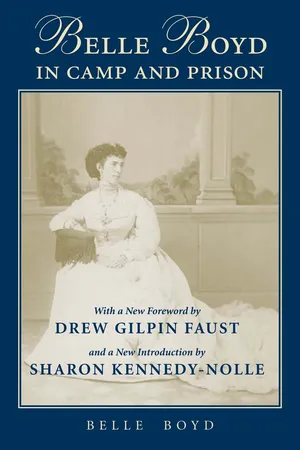
First published in 1865, Belle Boyd's memoir of her experiences as a Confederate spy has stood the test of time and interest. Belle first gained notoriety when she killed a Union soldier in her home in 1861. During the Federal occupations of the Shenandoah Valley, she mingled with the servicemen and, using her feminine wiles, obtained useful information for the Rebel cause.
In this new edition, Kennedy-Nolle and Faust consider the domestic side of the Civil War and also assess the value of Boyd's memoir for social and literary historians in its challenge to our understanding the most divisive years in American history.
- 288 pages
- English
- ePUB (mobile friendly)
- Available on iOS & Android
eBook - ePub
About this book
Information
Bell Boyd
CHAPTER I
MY ENGLISH READERS, WHO love their own hearths and homes so dearly, will pardon an exile if she commences the narrative of her adventures with a brief reminiscence of her far-distant birthplace—
Loved to the last, whatever intervenes
Between us and our childhood’s sympathy,
Which still reverts to what first caught the eye.
Between us and our childhood’s sympathy,
Which still reverts to what first caught the eye.
There is, perhaps, no tract of country in the world more lovely than the Valley of the Shenandoah. There is, or rather, I should say, there was, no prettier or more peaceful little village than Martinsburg, where I was born in 1844.
All those charms with which the fancy of Goldsmith invested the Irish hamlet in the days of its prosperity were realized in my native village. Alas! Martinsburg has met a more cruel fate than that of “sweet Auburn.” The one, at least, still lives in song, and will continue to be a household word as long as the English language shall be spoken: the other was destined to be the first and fairest offering upon the altar of Confederate freedom; but no poet has arisen from her ruins to perpetuate her name.
While America was yet at peace within itself, while the States were yet united, many very beautiful residences were erected in the vicinity of Martinsburg, which may be said to have attained some degree of importance as a town, when the large machinery buildings were raised, at a vast outlay, by the Baltimore and Ohio Railway Company. They were not destined to repay those who designed them.
While they were yet in course of construction, their doom was silently but rapidly approaching. They were destroyed, as the only means of averting their capture by the advancing Yankees, by that undaunted hero, that true apostle of Freedom, “Stonewall” Jackson.
Reader, I must once again revert to my home, which was so soon to be the prey of the spoiler.
Imagine a bright warm sun shining upon a pretty two-storied house, the walls of which are completely hidden by roses and honeysuckle in most luxuriant bloom. At a short distance in front of it flows a broad, clear, rapid stream: around it the silver maples wave their graceful branches in the perfume-laden air of the South.
Even at this distance of time and space, as I write in my dull London lodging, I can hardly restrain my tears when I recall the sweet scene of my early days, such as it was before the unsparing hand of a ruthless enemy had defaced its loveliness. I frequently indulge in a fond soliloquy, and say, or rather think, “Do my English readers ever bestow a thought upon that cruel fate which has overtaken so many of their lineal descendants, whose only crime has been that love of freedom which the Pilgrim Fathers could not leave behind them when they left their island home? Do they bestow any pity, any sympathy, upon us homeless, ruined, exiled Confederates? Do they ever pause to reflect what would be their own feelings if, far and wide throughout their country, the ancestral hall, the farmer’s homestead, and the laborer’s cot were giving shelter to the licentious soldiers of an invader or crackling in incendiary flames? With what emotions would the citizens of London watch the camp-fires of a besieging army?”
Say with what eye along the distant down
Would flying burghers mark the blazing town—
How view the column of ascending flames
Shake his red shadow o’er the startled Thames.
Much has lately been written of the comfort of our Southern home-steads; and now, though so many of them are things of the past, while those that remain are no longer what they were, I may safely say, that not even English homes were more comfortable, in the true sense of the word, than ours; while for hospitality we have never been surpassed.
I passed my childhood as all happy children usually do, petted and caressed by a father and mother, loving and beloved by my brothers and sisters. The peculiarly sad circumstances that attended my father’s death will be found recorded at a future page. Where my mother is hiding her head, I know not: doubtless she is equally ignorant of my fate. My brothers and sisters are dispersed God knows where.
But to return to my narrative. I believe I shall not be contradicted in affirming that nowhere could be found more pleasant society than that of Virginia. In this respect the neighborhood of Martinsburg was remarkably fortunate, populated as it was by some of the best and most respectable families of “the Old Dominion”—respectable, I mean, both in reputation and in point of antiquity—descendants of such ancestors as the Fairfaxes and Warringtons, upon whom Mr. Thackeray has lately conferred immortality.
According to the custom of my country, I was sent at twelve years of age to Mount Washington College, of which Mr. Staley, of whom I cherish a most grateful recollection, was then principal. At sixteen my education was supposed to be completed, and I made my entrée into the world in Washington City with all the high hopes and thoughtless joy natural to my time of life. I did not then dream how soon my youth was to be “blasted with a curse”—the worst that can befall man or woman—the curse of civil war.
Washington is so well known to English people that I need not pause to describe the city, its gayeties and pleasures. In the winter of 1860–1, when I made my first acquaintance with it, the season was preeminently brilliant. The Senate and Congress halls were nightly dignified by the presence of our ablest orators and statesmen; the salons of the wealthy and the talented were filled to overflowing; the theatres were crowded to excess, and for the last time for many years to come the daughters of the North and the South commingled in sisterly love and friendship.
I am inclined to think that at the time of which I speak the City of Washington must have very nearly resembled that of Paris during those few years which immediately preceded 1789, while the elements of a stupendous revolution were yet hidden beneath a tranquil and deceitful surface. Like the Parisians of that memorable epoch, we were wilfully or fatally blind to the signs of the times; we ate and drank, we dined and danced, we went in and came out, we married and were given in marriage, without a thought of the volcano that was seething beneath our feet.
Who can predict what will be the end and issue of our revolution, when we consider that the effects of that which burst forth seventy-five years ago, wrapped all Europe in flames, and hurled kings from their thrones, are even now but partially developed? How many thousands of our sons have fallen in battle, against oppressors who would not confess that our freedom was beyond their power! How many hapless women and children have perished miserably, or been driven forth to beg their bread in foreign countries, before enemies who with heavy hands have sought to rivet our chains—enemies who could not discern the truth of the Irish orator’s memorable axiom, and acknowledge that the genius of liberty is universal and irresistible!
CHAPTER II
THE GAYETIES OF WASHINGton, to which I alluded in my first chapter, were soon eclipsed by the clouds that gathered in the political horizon.
The contest for the Presidentship was over, and the men of the South could no longer hide it from themselves, that the issue of the struggle must determine their fate.
The secession of the Southern States, individually or in the aggregate, was the certain consequence of Mr. Lincoln’s election. His accession to a power supreme and almost unparalleled was an unequivocal declaration, by the merchants of New England, that they had resolved to exclude the landed proprietors of the South from all participation in the legislation of their common country.
I will not attempt to defend the institution of slavery, the very name of which is abhorred in England; but it will be admitted that the emancipation of the negro was not the object of Northern ambition; that is, of the faction which grasps exclusive power in contempt of general rights. Slavery, like all other imperfect forms of society, will have its day; but the time for its final extinction in the Confederate States of America has not yet arrived. Can it be urged that a race which prefers servitude to freedom has reached that adolescent period of existence which fits it for the latter condition? Meanwhile, which stands in the better position, the helot of the South, or the “free” negro of the North—the willing slave of a Confederate master, or the reluctant victim of Federal conscription?
And here I must take leave to ask a question of two great authors, both formerly advocates of an instantaneous abolition of slavery. Is the ghost of Uncle Tom laid? Has the slave dreamed his last dream? Will Mrs. H. B. Stowe and Mr. Longfellow admit that in either instance the hero owes his reputation for martydom to a creative genius and to an exquisite fancy? or will they still contend that the negro slave of the Confederate States is, physically and morally, a real object of commiseration?
The first champion of freedom—I speak advisedly, and in defiance of a seeming paradox—was South Carolina. She was a slaveholding State, but she flung down the gauntlet in the name and for the cause of liberty. Her bold example was soon followed; State after State seceded, and the Union was dissolved. It was now that we heard of the fall of Fort Sumter and Mr. Lincoln’s demand upon the State of Virginia. He called upon her to furnish her quota of 75,000 recruits, to engage in battle with her sister States. He sowed the dragon’s teeth, and he soon reaped the only harvest that could spring from such seed.
Virginia promptly answered to the call, and produced the required soldiers; but they did not rally under the Stars and Stripes. It was to the Stars and Bars, the emblem of the South, that Mr. Lincoln’s Virginia soldiers tendered the oath of military allegiance. The flag of the once loved, but now dishonored Union, was lowered, and the colors of the Confederacy were raised in its place.
Since that memorable epoch, those colors have been baptized with the blood of thousands, to whose death, in a cause so righteous, the honor and reverence that wait upon martyrdom have been justly awarded:
Oh, if there be in this earthly sphere
A boon, an offering, Heaven holds dear,
It is the libation that Liberty draws
From the heart that bleeds and breaks in her cause.
The enthusiasm of the enlistment was adequate to the occasion. Old men, with gray hairs and stooping forms, young boys, just able to shoulder a musket, strong and weak, rich and poor, rallied round our new standard, actuated by a stern sense of duty, and eager for death or victory. It was at this exciting crisis that I returned to Martinsburg; and, oh! what a striking contrast my native village presented to the scenes I had just left behind me at Washington! My winter had been cheered by every kind of amusement and every form of pleasure: my summer was about to be darkened by constant anxiety and heart-rending affliction.
My father was one of the first to volunteer. He was offered that grade in the army to which his social position entitled him; but, like many of our Virginian gentlemen, he preferred to enlist in the ranks, thereby leaving the pay and emoluments of an officer’s commission to some other, whose means were not so ample, and whose family might be straitened in his absence from home, an absence that must, of course, interfere with his avocation or profession.
The 2nd Virginian was the regiment to which my father attached himself. It was armed and equipped by means of a subscription raised by myself and other ladies of the Valley. On the colors were inscribed these words, so full of pathos and inspiration:
Our God, our country, and our women.
The corps was commanded by Colonel Nadenbush, and belonged to that section of the Southern army afterwards known as “the Stonewall Brigade.” “The Stonewall Brigade!”—the very name now bears with it traditions of surpassing glory; and I seize this opportunity of assuring English readers that it is with pride we Confederates acknowledge that our heroes caught their inspiration from the example of their English ancestors. When our descendants shall read the story of General Jackson and his men, they will be insensibly attracted to those earlier pages of history which record the exploits of Wellington’s Light Division.
My father’s regiment was hardly formed when it was ordered to Harper’s Ferry; for the sacred soil of Virginia was threatened with invasion, and it was thought possible to make a stand at this lovely spot, to see which is “worth a voyage across the Atlantic.” At the outbreak of the war Harper’s Ferry could boast of one of the largest and best arsenals in America, and of a magnificent bridge, which latter, spanning the broad stream of the Potomac, connected Maryland with Virginia. Both arsenal and bridge were blown up in July, 1861, by the Confederate forces, when the Federals, pressing upon them in overwhelming numbers, compelled a retreat.
My home had now become desolate and lonely: the excitement caused by our exertions to equip our father for the field had ceased, and the reaction of feeling had set in. A general sadness and depression prevailed throughout our household. My mother’s face began to wear an anxious, careworn expression. Our nights were not passed in sleep, but in thinking painfully of the loved one who was exposed to the dangers and privations of war.
My mother, the daughter of an old officer, was left an orphan when very young; she had married my father just as she entered upon her sixteenth year; and now, almost for the first time, they were parted, under circumstances which made the separation bitter indeed. For myself, I endeavored to while away the long hours of those summer days by the aid of my books, and in making up different kinds of portable provisions for the use of my father, to whom I knew they would, in his novel position, be a luxury.
But, notwithstanding all the restrictions I laid upon myself, and all the self-control I endeavored to exert, I soon found these employments too tame and monotonous to satisfy my temperament, and I made up my mind to pay a visit to the camp, coûte qui coûte. I had no difficulty in prevailing upon some of my friends to accompany me in an expedition to head-quarters. Like myself, they had friends and relations to whom they felt their occasional presence would be a source of encouragement and solace; and we all knew that such a goodly company as we formed could return safely to Martinsburg at almost any hour of the day or night.
The camp at Harper’s Ferry was at this time an animated scene. Officers and men were as gay and joyous as though no bloody strife awaited them. The ladies, married and single, in the society of husbands, brothers, sons, and lovers, cast their cares to the winds, and seemed, one and all, resolved that whatever calamity the future might have in store for them, it should not mar the transient pleasures of the hour. Since then I have had occasion to observe that such a state of feeling is not unnatural or unusual in the minds of men standing, as it were, on the brink of a precipice, or walking, as it were, over the surface of a mine. “Perils commonly ask to be paid in pleasures,” and the payment is doubly sweet when it is taken in anticipation of the debt.
I fear that at this time many fond vows were exchanged and many true hearts pledged between the girls of the neighborhood and the occupants of the camp; but it may be pardoned to beauty and innocence if they are not insensible to the virtues of courage and patriotism.
A true woman always loves a real soldier. In the earliest ages poets and philosophers foretold that the Goddess of Love and Beauty would ever move in the same orbit and in close conjunction with the God of Battles, and the experience of ages has confirmed the judgment of antiquity. Alas! the loves of Harper’s Ferry were in but too many instances buried in a bloody grave. The soldier who plighted his faith to his ladylove was not tried in a long probation, but canonized by an early death. War will exact its victims of both sexes, and claims the hearts of women no less than the bodies of men.
To return from this digression. Our insouciance was not of long duration. The advance of a Federal army was reported; and General Jackson, with a force amounting to five thousand men, marched out to reconnoitre, and, if possible, to check their aggressive movement. Our people encamped at “Falling Waters,” a romantic spot, eight miles from Martinsburg and four from Williamsport; for at this point of the river, it was rumored, the Yankees had resolved to force a passage.
It was early in the morning of the 3d July that we “gude folks” of dear Martinsburg were startled by the roar of artillery and the rattle of musketry; and the intelligence was presently circulated that the Yankees were advancing upon us in force, under the command of Generals Patterson and Cadwallader. It turned out, however, that, at the moment of which I speak, their advanced guard only was in motion; but the skirmish between our people and the enemy was sustained during nearly five hours. On both sides some fell, and besides the casualties of the Federals in killed and wounded, we took about fifty of them prisoners.
About ten o’clock, General Jackson’s army, in admirable array, marched through Martinsburg. They were in full retreat, their object being to effect a junction with the main body, under General J. E. Johnston, who had evacuated Harper’s Ferry, and was falling back, by way of Charlestown, upon Winchester.
Jackson’s retreat was covered by a few horsemen under the gallant Colonel Ashby; and scarcely were these latter disengaged from the stre...
Table of contents
- Cover
- Title Page
- Copyright Page
- Contents
- Foreword
- Introduction to the 1998 Edition
- Introduction by A Friend of the South
- Chapter I
- Chapter II
- Chapter III
- Chapter IV
- Chapter V
- Chapter VI
- Chapter VII
- Chapter VIII
- Chapter IX
- Chapter X
- Chapter XI
- Chapter XII
- Chapter XIII
- Chapter XIV
- Chapter XV
- Chapter XVI
- Chapter XVII
- Chapter XVIII
- Chapter XIX
- Chapter XX
- Chapter XXI
- Chapter XXII
- Chapter XXIII
- Chapter XXIV
- Chapter XXV
- Chapter XXVI
- Chapter XXVII
- Chapter XXVIII
- Index
Trusted by 375,005 students
Access to over 1.5 million titles for a fair monthly price.
Study more efficiently using our study tools.
Frequently asked questions
Yes, you can cancel anytime from the Subscription tab in your account settings on the Perlego website. Your subscription will stay active until the end of your current billing period. Learn how to cancel your subscription
No, books cannot be downloaded as external files, such as PDFs, for use outside of Perlego. However, you can download books within the Perlego app for offline reading on mobile or tablet. Learn how to download books offline
Perlego offers two plans: Essential and Complete
- Essential is ideal for learners and professionals who enjoy exploring a wide range of subjects. Access the Essential Library with 800,000+ trusted titles and best-sellers across business, personal growth, and the humanities. Includes unlimited reading time and Standard Read Aloud voice.
- Complete: Perfect for advanced learners and researchers needing full, unrestricted access. Unlock 1.5M+ books across hundreds of subjects, including academic and specialized titles. The Complete Plan also includes advanced features like Premium Read Aloud and Research Assistant.
We are an online textbook subscription service, where you can get access to an entire online library for less than the price of a single book per month. With over 1.5 million books across 990+ topics, we’ve got you covered! Learn about our mission
Look out for the read-aloud symbol on your next book to see if you can listen to it. The read-aloud tool reads text aloud for you, highlighting the text as it is being read. You can pause it, speed it up and slow it down. Learn more about Read Aloud
Yes! You can use the Perlego app on both iOS and Android devices to read anytime, anywhere — even offline. Perfect for commutes or when you’re on the go.
Please note we cannot support devices running on iOS 13 and Android 7 or earlier. Learn more about using the app
Please note we cannot support devices running on iOS 13 and Android 7 or earlier. Learn more about using the app
Yes, you can access Belle Boyd in Camp and Prison by Belle Boyd in PDF and/or ePUB format, as well as other popular books in History & American Civil War History. We have over 1.5 million books available in our catalogue for you to explore.