![]()
CHAPTER 1
INTRODUCTION
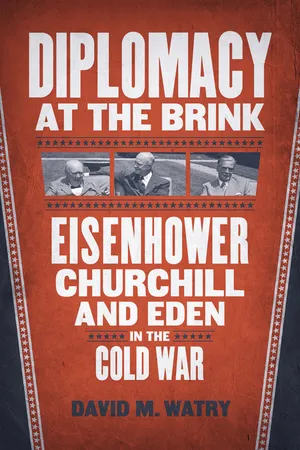
Few historians have discussed the significant differences among Dwight D. Eisenhower, Winston Churchill, and Anthony Eden during the Cold War. John Lukacs, an eminent Hungarian-born American historian well known for his admiration of Winston Churchill, observed that “in none of the numerous biographies of Eisenhower is there a substantial description of how this seemingly simple (though in reality rather complex) military man, with his easygoing and liberal reputation, shed his pro-Russian and sometimes pro-Democratic opinions to become a rigid anti-Communist, a Republican, and eventually even a self-styled conservative.” Lukacs’s analysis is insightful. Eisenhower did shed his pro-Russian and pro-Democratic opinions, and his eventual transformation to a right-wing ideologue, particularly in foreign affairs, can only be fully understood in the context of his transatlantic relationships with Churchill and Eden.1
In studying the relationship between Eisenhower and Churchill, one can easily see the tremendous ideological differences between them in dealing with the many international crises of the 1950s. During the Cold War, the roles of Eisenhower and Churchill essentially reversed from what they had been during the Second World War. Eisenhower no longer reported to Churchill; now Churchill reported to him. Eisenhower advocated a hard line on the Soviet Union, while Churchill advocated a détente with the Soviet Union, a complete reversal of their positions at the end of the Second World War. Eisenhower’s new conservatism rejected détente and called for the rollback of Communism throughout the world. U.S. foreign policy turned out to be diametrically opposed to Churchill’s foreign policy of détente. The United States and Great Britain could no longer count on each other for mutual support in foreign affairs. Eisenhower firmly rejected Churchill’s call for a grand and global Anglo-American alliance. Promised collective security through the North Atlantic Treaty Organization (NATO) and the Southeast Asia Treaty Organization (SEATO) broke down under the heavy weight of the ideological differences between them.
The “special relationship” between the United States and Great Britain continually deteriorated throughout Eisenhower’s first administration. Differing visions of the Communist threat in Korea, Indochina, and Quemoy and Matsu led to a fracturing of the transatlantic alliance. Cognizant of the problems of British and French colonialism, Eisenhower decided on a policy of anti-Communism and anticolonialism in the Far East, North Africa, and the Middle East. He deliberately put his policies of anti-Communism and anticolonialism ahead of helping Western allies in his global fight against Communism. Ironically, this split in the transatlantic alliance undoubtedly benefited the Soviet Union.
Shaking up the political and military establishment in Washington by rejecting Paul Nitze’s National Security Council Paper 68 (NSC-68), Eisenhower opposed a massive buildup of the U.S. military because it placed far too heavy a financial burden on the United States. He quickly moved to replace it with the more economical “New Look” defense policy, intended to assure the military and the public “more bang for the buck.” George F. Kennan’s reactive containment policy led to a disastrous and hugely unpopular stalemate in Korea. Eisenhower scrapped Kennan’s policy in favor of a far more ambitious and risky but potentially more successful policy of “brinksmanship.” Eisenhower worried about perceptions of the United States losing or retreating in the Cold War, while Churchill sought to negotiate with the Communists in deals that might prove to be mutually beneficial.2
Unlike President Harry Truman, who had lectured about the need to save the United States from Communism, Eisenhower discoursed about the “long-term” needs of the United States and about saving “the American way of life.” Furthermore, he understood the vital importance of maintaining the health of the economy in providing for an essential military defense. Truman’s inert and torpid foreign policy in his second term had too often relied on standard military strategies. Eisenhower preferred a nuanced, pro-active, covert, and even “hidden hand” foreign policy in order to defeat the Communists by outplaying them at their own subversive game.3
This new brand of Republican foreign policy resurrected the “Old Right” ideas of General Douglas MacArthur, Senator Robert A. Taft, and former president Herbert Hoover. Eisenhower’s political advisers, who in the 1960s often wrote admiringly of MacArthur’s military plan to end the Korean War, stand in stark contrast to the historians of the 1970s, 1980s, and 1990s, who have all but ignored MacArthur or gone so far as to trivialize his nuclear threats to end the Korean War. Yet, a close reading of Eisenhower’s memoirs and his National Security Council meetings in the first term shows the powerful influence of MacArthur’s military thinking on him, particularly when he faced a myriad of military problems in the Far East.4
The former isolationist Senator Robert A. Taft of Ohio also encouraged Eisenhower to adopt an extreme right-wing global foreign policy. He now argued against American isolationism in favor of a policy based in part on the nineteenth-century beliefs of Admiral Alfred Thayer Mahan. Taft’s and Mahan’s ideas would become the basis of Eisenhower’s New Look, with military emphasis on the air force and the navy over army ground troops. Taft strove to reduce military expenditures, exemplified by large numbers of American ground troops in Europe, while at the same time expanding the power and scope of the American military, specifically through the strategic use of the navy, air force, and atomic power. Eisenhower and Taft had previously disagreed on the importance of collective security agreements, the main reason for Eisenhower’s candidacy for the Republican nomination in 1952. After the election, however, he dramatically adopted Taft’s ideas about U.S. foreign relations, as written into the Republican platform by John Foster Dulles. The Republican platform, with its underlying unilateralism, harkened back to the nineteenth century, which would ultimately undermine and destroy the “special relationship.”5
A fervent supporter of Robert Taft in 1952, former President Herbert Hoover called for the United States to implement a “Gibraltar” defense of the Western Hemisphere. Eisenhower’s actions in Guatemala in 1954, and later in Cuba, demonstrated his serious disregard for international laws, organizations, and especially Western allies whenever he perceived a Communist threat in the Western Hemisphere. Eisenhower, like Theodore Roosevelt, acted as the policeman of the Western Hemisphere. The influence of conservative Republicans on hemispheric defense can most readily be seen in Guatemala, where he moved swiftly and unilaterally to overthrow the government of Jacobo Arbenz despite British objections to his covert plans. Nevertheless, Eisenhower fully expected Churchill and Eden to help him quash a UN investigation of his illegal activities in overthrowing the democratically elected Arbenz.6
Secretary of State John Foster Dulles deserves special recognition for orchestrating Eisenhower’s very deceptive foreign policy. His many speeches demonstrated his credentials and his influence as a hard-core cold warrior in the battle against Communism, even as his critics maintained that he offered few or very simple solutions to highly complex global problems. In his own article in Life, entitled “A Policy of Boldness,” Dulles proposed that American foreign policy should be active rather than reactive. He endorsed the liberation of the satellite countries and the rollback of Communism in Eastern Europe. Dulles backed a new strategy to attack the Communist threat that included the possibility of “massive retaliation.”7
Many American historians have disapproved of Dulles because of the huge gulf between his idealistic speeches and his actual policies. Still, they have admired Eisenhower for avoiding unnecessary military action. Historian Robert A. Divine contended, “Yet in the aftermath of Vietnam, it can be argued that a president who avoids hasty military action and refrains from extensive involvement in the internal affairs of other nations deserves praise rather than scorn.” He has completely misconstrued the Eisenhower years. Eisenhower not only engaged in numerous covert military actions and threats, but he was also heavily involved in manipulating the internal affairs of other nations, both hostile and friendly.8
A closer review of the archival record makes abundantly clear that Eisenhower and Dulles worked as a team while promoting a profoundly far-right Republican foreign policy agenda that did directly interfere in the internal affairs of other nations. The two men regularly conferred on the possible use of nuclear weapons in Korea, Indochina, and on the Chinese mainland. In Operation Everready, they plotted with Churchill a possible military ouster of Syngman Rhee in South Korea, shortly before the North Korean government signed an armistice. They actively sustained the highly unpopular and authoritarian Diem regime in South Vietnam. Eisenhower and Dulles, through the CIA, aggressively arranged the overthrow of Prime Minister Mohammed Mossadegh in Iran and President Jacobo Arbenz in Guatemala. They also planned covert political and military operations against Communist-influenced governments in Egypt and Syria. They not only initiated the overthrow of hostile dictators, but together they also swayed the internal affairs of Western allies. The president and secretary of state covertly supported those members of the British cabinet, such as Harold Macmillan and R. A. Butler, who sought Anthony Eden’s removal as prime minister in 1956. This powerful and ideologically driven U.S. diplomacy could never be made compatible with Britain’s balance-of-power diplomacy.9
British historian John Charmley has correctly asserted that British and American national interests diverged greatly in the 1950s. He maintained that Churchill’s subservience to the United States actually caused serious harm to British interests. Nonetheless, it would be Eden’s lack of subservience to the United States that would eventually lead to the complete unraveling of the British Empire, particularly in the Middle East. The great harm to British interests would occur, for the most part, under Eden and his successors. Churchill sought accommodation with Eisenhower, which became increasingly difficult with the growing ideological differences and the diverging national interests. He had hoped for “détente” with the new Soviet leadership after Stalin’s death, while Eisenhower saw the new Soviet leadership, guided by the same Communist ideology, as differing little from Stalin’s leadership. Churchill believed in personal diplomacy and the power of summits to create new agendas. He also defended the concept of colonialism, insisting it had helped civilize and democratize Third World countries. This put Churchill in direct conflict with Eisenhower, who promoted national independence movements.10
Unlike Eden, Churchill understood Great Britain’s growing economic weakness in its relation to the United States. This recognition of financial frailty severely handicapped British diplomatic initiatives throughout his premiership. British historian Alan P. Dobson contended that the special economic relationship between America and the United Kingdom began deteriorating as early as 1952, while Robin Edmonds asserted that mutual hostility toward the Soviet Union guaranteed the continuance of the “special relationship.” Nevertheless, this relationship radically deteriorated in 1952 with the election of Eisenhower, who purposely demoted the Anglo-American alliance and completely rebuffed Churchill’s proposal of a grand alliance.11
Military considerations also played an important role in the transatlantic alliance. Helen Leigh-Phippard looked closely at the importance of military aid in defining the relationship between the United States and Great Britain. She thought the “special relationship” between the two countries really began collapsing with the end of the Korean War. Similarly, British historian R. B. Manderson-Jones has examined the importance of the political, economic, and military differences between the Americans and the British on the future of western Europe. The minor differences in Europe proved far less important than the momentous differences between the two countries in the Middle East and the Far East. In the 1980s, Fraser J. Harbutt carefully scrutinized the importance of Churchill’s Iron Curtain speech as a cause of the Cold War and explained how Churchill alerted America to the growing Soviet threat. Timothy J. Botti concluded that the nuclear arms relationship between the Americans and British evolved slowly and painfully, eventually leading to a full partnership. In spite of these detailed analyses, it remains quite clear that the British in the 1950s moved from being an equal partner to a junior partner in the Anglo-American relationship.12
Great Britain’s political, economic, and military power around the world slowly dissipated in the early 1950s. Historian Chi-Kwan Mark has perceptively asserted that “Britain’s Cold War strategy was predicated on its postwar military and economic weaknesses, so that diplomacy would be the main instrument to preserve its influence in great power status in the world.” Britain’s policy toward China revolved around defending its vital interests in Hong Kong. The British incessantly urged military restraint with regard to China. The United States used Hong Kong as an intelligence base but did not consider it essential in fighting the Cold War. Nevertheless, Churchill and Eden took every opportunity to avoid any possibility of war with China.13
The Middle East in the early 1950s stood largely as a British sphere of influence. Great Britain, more than any other Western country, protected Arab nations from Soviet subversion through the Baghdad Pact signed in 1955. Eden’s justification for the British invasion of Egypt in 1956 rested on his deep-seated conviction that Nasser was a Soviet agent. In his biography of Eden, David Dutton summarized his entire career in reference to Egypt: “The ghost of Suez was still stalking Eden as he was getting ready for the end and wondering about the verdict of history. In his mind his whole proud career had been scarred by a decision which misfired for a lack of American co-operation.” This astonishing analysis concerned an experienced politician who had been told rather bluntly by Eisenhower that the United States would not support a British military invasion of Suez.14
Over time, Eisenhower and Dulles became more and more critical of British diplomacy, particularly as Prime Minister Eden executed it. Dutton further explained: “The Secretary [Dulles] was convinced that the British throughout the world were a rapidly declining power. He was convinced they no longer had any basic will to meet big international responsibilities, that they were trying to put as good a face on it as possible, but that you could not count on the British to carry on in any responsible way, or, indeed, form an effective bulwark with us against anything.” American policy makers constantly voiced their concerns and fears about the reliability of their British allies in combating the real dangers of Communism in the Middle East.15
Moreover, Eisenhower fiercely campaigned against British and French colonialism in northern Africa and the Middle East. He defended a new and growing nationalism and anticolonialism in the Middle East and Africa as a safeguard against any possible inroads by the Soviets. The internal political strife of the Middle East led sadly to the complete unraveling of the transatlantic alliance. The Soviets gradually gained tremendous influence in Egypt and Syria. The growing American and British rift over colonialism actually encouraged further Soviet subversion in the Middle East.16
On the crisis in Suez, Alan P. Dobson wrote: “When the shooting started several things determined Eisenhower’s response. He was angry that he had not been consulted and that the invasion took place on the eve of the US presidential election. He feared this type of gunboat diplomacy would tarnish the US reputation in the Third World unless he came out against it.” Eisenhower not only did not like the timing of the British invasion of Suez, but he also felt personally double-crossed by Eden. Eden failed to anticipate or understand Eisenhower’s cold-blooded hostility to British military action in Egypt.17
In a stunning response to the British military invasion of Suez, President Eisenhower forced a sterling crisis on Great Britain, which led to the cancellation of their invasion of Egypt. He used Britain’s internal economic and monetary weakness to crush British and French military adventurism in the Suez. Now it was Eden who felt betrayed. His chancellor of the Exchequer, Harold Macmillan, begged for help from the United States to stop the sterling crisis and avert a British economic catastrophe: “In the meantime it would be tragic and as I have said, a major victory for the communists—if we were to allow what has happened to result in an economic disaster for the free world. We can prevent it, but only if we act together and act speedily. That is why I most earnestly ask your help.” Ei...