- 266 pages
- English
- ePUB (mobile friendly)
- Available on iOS & Android
eBook - ePub
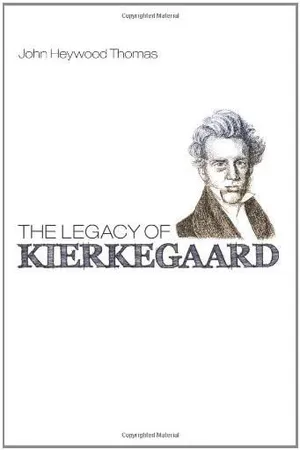
The Legacy of Kierkegaard
About this book
John Heywood Thomas was probably the earliest twentieth-century British scholar to study Kierkegaard's texts. Here he offers, as the fruit of a lifetime's devotion to that study, what Kierkegaard would call a "fragment"--a little of what needs to be said about the legacy of this radical Danish writer, philosopher, and theologian.
This book, based on lectures given at the University of Calgary, seeks to explore different aspects of Kierkegaard's work in its original context and its legacy. Chapters include studies on Kierkegaard the writer (located within the history and development of European literature and nineteenth-century aesthetic theory) and Kierkegaard the philosopher (understood within the context of the development of philosophy in the first quarter of the nineteenth century). Also, since he always described himself as a religious thinker, Kierkegaard's view of religion is explored and in particular his attitude to the possibility of Christianity without the confines of an established church. Because Kierkegaard's philosophy is never separate from his religious thinking, Heywood Thomas also offers studies on the issues of metaphysics in Kierkegaard--its relation to theology, the scope of reason, the problem of time, and the meaning of death. Finally, to appreciate Kierkegaard as a man of his time as well as a "man for all seasons," his views on education are considered.
Information
Topic
PhilosophySubtopic
Ethics & Moral Philosophy1
Kierkegaard: The Problem
An Autobiographical Statement
It is perhaps appropriate to begin a study of Kierkegaard with an autobiographical statement; for of all authors, Romantics and others, he was the master of the art of using autobiography. He scandalized his contemporaries by making such intimacies of biography as his courtship and engagement the basis of a thinly-disguised novelette. Lampooned by The Corsair, a magazine that is often described as scurrilous but is perhaps more accurately described as the Private Eye of its day and the radical press of its time, he showed the versatility of his literary skill and the acuity of his sociological perception, not to mention his great courage, by engaging in battle with the satirist. Himself a satirist of power with a scholarly understanding of irony, he became increasingly serious and steadfast in his purpose, which he understood to be part of his religious mission, to be “a spy in higher service,” a religious exception. My autobiographical statement is meant simply to describe the origin, persistence, and nature of my fascination with Kierkegaard.
I was born and brought up in South Wales, one of a family which on both sides had been associated with and indeed played a prominent part in the history of Welsh dissent. Naturally, therefore, my early religious life was in the context of the Congregational chapel of which my parents were members. Welsh Congregationalism perpetuated the old name of the denomination—the Independents; and independence indeed was the character of that spiritual formation which I was given. I was early taught not only the crucial importance of personal piety but also the religious responsibility of intellectual convictions and understanding. It is difficult for me to over-estimate the influence on me of the community where devout souls argued passionately about matters of faith, displaying as much sturdiness of intellect as they did conviction. By far the most significant figure was the minister who reigned supreme in his pulpit and was in fact my only minister until I was an undergraduate. In his beautiful book, Wales, Edward Thomas describes a minister dominating a chapel and a village but he was, in fact, rather a weak character whose power of dominance seemed to be confined to the pulpit and his oratorical performance. The character of whom I speak was very different. He was an extraordinary man of remarkable and commanding presence who was particularly impressive because of his very obvious and profound spirituality and the force of his great integrity. A stern man, he was perhaps more respected than loved and even friends would say of him that but for the grace of God he would have been a very hard man. The word “Puritan” is often used with varying degrees of the looseness that characterizes the use of such words generally nowadays, but of John Evans it is not only used correctly but is the most apt description of him. Together with the Puritan emphasis on the Bible and on the work of the Holy Spirit in effecting the communion that marks the church, his theology was also marked by a very strong antipathy towards Liberalism. Long before I ever saw the classic work of R. J. Campbell, The New Theology, I had heard of it as a travesty of Christian theology. Equally repugnant to this minister was the older and more persistent form of Liberalism as a critical modernism. There was, then, about him a very strange anti-intellectualism—stranger indeed this seemed to me as in my teens I used to visit him in his large study, the walls of which were completely covered with shelved books. In his way he was a learned man and yet his sermons were regular condemnations of the pride of learning and the errors of those who, he would say, with his voice rising in tones of scorn, “describe themselves so proudly as ‘we critics.’” That anyone thus presumed to set himself up as a critic of the Word of God was not only anathema to him—it was to be roundly condemned lest people be led astray. Only one book did this mentor and faithful pastor ever give me to read and that was Kierkegaard’s Training in Christianity. That alone would have made the book special but it was Kierkegaard rather than John Evans who really impressed me as I read. A lad of seventeen, I had already benefitted from the wide classical education of the grammar school and I had been familiarized with the legacy of Greece and Rome and introduced to the breadth of European literature, but I had never read prose like this. The rhetoric was spellbinding and the elaboration of paradoxes into clearly developed and strongly sustained theological argument was simply fascinating. Fascinated I was and I could not stop reading. I was then reading philosophy and I scoured the university library to find what I could. There was hardly anything of Kierkegaard’s writing and what secondary material was to be found was even more disappointing. It would seem that Kierkegaard was not a figure to be taken seriously as a philosopher.
Shortly afterwards I had the very good fortune to make the acquaintance of and become friendly with another extraordinary man, J. M. Lloyd Thomas. He had been a very successful solicitor who had displayed great skill as a counsellor and so had decided to become a minister. Having been the renowned minister of the Old Meeting House in Birmingham, he had suddenly retired from public life. His retirement had been occasioned by the development of the Unitarian denomination, a name he deemed to be as misleading as it was heretical. He had become one of the leading figures in the Reunion movement associated especially with the idea of a Free Catholic Church. He had debated with Chesterton, had been a friend of Baron von Hugel and Professor Norman Kemp Smith as well as the intimate counsellor of Father Orchard. In the depths of rural Wales, whither he had retired, he pursued his literary and theological interests by contributing articles and reviews to The Hibbert Journal, which at that time was still edited by his friend L. P. Jacks. This indefatigable writer was one of the first to herald the vogue that Kierkegaard was about to enjoy in English letters during the fifties. Though he was aware of Kierkegaard’s philosophical interests, for Lloyd Thomas Kierkegaard was first and foremost a religious thinker and indeed a prophet. To quote a bon mot from one of his letters to me—
“I came to survey Kierkegaard but instead he has looked at me and left me a bundle of rags on my own doorstep.” Yet he was sufficiently alive to the intellectual nature of this writing to show me that the philosophy was in the service of faith and indeed a means of articulating that faith.
“I came to survey Kierkegaard but instead he has looked at me and left me a bundle of rags on my own doorstep.” Yet he was sufficiently alive to the intellectual nature of this writing to show me that the philosophy was in the service of faith and indeed a means of articulating that faith.
The fashion of the fifties died the death of fashions but I had discovered what was to be a lifelong area of research as I became convinced that the fundamental problems of philosophy of Religion were not only raised here in the clearest fashion but illuminated too by a most subtle thinker as a matter of religious duty. There have been times when I have felt him to be uncomfortably like the Ancient Mariner’s albatross as I have never been able to leave him on one side. Other interests have occupied me but they always seemed to lead back to him. I have been irritated by his cleverness and his almost deliberate obscurity and yet I have not been able to dismiss the thought as either opaque or trivial. The truth is that he haunts me as a challenge on more than one level but not least the intellectual level. More and more he seems to me an enigma. Having seen the death of a fashion, I later saw a fresh surge of interest in Kierkegaard study in the eighties, which has developed our knowledge and understanding of Kierkegaard’s work quite dramatically. Despite this I describe Kierkegaard as a problem.
Kierkegaard as a Problem
That fresh surge of interest in Kierkegaard resulted in several important books—too great a number for any brief account of them to be useful; but some three themes can be picked out which help clarify what I mean.
Kierkegaard and Wittgenstein
First, there has been a good deal of interest on the part of some philosophers of religion in Kierkegaard’s influence on Wittgenstein. We know that Wittgenstein found Kierkegaard interesting and illuminating and it might even be said that he admired Kierkegaard. As a research student in Cambridge I had the good fortune to be supervised for two terms by Wittgenstein’s pupil, the late G. H. von Wright, who once remarked to me that he was never very sure what it was that Wittgenstein found so interesting in Kierkegaard. However, the fact of the influence is undeniable and this has led some authors to interpret Kierkegaard in the light of Wittgenstein’s philosophy and to view his thought as an anticipation of those theories of metaphysics and religion which they take to have been established by Wittgenstein. To some extent I shared this tendency, as my own interpretation of Kierkegaard’s philosophy of religion drew a comparison between it and the approach of linguistic analysis, but I neither argued for any connection between them or between Kierkegaard’s and Wittgenstein’s philosophy of religion nor defined either of them as some kind of fideism. However, after Malcolm’s memoir of Wittgenstein the connection became a commonplace among historians of philosophy and there was an occasional study of Wittgenstein’s debt to Kierkegaard.1 It was left to philosophers like Peter Winch and most notably D. Z. Phillips to develop the philosophical position and approach that have been labeled “fideism.”
In his first book, The Concept of Prayer, Phillips heralded the dominant theme of his work—that philosophy of religion was based on a mistake when it was engaged in the search for evidence to support religious assertions. For the religious man to seek empirical results which could be thought to verify his prayer is, in Phillips’ view, for him to lapse into superstition. The essential task, he says, is to look at a particular piece of language and elicit from it the rules of the particular language-game it represents. This way of doing philosophy cannot be first described in the abstract and then applied to concrete problems—it is a matter of examining those problems themselves philosophically but viewing them from the inside. Philosophy of religion will make progress, he thinks, only when it recognizes that to raise the question of the reality of God is not quite the same as discussing other reality claims; God’s reality is his divinity. Talk about God is not part and parcel of so much ordinary language as is talk about the material world. God’s reality or existence is not a fact but part of that language-game which is my worshipping, praying, believing, obeying, and loving. It is instantly clear how Phillips came to see Kierkegaard as an ally and a guide in philosophy of religion. That attraction and inspiration I well understand and applaud. My point here is that if this is meant to be an exposition of Kierkegaard’s thought then the interpretation is an extremely complex piece of hermeneutics. For it is one thing to argue, as I had done, that linguistic analysis is a very useful heuristic method to apply to Kierkegaard’s philosophy but quite another to identify that with a particular philosophical position based on or exemplifying that method. For instance, the normal methods of historical investigation and explanation, which would involve the contextualization of Kierkegaard within the European culture of the nineteenth century, would seem of little use or relevance. What must certainly follow from such an interpretation is that it is quite wrong to see Kierkegaard as involved in a religious struggle which was concerned to uphold orthodox doctrine. Whether or not one comes to think that he was mistaken in this understanding of his task is neither here nor there; the fact is that this is the first and immediate impression his work makes and one of which he leaves us in no doubt. I emphasize my point that we are not here concerned with the question whether this kind of approach to Kierkegaard is right but rather with the way in which the possibility of such an approach resulting in this kind of interpretation shows the problem of Kierkegaard. His philosophy and his theology are clearly not separate concerns. Moreover, they are far from straightforward in the way that, however difficult the philosophy of, say, Spinoza or the theology of Calvin may be, we have in them thought-creations that are not elusive.
Understanding Kierkegaard on His Own Terms
Slightly different, though he too was later much influenced by Wittgenstein’s thought, is the approach of Paul Holmer. It is more useful to look at his exposition of an approach—without reference to the later application of Wittgenstein’s philosophy—to the problems of theology. In a celebrated paper, “On Understanding Kierkegaard,” Holmer calls attention to the irony of there being such an immense volume of scholarship on the writings of Kierkegaard which seems “systematically oblivious to the peculiarities” of those writings and equally to Kierkegaard’s own comments on them. The paper calls into question the very presuppositions of historical scholarship in connection with Kierkegaard’s writing and indeed turns Kierkegaard’s thought back on its interpreters. I am being neither facetious nor dismissive when I say that this kind of approach would make us aware of the canon of Kierkegaard’s writings and pleads for the freedom of that “word” to speak to us and to our condition. My purpose in so describing this approach is to show that the strength of Holmer’s position lies precisely in his determination to let Kierkegaard be what he himself said he was from the beginning, namely, a religious writer. Holmer’s starting point is the insistence on the incontrovertible fact that Kierkegaard “presupposed a theory of knowledge which is novel and intrinsically significant.”2 Kierkegaard’s quarrel, he says, is not with scholarship as such but with a kind of metaphysics of knowledge, “a quasi-argument which says that all knowledge has a unity and a meaning in totality which no single knowledge-claim has apart from the rest.”3 The scholar’s “understanding” of an author’s writings which is a matter of exhausting the possible knowledge about the author is mythical, “an invented and contrived aim,” usually defined as qualitatively different from “understanding” any particular truth-claims regarding the author or any of his works. When Kierkegaard distinguished so clearly and sharply between logic and existence it was such ...
Table of contents
- Title Page
- Acknowledgments
- Chapter 1: Kierkegaard: The Problem
- Chapter 2: Kierkegaard and Literature
- Chapter 3: Hegelian Aesthetic and Kierkegaard’s Literary Art
- Chapter 4: Kierkegaard and Philosophy (i)
- Chapter 5: Kierkegaard and Philosophy (ii)
- Chapter 6: Kierkegaard and Religion (i)
- Chapter 7: Kierkegaard and Religion (ii)
- Chapter 8: Kierkegaard on Revelation, Knowledge, and Proof
- Chapter 9: Kierkegaard’s Alternative Metaphysical Theology
- Chapter 10: A Mature Rationalism
- Chapter 11: Kierkegaard and the Problem of Time
- Chapter 12: Kierkegaard and the Problem of Death
- Chapter 13: Kierkegaard and the Philosophy of Education
- Epilogue
- Bibliography
Trusted by 375,005 students
Access to over 1.5 million titles for a fair monthly price.
Study more efficiently using our study tools.
Frequently asked questions
Yes, you can cancel anytime from the Subscription tab in your account settings on the Perlego website. Your subscription will stay active until the end of your current billing period. Learn how to cancel your subscription
No, books cannot be downloaded as external files, such as PDFs, for use outside of Perlego. However, you can download books within the Perlego app for offline reading on mobile or tablet. Learn how to download books offline
Perlego offers two plans: Essential and Complete
- Essential is ideal for learners and professionals who enjoy exploring a wide range of subjects. Access the Essential Library with 800,000+ trusted titles and best-sellers across business, personal growth, and the humanities. Includes unlimited reading time and Standard Read Aloud voice.
- Complete: Perfect for advanced learners and researchers needing full, unrestricted access. Unlock 1.5M+ books across hundreds of subjects, including academic and specialized titles. The Complete Plan also includes advanced features like Premium Read Aloud and Research Assistant.
We are an online textbook subscription service, where you can get access to an entire online library for less than the price of a single book per month. With over 1.5 million books across 990+ topics, we’ve got you covered! Learn about our mission
Look out for the read-aloud symbol on your next book to see if you can listen to it. The read-aloud tool reads text aloud for you, highlighting the text as it is being read. You can pause it, speed it up and slow it down. Learn more about Read Aloud
Yes! You can use the Perlego app on both iOS and Android devices to read anytime, anywhere — even offline. Perfect for commutes or when you’re on the go.
Please note we cannot support devices running on iOS 13 and Android 7 or earlier. Learn more about using the app
Please note we cannot support devices running on iOS 13 and Android 7 or earlier. Learn more about using the app
Yes, you can access The Legacy of Kierkegaard by John Heywood Thomas in PDF and/or ePUB format, as well as other popular books in Philosophy & Ethics & Moral Philosophy. We have over 1.5 million books available in our catalogue for you to explore.