eBook - ePub
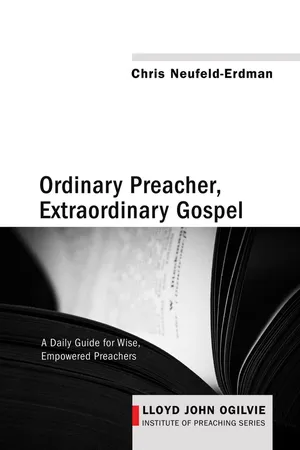
Ordinary Preacher, Extraordinary Gospel
A Daily Guide for Wise, Empowered Preachers
- 182 pages
- English
- ePUB (mobile friendly)
- Available on iOS & Android
eBook - ePub
About this book
What does it mean to preach the gospel today? How do we shape vibrant congregations? How do we preachers not merely survive, but thrive?
For nearly a quarter century, Chris Neufeld-Erdman has preached the gospel--sustaining congregational life and emboldening Christian witness in the midst of this turbulence. He's also taught seminarians and mentored working pastors. His theology and practice of preaching is hammered out on the anvil of real life. It's tested. True. Useful.
In this book, a veteran pastor meditates on everything from exegesis and sermon preparation to the way preachers might preach after tsunamis, hurricanes, and earthquakes. He reflects on what it means, for example, to host the text in the midst of what feels like a terminal state of war and violence, both abroad and at home, as well as the task of preaching in the midst of the massive anxiety produced by economic uncertainty and political gridlock.
Here's a book that will inspire and guide you as a wise, empowered preacher--an ordinary agent of the extraordinary gospel.
Trusted by 375,005 students
Access to over 1.5 million titles for a fair monthly price.
Study more efficiently using our study tools.
Information
Topic
Theology & ReligionSubtopic
Christian MinistryThursday

A Prayer Before the Word
On Genesis 1:1–5
Baptism of Jesus Sunday, January 8, 2006
Three great threats pressed in upon those who first listened to this text:
darkness, wind, and water.
At night, their lives were particularly vulnerable;
against the storm’s fury, they were powerless;
the ocean’s wave, terrified them beyond measure.
This last year we were made once again like the people of this text—
these threats pressed in upon us and made us afraid and bewildered;
they chastened our pride and arrogance,
our silly confidence that our knowledge and technology
had at last given us a control over the elements.
Water, wind, and darkness proved mighty against our puny presumption.
They taught us that we are not the masters,
and we felt a new threat of chaos larger than most of us can remember.
As the world turns to a New Year, hoping 2005 was only a short but painful season,
we, your church, turn to this text and trust its promise—
that no matter how terrifying are hurricanes and tsunamis,
no matter how destructive are earthquakes and tornadoes,
no matter how worrisome is the threat of global warming,
no matter how unsettling the instability of the global economy,
no matter how ugly the divisiveness of national politics—
we, your church, testify to your act of creating the world—
moving over the chaos of the darkness and the swirling waters,
breathing your holy wind,
overcoming all threats of chaos and destruction and disorder
bringing instead goodness and order and beauty.
Against every threat we might face you bring a new and holy three—
the water of rebirth,
the wind of life,
your word of command.
And whenever these three are present the world is renewed.
Renew us today and every Sunday—
when we, with all your church, move toward you through the water of baptism,
when we, with all your church, call upon the Wind of your life-giving Breath,
when we, with all your church, listen for the Word of your command.
Renew us in the grace that is Sunday,
the first day of creation,
the day you took charge,
the day we stop in Sabbath trust of water, wind, and word;
these three alone renew the earth.
Amen.
21
Thursdays Are for Writing
Preaching is an oral art and requires us to choose words more fitting for the ear than for the eye. That said, for me it is the act of writing—seeing words on a page—that turns me round the corner toward Sunday and preaching the text I’ve studied the first half of the week. Thursdays are for writing. And Thursdays are often the highlight of my week of preparation.
Fred Buechner—that masterful writer—once said, “After forty years of writing books, I find I need to put things into words before I can believe they are entirely real.”11 That is why I write. And I wonder too if that is not the reason we even have a Bible. Moses and the band of prophets, the sages and those whose prayers we call the Psalms, Jesus and the Apostles too, all preached in one way or another. And yet, either they or someone else put their words down on the page. Writing is an indispensable part of preaching—not just to give words durability, but also to make them real. After a quarter century of preaching sermons, I find that writing things down helps me believe things I might not otherwise come to believe. That is no small thing for a preacher.
I have always written as part of my preaching discipline, but too many of my preaching years I spent wringing my hands over the words I tried to put down on the page. During those years, I did not like Thursdays much at all. Dissatisfied with so much of what I wrote (it was rarely good enough in my mind to match the prose of those I felt compelled to imitate), Thursday felt like it never ended. Thursday had a habit of trespassing on Friday, and unhappy with what I wrote on Friday, the chore carried on into Saturday too. And it was a rare dawn on Sunday that didn’t find me still fussing with it all.
Somewhere about the tenth long year, worn out, frustrated, and my family in tatters because I was never able to be present and free on Saturdays, I determined to have a funeral. Either I put to death my own deadly habit of writing or, it seemed to me, I didn’t have many more years worth living as a pastor. I also figured that if I was not enjoying writing my sermons, folks were not likely to be enjoying my preaching of them. So I buried my old ways. I stopped struggling with words and determined to write for the sheer love of them.
I read somewhere in Annie Dillard’s The Writing Life,12 that writing is a lot like art. You cannot paint landscapes if you hate the smell of paint. Love that smell and you are well on your way to painting something of beauty. Love gives birth to art, I heard her say, and you’ve got to love words if you want to write. I loved words; I knew that. I loved what they could do. I loved what they helped me see and feel and touch. And if I loved words, I figured I could love putting them together. On top of this, take the pressure off writing a sermon fit for making myself famous, and I figured I might be able to love writing about the text.
For the last fifteen years, that is exactly what I’ve done. On Thursdays I steal away from my office to a little Roman Catholic coffee house and book store—my little monastery for the day. There, surrounded by things helpfully strange to a Protestant preacher—figurines of the saints, rosary beads, crucifixes, and books about Mary and by Aquinas, Merton, and the more famous popes—I tap away on my laptop. Sometimes I just dawdle. Other times I write in torrents of words that astound me when the storm subsides. Sometimes I write a commentary on the text with little to no interest in how it will preach. At other times I write a full sermon. Recently, as I have entered the visual age more fully, and use projected images, art, and video as adjuncts to my preaching, I meditate on these slides and write notes that root the movements of my sermon inside the world of the text, and explore the theological, spiritual, and ethical implications for our lives (I will talk more about preaching in the visual age in chapter 35). The point is, I do not make rules for myself; I take what comes and give myself gobs of freedom. It does not matter to me now what I end up with by early afternoon. What matters is that I was there, present to the text and to the Trinity, present to myself and to the daily experience of the people I love and among whom I will host this text come Sunday.
Let me add that my Thursdays are guided a great deal by a helpful piece of advice—something nearly gospel—from the writer William Blake. “Improvement makes straight roads,” Blake wrote, “but the crooked roads without improvement are roads of genius.”13 Now when I write, I am no longer aiming for straight, well-engineered roads. Instead, I play. And a lot of what I write feels pretty crooked. And while I can’t claim that it is genius, I can claim that it is much better than it used to be. Now I love my Thursdays. That is got to count for something when Sunday comes.
11. Buechner, Telling Secrets, 1.
12. Dillard, Three by Annie Dillard.
13. Cited in Ueland, If You Want to Write, 108.
22
Illustration
Illustrations have become mere trinkets, commodities bought and sold in the marketplace of religious goods and services. Slick promotional cards clutter my mail box, promising me ways I “can touch, relate, and motivate today’s media culture.” Digital ads clog my email with religious spam assuring me as a preacher the power to “quickly set up your message in a way that pulls your congregation in.” All I need is a subscription to sermonspice.com or any of a plethora of other illustration services, and with just a few clicks I’ve got access to stories or video clips that fit a myriad of situations, A–Z. Just what you and I as preachers need most. So we are told.
We preachers want to illustrate our sermons but I would rather we didn’t—not with what passes for sermon illustration today. Not unless we can move the practice of illustration away from the hackneyed art it has become. Not unless we can talk about sermon illustration in terms that do not mimic the tactics used to sell everything from cars to beer to feminine hygiene products and treatment for erectile dysfunction. By the way we engage this business of sermon illustration you would think we do not believe the Bible is very interesting. By the way we illustrate, we preachers seem to be saying that this old, embarrassingly distant, hard to understand text requires us preachers to mine its gold, discover a useful theme, then hammer it into a trusty form for delivery. “Three points and a poem.” Or to update the phrase, “three points and a video clip.”
This business of sermon illustration, though so common, actually obscures the text of Scripture we hoped to bring to the light of day. Sermons preached this way may draw the masses, but I cannot be persuaded that this is preaching. Speech-making, maybe. Entertainment, yes. But not preaching.
I used to illustrate my sermons this way too. There we...
Table of contents
- Title Page
- Some Groundwork
- Monday: A Prayer Before the Word
- Tuesday: A Prayer Before the Word
- Wednesday: A Prayer Before the Word
- Thursday: A Prayer Before the Word
- Friday: A Prayer Before the Word
- Saturday: A Prayer Before the Word
- Sunday: A Prayer Before the Word
- Two Sample Sermons
- Bibliography
Frequently asked questions
Yes, you can cancel anytime from the Subscription tab in your account settings on the Perlego website. Your subscription will stay active until the end of your current billing period. Learn how to cancel your subscription
No, books cannot be downloaded as external files, such as PDFs, for use outside of Perlego. However, you can download books within the Perlego app for offline reading on mobile or tablet. Learn how to download books offline
Perlego offers two plans: Essential and Complete
- Essential is ideal for learners and professionals who enjoy exploring a wide range of subjects. Access the Essential Library with 800,000+ trusted titles and best-sellers across business, personal growth, and the humanities. Includes unlimited reading time and Standard Read Aloud voice.
- Complete: Perfect for advanced learners and researchers needing full, unrestricted access. Unlock 1.5M+ books across hundreds of subjects, including academic and specialized titles. The Complete Plan also includes advanced features like Premium Read Aloud and Research Assistant.
We are an online textbook subscription service, where you can get access to an entire online library for less than the price of a single book per month. With over 1.5 million books across 990+ topics, we’ve got you covered! Learn about our mission
Look out for the read-aloud symbol on your next book to see if you can listen to it. The read-aloud tool reads text aloud for you, highlighting the text as it is being read. You can pause it, speed it up and slow it down. Learn more about Read Aloud
Yes! You can use the Perlego app on both iOS and Android devices to read anytime, anywhere — even offline. Perfect for commutes or when you’re on the go.
Please note we cannot support devices running on iOS 13 and Android 7 or earlier. Learn more about using the app
Please note we cannot support devices running on iOS 13 and Android 7 or earlier. Learn more about using the app
Yes, you can access Ordinary Preacher, Extraordinary Gospel by Chris Erdman in PDF and/or ePUB format, as well as other popular books in Theology & Religion & Christian Ministry. We have over 1.5 million books available in our catalogue for you to explore.