- 220 pages
- English
- ePUB (mobile friendly)
- Available on iOS & Android
eBook - ePub
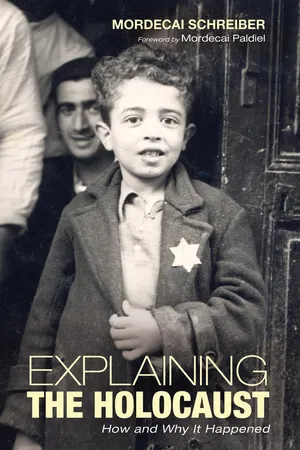
About this book
Seventy years after it took place, the Holocaust committed against the Jews of Europe during World War II continues to cast a giant shadow over humankind. Man's inhumanity to man is not a thing of the past. Genocidal action is still commonplace around the globe. Has humankind learned the lessons of the past? Is the human race doomed to live in a perpetual state of war and self-destruction?Explaining the Holocaust shows how, given the right circumstances, human beings can lose their humanity. Does that mean that the ethical teachings of the major religions are wishful thinking? This book tackles two questions that continue to be asked by people everywhere: Why did a highly civilized nation like Germany, in the middle of the twentieth century, commit the most heinous crime in all of human history? And if indeed there is a loving God who made a covenant with the people of Israel, why were millions of innocent, peaceful Jews dehumanized, starved, tortured, and systematically murdered?Explaining the Holocaust spares no one in discussing the enormity of the evil. But it also shows how the divine spark in human beings did not die during those years of darkness, and why we still have a glimmer of hope.
Tools to learn more effectively

Saving Books

Keyword Search

Annotating Text

Listen to it instead
Information
Part 1
Bottomless Evil
The Need to Explain
In the winter of 2012, while serving as a ship rabbi on a world cruise, I visited synagogues around the world. The most remote one was the synagogue of what has become known as the Shanghai Ghetto, now a memorial to a Jewish community of refugees from the Nazi horrors that lived there during World War II. The Shanghai Ghetto is located in an old and crowded part of this huge city of twenty-four million inhabitants, but the Chinese authorities have turned it into a dignified memorial for the Jewish refugees who once lived in their midst. They have restored an entire enclave, which one enters through a beautiful gate with commemorative plaques, leading to a small yet well-preserved synagogue. From there the path continues to former homes and courtyards—one of which has been converted into a small museum, which narrates the history of the ghetto. As my group visited the synagogue, once again I felt, as I have on several occasions over the years, the unfathomable presence of the Holocaust. I asked the group to join me in the reciting of the Kaddish, the Jewish prayer for the dead that reaffirms life. We all prayed, Jews and non-Jews.
During the Holocaust, Shanghai was about the only place in the world open to refugees from Nazi terror. Some twenty thousand Jews from Europe made the long journey to China and took residence in what is still known today as Ghetto Shanghai. The German regime contacted the Japanese authorities who occupied Shanghai at that time, and asked them to deal harshly with the Jews. The Japanese seemed to have their own agenda and did not pay much attention to the German request. The Jewish refugees were not disturbed, and after the war most of them found their way to America, to Israel, and elsewhere. Some of them pursued important careers and made major contributions to their adoptive countries.1
The story of the Shanghai Ghetto is one of the few happy-ending stories in that endless darkness known as the Holocaust. That darkness is still with us today and will continue to haunt us for generations to come. By “us” I don’t mean only the Jews, I mean everyone. Here human evil had reached its apex. Here civilization lost its moral compass. Here is where questions begin and answers cannot be found. Thousands of books have tried and failed. People continue to ask why. They continue to read the books, see the photos and the films and the plays, visit the museums, listen to the lectures, but two questions remain unanswered: First, why did the Germans, with the help of many non-Germans, systematically murder millions of Jews all throughout Europe? Second, why did God allow it to happen?
I am not so presumptuous as to think I can answer such questions. Human evil is unfathomable, and the ways of God are not known to man. But these two questions cut deep into the heart of human existence and demand some explication. I think it is safe to say that human evil is bottomless, and I do believe in a merciful God. If there was any doubt before the Holocaust that human evil is bottomless, Hitlerism has put this question to rest once and for all. As for God’s mercy, after Auschwitz, to use Richard Rubenstein’s famous book’s title, not only can it be argued that God is not merciful, but it can be argued that God does not exist altogether or has ceased to exist. I, for one, choose to believe that God does exist, and that God is merciful. I fully respect those who think otherwise, and I do realize that we have to make room for the entire human spectrum of belief and disbelief.
It seems to me that in order to fully understand the Holocaust it has to be considered in the context of the totality of human history, and even more specifically in the context of both Jewish and Christian history. Some have argued that the Holocaust stands apart from the rest of human history. When the celebrated Israeli Canadian architect Moshe Safdie designed the new Yad Vashem Holocaust Museum in Jerusalem, he cut a long wedge through a rocky hill on the museum grounds into which he designed the museum.2 He explained that to him the Holocaust was a rupture of history, as though an invisible knife had cut a wedge in time, altering human history forever. In explaining the Holocaust it will be necessary to show that no matter how incredible and incomprehensible the Holocaust may be, it is very much a part of human history, and yet it stands apart and defies all the rules of both individual and collective human behavior.
The Holocaust scholar and historian Lucy Dawidowicz has argued that Hitler conceived the idea of exterminating the Jewish people early on in his political career and had alluded to it in his political autobiography, Mein Kampf.3 Thus, to follow her line of thinking, the Holocaust was not a by-product of World War II but the main goal of the Nazi ideology that started the war in the first place and sought to impose the Nazi race theory on a world cleansed of Jews. This is a very compelling argument because it is the only way to explain German behavior during the last year of the war (mid-1944 to mid-1945), when the Germans were losing the war, and instead of marshaling all their resources to fight the enemy at their gates, they squandered them until the very last minute on killing Jews. Hitler’s last testimony before he shot himself in his bunker in Berlin blamed the Jews for starting the war, and concluded with the following sentence: “Above all I charge the leaders of the nation and those under them to scrupulous observance of the laws of race and to merciless opposition to the universal poisoner of all peoples, international Jewry.”4
It is a given that Hitler’s obsession with Jews was a form of mental disease, and that it played a huge part in the human tragedy known as the Holocaust. Hitler did not invent anti-Semitism, but he was able to put it into practice unlike anyone else in history. And yet, the Holocaust in all its enormity cannot be explained solely as the work of Hitler and his satraps. We do need to take a close look at this murderous gang, for the Holocaust would have not happened the way it did without them. But we cannot stop there, because there were others who, directly and indirectly, aided and abetted, and there were many factors, all of which converged through some satanic confluence and created the conditions for this unleashing of the most murderous event in all of history.
Some have learned the lessons of the Holocaust, but some have not. When NATO, representing the nations of Western Europe, intervened in the genocidal conflict in the Balkans and, with the help of U.S. President Bill Clinton put an end to it by dispatching its peacekeeping force, it was obvious that the lessons of the Holocaust were well learned. But in places like the Congo, Rwanda, Cambodia, and, more recently, Syria, it was not learned. Nor was it learned by the Ayatollahs of Iran, who have been threatening Israel with annihilation; or by all the radical forces in the Muslim world that have been using murder as a political weapon, are depriving women of their human rights, and preventing the people of the Middle East from experiencing peaceful progress. Here much still needs to be done.
The Jews are a tiny fraction of the human race, but it has been their fate to be the conscience of the world. It has been a given throughout time that wherever Jews were persecuted, evil reigned and decline followed. Conversely, wherever Jews were allowed to lend their talents and energy for the common good, the host society flourished. Perhaps this is what the Nazis meant when they spoke about the “world Jewish conspiracy.” Perhaps this has been the root cause of traditional Christian anti-Semitism, namely, the inability of the daughter religion to replace the mother religion as the moral compass of the world. Hitlerism, as we shall see, sought to replace both the Jewish God and the Christian God with a new religion, that of the “Aryan race.”
Perhaps the most shocking realization when we revisit those years of darkness will be to find out that the Nazis were not uneducated savages. Many of them had advanced degrees; came from upright middle-class or upper-class families; had refined tastes; and appreciated good music, art, and literature. Once we exhaust all the reasons why they fell prey to history’s greatest aberration, the question will still remain why they did what they did. Be that as it may, we will be left with a warning for all people and for all time that it can happen to anyone at any time.
1. Among the Jews who found their way to Shanghai on the eve of the Holocaust were some who became very accomplished people in the U.S., Israel, and elsewhere.
2. This was told to me by my cousin and longtime friend Dr. Mordecai Paldiel, the former director of the Righteous Gentiles Section at the Yad Vashem Holocaust Memorial Museum in Jerusalem.
3. In Mein Kampf, Hitler writes, “If at the beginning of the War and during the War twelve or fifteen thousand of these Hebrew corrupters of the people had been held under poison gas, as happened to hundreds of thousands of our very best German workers in the field, the sacrifice of millions at the front would not have been in vain” (Hitler, Mein Kampf, 679).
4. Hitler, “Final Political Testament.”
1
Not Just Another Genocide
The history of the human race is to a large extent a history of genocides. Yet the word genocide was not coined until 1944, when the Holocaust was at its peak.5 The problem with words like Holocaust and genocide is that they are imprecise terms. Holocaust is an archaic term derived from Greek, which means “a sacrificial offering that is consumed entirely by flames.” Genocide means the killing of an entire race or people. Both words denote complete destruction, yet they have been modified in our time to mean partial murder of a people, presumably with the intent of achieving total annihilation. While the capitalized term Holocaust has been universally accepted as applying only to the German war of extermination against the Jews, the term genocide took on an international legal meaning in the Genocide Convention of the United Nations of 1948, wherein the term refers to both intent and physical action, yet its precise meaning has been heatedly debated by scholars and by governments ever since. In recent years several events have been legally defined as genocides, including the Srebrenica Massacre during the conflict in the Balkans, in which thousands of Muslim Bosnians were systematically murdered, and the massacres of the Tutsi minority by the Hutu in Rwanda where some eight hundred thousand died.6
The twentieth century has topped all other centuries in the numbers of people killed by human action, not only on the battlefield but in premeditated genocidal assaults on unarmed civilians. The exact number is unknown, but it is estimated in the hundreds of millions. Interestingly, one of the first known genocides of the century was committed in 1904 by German settlers in the African country of Namibia, where the Herero tribe, deprived of its grazing lands, was driven into the desert where many died of thirst and starvation. A century later, in 2004, the German government made an official apology.

Herero tribe survivors of the genocide in Namibia, 1904
In 1915 the Namibian genocide was eclipsed by the genocide perpetrated by the Turks in which about one and a half million Armenians perished. Despite the urging of many countries, Turkey is yet to apologize for this historical crime. The indifference of the world towards the fate of the Armenian peo...
Table of contents
- Title Page
- Foreword
- Preface
- Acknowledgments
- Part 1: Bottomless Evil
- Chapter 1: Not Just Another Genocide
- Chapter 2: How It All Started
- Chapter 3: Germany and Europe after World War I
- Chapter 4: Satan’s Prophet
- Chapter 5: The World according to Hitler
- Chapter 6: The Complicity of the World
- Chapter 7: Those Who Did the Dirty Work
- Chapter 8: The Evolution of the Holocaust
- Chapter 9: The Judenrat Dilemma
- Chapter 10: Jewish Inaction during the Holocaust
- Chapter 11: Righteous Gentiles
- Part 2: The Problem of Faith
- Chapter 12: A Brief History of Jewish Martyrdom
- Chapter 13: A New Language of Faith
- Chapter 14: Christianity and the Holocaust
- Chapter 15: The Problem of Jewish Victimhood
- Chapter 16: The State of Israel as Sign and Wonder
- Chapter 17: The Universality of Faith
- Chapter 18: The Possibility of Faith after the Holocaust
- Chapter 19: The Way Back
- Conclusion
- Bibliography
Frequently asked questions
Yes, you can cancel anytime from the Subscription tab in your account settings on the Perlego website. Your subscription will stay active until the end of your current billing period. Learn how to cancel your subscription
No, books cannot be downloaded as external files, such as PDFs, for use outside of Perlego. However, you can download books within the Perlego app for offline reading on mobile or tablet. Learn how to download books offline
Perlego offers two plans: Essential and Complete
- Essential is ideal for learners and professionals who enjoy exploring a wide range of subjects. Access the Essential Library with 800,000+ trusted titles and best-sellers across business, personal growth, and the humanities. Includes unlimited reading time and Standard Read Aloud voice.
- Complete: Perfect for advanced learners and researchers needing full, unrestricted access. Unlock 1.4M+ books across hundreds of subjects, including academic and specialized titles. The Complete Plan also includes advanced features like Premium Read Aloud and Research Assistant.
We are an online textbook subscription service, where you can get access to an entire online library for less than the price of a single book per month. With over 1 million books across 990+ topics, we’ve got you covered! Learn about our mission
Look out for the read-aloud symbol on your next book to see if you can listen to it. The read-aloud tool reads text aloud for you, highlighting the text as it is being read. You can pause it, speed it up and slow it down. Learn more about Read Aloud
Yes! You can use the Perlego app on both iOS and Android devices to read anytime, anywhere — even offline. Perfect for commutes or when you’re on the go.
Please note we cannot support devices running on iOS 13 and Android 7 or earlier. Learn more about using the app
Please note we cannot support devices running on iOS 13 and Android 7 or earlier. Learn more about using the app
Yes, you can access Explaining the Holocaust by Schreiber in PDF and/or ePUB format, as well as other popular books in History & World History. We have over one million books available in our catalogue for you to explore.