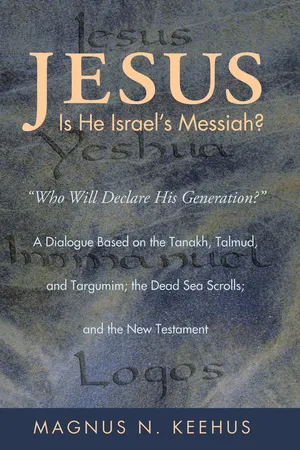
Jesus: Is He the Messiah of Israel?
eBook - ePub

Jesus: Is He the Messiah of Israel?

"Who will Declare His Generation?" A Dialogue Based on the Tanakh, Talmud, and Targumim; the Dead Sea Scrolls; and the New Testament

  1. 308 pages
  2. English
  3. ePUB (mobile friendly)
  4. Available on iOS & Android
eBook - ePub

Jesus: Is He the Messiah of Israel?

"Who will Declare His Generation?" A Dialogue Based on the Tanakh, Talmud, and Targumim; the Dead Sea Scrolls; and the New Testament

About this book

Jesus: Is He Israel's Messiah? Indeed he is! This book seeks to give evidence for Jesus being the Messiah of Israel and the world by drawing on various sources ranging from certain ideas observed in the Dead Sea Scrolls produced by the Qumran community, including illuminating certain writings concerning Messiah generated by ancient rabbis. The author also seeks to establish many prophecies fulfilled by Christ as spoken of in the Tanakh (Old Testament) and gives a strong case for miracles and the resurrection of Jesus. An exposition of selected parables taught by Jesus at the end of this book will reveal that the very claims he made about himself came from no other than Messiah-authenticated by his own ministry of miracles, fulfilled prophesy, performing resurrections including his own literal and physical rising from the dead.

Frequently asked questions

Yes, you can cancel anytime from the Subscription tab in your account settings on the Perlego website. Your subscription will stay active until the end of your current billing period. Learn how to cancel your subscription.
No, books cannot be downloaded as external files, such as PDFs, for use outside of Perlego. However, you can download books within the Perlego app for offline reading on mobile or tablet. Learn more here.
Perlego offers two plans: Essential and Complete
  • Essential is ideal for learners and professionals who enjoy exploring a wide range of subjects. Access the Essential Library with 800,000+ trusted titles and best-sellers across business, personal growth, and the humanities. Includes unlimited reading time and Standard Read Aloud voice.
  • Complete: Perfect for advanced learners and researchers needing full, unrestricted access. Unlock 1.4M+ books across hundreds of subjects, including academic and specialized titles. The Complete Plan also includes advanced features like Premium Read Aloud and Research Assistant.
Both plans are available with monthly, semester, or annual billing cycles.
We are an online textbook subscription service, where you can get access to an entire online library for less than the price of a single book per month. With over 1 million books across 1000+ topics, we’ve got you covered! Learn more here.
Look out for the read-aloud symbol on your next book to see if you can listen to it. The read-aloud tool reads text aloud for you, highlighting the text as it is being read. You can pause it, speed it up and slow it down. Learn more here.
Yes! You can use the Perlego app on both iOS or Android devices to read anytime, anywhere — even offline. Perfect for commutes or when you’re on the go.
Please note we cannot support devices running on iOS 13 and Android 7 or earlier. Learn more about using the app.
Yes, you can access Jesus: Is He the Messiah of Israel? by Keehus in PDF and/or ePUB format, as well as other popular books in Theology & Religion & Religion. We have over one million books available in our catalogue for you to explore.

Information

1

The Tanakh, Ancient Writings, and Jesus of Nazareth

As the navel is set in the center of the human body, so is the land of Israel the navel of the world, . . . situated in the center of the world, and Jerusalem is the center of the land of Israel, and the sanctuary in the center of Jerusalem, and the holy place in the center of the sanctuary, and the ark in the center of the holy place, because from it the world was founded.1
Jeremiah, an Israel Defense Forces soldier in training, happens to befriend David, an officer in the force. The two meet in the Judean region by the Dead Sea. Seeing archaeologists excavating nearby at Qumran, Jeremiah asks, ā€œWhat are they unearthing in those caves?ā€2
figure01.webp.webp
Cave 4, Qumran
David replies, ā€œThey are searching for additional scrolls and Essene artifacts.ā€
Jeremiah, a young man with an eager intellect and appetite for religious truth, contemplates David’s mysterious words. As time goes on, the two engage in a most life-changing and intellectually fascinating conversation as they read and discuss texts from the Tanakh, Talmud, Targumim, Dead Sea Scrolls, and New Testament.
The Essenes
Jeremiah: Who were the Essenes and what is the big deal about these scrolls?
David: The Essenes were a Jewish sect that left Jerusalem for Qumran. They are an important group to archeologists and theologicalns because of their writings.
Jeremiah: What things did they write about?
Qumran Scrolls
David: They copied much of the Tanakh, or Hebrew Bible, and produced numerous commentaries, or writings encompassing their Tanakh interpretations, sectarian rules, and rituals, and so on.3 In fact, their commentaries on various portions of the Tanakh have demonstrated a certain type of interpretation, otherwise not too well known (or perhaps unknown) in much of Judaism,4 specifically regarding interpretations of messianic prophecies. The discovery of this knowledge dating back some two thousand years ago has revolutionized much of the way we view messianic thinking of that time.
Dead Sea Messianism
David: Furthermore, this Jewish community occupied Qumran between 250 BC and AD 68 and literally left us with hundreds of scrolls and thousands of fragments—some of the earliest writings concerning the Tanakh (Hebrew Bible). However, the earliest Hebraic form of lettering known today are the silver scrolls. These silver amulets were discovered in the Hinnom Valley (south Jerusalem) and contain an abbreviated version of Num 6:24–26. They have been dated at ca. 700 BC.5
Jeremiah: What types of things did they write about concerning Messiah?
David: Believing in a certain Messiah of the Last Days,6 a Warring Messiah,7 as well as a kind of Suffering Servant,8 a Messiah whose duties include the performance of resurrections,9 a ā€œSon of Godā€ (Apochryphon of Daniel [4Q246], literally, ā€œSon of the Most Highā€10), and so on, they are unique in many ways. While many scholars differ on how to interpret Qumran writings, in all, we see distinctive messianic concepts in this sect. Some interpretations are more difficult than others. For example, the idea of an eternal destruction is clear:
And God’s hand will strike . . . for eternal destruction . . . and they will atone for you. (War Scroll [4Q; cf. 1QM] line 4)11
But as to how and when this destruction is to occur exactly is another thing.
As said, the Qumran sect also maintained that messianic duty included some form of performing resurrections, as is evident from the following:
They who lie in the dust will raise a flagstaff and the worms of the dead will lift up an ensign. (Thanksgiving Hymns [1QH] vi.34)12
Jeremiah: What is this Messiah of War all about?
David: First, from a biblical view, as early as Gen 14:1, some Jewish thinkers have argued that this passage concerns the coming of Messiah during a time when the nations of the world war against one another;13 however, that was long ago and is not an interpretation given by many Jews today. And, of course, followers of Jesus hold that Messiah will come a second time and save Israel from final destruction caused by the satanic influence of the antichrist.
And, according to Edersheim:
In the Jerusalem Targum on Num. 11:26 the prophecy of Eldad and Medad is supposed to have been with regard to the wars in the latter days against Jerusalem, and to the defeat of Gog and Magog by the Messiah.14
Moreover, the ā€œWarring Messiahā€ in the Dead Sea Scrolls is just as descriptive and breathtaking.15 The members of the sect saw themselves as the sons of light, almost like troopers for God, whose destiny was to conquer the sons of darkness and Belial (Satan). A last days Messiah of War was soon to come, they thought, and upon his arrival, they would be ready to fight and conquer darkness and its forces.
Jeremiah: That is some extreme business, David.
David: I know, so get ready!
Jeremiah: What else is unique about the Dead Sea community?
David: As a sect, they were deeply religious, productive, and exclusive. Equally importan...

Table of contents

  1. Title Page
  2. Abbreviations
  3. Introduction
  4. Chapter 1: The Tanakh, Ancient Writings, and Jesus of Nazareth
  5. Chapter 2: The Davidic Lineage of Jesus and His Fulfillment of Messianic Prophecies
  6. Chapter 3: Jesus’ Miracles, Natural Law, and Messianism
  7. Chapter 4: Resurrection and Skepticism: Jesus Rose from the Dead
  8. Chapter 5: Messianic Prophesies Fulfilled by Jesus
  9. Chapter 6: Parables and Teachings of Jesus
  10. Bibliography