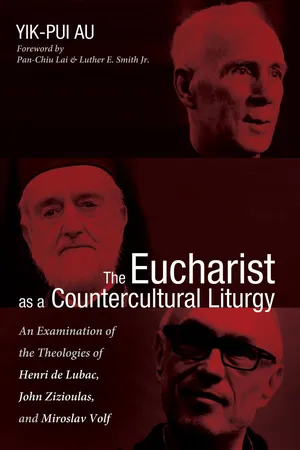
Since its institution, the Eucharist has been celebrated in all churches regardless of denominational differences. Yet its importance should not be just confined to the Christian communities; it can have transformational power in the cultural milieu. In this book, Yik-Pui Au argues that the Eucharist can be a countercultural liturgy that upholds the identity and values of Christianity by countering cultural currents that are contrary to the Christian faith. Au takes an interdisciplinary approach comprised of church history, ritual theory, and theology of culture to examine systematically the countercultural functions of the Eucharist interpreted by three modern theologians, Henri de Lubac, John Zizioulas, and Miroslav Volf, representing the Catholic, Orthodox, and Protestant traditions respectively. The comparative evaluation of this cross-tradition analysis supports Au’s argument that even though culture is complex and changing, the countercultural function of the Eucharist remains valid. Despite its complexity, culture can be transformed by the Eucharist and it can also challenge and renew our understanding of the Eucharist. She suggests that due to its richness, the countercultural function of the Eucharist cannot be exhausted by one tradition. It is the task of theologians to help the church continually venture to explore and vivify this function ecumenically.
eBook - ePub
The Eucharist as a Countercultural Liturgy
An Examination of the Theologies of Henri de Lubac, John Zizioulas, and Miroslav Volf
- 192 pages
- English
- ePUB (mobile friendly)
- Available on iOS & Android
eBook - ePub
The Eucharist as a Countercultural Liturgy
An Examination of the Theologies of Henri de Lubac, John Zizioulas, and Miroslav Volf
About this book
Information
Topic
Theology & ReligionSubtopic
Christian ChurchTable of contents
- Title Page
- Foreword by Pan-Chiu Lai
- Foreword by Luther E. Smith, Jr.
- Preface and Acknowledgments
- Chapter 1: Introduction
- Chapter 2: Recent Studies and Methods
- Chapter 3: Henri de Lubac’s Interpretation of the Eucharist
- Chapter 4: John Zizioulas’s Interpretation of the Eucharist
- Chapter 5: Miroslav Volf’s Interpretation of the Eucharist
- Chapter 6: A Comparative Evaluation
- Chapter 7: Conclusion
- Bibliography
Trusted by 375,005 students
Access to over 1.5 million titles for a fair monthly price.
Study more efficiently using our study tools.
Frequently asked questions
Yes, you can cancel anytime from the Subscription tab in your account settings on the Perlego website. Your subscription will stay active until the end of your current billing period. Learn how to cancel your subscription
No, books cannot be downloaded as external files, such as PDFs, for use outside of Perlego. However, you can download books within the Perlego app for offline reading on mobile or tablet. Learn how to download books offline
Perlego offers two plans: Essential and Complete
- Essential is ideal for learners and professionals who enjoy exploring a wide range of subjects. Access the Essential Library with 800,000+ trusted titles and best-sellers across business, personal growth, and the humanities. Includes unlimited reading time and Standard Read Aloud voice.
- Complete: Perfect for advanced learners and researchers needing full, unrestricted access. Unlock 1.5M+ books across hundreds of subjects, including academic and specialized titles. The Complete Plan also includes advanced features like Premium Read Aloud and Research Assistant.
We are an online textbook subscription service, where you can get access to an entire online library for less than the price of a single book per month. With over 1.5 million books across 990+ topics, we’ve got you covered! Learn about our mission
Look out for the read-aloud symbol on your next book to see if you can listen to it. The read-aloud tool reads text aloud for you, highlighting the text as it is being read. You can pause it, speed it up and slow it down. Learn more about Read Aloud
Yes! You can use the Perlego app on both iOS and Android devices to read anytime, anywhere — even offline. Perfect for commutes or when you’re on the go.
Please note we cannot support devices running on iOS 13 and Android 7 or earlier. Learn more about using the app
Please note we cannot support devices running on iOS 13 and Android 7 or earlier. Learn more about using the app
Yes, you can access The Eucharist as a Countercultural Liturgy by Yik-Pui Au in PDF and/or ePUB format, as well as other popular books in Theology & Religion & Christian Church. We have over 1.5 million books available in our catalogue for you to explore.