- 156 pages
- English
- ePUB (mobile friendly)
- Available on iOS & Android
eBook - ePub
About this book
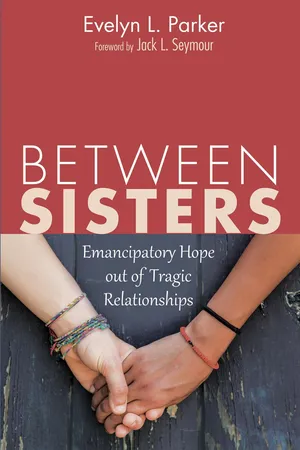
In a world laced with the lethal threads of racism, sexism, classism, and sexual oppression we need a liberating hope that dismantles these intersecting problems that render us into a stupor of chronic despair. In the United States, where the color of your skin can determine life or death, we need hope that will give us life abundantly. In a country where state laws prohibited mixed-race marriages between white and black people as recent as the year 2000 and black/white mixed-race children were demonized by both whites and blacks, our hope must be inspired by the Holy Spirit, God the Creator and Redeemer at work in the world today. This book offers emancipatory hope as this divine hope. With a focus on black/white mixed-race young women and their troubling relationships with women and girls of all ethnicities, Between Sisters provides a process toward emancipatory hope through forgiveness, femaleship, fortitude, and freedom. The process toward emancipatory hope challenges Christian churches to practice forgiveness, femaleship, fortitude, and freedom in a racist society. While the process is not without struggle, it promises that hope through the power of the Holy Spirit will someday usher in a society of justice, peace, and love.
Trusted by 375,005 students
Access to over 1.5 million titles for a fair monthly price.
Study more efficiently using our study tools.
Information
1
Forgiveness
The path to emancipatory hope for black/white mixed-race young women as well as all African-descended women and girls begins with forgiving those who have hurt them. Forgiveness is a process freely engaged in by individuals and communities to “move away from the overwhelming power of an experience of hurt or an injustice.”27 Forgiveness requires that one holds persons accountable for hurtful and unjust actions that include abuse, disloyalty, betrayal, and unfaithfulness. Such betrayal occurs among friends, coworkers in religious and secular institutions, in marriage relationships, among siblings, and among parents and their children. Those most intimately connected are particularly hurt by betrayal, and most in need of forgiveness. Pastoral theologian Joretta Marshall describes forgiveness as yielding liberation from bondage that allows one to live into a new relationship. She writes:
Forgiveness is a subversive and relational process summoned into action among persons, families, and communities when an injustice or hurt has been inflicted. It is a process that invites individuals and communities to move away from the overwhelming power of a hurt or pain while, at the same time, holding accountable those who have inflicted injustice or injury. Through this process individuals and communities are liberated from the bondage of oppressive anger and hurt, freeing their energies to work toward building, nurturing and sustaining relationships of justice and care.28
A disrupted relationship that causes “intentional or unintentional pain, injury, trauma or injustice” signals the need for forgiveness.29 We are created to relate human-to-human and human-to-divine. Relationality makes us human. When a relationship, a core aspect of our humanity, is fractured the natural inclination is to find ways to gather together the pieces of the fractured self, and this process of reconstitution begins with forgiveness.
In his instructions on prayer, the writer of the Gospel of Matthew indicates the importance of this relationality and the reciprocal nature of forgiveness for humankind. When we pray we are to say, “Forgive us our debts, as we also have forgiven our debtors” (Matt 6:12). This instruction comes with clarifying conditions in verses 14 and 15: “For if you forgive others their trespasses, your heavenly Father will also forgive you; but if you do not forgive others, neither will your Father forgive your trespasses.” The failure to forgive in the human-to-human relationship jeopardizes the human-to-divine relationship with God. A focus on relationality merits specific attention given its relevance for a discussion on relationships among African-descended women.
Among women of African descent, any discussion of relationships has to go beyond blood kin to include othermothering and fictive kin. Othermothering describes the action of a woman who cares for a child not biologically related to her. These two persons are fictive kin to one another, just as are any number of persons in relationship who survive by helping one another. Patricia Hill Collins’s epistemological framework for African American women notes such an ethic of care as one of several ways of knowing among black women.30 The ethic of care informs the historical and theoretical understanding of “othermothering” in the black community.31 “The concept of othermothering grew out of a survival mechanism prevalent during slavery when children and biological parents were separated at auction, and ‘fictive kin’ would take on mothering responsibilities for the orphaned children.”32 Black teachers in historically black colleges and universities as well as in predominantly white institutions of higher education have noted their practice of othermothering black students.33 These relationships are captured in familial terminology that usually endears the black teacher to her students. Monikers that include mom, Mama Hawk, and auntie all signal some level of othermothering between a black teacher and her college students.34 The practices of othermothering in the context of a college or university are mutually beneficial when they provide connectedness, fulfillment, and interethnic support and advocacy. They become harmful when boundaries are breached, teacher-student roles are confused or violated, and caring for a multiplicity of students’ needs leads to teacher exhaustion or “care-sickness.”35 As with any relationship, othermothering practices between black teachers and their black and black/white mixed-race female students can result in overwhelming hurt if the relationship is fractured. Likewise, the practices of othermothering or fictive kin relationships among any and all African-descended women can be a tinderbox for injustice that requires forgiveness.
While intimate betrayal is typically obvious to others, institutional betrayal of groups of people can be subtle, elusive—and covered up by the institution. The hurt caused by institutional betrayal often causes unidentified pain that is difficult to locate, difficult because the responsibility for the hurt is often shared among many persons and systems and cannot usually be attributed to a single person. Consider religious institutions that fail to create policies that protect children and women from violence and abuse in their congregations, or that have such policies but fail to enforce them. Ordinarily, women, children, and men go to church and to its many ministries expecting a safe and spiritually uplifting environment. So after, for example, a pastor rapes a teenager in that church, she is particularly traumatized; she is betrayed not only by a trusted leader but by the institution that employs and endorses him, an institution that perhaps even allows the leader to continue in his role when his crime has been revealed. So while this chapter focuses on forgiveness of intimate betrayal between mixed-race young adult women and their mothers, as you read, keep in mind also this connection between intimate and institutional betrayal, particularly betrayal by the institutional church.
Countless memoirs, poems, novels, biographies, and movies describe the powerful pain one feels from being betrayed by a friend, lover, sibling, or parent. I describe only three here, and do so only briefly: Sonia Sanchez’s Wounded in the House of a Friend, Toni Morrison’s The Bluest Eye and Beloved, and Judith Stone’s biography of Sandra Laing When She Was White and the movie Skin based on it. Poet and activist Sonia Sanchez describes the trauma of betrayal between a married couple in “Wounded in the House of a Friend.” 36 Sanchez suggests that when a husband betrays his wife, the wife often seeks reconciliation. Yet despite many attempts to do so, the wounded wife in Sanchez’s poem does not reconcile with her husband. Indeed, neither the husband nor the wife suggests their ultimate goal is forgiveness. Sanchez leaves the reader with the sense that betrayal in an intimate relationship can cause unspeakable pain that sometimes cannot be healed.
Toni Morrison captures the pain of betrayal that a vulnerable little girl feels when her father rapes her and her mother does not rescue her.37 Such was the experience of Pecola in Morrison’s novel, The Bluest Eye. Pecola’s drunken father, Cholly, rapes her while she is washing dishes. Cholly’s violent act of betrayal was so traumatic that Pecola passed out from the pain and shock. Morrison writes: “So when the child regained her consciousness, she was lying on the kitchen floor under a heavy quilt, trying to connect the pain between her legs with the face of her mother looming over her.”38 Earlier in the novel Morrison makes it clear that Pauline, Pecola’s mother, does not love her children or her husband but the white family, the Fishers, for whom she works.39 Pauline found beauty in the Fishers’ home and their praise of her service. For her part, Pecola found beauty in the blue eyes of little white dolls and she wondered how it felt to be loved and longed for like that.40 Desire for love and beauty is entangled in the morass of betrayal that Pecola experiences from her mother who also experiences ongoing pain from her fighting with Cholly. And Cholly also has a history of childhood pain, the result of being abandoned and abused. However, the book’s pri...
Table of contents
- Title Page
- Foreword
- Acknowledgments
- Introduction
- Chapter 1: Forgiveness
- Chapter 2: Fellowship/Femaleship
- Chapter 3: Fortitude
- Chapter 4: Freedom
- Chapter 5: Emancipatory Hope and the Holy Spirit
- Conclusion
- Bibliography
Frequently asked questions
Yes, you can cancel anytime from the Subscription tab in your account settings on the Perlego website. Your subscription will stay active until the end of your current billing period. Learn how to cancel your subscription
No, books cannot be downloaded as external files, such as PDFs, for use outside of Perlego. However, you can download books within the Perlego app for offline reading on mobile or tablet. Learn how to download books offline
Perlego offers two plans: Essential and Complete
- Essential is ideal for learners and professionals who enjoy exploring a wide range of subjects. Access the Essential Library with 800,000+ trusted titles and best-sellers across business, personal growth, and the humanities. Includes unlimited reading time and Standard Read Aloud voice.
- Complete: Perfect for advanced learners and researchers needing full, unrestricted access. Unlock 1.5M+ books across hundreds of subjects, including academic and specialized titles. The Complete Plan also includes advanced features like Premium Read Aloud and Research Assistant.
We are an online textbook subscription service, where you can get access to an entire online library for less than the price of a single book per month. With over 1.5 million books across 990+ topics, we’ve got you covered! Learn about our mission
Look out for the read-aloud symbol on your next book to see if you can listen to it. The read-aloud tool reads text aloud for you, highlighting the text as it is being read. You can pause it, speed it up and slow it down. Learn more about Read Aloud
Yes! You can use the Perlego app on both iOS and Android devices to read anytime, anywhere — even offline. Perfect for commutes or when you’re on the go.
Please note we cannot support devices running on iOS 13 and Android 7 or earlier. Learn more about using the app
Please note we cannot support devices running on iOS 13 and Android 7 or earlier. Learn more about using the app
Yes, you can access Between Sisters by Evelyn L. Parker in PDF and/or ePUB format, as well as other popular books in Social Sciences & Religion. We have over 1.5 million books available in our catalogue for you to explore.