eBook - ePub
Theologizing in the Radical Middle
Rethinking How We Do Theology for Spiritual Growth in Word and Spirit
- 340 pages
- English
- ePUB (mobile friendly)
- Available on iOS & Android
eBook - ePub
Theologizing in the Radical Middle
Rethinking How We Do Theology for Spiritual Growth in Word and Spirit
About this book
This book doesn't endorse any systematic theology; rather, it's about how we theologize. Why do two equally trained theologians, studying the same book and loving the same Lord, arrive at such different conclusions? This theological disagreement, at times becoming personal, spills over from the academia to seminaries and churches. And if history is any indicator, this always weakens the unity of the church. Who needs unity when correct doctrines are at stake, right? But, is the defense of all doctrines worth foregoing the unity of the church, despite Jesus' prayer that "they may be one even as we are one"? At bottom, our theological contentiousness stems from not recognizing that the way biblical revelation is framed is not designed to be handled the way seminaries typically do. Regardless, we strive for the rightness of our tidy theology, even disowning those who disagree while doing so. The disavowal of continuationists by the Strange Fire crowd is the most recent instance in a long line of placing doctrinal purity over the unity of the body. This book uncovers how Scripture is really structured and how, therefore, we need to theologize differently so that we may grow spiritually in Word and Spirit.
Tools to learn more effectively

Saving Books

Keyword Search

Annotating Text

Listen to it instead
Information
Topic
Theology & ReligionSubtopic
Christian Theology1
Urgency for the Paradigm of the Radical Middle
It was said that the reason Bill Jackson wrote The Quest for the Radical Middle is because cessationists who advocate word and continuationists who pursue Spirit have not been getting along. This chapter then is a longer version of that, which for the most part should be familiar to those who read the earlier responses to Strange Fire. Therefore, please allow me to present this discussion under the rubric of how two old theological rivals became fast friends after finding out that they had a common foe. In light of the first goal of the study—rethinking how we theologize—the amplification of cessationist and continuationist conflicts highlights the inherent weakness and potential danger in systematic theology, especially when it becomes very rigid and partial.
Ongoing Conflict Between Cessationists and Continuationists
Since the inception of Pentecostalism in 1906, Reformists and dispensationalists took little time to begin criticizing Pentecostalism and the related charismatic movement (i.e., traditionally those in non-Pentecostal churches who believe in and practice the sign gifts). According to the Center for the Study of Global Christianity (2011) at Gordon-Conwell Theological Seminary, there are 584 million Pentecostal and charismatic believers in the world. Naturally, this impressive worldwide growth has only deepened the concern of cessationists over a movement they feel is unbiblical in many regards.
So what are they fighting about? For most, the main issue at stake is the gifts of the Holy Spirit. Regarding these gifts (namely, the gift of tongues, prophecy, healing, and apostolicism), the discourse may be neatly separated into two camps: continuationists—who uphold that all spiritual gifts as delineated in the Bible continue to exist today—and cessationists—who believe that these signs or miraculous gifts have long ceased to operate in the church, as far back as the first century.
The Main Cessationist Argument
Evidently, the conviction held by cessationists against continuationism is so strong that it has had the effect of turning two long-time theological nemeses into allies.
Strange Bedfellows
Now it is no secret that the Reformed and dispensationalist theologians do not see eye to eye on many theological matters.
Regarding ecclesiology (i.e., the study of churches), while Reformists see the church as the true Israel, dispensationalists see them as separate entities. And many theologians would agree that this difference alone affects how the Bible is understood more than any other biblical issue (see chapter 4). In fact, they disagree on the very premise upon which God’s redemptive plan is established: five or six covenants for the Reformed1 and seven dispensations for the dispensationalist. A renowned dispensationalist, Charles Ryrie, irked by “opposition to Dispensationalism”2 on the part of Louis Berkhof, a Reformed theologian of equal prominence, writes:
After rejecting the usual dispensational scheme of Bible distinctions, [Berkhof] enumerates his own scheme of dispensations or administrations, reducing the number to two—the Old Testament dispensation and the New Testament dispensation. However, within the Old Testament dispensation Berkhof lists four subdivisions which, although he terms them “stages in the revelation of the covenant of grace,” are distinguishable enough to be listed. In reality, then, he finds these four plus the one New Testament dispensation, or five periods of differing administrations of God.3
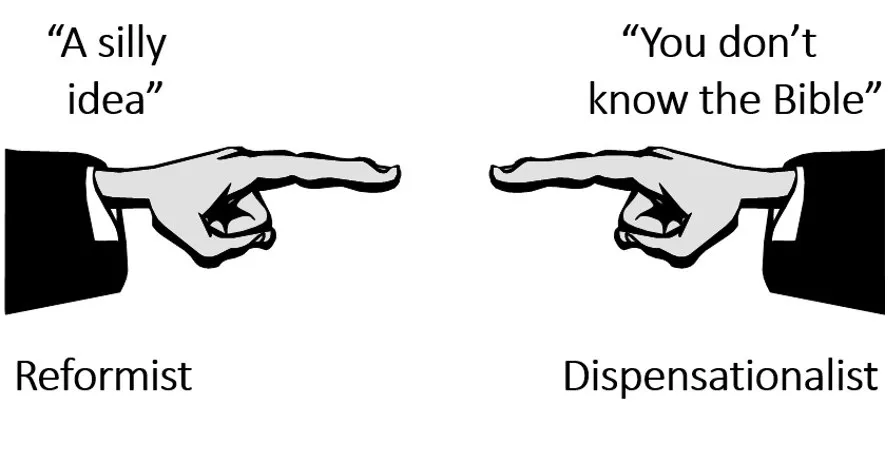
Ryrie’s response to Berkhof is quite tame when compared to how Thomas Ice, a dispensationist theologian and rapture expert, responded to the renowned Reformed theologian R. C. Sproul, who called rapture a “silly idea.”4 The doctrine of rapture posits that any day now Jesus will descend from heaven and meet the church in the air, and then they will return to heaven (1 Thess 4:15–17), at which point the seven-year tribulation will commence on earth.5 Ice said of Sproul, “Someone who thinks that rapture is a silly concept doesn’t know the Bible.”6
It is interesting how a biblical scholar says this about another of a different theological persuasion; in fact, even British theologian N. T. Wright felt like he was subject to it. His “New Perspective” view has garnered criticism for saying that “Paul was not countering legalistic Jewish individuals who were attempting to earn their salvation through works-righteousness,”7 but targeting instead their ethnocentrism and exclusivism which threatened to divide the church and keep the gentiles away. Now regardless how you feel about that view, I believe Wright knows the Bible rather well. Nevertheless, he felt that “some critics of [his view] write as if they are the ones who know ‘what the Bible says’ while others of us play fast and lose with it.”8
What happened? As is often the case when adherents of two differing theological systems discuss theology, the discussion becomes personal. Inasmuch as Ice felt chagrined by Sproul’s comment that denigrated a doctrine he values, had Sproul heard Ice’s comment about his lack of biblical knowledge, the Reformed theologian would have been just as irked—Wright sure was. In fact, this may be the only time anyone said that about Sproul, who likely knew the Bible as well as Ice. In truth, what separated them was not the level of biblical knowledge, but different approaches to interpreting Scripture. Once theological disagreements become personal, the disunity of the body of Christ is not too far behind.

Evidently, there is no love lost between Reformists and dispensationalists when it comes to theology. Howbeit, despite all these theological differences, they become immediate allies under the rubric of cessationism when encountering claims of the supernatural today.
Reformed Cessationists
Speaking on behalf of the Reformed view, Louis I. Hodges, in his Reformed Theology Today (1995), first states that “the extraordinary gifts (often called charismata), involving miraculous elements, . . . were given to confirm the gospel and to authenticate the apostles as God’s messengers (Hebrews 2:3–4)”.9 As to whether these gifts still operate today, he adds, “the majority of Reformed theologians . . . have insisted that the extraordinary gifts ceased with the original certification of the gospel during the time of the apostles.”10 Accordingly then, the sign gifts ceased to exist around the late first century, when the book of R...
Table of contents
- Title Page
- Foreword
- Preface
- Introduction: An Overview
- Chapter 1: Urgency for the Paradigm of the Radical Middle
- Chapter 2: The Antithetic/Antinomic Nature of Scripture and the Need for the Hermeneutics of the Radical Middle
- Chapter 3: Logocentrism and the Radical Middle: How They Differ
- Chapter 4: The Interpretation of Antithetic/Antinomic Revelation According to the Hermeneutics of Logocentrism
- Chapter 5: The Interpretation of Antithetic/Antinomic Revelation According to the Hermeneutics of the Radical Middle
- Chapter 6: The Gift of Tongues in the Radical Middle: A Hermeneutical Response to Hard Cessationism
- Chapter 7: The Gift of Tongues in the Radical Middle: A Hermeneutical Response to Flawed Versions of Continuationism
- Chapter 8: The Gift of Prophecy in the Radical Middle
- Chapter 9: The Gift of Apostleship in the Radical Middle
- Chapter 10: Divine Healing in the Radical Middle
- Chapter 11: Understanding the Western Mindset, Scripture, and the Disposition Necessary for the Radical Middle and Spiritual Growth
- Appendix A: “The Enemy is So United, but the Church, So Divided”
- Appendix B: What a Really Good Arminian Pastor Taught Me about Unity and Humility
- Appendix C: A Correct Understanding of Inspiration Can Resolve Many Discrepancies in the Bible
- Bibliography
Frequently asked questions
Yes, you can cancel anytime from the Subscription tab in your account settings on the Perlego website. Your subscription will stay active until the end of your current billing period. Learn how to cancel your subscription
No, books cannot be downloaded as external files, such as PDFs, for use outside of Perlego. However, you can download books within the Perlego app for offline reading on mobile or tablet. Learn how to download books offline
Perlego offers two plans: Essential and Complete
- Essential is ideal for learners and professionals who enjoy exploring a wide range of subjects. Access the Essential Library with 800,000+ trusted titles and best-sellers across business, personal growth, and the humanities. Includes unlimited reading time and Standard Read Aloud voice.
- Complete: Perfect for advanced learners and researchers needing full, unrestricted access. Unlock 1.4M+ books across hundreds of subjects, including academic and specialized titles. The Complete Plan also includes advanced features like Premium Read Aloud and Research Assistant.
We are an online textbook subscription service, where you can get access to an entire online library for less than the price of a single book per month. With over 1 million books across 990+ topics, we’ve got you covered! Learn about our mission
Look out for the read-aloud symbol on your next book to see if you can listen to it. The read-aloud tool reads text aloud for you, highlighting the text as it is being read. You can pause it, speed it up and slow it down. Learn more about Read Aloud
Yes! You can use the Perlego app on both iOS and Android devices to read anytime, anywhere — even offline. Perfect for commutes or when you’re on the go.
Please note we cannot support devices running on iOS 13 and Android 7 or earlier. Learn more about using the app
Please note we cannot support devices running on iOS 13 and Android 7 or earlier. Learn more about using the app
Yes, you can access Theologizing in the Radical Middle by Chang in PDF and/or ePUB format, as well as other popular books in Theology & Religion & Christian Theology. We have over one million books available in our catalogue for you to explore.