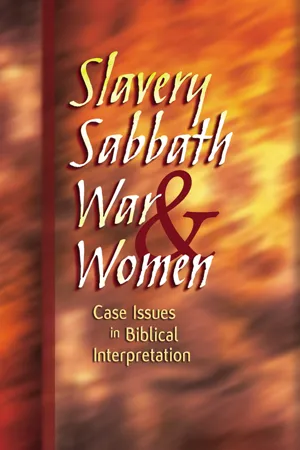
The Bible appears to give mixed and even conflicting signals on the four case issues of slavery, Sabbath, war, and women. New Testament scholar Willard Swartley seeks to identify the difficulties surrounding these discussions and clarify basic learnings in biblical interperation in a spirit of unity and dialogue. As a predecessor to his 2003 publication, Homosexuality, this book rounds out a thorough spirit-filled discussion of some of the most contentious and sensitive issues facing the church today.
- 368 pages
- English
- ePUB (mobile friendly)
- Available on iOS & Android
eBook - ePub
About this book
Trusted by 375,005 students
Access to over 1.5 million titles for a fair monthly price.
Study more efficiently using our study tools.
Information
CHAPTER 1
The Bible and Slavery
Preview of the Debate
| For | Against |
| The Bible’s defense of slavery is very plain. St. Paul was Inspired, and knew the will of the Lord Jesus Christ, and was only intent on obeying it And who are we, that in our modern wisdom presume to set aside the Word of God…and invent for ourselves a “higher law: than those holy Scriptures which are given to us as a light to our feet and a lamp to our paths,’ in the darkness of a sinful and a polluted world?” —John Henry Hopkins (1864)1 | Slavery seeks refuge in the Bible only in its last extremity…. Goaded to frenzy in its conflicts with conscience and common sense, … it courses up and down the Bible, “seeking rest and finding none.” The law of love, glowing on every page, flashes through its anguish and despair. —Theodore Dwight Weld (1837)2 |
The Pro-Slavery Case
Meet the Debaters
1. John Henry Hopkins, DD, LLD, bishop of the Episcopal diocese of Vermont and author of A Scriptural, Ecclesiastical, and Historical View of Slavery, from the Days of the Patriarch Abra-ham, to the Nineteenth Century, published In 1864.3 Hopkins also wrote a tract in 1861 on the “Bible View of Slavery” and circulated it to Episcopal bishops and ministers in the New England and middle eastern states.4 Earlier, in 1850, Hopkins presented his views in lectures at Buffalo and Lockport, New York; these lectures were published in The American Citizen in 1857.5
2. Albert Taylor Bledsoe, LLD, professor of mathematics at the University of Virginia Writing for the important volume Cotton Is King, published first in 1860, Bledsoe addressed his extensive treatise to the moral, political, and philosophical issues involved in slavery; it includes a lengthy section on “The Argument from the Scriptures.”6
3. Thornton Stringfellow, DD, from Richmond, Virginia. Stringfellow’s sixty—page treatise, published also in Cotton Is King and elsewhere,7 is notable for its lucid, eloquent, and relatively brief statement. In presenting the case of the slavery advocates, I employ his four theses as the outline. His essay is entitled “The Bible Argument: or, Slavery in the Light of Divine Revelation.”8
4. Charles B. Hodge, DD, distinguished Princeton professor. Hodge’s forty-page essay, appearing also in Cotton Is King, is entitled “The Bible Argument on Slavery.”9
5. George D. Armstrong, DD, pastor of the Presbyterian church of Norfolk, Virginia His book The Christian Doctrine of Slavery, published first in 1857,10 devotes its 148 pages almost exclusively to the exposition of pertinent New Testament texts.
6. Of lesser voice in the debate are Governor Hammond of South Carolina and Professor Dew of Virginia “Hammond’s Letters on Slavery” and Professor Dew’s arguments presented to the Vir—ginia legislature in 1831-32 appear in the book The Pro—Slavery Argument.11
Position In Brief
We, theologians and Christian statesmen from 1815 to 1865, hold that the Bible says nothing to condemn slavery as sinful, and some of us maintain that the Bible in fact commands slavery. Rooted in Noah’s prophetic cursing of Ham—Canaan’s descendants, slavery has been and should be practiced by God’s people. Abraham, champion of faith, had many slaves. God told the Israelites to buy slaves and gave specific instructions pertaining to their service. Jesus never spoke against slavery, but used the slave Image as a model for Christian conduct. Paul and Peter instructed masters and slaves in how to conduct themselves as Christians, and Paul obeyed the fugitive slave law in sending the runaway slave Onesimus back to Philemon, his master. Nowhere does the Bible condemn slavery. Either believe the Bible and support slavery, or oppose slavery and throw out the Bible as God’s authoritative Word.
We now present our use of Scripture which clearly supports our position that slavery accords with God’s will.
Thesis 1: Slavery was divinely sanctioned among the patriarchs.
First, consider Noah’s curse upon Canaan (Gen. 9:24-27). The “first appearance of slavery in the Bible” Is, as Hopkins says, “the wonderful prediction of the patriarch Noah.”12 Strlngfellow comments similarly. “May It not be said In truth, that God decreed this Institution before It existed.”13 Noah’s curse upon Canaan proph—esied the black African’s destiny. As S. A Cartwright said in his 1843 essays, when Japheth became enlarged by the discovery of America (foretold 3, 800 years before), Canaan appeared on the Af—rican beach to get passage to America, “drawn thither by an impulse of his nature to fulfill his destiny of becoming Japheth’s servant.”14
Second, Abraham is our godly example. Abraham—champion of faith for all Christians—received, possessed, and willed slaves to his children as property. Slavery Is not like divorce. It cannot be said that before Moses the situation was different. No, Abraham was a great slaveowner: he brought slaves from Haran (Gen. 12:5), armed 318 slaves born in his own house (Gen. 14:14), included them in his property list (Gen. 12:16; 24:35-36), received slaves as a gift from Ablmelech (Gen. 20:14), and willed them as part of his estate to his son Isaac (Gen. 26:13-14). The Scripture says that the Lord blessed Abraham by multiplying his slaves (Gen. 24:35). And did not the angel command the slave Hagar to return to her mistress (Gen. 16:1 -9)? This clearly supports the fugitive slave law.15
Third, In the time of Joseph, God approved slavery. How did Joseph save many Egyptians from famine? God commanded that Joseph buy the people and the land, making them slaves to Pharoah (Gen. 47:15-25).’16
Thesis 2: Slavery was Incorporated Into Israel’s national constitution.
God authorized two types of slavery for Israel’s national life: (1) Israel was allowed to take foreigners as slaves. God commanded theIsraelites to “go into the slave markets of the surrounding nations” to buy slaves, to hold them as property, and to will them to their descendants as an inheritance In perpetuity (Lev. 25:44-46).’17 Based on this text, Strlngfellow says, “God ingrafted hereditary slavery upon the constitution of government.”18 After quoting this text. Bledsoe says. “Now these words are so perfectly explicit that there Is no getting around them.”19 (2) God provided that the Hebrews might “sell themselves and their families for limited periods, with the privilege of extending the time at the end of the sixth year to the fiftieth year or jubilee, If they prefer(red) bondage to freedom.”20 This practice is described In detail in both Exodus 21 and Leviticus 25.
For this second type of slavery, two specific regulations merit our attention: (1) In Exodus 21 certain “conduct is punishable by death, when done to a freeman, which is not punishable at all, when done by a master to a slave, for the express reason, that the slave Is the master’s money” (verses 20-21. 26-27);21 and (2) the institution of slavery takes priority over the Institution of marriage (Ex. 21:2-4). If a slave leaves his master after seven years, having married the master’s daughter, both wife and children stay with the master. The slave Is required to leave his family and go out alone. As Stringfellow has said, “The preference is given of God to enslaving the father rather than freeing the mother and children.”22
Thesis 3: Slavery was recognized and approved by Jesus Christ and the apostles.
Jesus and the apostles saw the cruel slavery practices of the Roman empire but never said one word against them. The apostles, who represent Jesus Christ, fully agree with Jesus, even appealing to his words on this subject (1 Tim. 6:1-6). As Governor Hammond of South Carolina has put it:
It Is vain to look to Christ or any of his Apostles to Justify such blas-phemousperversions of the word of God. Although Slavery in its most revolting form was everywhere visible around them, no visionary notions of piety or philanthropy ever tempted them to gainsay the LAW, even to mitigate the cruel severity of the existing system. On the contrary, regarding Slavery as an established, as well as an Inevitable human condition of human society, they never hinted at such a thing as Its termination on earth, any more than that “the poor may cease out of the land,” which God affirms to Moses shall never be.
It Is Impossible, therefore, to suppose that Slavery Is contrary to the will of God. It Is equally absurd to say that American Slavery differs In form or principle from that of the chosen people. We accept the Bible terms as the definition of our Slavery, and Its precepts as the guide of our conduct.23
Hopkins comments similarly:
…while (Jesusl rebukes the sins of all around him, and speaks with divine authority,…he Uved In the midst of slavery,…and uttered not one word against It!24
The apostolic writings teach us seven points on slavery:
1. The apostles approved of slavery but disapproved of Its abuses (Eph. 6:5-9; Col. 3:22-25; 4:1; 1 Tim. 6:1-2; Tit. 2:9-10; 1 Pet 2:18-19.)
…they (the apostles! did not shut their eyes to the abuses of these several institutions—civil government, marriage, the family, slavery: nor did they affect an ignorance of them, but carefully distinguishing between the Institutions themselves and the abuses which had become attached to them, they set themselves to work with zeal and faithfulness…to correct the abuses.25
2. The apostles teach that the church has no authority to interfere with slavery as a political system: the church’s task does not interfere with the political and economic systems. Professor Dew says of both Jesus and the apostles:
When we turn to the New Testament we find not one single passage at all calculated to disturb the conscience of an honest slaveholder. No one can read It without seeing and admiring that the meek and humble Savior of the world In no instance meddled with the established institutions of mankind; he came to save the fallen world, and not to excite the black passions of men.26
3. The distinctions made between master and slave are not an Impediment to faith and are thus insignificant (Gal. 3:28; 1 Cor. 12:13; Col. 3:11). Whether he be slave or master, a man can be equally good as a Christian.
These external relations…are of little Importance, for every Christian is a freeman In the highest and best sense of the word, and at the same time Is under the strongest bonds to Christ (1 Cor. 7:20-22).27
Master and slave are, alike, the creatures of God, the objects of his care, the subjects of his government: and, alike, responsible to him for the discharge of the duties to their several stations.28
Paul treats the distinctions which slavery creates as matt...
Table of contents
- Cover Page
- Title Page
- Copyright
- Dedication
- Contents
- Foreword
- Author’s Preface
- Introduction
- Chapter 1: The Bible and Slavery: Preview of the Debate
- Chapter 2: The Bible and the Sabbath: Sabbath, Sabbath-Sunday, or Lord’s Day?
- Chapter 3: The Bible and War
- Chapter 4: The Bible and Women: Male and Female Role Relationships
- Chapter 5: How then shall We Use and Interpret the Bible?
- Conclusion: Summary of Learnings
- Appendices
- Notes
- Bibliography of Sources Cited
- Index of Scriptures
- Index of Persons
- The Conrad Grebel Lectures
- The Author
Frequently asked questions
Yes, you can cancel anytime from the Subscription tab in your account settings on the Perlego website. Your subscription will stay active until the end of your current billing period. Learn how to cancel your subscription
No, books cannot be downloaded as external files, such as PDFs, for use outside of Perlego. However, you can download books within the Perlego app for offline reading on mobile or tablet. Learn how to download books offline
Perlego offers two plans: Essential and Complete
- Essential is ideal for learners and professionals who enjoy exploring a wide range of subjects. Access the Essential Library with 800,000+ trusted titles and best-sellers across business, personal growth, and the humanities. Includes unlimited reading time and Standard Read Aloud voice.
- Complete: Perfect for advanced learners and researchers needing full, unrestricted access. Unlock 1.5M+ books across hundreds of subjects, including academic and specialized titles. The Complete Plan also includes advanced features like Premium Read Aloud and Research Assistant.
We are an online textbook subscription service, where you can get access to an entire online library for less than the price of a single book per month. With over 1.5 million books across 990+ topics, we’ve got you covered! Learn about our mission
Look out for the read-aloud symbol on your next book to see if you can listen to it. The read-aloud tool reads text aloud for you, highlighting the text as it is being read. You can pause it, speed it up and slow it down. Learn more about Read Aloud
Yes! You can use the Perlego app on both iOS and Android devices to read anytime, anywhere — even offline. Perfect for commutes or when you’re on the go.
Please note we cannot support devices running on iOS 13 and Android 7 or earlier. Learn more about using the app
Please note we cannot support devices running on iOS 13 and Android 7 or earlier. Learn more about using the app
Yes, you can access Slavery, Sabbath, War & Women by Willard M. Swartley in PDF and/or ePUB format, as well as other popular books in Theology & Religion & Biblical Criticism & Interpretation. We have over 1.5 million books available in our catalogue for you to explore.