![]()
1 Thessalonians
![]()
1 Thessalonians 1:1
The Salutation
PREVIEW
Gathered for a public reading of the letter from Paul and his coworkers, the believers in Thessalonica immediately hear the reassuring themes of grace and peace. They will hear the same themes when the letter ends.
First Thessalonians begins like other letters of its time, with a salutation (1:1) followed by a thanksgiving section (1:2-10). The salutation identifies the senders, names the addressee, and extends a greeting. By means of the greeting, Paul and his co-workers express a prayer whose themes resurface at the end of the letter. The greeting, Grace to you and peace, echoes in the twofold concluding benediction: May the God of peace himself sanctify; you to be whole (5:23, author’s translation; see note on copyright page), and The grace of our Lord Jesus Christ be with you (5:28). Prayers for grace and peace form a bracket around the whole letter!
EXPLANATORY NOTES
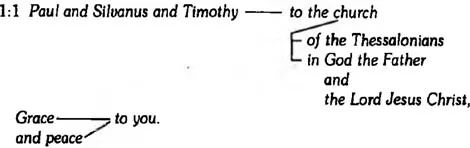
Paul led the initial mission in Thessalonica, and he takes the initiative in their ongoing pastoral intervention by writing this letter. In the salutation, he names as co-senders his co-workers, Silvanus (Silas) and Timothy, who have been involved with Paul during the evangelistic visit and/or the follow-up visit. The salutation also Identifies the addressee and conveys a greeting:
This letter is addressed to the church of the Thessalonians. As capital of the Roman province of Macedonia, Thessalonica had become a prominent political, cultural, and commercial center. When choosing Thessalonica as a setting for evangelism and church planting, Paul followed his customary urban strategy. Roman roads and communication links served the missionaries well in moving from one urban center to the next.
Some attention deserves to be given to the word church (ekklēsia). Why ekklēsia? Originally this term simply connotes an assembly or gathering, as, for example, in Acts 19:32, 39, 41. In the Septuagint (LXX, the OT in Greek), it usually translates the Hebrew word qahal, meaning assembly. Yet this secular term becomes the distinctive title for the Christian community, employed in the NT for both the local congregation (so here; also in 1 Cor. 1:2; Rom. 16:1) and the universal church (1 Cor. 10:32; 12:28; Col. 1:18, 24).
Perhaps in part because this word normally points to any assembly or gathering, Paul appends a qualifying phrase: in God the Father and the Lord Jesus Christ. Already in the Septuagint, assembly occasionally takes on sacred dimensions, through the added phrase, “assembly of the Lord” (as in Deut. 23:2-3). In the OT, assembly also becomes associated with Israel as a people called together by God and therefore assembled as God’s people. When addressing the Thessalonians as the church in God the Father and the Lord Jesus Christ, Paul is therefore making a radical claim. Jewish believers in Jerusalem and elsewhere in Judea are known as the churches of God which are in Judea in Christ Jesus (2:14). Now this community of Gentiles and Jews in Thessalonica is similarly recognized as belonging to God’s chosen people.
God the Father and the Lord Jesus Christ are here linked with the conjunction and. Some understand this as synonymous parallelism, implying that in Paul’s mind to be “in God” means also to be “in Jesus Christ.” So F. F. Bruce: “God and Christ are entirely one in the salvation of believers and in their maintenance in a spiritual fellowship” (Bruce, 1982:7). Others suggest that the sequence shows that Jesus Christ is the instrument through whom God creates the church: “To be a member of the Christian community is to participate in the salvation which has been achieved by God through Christ” (Best: 62). In the mystery of God’s working, both affirmations are true!
The greeting, Grace to you and peace, may be an adaptation of the traditional salutation used in Hellenistic letters, chairein (greetings), expanded under the influence of the normal Jewish greeting, shalom, peace. This brief greeting forms the central wish which recurs in expanded form in Paul’s later letters and becomes the model for the salutations in other NT epistles.
Did Paul create this greeting, which so strikingly blends both Greek and Jewish elements? Both grace and peace play central roles in Paul’s theology. A greeting of this nature may have emerged quite spontaneously within the life and worship of a bicultural Christian community such as Antioch of Syria, which included both Messianic Jews and Gentile Christians (Acts 11:19-25). However, there are also noteworthy precedents in the OT and in other Jewish literature for combining the notions of peace and grace or mercy (Mauser: 106-109). Jewish blessings, such as the priestly benediction of Numbers 6:24-26, illustrate this rich theological heritage (“Peace and Grace” in TBCfor2 Thess. 3:16-18).
![]()
1 Thessalonians 1:2-10
Work of Faith: You Turned Toward God
PREVIEW
The letter to the church at Thessalonica opens with a long-distance pastoral embrace! Separated from the Thessalonians by circumstances beyond their control, Paul, Silvanus, and Timothy use a letter to express gratitude toward God and communicate their deep affection toward these new believers.
The thanksgiving section (1:2-10) briefly traces the story of the conversion of the Thessalonians and their emergence as a community characterized by faith, love, and hope. Rhetorically, this section functions as the beginning of a narration detailing the grounds for thanksgiving. The behavior of the persons being addressed is lifted up for commendation.
Beginning with the fact that God loves and chooses, Paul refers to the witness through both the inspired words and deeds of him and his co-workers in Thessalonica. The thanksgiving section concludes with the grateful acknowledgment that the Thessalonian group also has became a model for their own immediate and more distant neighbors. While reporting the testimony of others regarding the Thessalonians’ response to the gospel, Paul summarizes what they as missionaries have preached during their initial visit. Their preaching has invited the people of Thessalonica to turn away from idols and toward God, to serve the living and true God, and to await his Son from heaven.
A characteristic feature of the thanksgiving section is that it sounds themes later developed in the letter. Especially important is the triad of qualities and commitments which Paul and his companions list as reasons for their thanksgiving: your work of faith and labor of love and steadfastness of hope (1:3). Faith, love, and hope appear together prominently elsewhere in Paul’s letters, notably in 1 Corinthians 13:13, though in a different order. In 1 Thessalonians this is also the case, most explicitly in 3:10-13 and 5:8.
The three themes of faith, love, and hope appear to signal the structure of the letter as a whole. The salutation (1:1) and the letter closing (5:23-28) provide the characteristic epistolary framework. The remainder of the letter can be viewed as follows:
| Work of faith | 1:2-10 |
| Labor of love | 2:1—3:13 |
| Steadfastness of hope | 4:1 —5:11 |
The last section (5:12-28) presents summary admonitions concerning life and leadership in the community in which faith, love, and hope need to become even more evident.
OUTLINE
Thanksgiving for Faith, Love, and Hope, 1:2-3
God Has Chosen You! 1:4
How the Gospel Came, 1:5
Imitators of Us and the Lord, 1:6-8
Turned Toward God to Serve and Await, 1:9-10
EXPLANATORY NOTES
The body of Paul’s letters generally opens with thanksgiving (2 Thess. 1:3-10; 1 Cor. 1:4-9; 2 Cor. 1:3-7; Phil. 1:3-11; Rom. 1:8-17). In this too, Paul follows the customary epistolary form of his time. One exception is Galatians, where Paul appears to have been too upset to express gratitude. In 1 Thessalonians the theme of thanksgiving begins with 1:2-10 but then resumes in 2:13 and again in 3:9.
The leading assertion, We give thanks, sets the tone and establishes the direction for this entire paragraph. Grammatically 1:2-10 can be considered as one rather unwieldy sentence which first states the reasons for thanksgiving (1:2-4) and then narrates the underlying story of the emergence of the Christian community in Thessalonica (1:5-10).
Thanksgiving for Faith, Love, and Hope 1:2-3
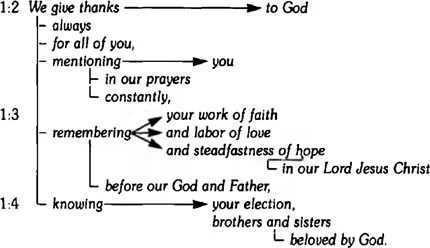
We can visualize the message of the first part of this paragraph through a sentence-flow diagram, [For an explanation of this way of presenting the text, see Grammatical Analysis, p. 350.]
Apparently taking to heart their own later admonition (in everything give thanks: 5:18), Paul and his co-workers here openly express their gratitude to God: We give thanks to God. Use of the present tense underscores the active character of prayerful thanksgiving, both ongoing, always, and all-encompassing, for all of you. Following their premature exit from Thessalonica, Paul and his companions find that these new believers are never far from their thoughts and their prayers.
As the sentence diagram above illustrates, the leading verb we give thanks is modified by three participial phrases: mentioning, remembering, and knowing. Grammatically it is not clear whether the adverb constantly modifies mentioning (RSV) or remembering (NRSV). Either way, this sentence vividly demonstrates the prayerful attitude of the missionaries in their continuing relationship with the church which they had founded.
What do the missionaries remember when they mention this Christian community in their prayers? Three things: your work of faith, labor of love, and steadfastness of hope. As noted above, the themes of faith, love, and hope form a familiar trio in Paul’s letters. These three themes can also be recognized as having provided the broad structure for this letter. In view of the fact that Paul and other NT writers have so much to say about faith, love, and hope, one gains a clear impression of the theological weight of this threefold statement (“Faith, Love, and Hope” in TBC below).
One interpretive matter, which has evoked debate, arises from the three prepositional phrases: of faith, of love, of hope. Some commentators find the notion of work of faith to be opposed to Paul’s clear insistence elsewhere that salvation comes by grace and is received by faith rather than by works or the law (Rom. 3:21-26; Eph. 2:8-9). These interpreters suggest that Paul here means work (which consists) of faith (and similarly also for love and hope). Others point out that for Paul faith and works are not in opposition. Even in Galatians, where some texts (such as 2:16) articulate the primacy of faith over works, Paul also stresses that faith results in works (5:6). According to these interpreters, therefore, Paul here prayerfully remembers the Thessalonians’ work of (which proceeds from) faith, labor of (which comes out of) love, and steadfastness of (which derives from) hope.
This latter interpretation rings true to the way in which the entire letter repeatedly invites the Thessalonians to experience a dynamic faith, which expresses itself in love and hope (especially 1 Thess. 5:8). Clearly the evangelists’ gratitude results from an awareness of the way in which the Thessalonians have already expressed their newly discovered faith. What Paul and his companions recall is an active faith, which has already been tested by affliction (cf. 1:6). Even though their faith has deficiencies needing to be remedied (as noted in 3:10), the Thessalonian believers are remembered for their faith, love, and hope. This triad therefore identifies the fruit-bearing nature of faith, love, and hope. Beginning a life of faith requires more than an act of passive acceptance. Life for the believer requires a dynamic faithfulness which expresses itself in acts of love and a stance of hope. It should be noted that hope has the climactic position here, perhaps because this is the evangelists’ primary area of concern as they address these new believers.
The fruit-bearing character of faith, love, and hope may also have a more concrete connection with the situation in Thessalonica. Both work and labor appear elsewhere in the letter, as both verb and noun, notably in the references to the evangelists’ model of hard work (1 Thess. 2:9; 3:5; 5:12-13; 2 Thess. 3:8), the general exhortations to follow this example (1 Thess. 4:11;2 Thess. 1:11; 2:17), and the specific admonitions directed to the unruly who were unwilling to work (2 Thess. 3:10-12)..
Jewett proposes that the community of faith in Thessalonica has instituted communal sharing of their resources with each other and with the poor in their midst. Love feasts provide the main vehicle for such “love communalism” (Jewett, 1994: ch. 6). In the opening thanksgiving of this first letter, Paul and his missionary partners articulate their gratitude for the Thessalonians’ active sharing. Not all is well, however, as 4:11 hints and 2 Thess. 3:6-18 makes clear. The generous spirit of brotherly/sisterly love is not evidenced by everyone in the community. At this point in the first letter, however, the missionaries articulate their thanksgiving for the active faith, love, and hope already being expressed.
The phrase in our Lord Jesus Christ can be construed as defining the object of the believers’ hope. More likely it describes the dynamic source and goal of their faith, love, and hope. Also the phrase before our God and Father, which in the original text comes after this reference to Jesus Christ, appears to be linked to the word remembering. In prayer before their God and Father, Paul and his co-workers remember the active faith, love, and hope already evident in this newly formed congregation.
God Has Chosen You! 1:4
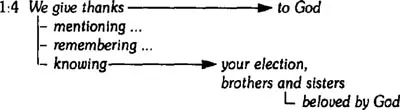
The third participle modifying the verb we give thanks illustrates a foundational theological conviction:
Here for the first time in the letter, the readers are addressed with the intimate family term, adelphoi, brothers and sisters, which occurs so frequently in all of Paul’s letters. Although adelphoi literally means brothers, the larger context within Paul’s letters as a whole clearly shows that this word is to be understood in an inclusive sense. Hence it is highly appropriate with the NRSV to read brothers and sisters.
This affectionate note is further deepened by the phrase beloved by God. Paul and his companions here let the Thessalonians know that their thanksgiving basically arises from the fact of their election: knowing your election (God … has chosen you, NRSV). The Thessalonians hear a moving reminder concerning God’s love and call. God loves and God chooses! Without the prior acti...