A history of those who have scaled Mount Everest—and the advances in mountaineering over a century.
At one time, the summits of the world's highest peaks—Everest included—were beyond reach. Pioneering attempts to overcome the dangers of climbing at extremely high altitudes ended in failure, sometimes with disastrous consequences. Yet today, high-altitude ascents are frequent, almost commonplace. Everest can be conquered by relatively inexperienced mountaineers, and their exploits barely merit media attention—unless they go fatally wrong.
This dramatic history of Everest climbs describes in vivid detail the struggle to conquer the mountain and the advances in scientific knowledge that made the conquest possible. It also offers compelling insight into the science of mountaineering—as well as the physical and psychological challenges faced by individuals who choose to test themselves in some of the harshest conditions on earth.
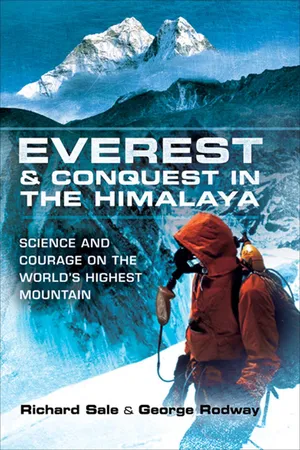
eBook - ePub
Everest & Conquest in the Himalaya
Science and Courage on the World's Highest Mountain
- 240 pages
- English
- ePUB (mobile friendly)
- Available on iOS & Android
eBook - ePub
Everest & Conquest in the Himalaya
Science and Courage on the World's Highest Mountain
About this book
Trusted by 375,005 students
Access to over 1.5 million titles for a fair monthly price.
Study more efficiently using our study tools.
Information
Subtopic
Military & Maritime HistoryChapter 1
The Early Quest for Extreme Altitude
Introduction
In 1995 Johan Reinhard, an American archaeologist heading a Peruvian-American expedition, discovered the almost perfectly preserved mummy of a teenage girl near the summit of Ampato, a 6288m stratovolcano in southern Peru. The mummy, quickly named la Doncella, ‘the maiden’, in Peru and ‘the ice maiden’ in the English-speaking world, caused a sensation, not least because of the altitude of the discovery. But four years later, working on Llullaillaco, another stratovolcano close to the Argentine-Chilean border and the Atacama Desert, Reinhard made another discovery. At 6723m, Llullaillaco is the sixth highest mountain in South America and the second highest active volcano on Earth. Reinhard’s team discovered the mummies of three children close to the summit. It is believed that they were child sacrifices, killed perhaps 500 years ago to appease the Incan gods, or to thank them for a successful harvest. Llullaillaco was probably the highest point reached by humans in South America in the pre-Conquistador era, and also the highest point reached by humans until the late nineteenth century. In Tibet the summer snowline can rise to 6500m, though vegetation is very sparse beyond 6000m. Yaks and snow leopards have been reported to roam up to 6100m, and Tibetan gazelle and kiang (wild asses) are occasionally seen at similar altitudes, though they prefer to stay below 5500m. It is likely that early Tibetan hunters reached heights similar to those of their prey, and that traders crossing the high passes between India, Nepal, Bhutan and Tibet also reached comparable heights. There is, however, no evidence for permanent or semi-permanent habitation above about 5,200m on either side of the Himalaya, and that is also likely to have been the limit in South America. Higher terrestrial elevations were truly terra incognita 150 years ago. Although a few very brave (and/or ignorant) men had ascended to altitudes over 8000m as early as 1862 in hot air balloons, these ‘exposures’ to the extreme altitude environment were short term, usually lasting little more than an hour or two. Nonetheless, their flights were full of near-misses as well as outright tragedy, as knowledge of the human body’s ability to deal with low atmospheric pressure and thus low tissue levels of oxygen, known as hypoxia, was extremely rudimentary.
Although some tentative steps had been taken towards an understanding of high-altitude physiology in the early years of the nineteenth century,1 it was not until the work of Paul Bert2 that the first giant leap forward was made. Bert, a Frenchman, was the first person to make an extensive study of the effects of barometric pressure. In the early 1870s he had a fortuitous meeting with Paris physician Denis Jourdanet, which was to have far-reaching consequences for the new science. Jourdanet was fairly wealthy and had travelled among the mountains of Mexico, where he developed an interest in high-altitude medicine. He and Bert shared enough medical interests to become friends and fellow-workers, with Jourdanet providing Bert with funds to establish a laboratory with a decompression chamber for the investigation of hypoxic phenomena. During the course of his high-altitude field experiences, Jourdanet had formulated the hypothesis that blood contained less oxygen on high mountains because the atmospheric pressure was lower, calling this theory ‘barometric anoxemia’. With Jourdanet’s financial backing, Bert aimed to put this theory to the test with a series of laboratory studies that would ultimately go an enormous distance in helping to sort out the puzzle of maladaptation to altitude that expresses itself, for instance, in the form of mountain sickness.
Although it seems so obvious today as to be easily taken for granted, Bert was able personally to confirm his deduction that mountain sickness is caused by exposure to an environment with low oxygen pressure. In a series of experiments, he allowed himself to be rapidly ‘taken up’ to a simulated altitude of approximately 5500m in a pressure chamber, and then breathed supplementary oxygen in order to successfully relieve his symptoms of acute hypoxia. Finally, he breathed supplementary oxygen during the course of being ‘taken up’ to the same altitude, finding himself untroubled by any noxious symptoms during the process, providing clear evidence that the use of supplementary oxygen in a low barometric pressure environment was based on a firm physiological footing.
Bert made other pioneering efforts of great interest to medical science, but his study of high-altitude (hypobaric) and high-pressure (hyperbaric) environments (such as deep-sea diving) is the work for which he is primarily remembered. This is no doubt due to the fact that, in 1878, he published his 1178 page magnum opus La Pression Barométrique, Recherches de Physiologie Expérimentale. This work contained not only Bert’s experimental results, but also an encyclopedic history of all that was then known or believed about high and low barometric pressures and mountain sickness. A very notable tribute to the lasting value of La Pression Barométrique is that it was of fundamental importance to aviation medicine during the Second World War. The need for an English edition at that time prompted its translation by the academicians Fred and Mary Hitchcock at Ohio State University in Columbus, Ohio. This first English edition of the book – Barometric Pressure: Researches in Experimental Physiology – was finally published in 1943, 65 years after its original publication in France! Bert’s studies were without doubt a most important milestone in the ever-expanding canon of knowledge concerning the physiological effects of oxygen and its lack on the human body. As such, Paul Bert is widely recognised today as the father of ‘modern’ high-altitude physiology and medicine.
While the hard-earned knowledge of Bert and other scientists was useful as mountaineers started to push the altitude ‘envelope’ to near the 7000m barrier by the end of the 1800s, mountain climbing exposed people to the hypoxia of high altitude over much longer periods (days, weeks or even months), and thus adaptation to altitude and deterioration from altitude were still unknown quantities. It should thus come as no surprise that early attempts to climb the world’s highest peaks, particularly K2 and Kangchenjunga, very early in the twentieth century were unsuccessful.
Laying the Foundation
In 1786 Mont Blanc (the highest peak in the European Alps, at 4810m) was climbed by two Chamonix residents, Dr Michel Paccard and Jacques Balmat, after the aristocratic Swiss scientist Horace-Bénédict de Saussure had offered a sizeable reward to the first ascentionists. Though their achievement is often regarded as the start of alpine climbing as a sport, another 70 years would pass before the ‘Golden Age’ of climbing in the European Alps began. Those early climbers, who were chiefly British, though invariably employing local guides, wore little more than old street clothes and concentrated on finding the most straightforward route to any summit they attempted.
In the Himalaya climbers were preceded by the map-makers of British India’s Great Trigonometric Survey (GTS). Work began in 1802, and just seven years later, while exploring the upper reaches of the Ganges, Lieutenant William Spencer Webb, a Survey employee, surveyed a peak known as Dhawala Gira (now known as Dhaulagiri) and found it to be 26,826ft (8190m). Astonished, he returned the following year to check his result: it was correct. But, rather than being excited by the finding of the world’s highest peak, the geographers of Europe scoffed at the absurd height calculated by this amateur surveyor: everyone knew that the world’s highest mountain was Chimborazo in the Ecuadorean Andes. In the years that followed GTS surveyors worked their way towards the border of forbidden Nepal. From close to the border they set up survey stations from which they were able to fix the height of the great peaks of the Himalaya. One, Peak X V, they discovered to be the highest mountain in the world. It was named after George Everest.
Occasionally, the survey stations set up by the GTS were at high altitude: some on the high Karakoram peaks were at over 6000m. As a consequence, exactly when climbers, rather than explorers or map-makers, came to the Himalaya is a matter of opinion – when does an explorer become a climber? Why does a map-maker choose one peak rather than another, or decide to press on to the summit when a lower shoulder would be adequate for his purposes? One of the most striking examples in this grey area was William Johnson, who was a member of the GTS but seems to have climbed as much for the thrill of it as to set up triangulation stations. In 1865, on an unsanctioned journey into China’s Kunlun Shan (a journey that eventually led to his resignation from the GTS), he claimed to have climbed a 7284m peak. More recent surveys give the peak’s height as 6710m and some, both at the time and today, question Johnson’s claim, though it is beyond doubt that he did achieve such altitudes elsewhere.
It is now generally agreed that the first ‘pure’ climber to visit the Himalaya was W.W. Graham in the spring of 1883. At that time Bhutan and Nepal were off-limits, Sikkim vaguely hostile and the Karakoram both remote and politically sensitive, the borders of Russia, Afghanistan and British India having still to be defined. Of the Himalaya only Himachal Pradesh and northern Uttar Pradesh (Garhwal and Kumaun) were easily and safely accessible. It is therefore surprising that Graham, accompanied by his Swiss guide Joseph Imboden, chose to go to Sikkim. The pair explored the southern approaches to Kangchenjunga, but then Imboden fell ill and had to return to Switzerland. Graham next employed two Swiss guides, Emil Boss and Ulrich Kauffmann, and headed for Garhwal. The trio arrived in July and apparently completed two climbs which, if true, were astonishing. Graham claims to have reached 6900m on Dunagiri (7070m, and not climbed until 1939), and then climbed Changabang (6864m), the peak whose fierce granite spire dominates the Ramani Glacier. This ascent of Changabang (which was not officially climbed until 1974) is now given no credence; indeed, it was being questioned within 15 years of Graham’s trip. The claimed height on Dunagiri is also disputed: many believe it likely he got no higher than 6100m on a subsidiary ridge.
Discovering and Naming the World’s Highest Mountain
In 1847 Andrew Waugh, Surveyor-General of India, measured the height of Kangchenjunga, finding it to be 28,176ft (8588m), a height which made it, at the time, the highest mountain in the world. But at the same time Waugh surveyed another peak well to the west. It was a long way off, making the height very uncertain, but Waugh was reasonably sure it was higher still. At the time there was no official identification system for the peaks the GTS was surveying, so Waugh referred to this new peak as ‘ ’’. In 1849, during surveys from the Ganges plain around Bihar, observations were made of several peaks in forbidden Nepal and John Armstrong, a survey assistant, calculated the height of a peak he called ‘b’. It was almost 29,000ft (8839m) high. When informed, Waugh wondered if his peak ‘ ’’ and Armstrong’s peak ‘b’were the same. He therefore sent out James Nicholson, another GTS surveyor, to take further readings. But rather than clarifying the position, Nicholson added to the confusion by creating his own reference system. On this, the highest peak was designated ‘h’. To bring order to the system, Waugh decided to redesignate all the peaks, starting with Kangchenjunga and working west. Kangchenjunga was designated Peak I. The high mountain was Peak XV and it was indeed the one previously designated ‘b’, ‘’and ‘h’. When its height was more accurately calculated, it was found, as Waugh had anticipated, that it was indeed the highest mountain in the world.
The height of Peak XV was positively determined in 1852, but it was not until 1856 that Waugh felt justified in announcing the discovery. In March that year he wrote to Henry Thuillier, the Deputy Surveyor-General (who, later, as General Sir Henry Thuillier, was to succeed Waugh as Surveyor-General):
I was taught by my respected chief and predecessor, Colonel Geo Everest, to assign to every geographical object its true local or national appellation … I have always scrupulously adhered to this rule as I have in fact to all other principles laid down by that eminent geodesist. But here we have a mountain, most probably the highest in the world, without any local name that we can discover, whose native appellation, if it has any, will not very likely be ascertained before we are allowed to penetrate Nepal, and to approach close to this stupendous snowy mass. In the meantime, the privilege, as well as the duty, devolves on me to assign to this lofty pinnacle … a name whereby it may be known among geographers, and become a household word … In testimony of my affectionate respect for a revered chief, in conformity with what I believe to be the wish of all the members of the scientific department over which I have the honour to preside, and to perpetuate the memory of that illustrious master of accurate geographical research – I have determined to name this noble peak … Mont Everest.
The height was given as 29,002ft (8842m).
The French ‘mont’ was dropped in 1857 in favour of ‘Mount’. Usually that too is now dropped, the peak just being known as Everest. In August 1856, in a letter to the Asiatic Society following Thuillier’s announcement, Brian Hodgson, a former political resident of Kathmandu, and then resident of Darjeeling, claimed the peak was actually called Devadhunga or Bhairathan. As a result of this letter, in early 1857 Waugh set up a committee to investigate the peak’s name. This concluded that Devadhunga (meaning God’s Seat) was applied to many places and that there was no evidence to support Bhairathan. Despite Waugh’s contention, both China (Tibet) and Nepal claim that the peak had a local name, though in the case of Nepal the suggested name, Sagamartha, is of very recent origin (dating from the 1960s) and was invented to prevent the Tibetan name gaining worldwide acceptance. The Tibetan name, Chomolungma, meaning ‘Goddess Mother of the World’, is also used by the Sherpas, the only Nepalese who had sight of the peak before modern times. The official Chinese name is now usually transcribed as Qomolangma. The Chinese claim that this name appeared on an eighteenth-century map.
The present accepted height of the mountain is 8848m (29,029ft), though a measurement based on a GPS system anchored to the closest rock to the summit in 1999 suggested a true height of 8850m (29,035ft) for the rock, and a further elevation of 1m due to the summit snow cone. The collision of the Indian tectonic plate with the Eurasian means that the summit is still being elevated and moved north-eastwards. The exact degree of change is subject to academic debate, but an annual elevation of 4mm is now generally accepted. If that figure is correct, and has remained essentially constant over the last 60 years, then Everest’s summit is now 23cm higher than when Ed Hillary and Tenzing Norgay reached it.
Sir George Everest
In 1818 William Lambton, the first Superintendent of the GTS, appointed as his Chief Assistant a young artillery captain by the name of George Everest. The captain pronounced his name Eve-rest rather than Ever-rest.
George Everest was born on 4 July 1790, probably in Gwernvale, a beautiful house (now a hotel) outside Crickhowell, a small town set between the River Usk and the Black Mountains, a range forming part of the Brecon Beacons National Park in South Wales. Some have suggested that George was born in London, but as his father, Tristram, was a solicitor in Crickhowell, that seems the more likely birthplace. George, the third of six children born to Tristram Everest and his wife Lucetta Mary, née Smith, became a Gentleman Cadet at the Royal Military Academy, Woolwich when he was 14 years old. Seven days after his 16th birthday he arrived in India as a lieutenant in the Bengal Artillery. In 1811, during a temporary posting to Java, it is known that he was involved in surveying work and it is assumed that he had had similar experience in India as well, sufficient for Lambton to appoint him as his Chief Assistant. Everest became Superintendent of the GTS on Lambton’s death in 1823, and Surveyor-General of India in 1830.
George Everest was a crotchety man, his subordinates and others finding it extremely easy to get on his wrong side: one fellow officer who referred to him as a ‘Compass Wallah’ very soon regretted the suggestion. On his return to England Everest was offered a knighthood, but he turned it down on the grounds that the proposed ...
Table of contents
- Cover Page
- Title Page
- Copyright Page
- Contents
- Prologue
- Introduction
- Chapter 1: The Early Quest for Extreme Altitude
- Chapter 2: Reaching the Highest Summits
- Chapter 3: The Next Generation
- Chapter 4: The Slippery Slope
- Chapter 5: Redefining the Game
- Plates
- Notes
- Index
Frequently asked questions
Yes, you can cancel anytime from the Subscription tab in your account settings on the Perlego website. Your subscription will stay active until the end of your current billing period. Learn how to cancel your subscription
No, books cannot be downloaded as external files, such as PDFs, for use outside of Perlego. However, you can download books within the Perlego app for offline reading on mobile or tablet. Learn how to download books offline
Perlego offers two plans: Essential and Complete
- Essential is ideal for learners and professionals who enjoy exploring a wide range of subjects. Access the Essential Library with 800,000+ trusted titles and best-sellers across business, personal growth, and the humanities. Includes unlimited reading time and Standard Read Aloud voice.
- Complete: Perfect for advanced learners and researchers needing full, unrestricted access. Unlock 1.5M+ books across hundreds of subjects, including academic and specialized titles. The Complete Plan also includes advanced features like Premium Read Aloud and Research Assistant.
We are an online textbook subscription service, where you can get access to an entire online library for less than the price of a single book per month. With over 1.5 million books across 990+ topics, we’ve got you covered! Learn about our mission
Look out for the read-aloud symbol on your next book to see if you can listen to it. The read-aloud tool reads text aloud for you, highlighting the text as it is being read. You can pause it, speed it up and slow it down. Learn more about Read Aloud
Yes! You can use the Perlego app on both iOS and Android devices to read anytime, anywhere — even offline. Perfect for commutes or when you’re on the go.
Please note we cannot support devices running on iOS 13 and Android 7 or earlier. Learn more about using the app
Please note we cannot support devices running on iOS 13 and Android 7 or earlier. Learn more about using the app
Yes, you can access Everest & Conquest in the Himalaya by Richard Sale,George Rodway in PDF and/or ePUB format. We have over 1.5 million books available in our catalogue for you to explore.