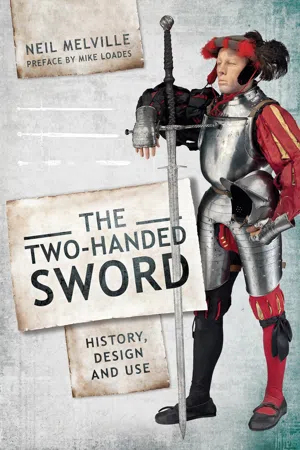
The two-handed swords found in modern museums are often so large and elaborately decorated that the onlooker might question whether such an apparently impractical weapon could ever have been a serious weapon of war. Yet during the Late Middle Ages, although never numerous, such weapons could instil dread in those that faced them on the battlefield and in skilled hands posed a very real danger, being capable of inflicting fearsome wounds.Neil Melville explains how, from the late-13th century, technological advances made the development of larger swords requiring both hands both possible and desirable. From their origins in Germany he traces their development and divergence into regional variations. He examines the evidence for their use on the battlefield over 300 years, most notably in the hands of the Swiss, the German landsknechts and the Scottish clans, before considering their later use in fencing and as ceremonial weapons. Practical advice on fighting with the two-handed sword is also given, drawing on contemporary fencing manuals. The detailed and informative text is beautifully enhanced by dozens of illustrations.
- 224 pages
- English
- ePUB (mobile friendly)
- Available on iOS & Android
eBook - ePub
About this book
Trusted by 375,005 students
Access to over 1.5 million titles for a fair monthly price.
Study more efficiently using our study tools.
Information
Subtopic
Military & Maritime HistoryIndex
HistoryChapter 1
How Two-Handed Swords Differ From Ordinary Swords
The two-handed sword, an object of amazement to present-day museum visitors and an instrument of menace on the battlefields of the late Middle Ages, has had little attention from modern military historians and arms scholars, apart from a handful of short studies such as those by E.A. Gessler: Der Zweihänder, by Clement Bosson: L’Epée à Deux Mains, by Kurt Kamnicker and Peter Krenn: Die Zweihänder des Landeszeughauses in Graz and most recently by Jurg Meier: Zweihänder, von der Waffe zum Symbol.1 Otherwise it has warranted but a paragraph or two in general works on swords. One reason, perhaps, for its lack of serious consideration in modern times is that the two-handed sword in general has been epitomised by one particular variant, the late sixteenth-century version, of enormous size and elaborate decoration. This has been dismissed as undeserving of attention as a serious and valuable weapon of war, and in consequence the whole type has suffered neglect. Admittedly it seems to have appeared but occasionally from its origins at about the end of the thirteenth century, finding more frequent employment in the hands of the Swiss, the Burgundians and others during the fifteenth century, being adopted by the German Landsknechts in the first half of the sixteenth century, becoming a symbol of power and authority for parades and other ceremonial occasions later in the same century, and finding a niche as a fencing weapon in the seventeenth century.
We can trace the origins and appearances on the stage of history of the two-handed sword in three ways: written references, either specifically to ‘two-handed swords’, ‘épées à deux mains’, ‘zweihänder’, ‘bidenhänder’, ‘spadoni a due mani’, and so on; descriptions of actions which clearly imply their definite use, such as representation of two-handed swords in dated/dateable paintings, manuscript illustrations and sculpture (occasionally on grave effigies); and actual swords which can be dated from marks, inscriptions or features of form and shape. I intend to give an account of all three types of material, suggest likely terminal periods for its working life, describe how it was used and in what circumstances, and propose a typology of its development, both chronological and regional.
Definition
There are numerous surviving examples and equally numerous references in the literature of the thirteenth to fifteenth century to ‘long swords’, ‘great swords’, ‘swords of war’, swords designed to deliver large slashing cuts from horseback with one hand or to be wielded with two hands if necessary on foot, such as those which fit into Oakeshott’s Type XIIIa.2 These large swords, with blades of 85–100cm and grips of 15–20cm, are matched by equivalent representations in art. These are the swords referred to in the chronicles as ‘great swords’ or ‘swords of war’ – the terms seem to be used interchangeably, both describing the same weapon, the sword which the knight wielded in battle on horseback. They also appear in the late thirteenth century, before the two-handed sword proper had developed.3 By the fourteenth century chroniclers frequently refer to ‘épées à deux mains’ and ‘twahandswerds’, as they do to ‘espées de guerre’ and ‘grete swerdes’, suggesting a clear distinction. Describing a sword as ‘two-handed’ is as precise as describing it as ‘great’ or ‘war’ is vague.
‘Great swords’ and ‘war swords’, then, are not strictly ‘two-handed swords’, for which I would suggest the following criteria: the two-handed sword must, by reason of its dimensions and weight, require two hands for its effective management. Hence the blade as well as the hilt must be longer than normal, over 100cm. Then the hilt should not merely be long enough to accommodate two hands, but should also enable the two hands wielding it to be spaced far enough apart to give a fulcrum effect, and the greater the possible distance between the hands the more easily could the comparatively long heavy blade be manoeuvred for an offensive cut or a defensive counter-blow. A wide grip like this affords more precise control of the blade and greater speed in the delivery of a cut. This means that the grip of a genuine twohander should be not less than 30cm, and the sword’s minimum overall length about 140cm. In the case of the hand-and-a-half sword, however, the application of the second hand to the end of the hilt, even overlapping the first hand or the pommel, is clearly intended only to add weight to the blow, not to aid in wielding the weapon as such, which can still be managed with one hand. Modern commentaries on the Fechtbücher of the fifteenth and sixteenth century frequently refer to the long swords wielded with two hands by the combatants in the illustrations as longswords. I am inclined to think that this term is used to encompass all the swords, of whatever size and shape, which are depicted in the Fechtbücher, many of which might otherwise be described as ‘bastard’ or ‘hand-and-a-half’ swords. Those ‘longswords’ that clearly require two hands for their effective management, i.e. with blades so long and heavy that they could not be effectively wielded with one hand, and with hilts designed to accommodate two hands spaced apart, I regard as two-handed swords, albeit at the smaller end of the spectrum; I refer to them as such and take some of them as my examples.

A ‘great sword’, c.1270–1350. This is a large example, 130cm overall.
Two further points relevant to the definition of the two-handed sword are the weight of the sword and the ratio of hilt length to blade length. Evidence for the weight of these swords is less accurate where swords have lost their grips and are corroded. Nevertheless it seems that the average weight of a combat two-handed sword of the fifteenth to early sixteenth century is around 3kg.4 Some early examples weigh little more than 2kg, such as the twohanded swords recovered from the Castillon hoard, which date to the first half of the fifteenth century,5 and few weigh as much as 3.5kg. Heavier twohanded swords, from the later sixteenth and early seventeenth century, exist in considerable numbers, but these are almost certainly parade or ceremonial swords, designed to impress not for battle. It is interesting to look at the ratio of hilt to blade length in swords of different types. It ranges from around 1:5 on ordinary fourteenth to fifteenth-century swords, to around 1:3 or 1:4 on early fighting two-handed swords6 to 1:2 in the case of some very late German two-handed swords, many of the Brunswick Ducal Guard swords, for example, nearly all of which weigh 4–4.5kg. In other words the hilt of a genuine two-handed sword should be around a quarter of the total length, often somewhat more and not often less.

A prototype two-handed sword, mid-fourteenth century. It has a longer blade, but the hilt is rather short for efficient two-handed use; 135cm overall.

Another prototype two-handed sword. Note inlaid copper symbols, including a fourteenthcentury helm.

English two-handed sword from the Castillon hoard, before 1453; 148.5cm.

Later fifteenth-century English two-handed sword; 161cm overall.
Early pictorial evidence has to be treated with a great deal of caution; painters and manuscript illuminators sometimes portrayed a clearly twohanded grip on a sword while neglecting to portray a proportionately longer blade. We have to be careful in how far we trust the accuracy of detail in the portrayal of soldiers’ accoutrements, especially when the artist is trying to inject a sense of drama into the scene. Numerous illustrations from the twelfth and thirteenth century depict the use of quite ordinary sized swords with two hands, sometimes overlapping, sometimes close together as with a golf club, sometimes apart but grasping the pommel.7
We also have a number of written references to men wielding with two hands swords which, due to the early date of the account, must be ‘war swords’ or ‘grans espées’ (or even ordinary arming swords) rather than actual two-handed swords. Guillaume Guiart, writing in his Chronique (a verse history of the French) in around 1304 described the German cavalry fighting (supposedly in the year 1264, but in fact 1266 at the battle of Benevento) when Manfred, King of Sicily, was defending his kingdom against Charles of Anjou. Guiart, who had fought in the French army at the battle of Mons-en-Pévèle and so presumably knew what he was describing, writes: ‘their two hands raised on high wielded long swords, calmly chopping down in broad strokes’.8 This fits with comments by Hugues de Bauçoi, an eyewitness of the battle, about the Germans’ long swords,9 and Primatus, a contemporary French monk, who wrote that the French troops of Charles were initially unable to withstand Manfred’s German mercenaries wielding their great cutting swords with both hands.10 In all these extracts we read of swords being wielded with two hands, not that the swords were necessarily twohanded.11

Two-handed use of a one-handed sw...
Table of contents
- Cover
- Title
- Copyright
- Contents
- Preface
- Acknowledgements
- 1. How Two-Handed Swords Differ From Ordinary Swords
- 2. Origin and Development
- 3. General Form, National and Regional Styles
- 4. How to Fight with the Two-Handed Sword
- 5. Use of the Two-Handed Sword in Combat
- 6. Fencing, Duelling and Tournaments
- 7. Significance and Symbolic Status
- 8. Conclusion
- Appendix I: Miscellanea
- Appendix II: Text of Quotations from Foreign Language Sources
- Notes
- Picture Credits
- Bibliography
Frequently asked questions
Yes, you can cancel anytime from the Subscription tab in your account settings on the Perlego website. Your subscription will stay active until the end of your current billing period. Learn how to cancel your subscription
No, books cannot be downloaded as external files, such as PDFs, for use outside of Perlego. However, you can download books within the Perlego app for offline reading on mobile or tablet. Learn how to download books offline
Perlego offers two plans: Essential and Complete
- Essential is ideal for learners and professionals who enjoy exploring a wide range of subjects. Access the Essential Library with 800,000+ trusted titles and best-sellers across business, personal growth, and the humanities. Includes unlimited reading time and Standard Read Aloud voice.
- Complete: Perfect for advanced learners and researchers needing full, unrestricted access. Unlock 1.5M+ books across hundreds of subjects, including academic and specialized titles. The Complete Plan also includes advanced features like Premium Read Aloud and Research Assistant.
We are an online textbook subscription service, where you can get access to an entire online library for less than the price of a single book per month. With over 1.5 million books across 990+ topics, we’ve got you covered! Learn about our mission
Look out for the read-aloud symbol on your next book to see if you can listen to it. The read-aloud tool reads text aloud for you, highlighting the text as it is being read. You can pause it, speed it up and slow it down. Learn more about Read Aloud
Yes! You can use the Perlego app on both iOS and Android devices to read anytime, anywhere — even offline. Perfect for commutes or when you’re on the go.
Please note we cannot support devices running on iOS 13 and Android 7 or earlier. Learn more about using the app
Please note we cannot support devices running on iOS 13 and Android 7 or earlier. Learn more about using the app
Yes, you can access Two Handed Sword by Neil Melville in PDF and/or ePUB format, as well as other popular books in History & Military & Maritime History. We have over 1.5 million books available in our catalogue for you to explore.