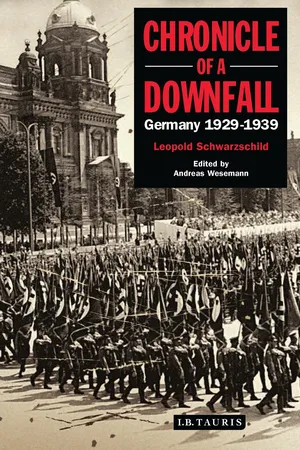
Few figures of interwar Germany were as influential as Leopold Schwarzschild, the brilliant editor of the liberal magazine 'Das Tage-Buch'. In the uncertain years of the Weimar Republic, Schwarzschild became famous for his perceptive political analyses and critique of the economic policies of successive governments in the twilight of Germany's first experiment with democracy. When he was forced to emigrate in 1933, following Hitler's rise to power, he pursued his analysis of developments in Germany from Paris, where he resumed publication of his journal under the new name 'Das Neue Tage-Buch', while also mounting a furious attack on the European powers taken by surprise by the Nazi ascendancy. 'One thing is already beyond question today...', he wrote in the spring of 1933, '...part of the new era is an unremitting descent into some kind of military conflagration'. Winston Churchill, a great admirer of Schwarzschild, made one of his later books required reading for the War Cabinet, yet his campaigning journalism has never before appeared in English.
In bringing his writings to an English-speaking readership, Chronicle of a Downfall will restore Leopold Schwarzschild to his rightful place as one of the most poignant chroniclers of the fall of German democracy and the descent of Europe into World War II.
- 256 pages
- English
- ePUB (mobile friendly)
- Available on iOS & Android
eBook - ePub
About this book
Trusted by 375,005 students
Access to over 1.5 million titles for a fair monthly price.
Study more efficiently using our study tools.
Information
Das Neue Tage-Buch 1933–39
Caught up in the nationalist revolution – 1 July 1933
I
Five months have passed since Captain Franz von Papen and Colonel Oskar von Hindenburg, who, shortly before, had seen it as in their own interest to dismiss Hitler’s claim to the post of Chancellor with a resounding ‘No!’, suddenly discovered their interests demanded the opposite. Historians will find it impossible to fathom how it was that on 13 August 1932 the national interest, which is naturally always the sole deciding factor, decreed that the man who insisted on absolute control should be kept out, while on 30 January 1933 it decreed he should be called in.
In the first instance they will simply note that in the interim Herr Franz von Papen had lost the office of chancellor and that he had sworn at all costs to overthrow his overthrower, Schleicher, and to haul himself back up on top.
In the second instance they will simply note that in the meantime Herr Oskar von Hindenburg had become the source of a scandal, which Schleicher had at the very least done nothing to prevent and which was giving off an increasingly foul stench. This scandal – ironically it was General Ludendorff who had taken command of the newspaper campaign – was a regular you-scratch-my-back-and-I’ll-scratch-yours scandal involving the neighbouring estates of Herr Hindenburg and Herr Oldenburg-Januschauz1 in which one back was scratched with millions from a private foundation as well as undeclared taxes, the other with millions intended by the government to support bankrupt East Prussian estates and further undeclared taxes. The whole affair stank to high heaven and the commentaries in the left-wing and Centre Party newspapers grew more and more scathing. Together with other pieces of sharp practice by aristocratic landowners it had been the subject of a question in parliament. An investigation was in progress. A public debate in parliament was imminent.
It was at precisely this point – and that alone is what historians will be able to record – that a new revelation befell Colonel von Hindenburg, namely that the new revelation that had befallen Captain von Papen pointed in the right way and that now the national interest decreed the opposite of what it had decreed in August. Herr Hitler, with his demand for absolute control, with the millstone of his Party’s debts round his neck, with the 20 per cent fall in votes at the last election, with Gregor Strasser splitting the Party behind his back and the certain, universally accepted, sharper fall-off of support facing him – this Herr Hitler was summoned to the presidential palace. The new carve-up of posts was agreed by a trio, later a quartet, behind closed doors; and it was further agreed that this pacte à quatre, hatched in the dark, under no compulsion whatsoever, contrary to all developments and expectations, by a capricious and despotic clique, should be masked by the glittering firework display of a ‘revolution’, a ‘national revolution’. In the afternoon the nation learnt that since the morning it had been involved in a victorious revolution. In the evening the brown and grey crypto-armies were sent out on a torchlight parade, to make clear to the public, with due pomp and circumstance, the success of the revolution ordained from above, from the very top. Whilst revolutions usually build up pressure, then explode and bring about a change of government through the force of the explosion, in this case the change of government came first and then the non-existent revolution was staged by our new masters, ex post facto, so to speak.
When did a nation ever have the opportunity to take part in a ‘revolution’ that was not led from below against those in power, but led from above against those who had already been overthrown?
When did a nation ever have the opportunity to combine the greatest social ecstasy – revolt – with the greatest social respectability – strict subordination to the legally constituted authorities?
The masquerade worked its magic. The government’s call to people to ignore the law, their announcement that savagery and violence were now not just allowed, but actually were the law, their promise that in this way every German would find bread, prosperity and freedom from troublesome competitors, released the raging movement which completely disguised the fact that the whole scene change was nothing more than a backstage fix between three soothsayers with seriously tarnished political or personal reputations.
The ‘revolution’ broke out and its unleashing really did serve the purpose for which Messrs Papen and Hindenburg II – hardly revolutionary types! – had adopted it as part of their script. In the face of the torrent pouring forth, no one, neither insiders nor outsiders, got round to assessing the individuals and circumstances that had, secretly and treacherously, opened the floodgates. The mere existence of the torrent seemed to prove that it must have forced its own way into history. The tracks of those two noble gentlemen who, for such noble reasons, had picked the lock of the back door to let the current occupiers in and then proclaimed the event from the balcony at the front as the verdict of history were washed away in the deluge of the ex-post-facto revolution. A success! The noble gentlemen could congratulate themselves. Five months ago ...
II
The months that have passed since then have presumably taught even those two noble gentlemen that their biggest mistake was to sanction and arrange the unleashing of the masses as the backdrop for their little fix. On 30 January they calculated that it would be they and the forces of their Junker class who would actually govern, with Hitler as their figurehead. And their calculation was correct – as long as the result was no more than a change of government and a stricter dictatorial system of government. They had eight ministries against three for the National Socialists. They had the backing of the President. They had control of Prussia. They had the army, business and, in reserve, the paramilitary Stahlhelm units. They could be pretty certain of staying in the saddle, provided that while negotiating this awkward hurdle they kept the racehorse – the people – on the tightest possible rein. Instead, they themselves spurred it on, whipped it up into a gallop, lashed it into a frenzy. Their strength lay in precisely those factors by means of which a privileged minority can rule the masses, and can rule them all by itself. As soon as they called on the masses to play an active role, to go out onto the streets, to exercise the authority of the state themselves, they destroyed the foundations on which their privileged position rested. It is impossible to have a ‘revolution’, that is, to rouse the many to independent action, without at the same time reducing the power of the few by a corresponding amount. One could not foresee that the intelligence and basic instincts of the Hindenburg-Hugenberg clique would be so debilitated that they could not comprehend even these elementary truths. One was justified in assuming that the torchlight processions of 30 January would be the only real concession to the mob. Even the most stupid, we assumed, would not be so stupid as to be taken in by their own slogans to the extent that they would allow the ‘uprising’ to carry on its merry way until they themselves were swept from power. No one could have imagined that a caste, whose sole asset was its centuries-old tradition, revived between 1918 and 1933, in the exercise of power, would be so intoxicated by patriotic demagoguery, impassioned vows of brotherhood and uniforms marching up and down that they would agree to the drastic measures which prepared their own, later elimination.
It is difficult to cite the precise point at which the ‘revolution’ had, of its own force, so emasculated its aristocratic partners that they were left defenceless and found themselves transformed from ally into victim. Does it matter? They are hors de combat. That most determinedly reactionary of castes, the Prussian Junkers and their hangers-on, has paid for its sole revolutionary venture with the end of its rule, at least for the time being and for the duration of the revolution, which seemed such an excellent idea to the talented Hindenburg-Papen duo. This caste, the classic instrument for ruling Germans, seems no more capable of playing any role at all in the phase of German history that will bear the sign and stigma of the swastika, nor even of influencing its course, than all those groups and parties which only yesterday it was helping to subjugate or to vilify.
III
The elimination of the German National Party is particularly striking not merely because it was, of all the groups that were still drifting along in suspended animation, the one with the most solid foundation. It is striking above all because the various stages of the elimination of Hugenberg were quite clearly not the result of a decision from above but of pressure from below. Once the question of power had been decided, it was clear that Mussolini’s method of dealing with the party system would also be copied (while the Hungarian fascists, for example, invented different, much more flexible forms). The negative aspect of the one-party programme was settled: not to allow any cell or unit to survive which could become the source of a future attack. But beyond this certainty on the negative – namely that the National Socialist Party will not tolerate any political organisation beside its own – there remained uncertainty on the positive side – namely how political goals were to be developed within its own organisation. And in this area the fall of the German National Party, which is mixed up with all the problems of deciding between a socialist or capitalist, conservative or working-class way forward, provides some important hints.
For it appears that everything that was undertaken in any area against the aristocratic and middle-class right wing, which we can lump together for the sake of convenience, came from lower reaches – difficult to specify with any precision – of the Party, and the upper tiers only followed, reluctantly and one step at a time, as far as was unavoidable. Remember the hundreds of attacks on the Stahlhelm in the villages, in towns, in whole Länder such as Brunswick, which kept being repudiated by the next higher level up the command chain, several times by Hitler himself, only to drag on after every half-hearted compromise.
Remember the hundreds of directives not to do anything to upset industry or any kind of business, the only result of which so far appears to be that works cells, mayors and other Party organisations continue to agitate for change. The clear image is of a Party leadership which naturally wants to consolidate it power all round but does not want to touch the social order because it has made it to the top and because its whole history, its ties and instincts incline it to the upper classes and the aristocracy. Facing them, however, is a hierarchy of many millions, from the second-string of Kerrls,2 Kubes,3 Freislers,4 Leys,5 right down to the unknown storm trooper, worker, farmer and shopkeeper, who are expecting (or promising) that the real change, the great moment of fulfilment is yet to come; in their revolutionary fervour they are sufficiently uninhibited to continue to push forward, now in one place, now another, on their own initiative. There is a struggle going on between those at the top and those below in which the back-up and support of Hugenberg and his class was of such fundamental importance as a buffer to Herr Hitler, later presumably to Herr Goering as well, that they certainly had no desire to disown and annihilate them during the present phase. It wasn’t Hitler – who could now be called a German Nationalist himself; at least one has not heard him use the word ‘socialist’ for many a long day – it wasn’t the ‘Führer’, with his need for stability, who wanted to give his ally in the fight against his own revolution the coup de grâce so soon. And it is symptomatic of the whole process in which Germany has been caught up since the ‘revolution’ was unleashed that this pressure from below has been strong enough to force the leadership to sacrifice its own accomplice.
One could say that the ‘Führer’ is in the same position in 1933 as his worthy predecessor, Ebert, was in 1918. Both had to get their revolutionaries quickly back on a tight leash. Ebert’s success in shackling the forces of radical change, which laid the foundations of the Third Reich, was both thorough and exemplary. In memory of this achievement, the street leading to the Reichstag in the capital, where all memory of the ‘November criminals’ and ‘Marxists’ has been erased, still bears the honourable name Friedrich-Ebert-Strasse. For Hitler the task is more difficult. Social Democracy had only made promises to the industrial workers, so they were the only people Ebert had to cheat out of their promised rewards. The promises (the public promises!) made by National Socialism, inflated to extravagant levels, have been showered on the industrial workers and the farmers and the middle class. They are absolutely incompatible, each one directly contradicting the other. Each of the three estates is ‘on the move’ – to get what they were told was their due. Moreover Hitler’s armed force, the SA, is to a large extent identical with the revolutionaries. And they are not peaceable men, nor are they weary of conflict, in fact they have hardly had a proper taste of the intoxication of violence. The outcome of this subterranean struggle can no more be predicted than the outcome of a game of chess that has only just begun.
It is possible that those are right who suspect that all efforts to divert this struggle towards easier targets – and initially such efforts can be expected to come in waves – will only prolong the revolutionary ferment and make matters worse. They may also be right in arguing that under the pressure of the crisis, which no amount of fake statistics can relieve, the revolution will continue to drift along its unpredictably haphazard way, with no guiding idea and no progamme, into confusion, disruption and anarchy. But it is equally possible that eventually the German nation’s instinct for obedience will be sufficient – despite years of schooling in ruthlessness, despite the pathological stimulation of every instinct of hatred and envy, despite all the drill and calls for violence and for taking the law into one’s own hands, despite the idolisation of emotion and the downgrading of reason, despite the glorification of arbitrary despotism and lawlessness – to restrain and subjugate it, to force it under the yoke of a solid dictatorship, where it will have to suffer in silence whatever joy or misery awaits it. No one can say what the outcome will be. All prophecies, however convincing they sound, however scientific the jargon they are couched in, are pure guesswork. Just one thing is clear: this revolution is not over yet, only now has it reached the stage where it is gradually changing from a matter between the victorious party and its opponents into a process within the victorious party.
IV
There is only one patch of dry ground in this murky, seething morass of uncertainty. Whatever happens, one thing is already beyond question today: part of the innate and immutable characteristics of the new era is an unremitting psychological and physical descent into some kind of military conflagration. The field of war is the only area in which National Socialist theory and practice are completely clear and in harmony, the only area in which from day one a consistent line has been pursued. What can be said about that is clearly set out not only in Hitler’s Holy Writ (of which, at the same time as they take offence at people ‘still’ quoting from it ‘even today’, they are pouring thousands and thousands of free copies into schools, universities, associations and factories); it is also set out in all the speeches for home consumption; and it is most clearly set out in the measures taken by the government. The Commissioner for Sport – when addressing the home audience – has made no secret of the fact that he sees his task as fulfilling a ‘military’ objective; and the Commissioner for the Labour Service – when addressing the home audience – has made no secret of the fact hat he sees his mission in military terms. No one on God’s earth can or will deny that the ideals which are instilled in the Hitler Youth, the SA, the SS, the Stahlhelm and whatever else are military, entirely military. Nor will anyone need to rack their brains about what mysterious psychological purpose is served by the patriotic ceremonies and solemn commemorations which have come so thick and fast. And it is a fact that even in the area where the new era is still stumbling around in the dark, in economic policy, the only firm steps that have been taken are those securing Germany’s supply of war materials; it was this consideration that was expressly given, in the official communiqué, as the reason for the Law on Fats of April – the sole substantial piece of economic legislation that has so far been enacted.
Bearing all that in mind, it means little that occasionally – for foreign consumption – a peaceful tone is adopted. And it means nothing at all when they protest, ‘But we have no military equipment!’ – a claim which, despite Goering, Rheinmetall6 and BMW, may still be partly true today but will, at some point or other, be completely untrue, if only because the current equipment for land warfare is becoming obsolete at a galloping pace and even today is not much more than scrap metal, compared to equipment for the air force. It is not the armaments that are the priority at the moment, but the nation’s psychology, whose pressure gauge is constantly kept at the level of an army camp about to march off to war. No, there is no war planned, there is no desire for war at the moment. Nothing concrete, nothing immediate. But there is that terrible gospel according to Herr Hitler and the banalities of his patriotic outpourings on our ‘great Fatherland’. Behind them is a very literal interpretation of the word ‘great’: it is understood in terms of square metres. At Versailles Germany lost some provinces; since then it has lived in poverty and shame. Honour and wealth can only be restored if the film can be run backwards: if those same square metres can be reconquered or at least some others, at best even more, simply conquered.
The gospel according to Hitler appears in a thousand forms. It speaks in the demand for treaty revision. It lies behind the call for colonies. It is the driving force behind the claim to Austria. Mess...
Table of contents
- Cover
- Author biography
- Title page
- Copyright page
- Contents
- Publisher’s Note
- Introduction
- Das Tage-Buch 1929–33
- Das Neue Tage-Buch 1933–39
- Notes
Frequently asked questions
Yes, you can cancel anytime from the Subscription tab in your account settings on the Perlego website. Your subscription will stay active until the end of your current billing period. Learn how to cancel your subscription
No, books cannot be downloaded as external files, such as PDFs, for use outside of Perlego. However, you can download books within the Perlego app for offline reading on mobile or tablet. Learn how to download books offline
Perlego offers two plans: Essential and Complete
- Essential is ideal for learners and professionals who enjoy exploring a wide range of subjects. Access the Essential Library with 800,000+ trusted titles and best-sellers across business, personal growth, and the humanities. Includes unlimited reading time and Standard Read Aloud voice.
- Complete: Perfect for advanced learners and researchers needing full, unrestricted access. Unlock 1.5M+ books across hundreds of subjects, including academic and specialized titles. The Complete Plan also includes advanced features like Premium Read Aloud and Research Assistant.
We are an online textbook subscription service, where you can get access to an entire online library for less than the price of a single book per month. With over 1.5 million books across 990+ topics, we’ve got you covered! Learn about our mission
Look out for the read-aloud symbol on your next book to see if you can listen to it. The read-aloud tool reads text aloud for you, highlighting the text as it is being read. You can pause it, speed it up and slow it down. Learn more about Read Aloud
Yes! You can use the Perlego app on both iOS and Android devices to read anytime, anywhere — even offline. Perfect for commutes or when you’re on the go.
Please note we cannot support devices running on iOS 13 and Android 7 or earlier. Learn more about using the app
Please note we cannot support devices running on iOS 13 and Android 7 or earlier. Learn more about using the app
Yes, you can access Chronicle of a Downfall by Leopold Schwarzschild, Andreas P. Wesemann in PDF and/or ePUB format, as well as other popular books in History & 20th Century History. We have over 1.5 million books available in our catalogue for you to explore.