- 368 pages
- English
- ePUB (mobile friendly)
- Available on iOS & Android
eBook - ePub
About this book
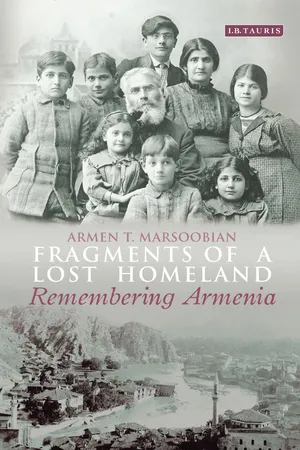
The Armenian world was shattered by the 1915 genocide. Not only were thousands of lives lost but families were displaced and the narrative threads that connected them to their own past and homelands were forever severed. Many have been left with only fragments of their family histories: a story of survival passed on by a grandparent who made it through the cataclysm or, if lucky, an old photograph of a distant, silent, ancestor. By contrast the Dildilian family chose to speak. Two generations gave voice to their experience in lengthy written memoirs, in diaries and letters, and most unusually in photographs and drawings. Their descendant Armen T. Marsoobian uses all these resources to tell their story and, in doing so, brings to life the pivotal and often violent moments in Armenian and Ottoman history from the massacres of the late nineteenth century to the final expulsions in the 1920s during the Turkish War of Independence. Unlike most Armenians, the Dildilians were allowed to convert to Islam and stayed behind while their friends, colleagues and other family members perished in the death marches of 1915-1916.Their remarkable story is one of survival against the overwhelming odds and survival in the face of peril.
Trusted by 375,005 students
Access to over 1 million titles for a fair monthly price.
Study more efficiently using our study tools.
Information
1
The Dildilians of Sivas
How the Family Got its Name
The Dildilian family story begins in the mid-eighteenth century. I say “story” because what we know about my family in those early years was shared orally by one generation with the next. I do not know when these stories were first written down, but in a speech my grandfather Tsolag tells us that his grandfather, Mourad, often read aloud family stories from what he calls “a book of dreams.” This book has long been lost, but decades later these stories appeared in the memoirs of both Aram and Maritsa.
The Dildilian family name has long been associated with photography but much before the invention of photography in 1839, the Dildilians were practicing a variety of skilled crafts in the Anatolian city of Sivas, known to many Armenians by its earlier name, Sebastia. One of these crafts, blacksmithing, accounts for the creation of the family surname, Dildilian, a name unique among Armenian surnames. Unlike most Armenian surnames shared by many unrelated families, the Dildilian name is found only among Armenians who are members of our extended family. Aram begins his memoir with a description of one of his earliest known ancestors: “My great-grandfather, Garabed, was a blacksmith. He was born and lived and died in Sivas, Asia Minor, which is situated on a high plateau by the Alice River (Kuzul), which was once the capital city of an Armenian king, Senekereme. That is why that western section [of the Armenian Highlands] is called Poker Haigks, ‘Minor Armenia’.”
As I discovered only recently, the Dildilians were not always called “Dildilian,” but at one time went by the surname Keledjian. My great-great-great-grandfather, Mouradentz Garabed Keledjian, born in Sivas in 1768, was the talented blacksmith identified above whose act of skill caused the surname change. My grandfather Tsolag, the eldest of his siblings, provides the first known record of this event in a speech given to family and friends in January of 1928:
My grandfather Mourad had a “Book of Dreams” in which it was recorded that 150 years ago a military Pasha came to Sebastia and sent for a farrier, commanding that his 400 horses be shod with new horseshoes within four days. “If you cannot fill the order, your head will be off.” The poor craftsman, driven by the fear of losing his head, with an unbelievable speed finishes the task, puts the pincers and the hammer at the Pasha’s feet and salutes him. The Pasha lifts his head and asks, “What do you want?” The master craftsman replies, “Sir, your command has been completed.” The surprised Pasha says, “Aferim, usta duel duel mi oldun.” (Bravo, master, you are the master duel duel.) Duel Duel is a small fast-moving horse from Mytilene [a Greek island in the Aegean off the west coast of Turkey, in Turkish called Midillisi]. Thus, as a result of grandfather’s saving his head, today, I, his grandson – I do not know by how many generations – keep his respectable surname, Dildilian. I, too, have saved my head by a hair’s breadth from Pashas.1
Aram’s memoir includes a slightly different version but still involves the family being named after a fast horse.

4. A pair of Midilli/Mytiline ponies in a stable.
Maritsa many years later recounts the story of this defining event but gives a different version of the specific origin of the name “Dildilian.” There is no fast Mytilene pony referenced in this story:
This is how the Keledjians became the Dildilians.
A long time ago, when the beys had armed escorts of men on horseback or on foot and could thus rob, abduct and ransom … a bey brings, I don’t know how many horses to be re-shoed … instructing him to have the job completed before daybreak or he would be beheaded. Begging, or imploring the implacable bey would be futile. The bey knows it is an impossible task.
The blacksmith sets to work. When the bey comes the next morning, the blacksmith is distraught, and having just finished the job, he presents his tools at the bey’s feet. But weariness and awe are such that he is unable to speak. Surprised at his silence, the bey asks him: “Dilinle mi nallatın?” (Did you shoe them with your tongue?) But the master still cannot utter a word, so the bey cries: “Dil, dil!” (Your tongue, your tongue!) In other words, “Speak up!”
These words remained and the blacksmith was called dildil, which became Dildilian.
Whether named in honor of a fast pony or a tongue-tied blacksmith, the Dildilian name stuck.
My Great-Great-Grandfather:
The Successful Merchant or the Loafing Man of Leisure?
For those fortunate to have a family memoir that tells stories about ancestors and events long since past, the reader is usually given a singular perspective. The memoirist controls the space of memory. Characters may be sugar-coated or demonized. In the case of the Dildilian family story, we have multiple perspectives, both written and oral, male and female. Sometimes they may disagree about the facts, though more often they color those facts with their own meanings. Differences about religion will come to play a profound role in our memoirists’ judgments about these facts. A more benign disagreement, one not based on religion, is evidenced in the portrayal of my great-great-grandfather, Mourad Garabed Dildilian. Mourad, unlike his ancestors in the blacksmithing trade, was a grocer. Aram briefly describes his “great-grandpa” without making any judgment as to his character. But as we will see, Aram’s sister Haïganouch certainly had a different opinion. Aram writes:
My great-grandpa, Garabed, had only one son, who was my grandfather, Mourad, and two daughters, Karan and Yeva. Grandpa Mourad was a tall, strong man. He had a grocery store. He married a very rich man’s only daughter, Margaret Dildarian, a very short lady. They were blessed with three sons. My father, Krikor, was the first-born in 1838 in Sivas. He was fair complexioned, hazel eyed, and had black hair. My dearest uncle Haroutioun, was born in 1854 in Sivas, and was fair, with blue eyes and brown hair. My youngest uncle Mikael was born 1863 in Sivas and was fair with brown eyes and black hair.
To give you a flavor of what a grocery store would look like in mid-nineteenth-century Sivas, Aram drew a sketch.

5. Mourad Garabed Dildilian’s grocery store drawn by Aram Dildilian.
Now Haïganouch had a starkly negative opinion of her grandfather, whom she chooses to call by his second name, Garabed. She conveyed her unflattering view of her grandfather to her daughter Maritsa, whose words capture her mother’s perspective:
Garabed is a handsome young man with delicate features, nice-looking but almost penniless. But he is probably a lucky man.
He marries the daughter of Dildarian, a wealthy and well-known man. The girl was of short height but this was offset by many qualities. She had a sharp mind and a sure taste, she was active, hard-working and full of common sense, in one word she was a pearl as her name said: Markarid, the pearl.
She had no money problems as a married woman. She lived a quiet and serene life with her three children, Krikor, Haroutioun and Mikael. It may be said that the children were brought up by the sole care of their mother, as Garabed did not work and had progressively become a perfect loafer. My mother used to say, when speaking of him: “My lazy grandfather.” While his wife knitted stockings, or embroidered crepe cloth ornate with gold or silver threads or velvet cloth for the trousseaus of Turkish girls while at the same time bringing up her children.
Maritsa describes how Markarid and her children were often very busy with household chores and activities in order to bring in more household income. Yet Mourad Garabed seemed oblivious: “And while these activities were going on, the father carelessly was playing knucklebones on the house terrace.”
Knucklebones, or what is more commonly called the game of jacks, has a venerable history which some have traced to Asia Minor. Knucklebones is a very ancient game usually played with five small objects, originally the “knucklebones” or hocks of a sheep, that are thrown up and caught in various ways. Sophocles, in a fragment, ascribed the invention of knucklebones to Palamedes, who taught the pastime to his Greek countrymen during the Trojan War. Maybe the game was then picked up by the locals and spread across Anatolia, finding itself in the DNA of Mourad Garabed! Successful merchant or a lazy loafer who loved to play jacks and lived off his wife’s money and hard work – we will never know for sure.
Great-Grandfather Krikor:
A Son Who Chooses a Different Path
Krikor Dildilian, my great-grandfather, was a man much admired by all members of the family. He was born in Sivas in 1838. The eldest of three siblings, he eventually chose not to follow his father into the grocery business. This last statement must be qualified because he did make an unsuccessful childhood attempt at being a grocer. Aram relates the following about his father:
One day when he was about four or five years old, he suggested to his cousin to play grocery store in the basement where his father stored his extra supplies. In the olden times, grocery men used to display all their merchandise in the open on big round wooden or straw trays, side-by-side and in rows … So, to imitate the grocery store, my father gets a bright idea. He takes his father’s gold-embroidered Sunday blue jacket and cuts it in small square pieces, puts them side-by-side in rows and uses them as trays. On each square he puts some raisins, nuts, candy, and other dried fruits, etc. Soon they get tired of playing grocery store and want to drink sherbet but instead of mixing it in a small bowl, they pour the readymade candies into the upper small basin of the running fountain with the expectation of drinking sweet sherbet from the faucet. Fortunately, a passerby neighbor notices some candy floating on the river in front of our house as the drain was connected to the river (I should add that in those days candies were very expensive). So he follows [the trail of candies] up the river and notices that it is coming out of our house. He knocks on the door and warns of what is going on, but by that time the candy sack was half full. Maybe his rich grandfather, Dildarian, saw in his grandchild some business ability in that childish but costly grocery game. Maybe that was the incentive for him to send father to Constantinople in his early youth to manage his business … and surely he became a real success there.
Despite this early business failure, if you could call it that, Krikor did develop his skills as a merchant and businessman. His grandfather employed him in the family business and sent him to Constantinople and to other cities. Aram writes admiringly of his father: “My father was a smart man, quite well-informed and educated for his time. He was wise, prudent, progressive, diplomatic, good-natured, influential, and he knew how to make friends. I suppose he was a born businessman too.”
Even as a very young man, Krikor seemed to have a bright future in Sivas. Maritsa also describes how he assisted his mother in her various home textile activities and soon found himself in the family business: “In the course of selling objects made by his mother and of making purchases, Krikor gained experience in the art of trade, which did not escape the attention of his uncle who took him as an apprentice at the age of 14.” This entrepreneurial trait not only characterized Krikor but was passed down to the next generation, for my grandfather’s generation was highly successful in a variety of endeavors even in the midst of some very difficult economic times.
Mid-nineteenth-century Ottoman city centers, such as the one in which the family home was located, often had houses constructed close together with walled courtyards in the rear. Such close-in construction provided a degree of security, that is, if one could trust one’s neighbors. Both Aram and Maritsa tell a story in which such proximity may well have encouraged a crime. Aram writes:
In those days there were no banks or safes and safe deposit vaults to keep money in as there are now, so businessmen used to keep the daily earned money at home or put it in the bedroom in money sacks made of goat’s hair. One night while father Krikor was sleeping in his room, he wakes up to some noise and sees in the dark a man across his room’s window trying to put a plank to the window. So, in fear, he cries for help. The man must have been scared and ran back to his room. Next day, father goes to a Turkish friend, a very influential man, and he, in turn, said not to worry and not to tell anyone else about it. He tells father to go to his room at night as if nothing had happened, put the candle light on, pour out all his money and count it, and take his time in counting, put the money back into the sack and put it next to his bed and go to bed pretending sleep. In the meantime, he [the Turkish friend] sends his guard to take care of Krikor. The guard comes to the room beforehand and hides himself next to the window. Father goes to bed as if nothing had happened, putting the money sack near his pillow. Sure enough, about midnight the man puts a plank across the window again and walks towards father’s window and tries to open the window latch. By the time he stretched his arm, bang! The sharp sword of the guard comes down in force. He misses the thief’s arm, but two of his fingers fall on the floor (I remember very well that my father used to keep those fingers in his desk as a souvenir).
Maritsa relays a similar story but with a slightly different twist. Justice was meted out not by a Turkish guard, but by Krikor himself, and the culprit was a “turbaned mullah.” The upshot was the same: “a number of fingers fell onto the floor.” No mention is made here of souvenirs.
Krikor was young, ambitious and with the help of his mother’s family seemed well on the road to a successful business career in his ancestral hometown of Sivas. With these bright prospects, it was natural that marriage should come into the picture. Markarid, Krikor’s mother, would be the matchmaker as was the custom in those days:
After a few years, the uncle [the wealthy Dildarian brother of his mother] wanted to send Krikor to some other place. Krikor’s mother thought it would be better if he were engaged first and she started to look for a suitable girl. One day, as she was coming back from a girl-viewing visit [that is, match-making visit], the young girl who had just been placed with her as an apprentice seamstress came running to welcome her. As usual, the girl had taken off the veil covering her head that she wore as a sign of deference and, for the first time, Markarid closely observed the girl. She thought: “Why a far-flung quest? This girl is quite all right” and she had her engaged to her son. After that, Krikor went to work as a migrant trader or merchant [bantoukht]. He succeeded in his ventures and earned much money for his uncle.
Krikor’s youthful days of success in Sivas were not to last. In Maritsa’s account, passed on to her by her mother, Krikor’s travels to Constantinople and beyond were not all a result of being brought into his maternal grandfather and uncle’s business. Quite the opposite, as we will see, some of these travels found their origins in the greed of family and neighbors and the slanders made against him by those jealous of his success.
A Sojourn in Yozgat: The Dildilians Start Over Again
“Yozgat,” another strange-sounding name from my youth. I remember as a young teenager seeing this name for the first time on a fancy hand-drawn family tree that was being passed around at one of our family reunions. Every autumn we would make the long journey up from New York City to Broadalbin, or in l...
Table of contents
- Author Biography
- Title Page
- Copyright Page
- Contents
- Preface
- Acknowledgments
- Introduction: Telling Our Story – How It All Began
- 1 The Dildilians of Sivas
- 2 Prosperity and Loss Soon to be Captured in the Dildilian Camera Lens
- 3 The Childhood Recollections of Aram Dildilian
- 4 The Hamidian Massacres of 1894–96 and their Aftermath
- 5 The Dildilians Begin their Separate Paths
- 6 The End of a Century and New Beginnings
- 7 The Prosperity and Premonitions of the Pre-War Years
- 8 The Clouds of War and Catastrophe
- 9 The Years after the Great War: Rebuilding their Shattered Lives
- 10 Their Days Are Numbered: No Place in Turkey for the Dildilians
- Notes
- List of Illustrations
Frequently asked questions
Yes, you can cancel anytime from the Subscription tab in your account settings on the Perlego website. Your subscription will stay active until the end of your current billing period. Learn how to cancel your subscription
No, books cannot be downloaded as external files, such as PDFs, for use outside of Perlego. However, you can download books within the Perlego app for offline reading on mobile or tablet. Learn how to download books offline
Perlego offers two plans: Essential and Complete
- Essential is ideal for learners and professionals who enjoy exploring a wide range of subjects. Access the Essential Library with 800,000+ trusted titles and best-sellers across business, personal growth, and the humanities. Includes unlimited reading time and Standard Read Aloud voice.
- Complete: Perfect for advanced learners and researchers needing full, unrestricted access. Unlock 1.4M+ books across hundreds of subjects, including academic and specialized titles. The Complete Plan also includes advanced features like Premium Read Aloud and Research Assistant.
We are an online textbook subscription service, where you can get access to an entire online library for less than the price of a single book per month. With over 1 million books across 990+ topics, we’ve got you covered! Learn about our mission
Look out for the read-aloud symbol on your next book to see if you can listen to it. The read-aloud tool reads text aloud for you, highlighting the text as it is being read. You can pause it, speed it up and slow it down. Learn more about Read Aloud
Yes! You can use the Perlego app on both iOS and Android devices to read anytime, anywhere — even offline. Perfect for commutes or when you’re on the go.
Please note we cannot support devices running on iOS 13 and Android 7 or earlier. Learn more about using the app
Please note we cannot support devices running on iOS 13 and Android 7 or earlier. Learn more about using the app
Yes, you can access Fragments of a Lost Homeland by Armen T. Marsoobian in PDF and/or ePUB format, as well as other popular books in History & 20th Century History. We have over one million books available in our catalogue for you to explore.