Bernard Porter is Emeritus Professor of History at the University of Newcastle. He has also taught at the universities of Cambridge, Hull, Yale, Sydney, Stockholm and Copenhagen. He has published ten books before this one, many of them on imperial themes, including Critics of Empire, The Lion’s Share and The Absent-Minded Imperialists. He also contributes regularly to the London Review of Books, the Guardian and other journals.
- 224 pages
- English
- ePUB (mobile friendly)
- Available on iOS & Android
eBook - ePub
About this book
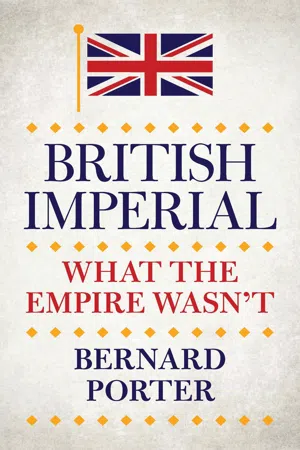
The British Empire is often misunderstood. Judgments of it differ widely, from broadly adulatory - a 'great' enterprise, spreading 'civilization' through the world; to the blame that is often put on it for most of the world's ills today, including racism, exploitation and the problems of the Middle East. In this provocative book, Bernard Porter argues that many of these judgments arise from some fundamental misreadings of the nature, causes and effects of British imperialism, which was a more complex, ambivalent and in some ways accidental phenomenon than it is often taken to be. Drawing on his fifty years' experience of research and writing on the subject, Porter aims to clear away many of the misconceptions that surround the story of the British Empire's rise, governance and fall; and to point some ways to a fairer (though not necessarily more favourable) assessment of it. He addresses the connections of imperialism with capitalism, racism and British domestic culture, and ends with some reflections on the modern repercussions of both the Empire itself, and the myths which have sprung up around it.
Trusted by 375,005 students
Access to over 1 million titles for a fair monthly price.
Study more efficiently using our study tools.
Information

‘Bernard Porter writes in a clear and engaging manner and does not hesitate to take on some of the most difficult and controversial issues’
Wm. Roger Louis, Kerr Professor of English History and Culture, The University of Texas at Austin
‘Bernard Porter writes with the authority and verve one has come to expect from an author of a number of books on the history of the British Empire. This one is short, pointed, iconoclastic and highly readable. He makes the point that the “the British Empire is misunderstood in popular mythology”, and in clarifying why this is so, he succeeds wonderfully well. Porter’s British Imperial is sure-handed and confident and his publication is to be welcomed and celebrated.’
C. Brad Faught, Professor of History, Tyndale University College

Published in 2016 by
I.B.Tauris & Co. Ltd
London • New York
www.ibtauris.com
I.B.Tauris & Co. Ltd
London • New York
www.ibtauris.com
Copyright © 2016 Bernard Porter
The right of Bernard Porter to be identified as the author of this work has been asserted by the author in accordance with the Copyright, Designs and Patents Act 1988.
All rights reserved. Except for brief quotations in a review, this book, or any part thereof, may not be reproduced, stored in or introduced into a retrieval system, or transmitted, in any form or by any means, electronic, mechanical, photocopying, recording or otherwise, without the prior written permission of the publisher.
Every attempt has been made to gain permission for the use of the images in this book. Any omissions will be rectified in future editions.
References to websites were correct at the time of writing.
ISBN: 978 1 78453 445 5
eISBN: 978 0 85773 957 5
eISBN: 978 0 85773 957 5
A full CIP record for this book is available from the British Library
A full CIP record is available from the Library of Congress
A full CIP record is available from the Library of Congress
Library of Congress Catalog Card Number: available
Text designed and typeset by Tetragon, London
Contents
- Introduction
- 1 Hybridity
- 2 Riding the Beast
- 3 Imperialisms, Left and Right
- 4 In the Field
- 5 How It Happened. Broadly.
- 6 The Empire at Home
- 7 The Beginning of the End
- 8 Legacies
- 9 Conclusions
- Bibliography and Notes
For Jasmine, Sid, Allie,
Tegan, Edie, Mary and Sonja:
when they’re old enough to read it.
Tegan, Edie, Mary and Sonja:
when they’re old enough to read it.
Introduction
The British Empire is so misunderstood. Not by serious students of it, necessarily, but in popular mythology. The idea for this book first came to me when I was once asked by a fellow guest at a party in Sweden, who had learned what I work on – I usually try to keep it quiet, but she was insistent: ‘Why on earth did you’ – she meant Britain, not me personally, I think – ‘want an empire?’ For a good Social Democrat that seemed difficult to understand. Of course it is, put in that way. I can’t remember exactly how I replied to her, except to regurgitate some of the research I had been writing up recently that seemed to show that people generally in Britain didn’t want one, particularly. That, however, didn’t answer the underlying question, which now became: if most of you were indifferent about your empire, why did it come about nonetheless? That deserved a fuller explanation than I was able to offer over sill and aquavit at a generally light-hearted occasion in a suburb of Stockholm. Hence this short book. The idea of it is to pre-empt future questions like my fellow guest’s, which arise from a series of basic misconceptions of the subject. Of course Britain didn’t acquire her empire because she ‘wanted’ one. It was more complicated than that.
That may be uncharacteristic of empires generally. This might be one of our problems: that the word ‘empire’ immediately suggests comparisons with other historical empires, which tend to stick. The main ones in Britain’s historical memory are the Roman, which she was part of, and the Napoleonic, which she successfully resisted. Both of those were the results of conquest by men – ‘emperors’ – who set out to conquer, deliberately. The word itself also has a strong and positive resonance, deriving as it does from the Latin imperium, which meant power or authority. Together, and encouraged by late-nineteenth-century imperialists who rather liked these analogies (the first one, at any rate; the second was too close for comfort), this puffed up the image of the British Empire into something quite different from the reality. Later the fault was compounded by left- and right-wing analyses of British imperialism which painted it, on the one hand, as an unconscionable evil – capitalist, racist, even genocidal – and on the other as the means by which Britain helped ‘civilise’, or ‘modernise’, the world. That is generally what the popular British debate about imperialism focuses on today. My take on it is that both sides are mistaken, because they get the whole nature of the phenomenon wrong.
Here is my understanding of most other people’s understanding of the old British Empire today. (I may be wrong; I’ve not talked to everyone.) It was big – a quarter of the earth’s land surface and a fifth of its population: or was it the other way around? – and powerful. It was what made Britain a ‘Great Power’. It went back in time to the Elizabethans – so it was pretty durable. It was accumulated by ‘imperialists’, as a matter of policy. It was cheered on by the people. It either reflected, or else permeated, British culture and society. It sought to impose British ways on everyone it ruled; all who could benefit from them, that is, because it also tended to be racist, and so to exclude ‘inferior races’, who were to be eradicated, or enslaved, or – the best hope for them – looked after for aeons like children. It was exploitative, often brutally so. In the end, however, it was dissolved voluntarily, calmly and mainly peacefully. Finally, it had a great and lasting impact on the world, either for good or for ill. As a consequence it should be a matter either of pride for us Britons today, or of shame. Is that fair? If not I may be setting up straw dolls. But it still may be worth examining the reality of British imperialism against them, using them as benchmarks or touchstones, for emphasis and clarity. They are not all entirely wrong, incidentally. That is not usually the way with historical analyses. It is why historians are so often and so infuriatingly equivocal when they are asked to adjudicate on areas of their expertise: ‘Well, yes, in a way, but…’ A number of my ideas will be along those lines; the point being, of course, that the ‘but’ is crucially important. And then, of course, there is the possibility that I might be wrong. (A number of scholars think I am on the subject of ‘popular imperialism’.) That must always be borne in mind.
What I aim to do in this book is to examine the phenomenon of British imperialism critically, by, firstly, contextualising it, against the background of contemporary British society, the situation of the world, and rival or complementary historical forces; and secondly, deconstructing it, in the sense of breaking it down into its constituent components. All this needs to be done in order to counter the common trend today to lump so many disparate things together under the name of imperialism, and then to account for them simply in terms of that word, as though the notion of ‘imperialism’ contained a sufficient explanation on its own without any further examination being necessary. (‘Oh, that’s American imperialism.’ Full stop.) Some years ago I suggested at a conference that we imperial historians agree to a moratorium on the ‘e’, ‘i’ and ‘c’ words – ‘empire’, ‘imperial’, ‘colonial’, and so on – for, say five years, forcing us to see if we couldn’t understand our subject more, or at least differently, without them. No one, so far as I can tell, took any notice of this, and in any case the five years is now up, so I won’t be following my own advice in this book; but I shall endeavour to delve behind the ‘e’, ‘i’ and ‘c’ words whenever I can. A disadvantage of this approach may be that it complicates things – it’s much easier if we put them all in one ‘imperial’ basket – but isn’t that, after all, one of the purposes of serious history? And complex doesn’t necessarily mean difficult. I’ve aimed for a clear exposition and approachable style in what follows – it wasn’t difficult; it’s how I usually write before po-faced editors come in to ‘correct’ me – with even a few jokes. I’m sure I’ll get some stick for the latter. One of my previous books was once banned by a southern American state school board for one; it made light fun of Christianity. But I’m too old and unambitious now to care.
Because it’s mainly an ‘ideas’ book, and pretty short, there won’t be much narrative in it – just a bit, to give the bare outlines of the story, and for flavour. This is partly to make the ideas stand out more clearly; and partly because I have already written my narrative account, in The Lion’s Share, now in its fifth edition, to which readers are of course directed if that’s what they want. They might also take a look at my Empire Ways, a collection of essays to be published at roughly the same time as this, which is even more flavoursome. Or, if they prefer something more up-to-date and (I think) better, to a couple of quite recent books by others, which are the first to be cited in the Bibliography.
The other caveat, or warning, I should issue at the start – a more important one – is that this is a very one-sided view of British imperialism. By that I don’t mean that it is judgementally biased – I think that readers will find it is far from that – but that it deals with the subject from a metropolitan British point of view, rather than that of Britain’s colonial subjects. It is, in other words, an account of British imperialism – its sources, motives, methods, and so on – rather than of the British Empire as such. The latter would have required far more detail and analysis of how colonial peoples were affected by imperialism, how they lived under the British flag in the Gold Coast or Bengal or New Zealand, for example, or without the British flag in places that were merely informally dominated by Britain, which – although I have read plenty of the secondary literature about this, and have kept that in mind in what follows – I have never researched to the extent that would make me feel confident about generalising in this area. A colonial view of the Empire at any time was bound to diverge from a metropolitan one, while being, of course, just as valid. The same is true of its history. But these are complementary perspectives, not alternatives. They can inform each other. If you are at the barrel end of a gun, it is useful to know what is happening at the butt.
Lastly, readers may be puzzled by the references to Sweden here. Sweden was not one of the leading European imperial powers in the period covered by this book, which may make this seem anomalous. My excuses are that I live there much of the time, and was started off on this enterprise there, as I explained at the beginning of this Introduction; but also that it never does any harm to look at even narrow national histories from a wider perspective. ‘What should they know of England who only England know?’ asked Kipling once. He meant something entirely different – he was complaining about...
Table of contents
- Introduction
- One • Hybridity
Frequently asked questions
Yes, you can cancel anytime from the Subscription tab in your account settings on the Perlego website. Your subscription will stay active until the end of your current billing period. Learn how to cancel your subscription
No, books cannot be downloaded as external files, such as PDFs, for use outside of Perlego. However, you can download books within the Perlego app for offline reading on mobile or tablet. Learn how to download books offline
Perlego offers two plans: Essential and Complete
- Essential is ideal for learners and professionals who enjoy exploring a wide range of subjects. Access the Essential Library with 800,000+ trusted titles and best-sellers across business, personal growth, and the humanities. Includes unlimited reading time and Standard Read Aloud voice.
- Complete: Perfect for advanced learners and researchers needing full, unrestricted access. Unlock 1.4M+ books across hundreds of subjects, including academic and specialized titles. The Complete Plan also includes advanced features like Premium Read Aloud and Research Assistant.
We are an online textbook subscription service, where you can get access to an entire online library for less than the price of a single book per month. With over 1 million books across 990+ topics, we’ve got you covered! Learn about our mission
Look out for the read-aloud symbol on your next book to see if you can listen to it. The read-aloud tool reads text aloud for you, highlighting the text as it is being read. You can pause it, speed it up and slow it down. Learn more about Read Aloud
Yes! You can use the Perlego app on both iOS and Android devices to read anytime, anywhere — even offline. Perfect for commutes or when you’re on the go.
Please note we cannot support devices running on iOS 13 and Android 7 or earlier. Learn more about using the app
Please note we cannot support devices running on iOS 13 and Android 7 or earlier. Learn more about using the app
Yes, you can access British Imperial by Bernard Porter in PDF and/or ePUB format, as well as other popular books in History & Asian History. We have over one million books available in our catalogue for you to explore.