While the history of the non-violent Civil Rights Movement, from Rosa Parks to Martin Luther King, is one of the great American stories of the twentieth century, the related Black Power movement has taken a more complex path through the nation's history. Formed by a multitude of individuals, the long history of the Black Power movement stretches before and beyond its political manifestations.
Beginning with the folk-narratives told on the plantation, Black Power and the American People charts a course through the iconoclasm of the Harlem Renaissance, the battleground of the American campus, the struggle and skill of the Negro Leagues, the drama of the boxing ring, the killing fields of Vietnam and the cold concrete of the penitentiary, right up to the Black Lives Matter movement of the present day. Tracing these connected cultural expressions through time, Black Power and the American People explores the profound legacy of Black Power from its earliest roots to its most futuristic manifestations, its long history in American culture and its profound influence on the American imagination.
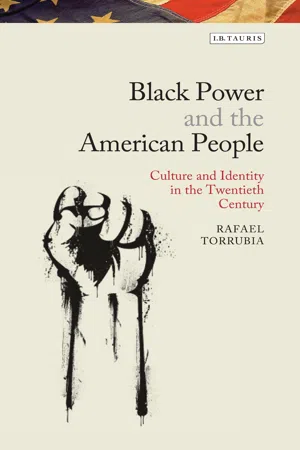
eBook - ePub
Black Power and the American People
The Cultural Legacy of Black Radicalism
- 352 pages
- English
- ePUB (mobile friendly)
- Available on iOS & Android
eBook - ePub
About this book
Trusted by 375,005 students
Access to over 1.5 million titles for a fair monthly price.
Study more efficiently using our study tools.
Information
CHAPTER 1
HOTHEADS AND DEMAGOGUES:WHAT IS BLACK POWER?
Understanding Black Power first entails grappling with the images that accompanied its emergence into American popular culture. From the outset, Black Power was presented in a two-dimensional manner due to white America’s aversion to investigating beneath the surface of a photogenic and alluring image. From this perspective, the movement’s diversity and constant evolution was manifested as chaos and disorganisation, with ideological and practical distinctions obscured in the media avalanche of berets, shotguns and snarling beasts.
The media and the militants were occasionally complicit in the creation of Black Power’s iconic imagery, most obviously demonstrated in the regalia of the Black Panther Party for Self-Defense. A carefully crafted enterprise from the start, everything about the Panthers’ iconography, from their snarling symbol, ‘a bold beautiful animal, representing the strength and dignity of black demands today’, to the classic garb of beret, dark glasses, shotgun and the oft-forgotten law book; was designed to project an image of resilience, confidence and a willingness to push back if pushed.1 This often proved a double-edged sword. As David Hilliard, Panther Chief of Staff, commented, there was a fine line between the use of violent imagery and its appropriation toward a negative stereotype.2 Even Malcolm X admitted, ‘[The press was] looking for sensationalism, for something that would sell papers and I gave it to them’.3 News coverage may have brought the image of Black Power to the forefront, but popular discussions of the concept remained clouded by misperception, assumption and fear.
This has persisted to the present day. As recently as 2003, San Francisco Chronicle journalist Kate Coleman rather archaically castigated the Panthers as a ‘bunch of thugs’ who continue to ‘capture the imagination of American intellectuals’ while fringe academic David Horowitz unsurprisingly sees any faith in the positivity of the Panther legacy as the preserve of ‘acolytes, idolaters and the credulous.’4
In order to conceive of how Black Power could have left a consistent cultural legacy the term needs clarification. The drive to ‘understand’ this new and frightening phenomenon often compromised the initial street-level surveys. Rather than explore the psychological and social factors behind militancy, surveys focused on the followers and support received by the movement. The qualifiers used to define militancy were often so vague as to be almost useless; small scale, marginal samples were used to give the aura of a clear public sentiment without being genuinely representative.5
The overriding insinuation of such surveys was that Black Power was nothing more than a fringe element which seldom matched the approval rate of the civil rights establishment.6 When black Chicagoans were asked who best represented their position, almost twenty times as many respondents favoured Martin Luther King as did Stokely Carmichael.7 The pattern seemed endlessly repeated, and yet when one 1967 study of Watts found 58 per cent of respondents favoured Black Power and only 24 per cent opposed it, the conclusion was that Black Power would fail as ‘most urban Negroes simply reject the Black Power ideology’.8 The initial flurry of media interest apparently seduced analysts into conflating wishful thinking and social science gospel. The conception of black militancy as some ephemeral, marginal force was so pervasive that in Harlem, a street gang known as the ‘Five Percenters’ named themselves after the oft-touted assumption that only 5 per cent of African-Americans were sufficiently militant to achieve change.9 There was a real problem here; as the ‘Five-Percent Nation’ demonstrated, even inaccurate interpretations of Black Power had a distinct influence on the society of the block and ghetto.
Overall, studies which show minimal support for militancy obscure the fact that Black Power was consistently more significant in its cultural aspects than as a political expression. In a 1966 national survey on contributions to the fight for African-American rights, the first African-American Major League Baseball player of the modern era, Jackie Robinson, received ten times the endorsement given to the ‘Black Muslims’, a term which incorporated the Nation of Islam, a political group fundamentally involved in practical community support projects.10 Despite his conservative politics, perceptions of Robinson’s cultural contribution were so prevalent that the Umbra co-founder Calvin C. Hernton, on applying for a prestigious job, was informed he had the potential to become the ‘Jackie Robinson’ of the company, not for his skills, but for what he represented.11
Outside of class, Black Power rode the statistics into African-American cultural consciousness.12 Distinctive new trends in clothing, cuisine, hairstyles and music found purchase with a surprisingly wide range of age groups within African-America.13 Seventy-six per cent of young northern black Americans, tellingly dubbed the ‘Stokely Generation’ by pollsters, liked the new natural hairstyles, but more significantly 45 per cent of all African-American respondents in 1969 saw the appeal.14 A 1968 survey found approximately 40 per cent of African-Americans in Detroit endorsed the wearing of dashikis while eight out of ten enjoyed soul food and music.15 With greater wealth appeared to come greater approbation of the new aesthetic, as ‘middle-income’ African-Americans both North and South took to the dashiki and buba quicker than their impoverished counterpoints.16
Surveys which assessed abstract cultural concepts like ‘soul’, ‘black is beautiful’, and collective identity suggested the cultural aspects of the Black Power movement possessed a profound and distinct appeal.17 Regrettably, the implications of these surveys were seldom explored.18 There was a more immediate concern with creating a scale of militancy, a barometer of African-American discontent, so that America could predict where and among whom the next outbreak of militant fever would strike.19 Hampered by overly subjective topics and poorly constructed samples, such surveys are unwieldy tools for investigating the foundations of the movement.
More relevance can be gleaned from individual interpretations of the meaning of Black Power. Responses of white people differed greatly from those of black people. In a Harris opinion poll towards the end of the decade, 60 per cent of white respondents expressed concern about the Black Panthers, compared to only 20 per cent of the black Americans surveyed.20 Earlier, and more explicitly, a 1967 University of Michigan survey of community perspectives found almost 60 per cent of white people equated Black Power with African-American supremacy, civil disorder and racism.21 As interviewers were matched with respondents based on race, the perspectives which emerged spoke to potentially genuine fears. Like the media, many of these ordinary men and women (a significant proportion of whom lived in the less urban lakeside areas of Grosse Pointe and Harper Woods) were intimidated and confused by the rapid and strident emergence of Black Power onto the national scene.22 At the far end of the spectrum, some white commentators warned of a complete ‘Black takeover’ effected by fervent Black Panthers arming for ‘a last-stand guerrilla fight in what . . . members believe will be a white war of extermination against Negroes.’23 These fears were primarily a white construction; according to the same surveys, fewer than 9 per cent of black people interviewed held similar views.24
Yet perception mattered. When Russell Sackett warned that ‘in secret recesses of any ghetto in the US there are dozens and hundreds of black men working resolutely toward an Armageddon in which whitey . . . is forced to his knees’, his claims were not isolated vitriol.25 Police officers believed the Panthers would ‘invade their homes . . . killing wives and children’, as late as January 1970.26 Consistently, the nascent Black Power movement was pitched against the earlier nonviolent struggle, with the contrast established repeatedly and carefully, word by loaded word. Whereas civil rights protests had been framed as marches and assemblies, the Panthers roamed, stalked and forced their way into events.27 In a country wracked by conflict and unrest, fragmented whispers of terror slithered in from every state. Look out, the news wires hummed, look out. The blacks are coming to kill you, and they are going to do it in style.28
Panic over African-American militancy was not confined to the late twentieth century, for all contemporary newspapers might have created the impression of a new and terrifying phenomenon. As early as 6 October 1919 the New York Times cautioned its readers to beware a ‘Planned Massacre of Whites’, while in the closing months of the war the same organ warned weary Manhattanites that they risked becoming the victims of a ‘200 pound Negro armed with a Shark Knife’ who had been seen wading through rioting streets thronged with excited negroes, armed with revolvers, knives, stones and bottles.’29
The Times’ provocations were indicative of how many newspapers of the era ‘uncritically mediated and disseminated prevailing ideologies of race’.30 As a consequence, African-American militancy existed within a narrow spectra from the outset. If the black rioters of the early twentieth century were seen as an impulsive and politically naı¨ve threat to the social order, the militants of the late 1960s fared little better. An article in the San Francisco Sunday Chronicle again attempted a pithy definition, asserting that ‘Black Panthers; Wear Guns, Talk Revolution.’31 Here the dependable allure of the Black Panthers was highlighted, with members cast as ‘stars of a movie melodrama of revolution’, placing the Panther party as magnetic centres of a poorly defined whole.32
Lack of definition became the bete noire of media coverage of Black Power. Part of the problem lay in the fact that, for many media observers, extremists were extremists, whether they wore white hoods or black berets. Simplistic analysis cast the Panthers as the black analogue of white terror, and assumed they would threaten American life in the same way.33 The Panther’s taint of lawlessness, readers were informed, ‘pervades the American scene.’34 Too often, the media preferred moral judgements before simple observation. It was no wonder that when surveyors and pundits took white America’s pulse that it ran feverish and hot.
Media commentary and popular survey may have reveale...
Table of contents
- Cover
- Halftitle Page
- Title Page
- Contents
- Dedication
- Preface
- Introduction
- 1. Hotheads and Demagogues: What is Black Power?
- 2. Why Black Power?
- 3. A Nation of Militants?
- 4. ‘Dramas-of-Aggression’: Black Power in Sports
- 5. Behind Bars and Under Fire
- 6. Chariots to the Stars
- 7. Culture from the Midnight Hour
- Conclusion The Long History of Black Power
- Notes
- Bibliography
- Index
- eCopyright
Frequently asked questions
Yes, you can cancel anytime from the Subscription tab in your account settings on the Perlego website. Your subscription will stay active until the end of your current billing period. Learn how to cancel your subscription
No, books cannot be downloaded as external files, such as PDFs, for use outside of Perlego. However, you can download books within the Perlego app for offline reading on mobile or tablet. Learn how to download books offline
Perlego offers two plans: Essential and Complete
- Essential is ideal for learners and professionals who enjoy exploring a wide range of subjects. Access the Essential Library with 800,000+ trusted titles and best-sellers across business, personal growth, and the humanities. Includes unlimited reading time and Standard Read Aloud voice.
- Complete: Perfect for advanced learners and researchers needing full, unrestricted access. Unlock 1.5M+ books across hundreds of subjects, including academic and specialized titles. The Complete Plan also includes advanced features like Premium Read Aloud and Research Assistant.
We are an online textbook subscription service, where you can get access to an entire online library for less than the price of a single book per month. With over 1.5 million books across 990+ topics, we’ve got you covered! Learn about our mission
Look out for the read-aloud symbol on your next book to see if you can listen to it. The read-aloud tool reads text aloud for you, highlighting the text as it is being read. You can pause it, speed it up and slow it down. Learn more about Read Aloud
Yes! You can use the Perlego app on both iOS and Android devices to read anytime, anywhere — even offline. Perfect for commutes or when you’re on the go.
Please note we cannot support devices running on iOS 13 and Android 7 or earlier. Learn more about using the app
Please note we cannot support devices running on iOS 13 and Android 7 or earlier. Learn more about using the app
Yes, you can access Black Power and the American People by Rafael Torrubia in PDF and/or ePUB format, as well as other popular books in Politics & International Relations & 20th Century History. We have over 1.5 million books available in our catalogue for you to explore.