![]()
Sir Brian Unwin studied at the universities of Oxford and Yale. After a career in the civil service in Whitehall he became President of the European Investment Bank. He has a long-standing interest in the Napoleonic period and Napoleon’s captivity on St Helena and in 2007 visited the island in pursuit of his research into Napoleon’s captivity there.
Terrible Exile
The Last Days of Napoleon on St Helena
Brian Unwin
Published in 2010 by I.B.Tauris & Co Ltd
6 Salem Road, London W2 4BU
175 Fifth Avenue, New York NY 10010
www.ibtauris.com
Distributed in the United States and Canada Exclusively by Palgrave Macmillan,
175 Fifth Avenue, New York NY 10010
Copyright © 2010 Brian Unwin
Line drawings and maps copyright © 2010 Mike Unwin
The right of Brian Unwin to be identified as the author of this work has been asserted by him in accordance with the Copyright, Designs and Patents Act 1988.
All rights reserved. Except for brief quotations in a review, this book, or any part thereof, may not be reproduced, stored in or introduced into a retrieval system, or transmitted, in any form or by any means, eletronic, mechanical, photocopying, recording or otherwise, without the prior written permission of the publisher.
ISBN 978 1 84885 287 7
eISBN 978 0 85773 122 7
A full CIP record for this book is available from the British Library
A full CIP record is available from the Library of Congress
Library of Congress Catalog Card Number: available
Typeset by JCS Publishing Services Ltd, www.jcs-publishing.co.uk
Contents
˜˜˜
List of Illustrations
Map of St Helena
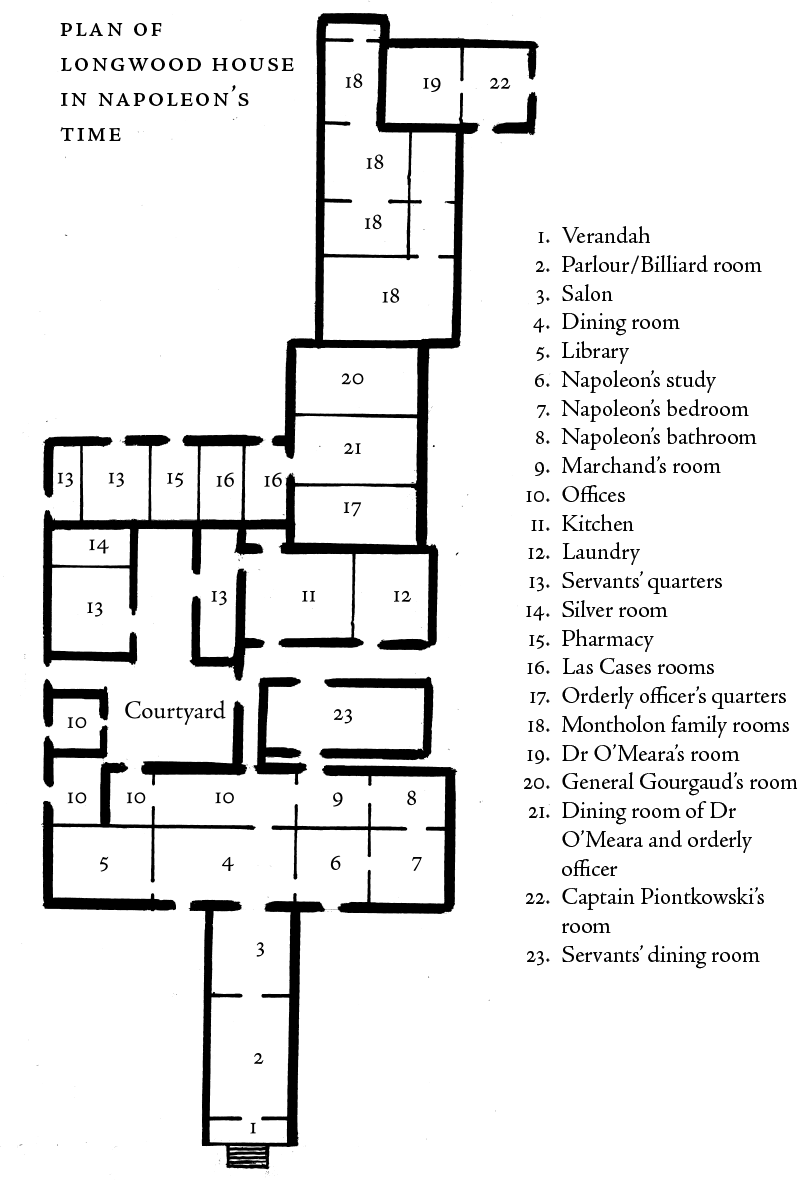
Plan of Longwood House in Napoleon’s Time
Preface
Principal Characters on St Helena
Introduction: The Lion or the Ass?
1 From Waterloo to Rochefort
2 The Journey from Rochefort to Plymouth
3 The Voyage to St Helena
4 Arrival at St Helena
5 Longwood House
6 The Arrival of Sir Hudson Lowe
7 Captivity and Confrontation
8 Napoleon’s Continuing Problems
9 Sir Hudson Lowe’s Problems
10 The Road to the End
11 A Judgement
Epilogue
Notes
Select Bibliography
Picture Credits
Illustrations
˜˜˜
1 Napoleon boarding the Bellerophon, 15 July 1815
2 First view of St Helena, December 2007
3 Jamestown harbour as Napoleon would have known it in 1815
4 Jamestown harbour, 2007
5 Napoleon gazing out to sea, with Sir Hudson Lowe and Major Gorrequer looking on
6 Napoleon at Longwood dictating to Count de Las Cases
7 The pavilion at the Briars, where Napoleon stayed from October to December 1815
8 The Briars pavilion, 2007 – now a small museum
9 Sandy Bay, with the rusting cannon barrels lying across the beach, December 2007
10 Longwood House, front view, December 2007
11 Plantation House, the Governor’s official residence, December 2007
12 Napoleon working in the Longwood garden
13 Napoleon at Longwood being watched by British sentries
14 Napoleon on his deathbed, surrounded by his faithful companions, 5 May 1821
15 Fanny Bertrand and her children at Napoleon’s deathbed (detail)
16 Exhumation of Napoleon’s remains, October 1840
17 Napoleon’s tomb, Geranium Valley, December 2007
18 Napoleon on HMS Bellerophon, July 1815
19 Sir Hudson Lowe entering Napoleon’s study at Longwood
20 Napoleon with his close companions on St Helena, Generals Bertrand, de Montholon and Gourgaud, and Count de Las Cases and his son
21 Betsy Balcombe (later Mrs Elizabeth Abell), 1816
22 The corpulent Napoleon on St Helena, with the Briars in the background
23 General and Mme Bertrand, with their youngest son, at Napoleon’s tomb, Geranium Valley
24 Fanny Bertrand
25 Albine de Monthalon
26 Lieutenant-General Sir Hudson Lowe, Governor of St Helena
27 Rear-Admiral Sir Pulteney Malcolm, naval Commander at St Helena, 1816–18
28 Major Gideon Gorrequer, Aide de Camp to Sir Hudson Lowe throughout his stay at St Helena
29 Dr Barry O’Meara, Napoleon’s doctor from 1815 to July 1818
30 General Charles Jean Tristan de Montholon
31 General Gaspard Gourgaud
32 Count Emmanuel de Las Cases
33 Dr Francesco Antommarchi, Napoleon’s doctor from September 1819 until his death
34 Mt Pleasant House, December 2007; the home of Sir William Doveton, to which Napoleon made his final excursion from Longwood in October 1820
35 Louis Marchand (first valet)
36 Louis Etienne St-Denis, known as Mameluke Ali (second valet)
37 A replica of the wooden aviary built for Napoleon in 1819 by his Chinese gardeners at Longwood, from which sadly all the captive birds escaped
38 Sketch by Captain Frederick Marryat of Napoleon on his deathbed, May 1821
39 The triumphal return of Napoleon’s remains to Paris, December 1840
40 Napoleon’s funeral cortège on St Helena, 9 May 1821
˜˜˜
to Diana
˜˜˜
Preface
˜˜˜
My first hero was the Duke of Wellington. He was a public servant of the utmost dedication and integrity – a ‘nimmukwallah’, who served the King ‘with unfailing zeal and cheerfulness’ as long as he ate the King’s salt – and probably the finest general Britain has ever had. He never lost a battle. I avidly collected books about his great final victory, thanks to Blücher and the Prussians, at Waterloo and often tramped over the battlefield when I could escape from my own battles over the European budget in the Council and Commission meeting rooms in Brussels.
The more I studied Waterloo, however, the more curious I became about the fate of the defeated Napoleon. With some feeling of guilt at deserting my first hero the emphasis of my research switched from the Duke to the Emperor and I began to devour the memoirs of those who had shared or witnessed his captivity on St Helena. My interest became an obsession and I felt compelled to write about it, moved partly by the fact that although there are thousands of books about Napoleon, there is relatively little detailed coverage, at least in English, of this final period of his life.
The heart of the St Helena drama is the confrontation between Napoleon and the British Governor, General Sir Hudson Lowe, who was sent out with over 2,000 troops to ensure he did not escape. Although Andrew Roberts in his Napoleon and Wellington dismisses the rows between Napoleon and Lowe as no more than a ‘footnote to a footnote to history’, it is a fascinating story. History has, however, been hard on Lowe. The French tradition casts him as an out and out villain – a brutal jailor, who cruelly persecuted his prisoner – and much of the British tradition is little kinder. I therefore set out to judge how fair this verdict is and whether Lowe’s reputation could be rehabilitated. I found it hard to do so entirely, but I came to believe that for all his faults the balance should be struck more evenly in his favour.
My obsession became such that I had to visit St Helena to see the place of Napoleon’s prison for myself. My wife and I accordingly went to the island in December 2007. It was an amazing adventure and I was able to visit Longwood House, the Briars, Napoleon’s tomb in Geranium Valley, and even Mount Pleasant House, where Napoleon made his last excursion from Longwood in October 1820. I am most grateful to J.J. Smith, Trevor Magellan and Rebecca Cairns-Smith for facilitating our visits to Longwood, the Briars and Mount Pleasant respectively; and also for the kind hospitality of the Governor, Andrew Gurr, and Jean Gurr which allowed us to explore his official residence, Plantation House, which Lowe had occupied. As we walked through the corridors I could almost feel the presence of Lowe’s aide de camp (ADC), Major Gideon Gorrequer, as he sat alone in his small room each evening scribbling by candle light his extraordinarily bitter diary of each day’s events. But the most dramatic moment of the visit was our first sighting of the island from the good ship RMS St Helena, as the distant dot on the horizon gradually transformed into a mass of high, jagged, volcanic cliffs, like prison walls. I could just begin to imagine Napoleon’s horrified feelings as he saw it for the first time from the deck of the Northumberland on 15 October 1815.
Many people have helped and encouraged me, above all my wife, Diana. In addition to the photographs she took on St Helena she read each chapter as it emerged, making many valuable corrections and suggestions; she gave particular help in compiling the notes and the index; but above all tolerated patiently my incessant chatter about Napoleon, who somehow crept into every conversation both at home and with friends. I also benefited greatly from the professional advice and help of our eldest son, Michael, a talented author, artist and editor himself, whose chapter heading illustrations adorn this book. My sister-in-law, Dr Elspeth Adams, kindly gave me valuable advice on Napoleon’s illness; and I was much helped by the librarian of the Reform Club, Simon Blundell, who allowed me a long lease of crucial 19th-century texts. Finally, I owe a great debt to my editor, Liz Friend-Smith, for her faith in this project and her ever perceptive and constructive advice when it came to organizing and licking it into shape; and also to Jessica Cuthbert-Smith and copy-editor Steve Williamson for their expert help in the final stages. Needless to say, however, any errors or failings of fact or judgement are entirely mine.
I hope this book will be an interesting and enjoyable read and that, while seeking to portray sympathetically the appalling circumstances in which Napoleon ended his career, it will also correct the historical balance a little more in Sir Hudson Lowe’s favour. He certainly did not merit the shabby treatment he received from the British Government after he returned from St Helena ‘mission accomplished’. As Napoleon’s companion, General Gourgaud, remarked: ‘Even if an angel had been sent out as Gov...