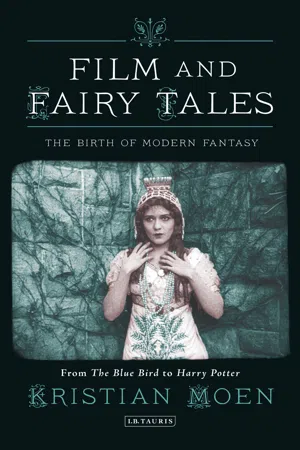
Far from a realm of pure fantasy helping people to escape harsh realities, fairy tales and the films that rooted themselves in their tropes and traditions played an integral role in formulating and expressing the anxieties of modernity as well as its potential for radical, magical transformation. In Film and Fairy Tales, Kristian Moen examines the role played by fairy tales in shaping cinema, its culture, and its discourse during its most formative years. Well-established by the feerie of the nineteenth century as popular entertainment and visual spectacle, the wonders of mutability offered by fairy tale fantasies in the early films of Melies situated cinema itself as a realm of enchantment rife with enthralling and disturbing possibilities. Through an analysis of early film theorists and a detailed case study of Tourneur's 1918 film The Blue Bird, Moen shows how the spectacles and tropes of the fairy tale continued to shape ideas of cinema's place in modern life.
Stars like Mary Pickford and Marguerite Clark, who not only played fantasy roles but presented their off-screen personae in deliberately fantastic terms, and the transformative claims of modernity expressed through visions such as Orientalist fairylands are analysed to show the extent to which fairy tales were used to negotiate different experiences of modernity - the giddy adventures of social mobility, consumer culture and identity transformation, the threats and anxieties of cultural change, impermanence and mutability. Moen traces the evolution of the fairy tale in film to its self-aestheticising peak in Snow White and the Seven Dwarfs, alongside ironic allusions in films like Hitchcock's Rebecca and Howard Hawks' Ball of Fire, concluding with an examination of how fairy tale visions of fantastic transformation have seen a resurgence in contemporary cinema, from Tim Burton to Harry Potter. In the process, he shows how cinema made fairy tales modern - and fairy tales helped make cinema what it is today.
- 304 pages
- English
- ePUB (mobile friendly)
- Available on iOS & Android
eBook - ePub
About this book
Trusted by 375,005 students
Access to over 1.5 million titles for a fair monthly price.
Study more efficiently using our study tools.
Information

Kristian Moen is Lecturer in Screen Studies in the Department of Drama: Theatre, Film, Television at the University of Bristol. He has published and presented on topics including nineteenth-century visual culture, cinema and modernity, and the relationship between cinema and fantasy.

Published in 2013 by I.B.Tauris & Co Ltd
6 Salem Road, London W2 4BU
175 Fifth Avenue, New York NY 10010
www.ibtauris.com
6 Salem Road, London W2 4BU
175 Fifth Avenue, New York NY 10010
www.ibtauris.com
Distributed in the United States and Canada
Exclusively by Palgrave Macmillan
175 Fifth Avenue, New York NY 10010
Exclusively by Palgrave Macmillan
175 Fifth Avenue, New York NY 10010
Copyright © 2013 Kristian Moen
The right of Kristian Moen to be identified as the author of this work has been asserted by the author in accordance with the Copyright, Designs and Patents Act 1988.
All rights reserved. Except for brief quotations in a review, this book, or any part thereof, may not be reproduced, stored in or introduced into a retrieval system, or transmitted, in any form or by any means, electronic, mechanical, photocopying, recording or otherwise, without the prior written permission of the publisher.
Versions of some chapters were published previously. Portions of Chapters 1 and 2 originally appeared in a somewhat different form as “‘Never Has One Seen Reality Enveloped in Such a Phantasmagoria’: Watching Spectacular Transformations, 1860–1889”, Comparative Critical Studies 6, no. 3 (2009): 361–72. Chapter 5 is a substantial revision of an article that was published as “‘The Well‐Organized Splendor of a Growing Culture’: Sites of Fantasy and The Thief of Bagdad”, Early Popular Visual Culture 8, no. 1 (2010): 63–73.
International Library of the Moving Image: 8
ISBN: 978 1 78076 251 7
eISBN: 978 0 85773 319 1
eISBN: 978 0 85773 319 1
A full CIP record for this book is available from the British Library
A full CIP record is available from the Library of Congress
A full CIP record is available from the Library of Congress
Library of Congress Catalog Card Number: available
Typesetting and eBook by Tetragon, London
For my mom
Contents
- List of Illustrations
- Acknowledgements
- Introduction
- Chapter 1 ∙ “A Dream We Make Wide Awake”: The Nineteenth-Century Féerie
- Chapter 2 ∙ A Cinema of Transformations: The Film Féerie and Georges Méliès
- Chapter 3 ∙ Fairy-Tale Aesthetics: Early Film Theory and The Blue Bird (1918)
- Chapter 4 ∙ Mary Pickford and the Fantasies of Stardom
- Chapter 5 ∙ Sites of Enchantment and The Thief of Bagdad (1924)
- Chapter 6 ∙ Delimiting Fairy Tales: Snow White and the Seven Dwarfs (1937)
- Afterword ∙ Mutability Lessons
- Notes
- Bibliography
List of Illustrations
- 1 Cendrillon ou La pantoufle merveilleuse: grande féerie en 5 actes et 30 tableaux, 1879. Bibliothèque nationale de France.
- 2 G. Webb and Co., Poster advertising Ye Belle Alliance at Covent Garden Theatre, 1855. © Victoria and Albert Museum, London.
- 3 Joseph Nash, “The Indian Court”, 1854. © Victoria and Albert Museum, London.
- 4 Odilon Redon (1840–1916), Le Soleil noir (The Black Sun), c. 1900. New York, Museum of Modern Art (MoMA). Oil with incising on board, 12 3/4 x 9 3/8' (32.4 x 23.8 cm). Gift of The Ian Woodner Family Collection. Digital image © 2012, The Museum of Modern Art/Scala, Florence.
- 5 A Trip to the Moon (Méliès, 1902).
- 6 Cinderella (Méliès, 1899)
- 7 Bluebeard (Méliès, 1901)
- 8–11 The Kingdom of the Fairies (Méliès, 1903)
- 12 Pierre Puvis de Chavannes (1824–98), Winter, 1896. Oil on canvas, 93.3 x 146.5 cm. © National Gallery of Victoria, Melbourne, Australia / Felton Bequest / The Bridgeman Art Library.
- 13 The Blue Bird (Tourneur, 1918)
- 14 The Blue Bird (Tourneur, 1918)
- 15 Jules Chéret (1836–1932), Folies-Bergère. Loïe Fuller, 1897. Colour lithograph, 120 x 80 cm. Bibliothèque nationale de France.
- 16 Cinderella (Kirkwood, 1914)
- 17 The Golden Chance (DeMille, 1915)
- 18 Cinderella (Kirkwood, 1914)
- 19 The Golden Chance (DeMille, 1915)
- 20 The Thief of Bagdad (Walsh, 1924)
- 21 Seventh Heaven (Borzage, 1928)
- 22 Snow White and the Seven Dwarfs (Hand, 1937)
- 23 Snow White and the Seven Dwarfs (Hand, 1937)
- 24 The Scarlet Empress (von Sternberg, 1934)
- 25 Snow White and the Seven Dwarfs (Hand, 1937)
- 26 Ball of Fire (Hawks, 1941)
- 27 Sleepy Hollow (Burton, 1999)
- 28 Harry Potter and the Deathly Hallows Part 1 (Yates, 2010)
- 29 The Adventures of Prince Achmed (Reiniger, 1926)
Acknowledgements
This project has gone through many metamorphoses since the idea of fairy tales in film first began to fascinate me, and I would like to thank and acknowledge those who have helped and supported me as the book came into being. Thank you to those at the University of East Anglia who helped me so much during this book’s first incarnation as a PhD thesis: my astute supervisors, Justine Ashby and Yvonne Tasker, Peter Krämer whose intellectual generosity never failed to surprise me, and Jonathan Tooke, Charles Barr and Andrew Higson, who provided much valued encouragement. In countless discussions, Corin Depper always offered critical acuity and a delight in ideas for which I am deeply thankful. Staff at the Archives Municipales de Toulon, the Bibliothèque nationale de France, the British Film Institute, and the Library of Congress were tremendously helpful, and I thank them. I also acknowledge the support of the Canadian Social Sciences and Humanities Research Council for their funding during my PhD study. At the University of Bristol, as the book took shape, Alex Clayton and Sarah Street were instrumental in helping me out and keeping me on track, and I thank them along with my colleagues Catherine Hindson, Simon Jones, Katja Krebs, Jacqueline Maingard, Richard Misek, Angela Piccini and Martin White. Thanks also go to Liza Thompson at I.B.Tauris for her patience and guidance. Finally, I am deeply grateful to Carole Zucker and Mario Falsetto for their inspirational teaching and generosity, Sherry Kelly for her perceptive insights, and my family and my wife Eventhia for their fantastic support.
Introduction
While the spread of urban-industrial technology, the large-scale disembedding of social (and gender) relations, and the shift to mass consumption entailed processes of real destruction and loss, there also emerged new modes of organizing vision and sensory perception, a new relationship with “things”, different forms of mimetic experience and expression, of affectivity, temporality, and reflexivity, a changing fabric of everyday life, sociability, and leisure.
– Miriam Hansen (2000)1
The cinema screen is the modern miracle placed within everyone’s means. This luminous picture window opened in the wall is the will-o’-the-wisp, the clearing in which fairies dance. It is the place of dreams in a prosaic existence; it is a refreshment of the eyes after the fatigue of withering labour.
– Émile Vuillermoz (1919)2
In this book, I examine how cinema made fairy tales modern. I look at a range of fairy tales, but perhaps not in the ways we have grown accustomed to think of them. Rather than approaching fairy tales as “the purest and simplest expression of...
Table of contents
- List of Illustrations
- Acknowledgements
Frequently asked questions
Yes, you can cancel anytime from the Subscription tab in your account settings on the Perlego website. Your subscription will stay active until the end of your current billing period. Learn how to cancel your subscription
No, books cannot be downloaded as external files, such as PDFs, for use outside of Perlego. However, you can download books within the Perlego app for offline reading on mobile or tablet. Learn how to download books offline
Perlego offers two plans: Essential and Complete
- Essential is ideal for learners and professionals who enjoy exploring a wide range of subjects. Access the Essential Library with 800,000+ trusted titles and best-sellers across business, personal growth, and the humanities. Includes unlimited reading time and Standard Read Aloud voice.
- Complete: Perfect for advanced learners and researchers needing full, unrestricted access. Unlock 1.5M+ books across hundreds of subjects, including academic and specialized titles. The Complete Plan also includes advanced features like Premium Read Aloud and Research Assistant.
We are an online textbook subscription service, where you can get access to an entire online library for less than the price of a single book per month. With over 1.5 million books across 990+ topics, we’ve got you covered! Learn about our mission
Look out for the read-aloud symbol on your next book to see if you can listen to it. The read-aloud tool reads text aloud for you, highlighting the text as it is being read. You can pause it, speed it up and slow it down. Learn more about Read Aloud
Yes! You can use the Perlego app on both iOS and Android devices to read anytime, anywhere — even offline. Perfect for commutes or when you’re on the go.
Please note we cannot support devices running on iOS 13 and Android 7 or earlier. Learn more about using the app
Please note we cannot support devices running on iOS 13 and Android 7 or earlier. Learn more about using the app
Yes, you can access Film and Fairy Tales by Kristian Moen in PDF and/or ePUB format, as well as other popular books in Media & Performing Arts & Film & Video. We have over 1.5 million books available in our catalogue for you to explore.