eBook - ePub
Available until 23 Dec |Learn more
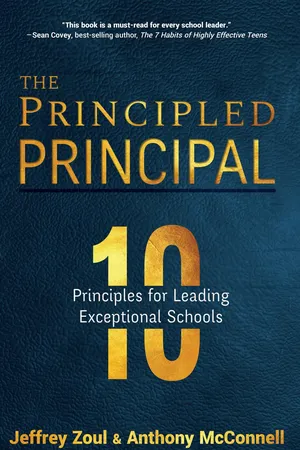
The Principled Principal
10 Principles for Leading Exceptional Schools
This book is available to read until 23rd December, 2025
- English
- ePUB (mobile friendly)
- Available on iOS & Android
eBook - ePub
Available until 23 Dec |Learn more
The Principled Principal
10 Principles for Leading Exceptional Schools
About this book
Jeffrey Zoul and Anthony McConnell know from personal experience that the role of school principal is one of the most challenging and the most rewarding in education. Using relatable stories and real-life examples, the authors reveal ten core values that will empower you to work and lead with excellence.
Frequently asked questions
Yes, you can cancel anytime from the Subscription tab in your account settings on the Perlego website. Your subscription will stay active until the end of your current billing period. Learn how to cancel your subscription.
At the moment all of our mobile-responsive ePub books are available to download via the app. Most of our PDFs are also available to download and we're working on making the final remaining ones downloadable now. Learn more here.
Perlego offers two plans: Essential and Complete
- Essential is ideal for learners and professionals who enjoy exploring a wide range of subjects. Access the Essential Library with 800,000+ trusted titles and best-sellers across business, personal growth, and the humanities. Includes unlimited reading time and Standard Read Aloud voice.
- Complete: Perfect for advanced learners and researchers needing full, unrestricted access. Unlock 1.4M+ books across hundreds of subjects, including academic and specialized titles. The Complete Plan also includes advanced features like Premium Read Aloud and Research Assistant.
We are an online textbook subscription service, where you can get access to an entire online library for less than the price of a single book per month. With over 1 million books across 1000+ topics, we’ve got you covered! Learn more here.
Look out for the read-aloud symbol on your next book to see if you can listen to it. The read-aloud tool reads text aloud for you, highlighting the text as it is being read. You can pause it, speed it up and slow it down. Learn more here.
Yes! You can use the Perlego app on both iOS or Android devices to read anytime, anywhere — even offline. Perfect for commutes or when you’re on the go.
Please note we cannot support devices running on iOS 13 and Android 7 or earlier. Learn more about using the app.
Please note we cannot support devices running on iOS 13 and Android 7 or earlier. Learn more about using the app.
Yes, you can access The Principled Principal by Jeffrey Zoul, Anthony McConnell in PDF and/or ePUB format, as well as other popular books in Education & Education Administration. We have over one million books available in our catalogue for you to explore.
Information
Topic
EducationSubtopic
Education AdministrationPrinciple 1
The Priority Principle
Everything is important; success is in the details.
—Steve Jobs
One of our favorite times of year is March. In the Chicago area, where we live, it means the long cold winter is almost over. But a more important reason to love March is because college basketball’s March Madness is upon us. The NCAA basketball tournament is one of our favorite sporting events—a single-elimination tournament in which there can be only one champion. The team that comes out on top isn’t always the one with the best offense or the best defense; rather, it’s the team that plays both offense and defense well. All champions in the NCAA tournament as well as champions in other sports understand: when it comes to winning, it’s all important.
But if it’s all important, how do we decide where to focus our time and effort? What needs our attention and when? These are questions that often arise in schools regardless of the initiative or undertaking. Another question that pops up in schools happens to be one of the most counterproductive questions we ask: “Is that the most important thing we do?” If you are a principal, assistant principal, or a teacher, you’ve heard this question before, more than likely when confronting teachers or staff with student performance data. You may have even posed the question yourself.
Is that the most important thing we do? can be a deadly question to pose in our schools, and principals who answer it incorrectly commit a critical error.
The reason why is simple: It is all important. That’s right; everything we do is important. In education we do not get to make distinctions that one thing is more important than another. How can we say that social-emotional learning is more important than reading or vice versa? When we ask and answer that question, we are doing nothing more than stating an individual opinion that is not supported by facts.
Everything we do is important.
In reality, students need our full commitment to everything we provide in schools. Schools should be in the business of developing well-rounded critical thinkers who are socially and emotionally prepared to be contributors in our society. In order for schools to embrace this concept, we need principals to believe every facet of education is important—and possible—to deliver.
We’re well aware of the familiar mantra, “If everything is important, then nothing is important.” We understand this sentiment and realize the need to juggle priorities. But in the noble profession of education, everything we provide—and every way we provide it—is important.
The False Dilemma
In philosophy there is a term called a “false dilemma.” It is a type of logical fallacy where only two options are presented when, in actuality, more options exist. A clear example of the false dilemma is the phrase, “You are either with us or against us.” There are only two choices presented, but there may be many more options.
In education, we seem to love the false dilemma; in fact, it’s baked into the culture of many classrooms and systems. Consider the following common examples:
False Dilemmas in Education
- You pass or fail
- That answer is right or wrong
- Full credit or no credit
- Homework is complete or it’s not done at all
- Either you support school choice, or you support failing schools
- And on and on it goes.
The most damaging of these false dilemmas, however, is usually presented as a choice between several core areas of schools. Academics, social-emotional learning, and innovation come to mind as three areas we deem as equally important but are often asked to choose between. For example, a grade level that had poor academic growth for the school year might be very quick to ask, “But is ensuring academic growth the most important thing we do? The kids really loved school this year, and isn’t that more important?”
It is important that kids like (or even love) school. But it is also important that they learn and grow. As principals, we cannot give in to the idea that there are some things in school more valued than others when, in fact, they should all be valued.
Another common example is the resistance from some to move from traditional to more innovative instructional practices. More than once we have heard the following statement: “I would love to do these cool, innovative activities in my classroom, but we have to be accountable for those darn test scores.”
This statement is one of the most damaging in terms of its impact on innovation and student learning. Let’s look at a clear example from the 2015 Partnership for Assessment for College and Career Readiness (PARCC) released items test questions. This is a public test practice item available on their website.
4. A patio is in the shape of a rectangle with a width of 8 feet and a length of 9 feet. What is the area? Enter your answer in the box.
square feet |

Now, what is it about this question that tells educators they cannot teach creatively or implement innovative learning experiences that put students in charge of their learning? Would the best way to learn this content and answer this question successfully be to sit at a desk and listen to a lecture or engage in project-based learning and actually build things? And what about the above question would make someone think they couldn’t have students blogging or using multimedia tools to explain their thinking and then share it with classmates?
Another counterproductive outcome of false-dilemma thinking is the devaluing of valid and reliable assessments of student learning. The more principals buy into this, the more damaging it becomes. Schools and classrooms are publicly touting a choice between twenty-first-century innovation and student learning. Devaluing academic learning and measurements of that learning is not the intention of innovation. But far too often, that is exactly what happens.
Only those living under a rock the past few years missed the uproar from both the education community and the general public over the new state assessments such as PARCC or Smarter Balanced, which were unveiled to align with the new state standards. There are numerous reasons given for why people are against standardized assessments, but we suspect it is less about testing and more about measuring student learning in the first place.
This is a simplistic example, but it makes the point. Teachers are not the sole purveyors of these false dilemmas; in fact, we hear just as many of these comments emanating from principals. One of the most important things a principal can do is not fall prey to this false choice. We must demonstrate to our teachers, parents, and students that it is all important, including measuring whether students are learning and prepared for the next steps of their journeys.
What Are the Most Important Things We Do?
If we take the time to do something in school, it should be important enough to do well; yet, there are areas that encompass the vast majority of what we do in school. These are often posed as either/or, false-dilemma choices. With the mindset of it’s all important, let’s examine three general areas of a school’s responsibilities.
Social-Emotional Health and Learning
Social-emotional learning is crucial for students. We are not, after all, creating widgets. Our schools are the development centers for the next generation of scholars, leaders, CEOs, politicians, and… humans! We need to ensure these students and future leaders will grow up with a healthy dose of empathy and the ability to understand themselves and others. Aside from the mental health and societal benefits of social-emotional learning, students benefit from increased self-management and self-awareness. They become goal setters and, in turn, goal achievers. Research has also shown that social-emotional learning can have a positive impact on a student’s academic performance as well.
In many schools, however, social-emotional learning is often subordinated in importance to academics. We can make the mistake of thinking schools doing well academically do not need strong social-emotional curricula. We cannot assume students naturally have these skills and dispositions. Students from all backgrounds must be taught life skills and preventative education around drugs and alcohol. They must have the opportunity to develop positive self-perceptions. It is up to us, as principals, to avoid the trap of false dilemmas and instead champion social-emotional health and learning as a non-negotiable component of our schools.
Academics
Another major area of importance in schools is, obviously, academic learning. Research has shown that many students who are not reading proficiently by the end of third grade do not graduate from high school on time. According to the Annie E. Casey Foundation (2012), every student who does not graduate high school costs our society $260,000 in lost earnings, taxes, and productivity. For students who eventually graduate from high school and go on to college, there are other costs to not being properly prepared. Approximately one in four students graduating high school today require remedial classes during their first year in college. This is not just inconvenient, it also costs almost $1.5 billion per year for students and their families. When principals look at K–2 students, they should view this period as the most important educational years of students’ lives. How they grow in these early grades will lay the foundation for all future learning.
As harsh as it sounds, it is simply not enough for students to feel good about school. We want them to enjoy school, of course, but they must also learn, and we must commit to this outcome as a professional guarantee we offer every child we serve. To accomplish this goal, we need excellent teachers. A poor teacher can set a child back a year or more in their learning and potentially create a gap so vast it becomes nearly impossible to catch up with peers.
One of the most important jobs of the principal is to ensure students are learning and growing. This is done in many ways, including monitoring teaching, ensuring a guaranteed and viable curriculum, and maintaining a positive school culture. But it is first and foremost accomplished by never compromising the fact that learning needs to happen. Results do matter.
When students do not learn and grow, teachers, principals, and school systems tend to look at any and every possible cause but themselves. “It’s the test, the lack of funding, the kids, or their parents.” And while lack of funding and resources are real problems to overcome, successful principals never let them become an excuse. Our students will be negatively impacted at some point if they are not learning. It is up to us to insist on learning as a non-negotiable in our schools.
Innovation
We are preparing students for jobs that do not even exist in today’s society. Many of the in-demand jobs today were not even in existence ten years ago. This is just one of many reasons to foster innovation in our schools. George Couros aptly defines innovation as “something both new and better.” This does not necessarily mean technology, although it can be included; rather, it means doing something you have not done before or doing it better—with an improvement of some sort. Innovating, in order to change outdated school practices for new generations of learners, is one of the most important things we can do as principals. There is no excuse for not innovating.
There is no excuse for not innovating.
We love speaking with principals who are reimagining their learning spaces—regardless of their resources. These makerspaces, STEM labs, or even reimagined libraries allow teachers and students to explore concepts in hands-on, project-based learning environments. When first looking for ways to innovate, a school library is a great place to start. If you are still teaching encyclopedia skills … stop! You will have taken your first step toward innovation in your library. Yes, the school library is a special place, but it’s also one of the spots becoming more and more outdated for our students. If you look at new community libraries, they look nothing like most school libraries. The furniture and layout of all the spaces has changed with the times. It’s time all schools follow suit.
Another way we see great principals pushing for innovation in their schools is to rethink the furniture in classrooms. When it is time to replace desks and chairs, many great principals we know are opting for tables rather than desks so students can collaborate more readily. They also have begun to abandon the idea of having a “front of the room” and a “back of the room.” (By the way, this rearrangement of desks costs exactly zero dollars.) The entire environment is being redesigned to support learning. In these classrooms, lessons begin to reflect the new design of the learning environment, and student collaboration becomes the norm, not the exception.
If you are not at the point of replacing furniture or upgrading facilities, look to instruction as t...
Table of contents
- Introduction
- Principle 1: The Priority Principle
- Principle 2: The People Principle
- Principle 3: The Self-Leadership Principle
- Principle 4: The Outcomes Principle
- Principle 5: The Talent Principle
- Principle 6: The Change Principle
- Principle 7: The Communication Principle
- Principle 8: The Management Principle
- Principle 9: The Harmony Principle
- Principle 10: The Collaboration Principle
- Conclusion: Principals Leading with Principles
- References
- Acknowledgments
- Bring Jeff Zoul or Anthony McConnell to Your School or Event
- More From Dave Burgess Consulting, Inc.
- About the Authors