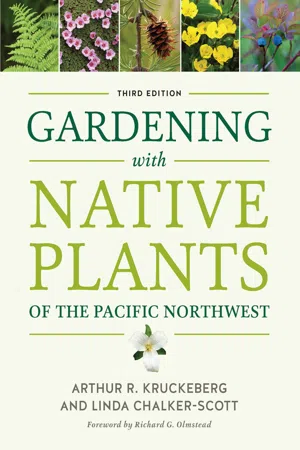
Gardening with Native Plants of the Pacific Northwest
eBook - ePub
Available until 23 Dec |Learn more

Gardening with Native Plants of the Pacific Northwest

  1. 392 pages
  2. English
  3. ePUB (mobile friendly)
  4. Available on iOS & Android
eBook - ePub
Available until 23 Dec |Learn more

Gardening with Native Plants of the Pacific Northwest

About this book

The Pacific Northwest abounds with native plants that bring beauty to the home garden while offering food and shelter to birds, bees, butterflies, and other wildlife. Elegant trilliums thrive in woodland settings. Showy lewisias stand out in the rock garden. Hazel and huckleberry number among the delights of early spring, while serviceberry and creek dogwood provide a riot of fall color. Gardening with Native Plants of the Pacific Northwest is the essential resource for learning how to best use this stunning array. Close to 1, 000 choices of trees, shrubs, perennials, annuals, and grasses for diverse terrain and conditions, from Canada to California, and east to the Rockies 948 color photographs, with useful habitat icons Fully updated nomenclature, with an index of subjects and an index of plant names (common and scientific) New to this edition: chapters on garden ecology and garden science Appendix of Pacific Northwest botanical gardens and native plant societies Glossary of botanical, horticultural, and gardening terms With enthusiasm, easy wit, and expert knowledge, renowned botanist Art Kruckeberg and horticulturist Linda Chalker-Scott show Northwest gardeners, from novice to expert, how to imagine and realize their perfect sustainable landscape.

Frequently asked questions

Yes, you can cancel anytime from the Subscription tab in your account settings on the Perlego website. Your subscription will stay active until the end of your current billing period. Learn how to cancel your subscription.
No, books cannot be downloaded as external files, such as PDFs, for use outside of Perlego. However, you can download books within the Perlego app for offline reading on mobile or tablet. Learn more here.
Perlego offers two plans: Essential and Complete
  • Essential is ideal for learners and professionals who enjoy exploring a wide range of subjects. Access the Essential Library with 800,000+ trusted titles and best-sellers across business, personal growth, and the humanities. Includes unlimited reading time and Standard Read Aloud voice.
  • Complete: Perfect for advanced learners and researchers needing full, unrestricted access. Unlock 1.4M+ books across hundreds of subjects, including academic and specialized titles. The Complete Plan also includes advanced features like Premium Read Aloud and Research Assistant.
Both plans are available with monthly, semester, or annual billing cycles.
We are an online textbook subscription service, where you can get access to an entire online library for less than the price of a single book per month. With over 1 million books across 1000+ topics, we’ve got you covered! Learn more here.
Look out for the read-aloud symbol on your next book to see if you can listen to it. The read-aloud tool reads text aloud for you, highlighting the text as it is being read. You can pause it, speed it up and slow it down. Learn more here.
Yes! You can use the Perlego app on both iOS or Android devices to read anytime, anywhere — even offline. Perfect for commutes or when you’re on the go.
Please note we cannot support devices running on iOS 13 and Android 7 or earlier. Learn more about using the app.
Yes, you can access Gardening with Native Plants of the Pacific Northwest by Arthur R. Kruckeberg,Linda Chalker-Scott in PDF and/or ePUB format, as well as other popular books in Scienze biologiche & Orticoltura. We have over one million books available in our catalogue for you to explore.

Information

1

Garden Ecology

THE PACIFIC NORTHWEST is broadly taken to include southern British Columbia and southwestern Alberta, through Washington and Oregon, to the northern counties of California; its eastern boundaries are the northern Rocky Mountains and the Great Basin. This region covers a great diversity of terrain, climate, and vegetation types. The mild oceanic climate of the western part is separated from the more extremes of heat, cold, and low moisture in the eastern sector by the Cascade Range, a nearcontinuous rampart cleaving in two the north–south sweep of the Northwest country.
It will be necessary to look more closely at the diversity of this vast region as a source of native plants and of gardens where natives can flourish. Simply dividing the territory into the “wet side” and the “dry side” of the mountains is not enough. Within each of these broad subdivisions are local conditions of microclimate, soil, and vegetation that accommodate plants of particular temperament as natives in a garden setting.

NATURAL ENVIRONMENTS IN THE PACIFIC NORTHWEST

The vast territory of the Pacific Northwest embraces a diversity of climates, terrain, and natural vegetation. Towering coastal forests, open coastal prairies and bogs, montane forests, timberline and alpine tundra in the high country, yellow-pine forests, sagebrush and bunchgrass hills and plains, all are attuned to particular mixes of climate and other defining features of habitat. Some appreciation of this rich variety of growing conditions is needed for gardening with natives, as with exotics. First, having information on the natural habitats of desirable natives for the garden can make their cultivation elsewhere more successful. Knowing that the blueblossom or wild lilac (Ceanothus thyrsiflorus) is restricted to coastal Oregon tells us where it is likely to do best in the Pacific Northwest. Second, the garden habitat itself has to be appreciated. The growing conditions in a garden in Spokane, Bend, or Omak will be far different from those in Tacoma, Coos Bay, or Victoria. While it is true that a garden is a less demanding habitat than the nearby natural environment, the local and regional setting of a garden does place restraints on the adaptability of a plant.
Ecologists recognize over sixteen natural provinces in the Northwest (see map p. 19). Each is characterized by relatively uniform climate, geology, and vegetation. Table 1.1 lists some of the major attributes of those provinces where gardening is practiced. We’ve included photographs illustrating each of these provinces on pages 22–25.
images
TABLE 1.1. GARDENING POTENTIAL FOR REGIONS OF THE PACIFIC NORTHWEST
PROVINCE
CLIMATE
GEOLOGY AND NATIVE SOILS
GARDENING CONDITIONS
Puget Trough: Lower Fraser River, San Juan Islands, Puget Sound, and south to the Columbia River
Winters mild, wet; summers mild to hot, generally dry
Mostly alluvial soils from rivers and glacial action
Year-round growing conditions for evergreen trees and shrubs. Optimal hardiness for all Pacific Northwest natives and mild temperate exotics; summer watering
Willamette Valley: Portland to Roseburg
Winters mild, wet; summers warm to hot, dry
Alluvial soils in valleys, mostly lava soils in foothills
Similar to Puget Trough, but milder winters. Excellent for all natives and temperate exotics; summer watering
Olympic Peninsula: Lowlands, including...

Table of contents

  1. Gardening with Native Plants of the Pacific Northwest: Third Edition
  2. Title
  3. Copyright
  4. Contents
  5. Foreword by Richard G. Olmstead
  6. Preface by Linda Chalker-Scott
  7. Acknowledgments
  8. Introduction
  9. 1. Garden Ecology
  10. 2. Garden Science
  11. 3. Native Ornamental Trees
  12. 4. Native Ornamental Shrubs
  13. 5. Native Ornamental Herbaceous Perennials
  14. 6. Native Ornamental Grasses and Grasslike Plants
  15. 7. Native Ornamental Annuals
  16. Appendix: Native Plant Societies and Botanical Gardens
  17. Glossary of Botanical, Horticultural, and Gardening Terms
  18. Selected Bibliography
  19. Photography Credits
  20. Index of Subjects
  21. Index of Scientific and Common Names