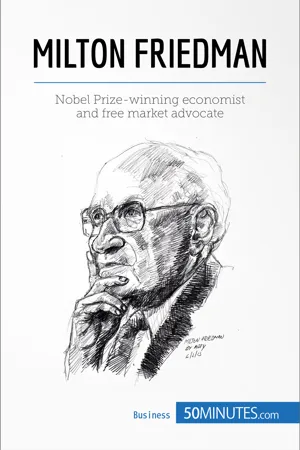
Nobel Prize-winning economist and free market advocate
This book is a practical and accessible guide to understanding the life and works of Milton Friedman.
In 50 minutes you will be able to:
• Recognize and understand the main ideas behind the works of Milton Friedman and his reasons for writing them
• Identify the impact Milton Friedman had on other economists and political figures, including Ronald Raegan and Margaret Thatcher
• Evaluate the mixed reception of his works: the numerous criticisms and the extensions of similar economists
ABOUT 50MINUTES.COM | Economic Culture
50MINUTES.COM provides the tools to quickly understand the main theories and concepts that shape the economic world of today. Our publications are easy to use and they will save you time. They provide elements of theory and case studies, making them excellent guides to understand key concepts in just a few minutes. They are the starting point for readers to develop their skills and expertise.
- English
- ePUB (mobile friendly)
- Available on iOS & Android
eBook - ePub
About this book
Information
HIS WORK: A CONSIDERABLE CONTRIBUTION TO THE ECONOMY
Capitalism and Freedom (1962), Monetary History of the United States (1963) and Free to Choose (1980) are three major works of Milton Friedman that have significantly influenced the economists and politicians of the twentieth century.
CAPITALISM AND FREEDOM (1962)
Context
Published at a time when Keynesian ideas dominated the policies of the economic world, Capitalism and Freedom claims that inflation and unemployment slow down the economy. Today, this book is still considered one of the most influential works published since World War II because it remains relevant in an absolute economic context. In this works, the author discusses major issues, such as money, education, competition and regulation.
Main idea: economic freedom
The main idea developed by Friedman in this works can be summarized as:

In fact, based on the fact that each individual has natural rights that no power can violate, the Liberals – such as Milton Friedman – want to protect them by limiting any social obligations (and therefore any state intervention) that are capable of hindering individual economic and civic freedoms.
Friedman therefore advocates:
- Complete freedom of individuals;
- Private initiative;
- Free competition.
More generally, Milton Friedman defends a market economy where state intervention is reduced to guarantee the greatest level of civil liberty possible. However, absolute freedom (or anarchy) is not possible or viable; Friedman agrees that government is still necessary to ensure compliance with certain rules (rights, laws, etc.).
Like total civil liberty, political freedom can also lead to abuse such as dictatorships, which then prevent any economic freedom.
Other ideas: The theory of free trade and consumption
The second important idea defended by Milton Friedman is the theory of free trade in international commerce.
Questioning Keynes’ ideas, in particular he formed the permanent income hypothesis, which states that consumer choices are not guided by their current income but the expectations they have of their future income. Thus, if expectations are stable, they will tend to regulate consumption, even when disposable income increases or decreases.
Friedman, a monetarist, also criticized the monetary control of the state, thinking of it as the source of danger and downward spirals. According to him, without the intervention of the central bank, recessions would not have degenerated into disasters during the 1929 Wall Street Crash.
Friedman also said that the role of the state is to guarantee citizen’s security, ensuring compliance with legal rules and to intervene if the market fails or shows weakness (e.g. the monopoly of some companies). According to him, even if limited government intervention contributes to freedom, this does not mean that it can do this definitively.
Finally, this text also addresses the role of the state in funding education. Since basic education is essential for everyone, he suggests a system of ‘education vouchers’ in order to monitor the individual student, not the institution. For him, this was the best solution available.
In conclusion, Friedman is firmly opposed to Keynesianism, which advocates a planned economy, and puts freedom at the heart of his thoughts. For him, this actually involves an inevitable limitation of public power and decentralization.
MONETARY HISTORY OF THE UNITED STATES (1963)
Context
This book, by Milton Friedman and Anna Schwartz, offers a different view on the prevailing issue of the time, Keynesianism. In fact, the authors attempt to statistically and theoretically demonstrate the ineffectiveness of Keynesian policies. Their words echo those seen in Capitalism and Fre...
Table of contents
- Title Page
- Milton Friedman
- His life
- His work: a considerable contribution to the economy
- Limits and extensions of the economist’s approach
- Summary
- Further reading
- Copyright
Trusted by 375,005 students
Access to over 1.5 million titles for a fair monthly price.
Study more efficiently using our study tools.
Frequently asked questions
Yes, you can cancel anytime from the Subscription tab in your account settings on the Perlego website. Your subscription will stay active until the end of your current billing period. Learn how to cancel your subscription
No, books cannot be downloaded as external files, such as PDFs, for use outside of Perlego. However, you can download books within the Perlego app for offline reading on mobile or tablet. Learn how to download books offline
Perlego offers two plans: Essential and Complete
- Essential is ideal for learners and professionals who enjoy exploring a wide range of subjects. Access the Essential Library with 800,000+ trusted titles and best-sellers across business, personal growth, and the humanities. Includes unlimited reading time and Standard Read Aloud voice.
- Complete: Perfect for advanced learners and researchers needing full, unrestricted access. Unlock 1.5M+ books across hundreds of subjects, including academic and specialized titles. The Complete Plan also includes advanced features like Premium Read Aloud and Research Assistant.
We are an online textbook subscription service, where you can get access to an entire online library for less than the price of a single book per month. With over 1.5 million books across 990+ topics, we’ve got you covered! Learn about our mission
Look out for the read-aloud symbol on your next book to see if you can listen to it. The read-aloud tool reads text aloud for you, highlighting the text as it is being read. You can pause it, speed it up and slow it down. Learn more about Read Aloud
Yes! You can use the Perlego app on both iOS and Android devices to read anytime, anywhere — even offline. Perfect for commutes or when you’re on the go.
Please note we cannot support devices running on iOS 13 and Android 7 or earlier. Learn more about using the app
Please note we cannot support devices running on iOS 13 and Android 7 or earlier. Learn more about using the app
Yes, you can access Milton Friedman by 50minutes,50minutes in PDF and/or ePUB format, as well as other popular books in Economics & Business Biographies. We have over 1.5 million books available in our catalogue for you to explore.