- 320 pages
- English
- ePUB (mobile friendly)
- Available on iOS & Android
About this book
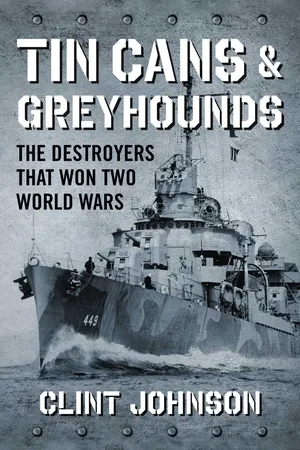
For men on destroyer-class warships during World War I and World War II, battles were waged "against overwhelming odds from which survival could not be expected." Those were the words Lieutenant Commander Robert Copeland calmly told his crew as their tiny, unarmored destroyer escort rushed toward giant, armored Japanese battleships at the Battle off Samar on October 25, 1944. This action-packed narrative history of destroyer-class ships brings readers inside the half-inch-thick hulls to meet the men who fired the ships' guns, torpedoes, hedgehogs, and depth charges. Nicknamed "tin cans" or "greyhounds, " destroyers were fast escort and attack ships that proved indispensable toAmerica's military victories. Beginning with destroyers' first incarnation as torpedo boats in 1874 and ending with World War II, author Clint Johnson shares the riveting stories of the Destroyer Men who fought from inside a "tin can"—riskingdeath by cannons, bombs, torpedoes, fire, and drowning. The British invented destroyers, the Japanese improved them, and the Germans failed miserably with them. It was the Americans who perfected destroyers as the best fighting ship in two world wars. Tin Cans & Greyhounds compares the designs of these countries with focus on the old, modified World War I destroyers, and the new and numerous World War II destroyers of the United States. Tin Cans & Greyhounds details how destroyers fought submarines, escorted convoys, rescued sailors and airmen, downed aircraft, shelled beaches, and attacked armored battleships and cruisers with nothing more than a half-inch of steel separating their crews from the dark waves.
Trusted by 375,005 students
Access to over 1 million titles for a fair monthly price.
Study more efficiently using our study tools.
Information
Table of contents
- Cover
- Dedication
- Preface
- Chapter 1: The Early Years
- Chapter 2: World War I in Europe
- Chapter 3: U.S. Enters the War
- Chapter 4: The 1920s
- Chapter 5: The 1930s
- Chapter 6: Atlantic Theater 1939-1941
- Chapter 7: Pacific Theater 1941
- Chapter 8: Atlantic Theater 1942
- Chapter 9: Pacific Theater 1942
- Chapter 10: Atlantic Theater 1943
- Chapter 11: Pacific Theater 1943
- Chapter 12: Atlantic Theater 1944
- Chapter 13: Pacific Theater 1944
- Chapter 14: Atlantic Theater 1945
- Chapter 15: Pacific Theater 1945
- Appendix
- Acknowledgments
- About the Author
- Bibliography
- Notes
- Index
- Ships/Destroyers Index
- Copyright
Frequently asked questions
- Essential is ideal for learners and professionals who enjoy exploring a wide range of subjects. Access the Essential Library with 800,000+ trusted titles and best-sellers across business, personal growth, and the humanities. Includes unlimited reading time and Standard Read Aloud voice.
- Complete: Perfect for advanced learners and researchers needing full, unrestricted access. Unlock 1.4M+ books across hundreds of subjects, including academic and specialized titles. The Complete Plan also includes advanced features like Premium Read Aloud and Research Assistant.
Please note we cannot support devices running on iOS 13 and Android 7 or earlier. Learn more about using the app