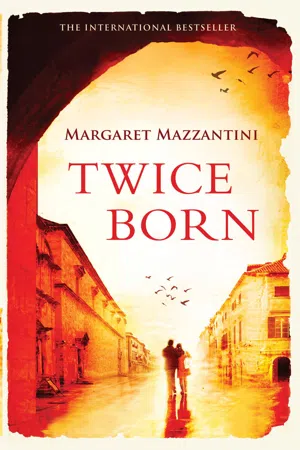
Twice Born
eBook - ePub

Twice Born

The International Bestseller

  1. 464 pages
  2. English
  3. ePUB (mobile friendly)
  4. Available on iOS & Android
eBook - ePub

Twice Born

The International Bestseller

About this book

From the multi award-winning Irish-Italian author of Don’t Move comes an international bestseller wrought in the fires of love and war

The international bestseller that masterfully explores the depths of love and the power of motherhood, set against the backdrop of the Bosnian war

Gemma hasn't been back to Sarajevo in sixteen years. She returns to teach her son Pietro about the city of his birth and the father he never knew. But the visit brings with it impassioned memories of her love affair with Pietro's father, their determination to have a child at any cost, and their deep connection to the city even as war threatened to destroy it.

Perfect for fans of Jodi Picoult, Twice Born is a tale of the brutality of conflict, but also of the acts of generosity that emerge from war. A heartrending and inspiring tale of the ties that bind families, fused in a time of crisis.
Frequently asked questions

Yes, you can cancel anytime from the Subscription tab in your account settings on the Perlego website. Your subscription will stay active until the end of your current billing period. Learn how to cancel your subscription.
No, books cannot be downloaded as external files, such as PDFs, for use outside of Perlego. However, you can download books within the Perlego app for offline reading on mobile or tablet. Learn more here.
Perlego offers two plans: Essential and Complete
  • Essential is ideal for learners and professionals who enjoy exploring a wide range of subjects. Access the Essential Library with 800,000+ trusted titles and best-sellers across business, personal growth, and the humanities. Includes unlimited reading time and Standard Read Aloud voice.
  • Complete: Perfect for advanced learners and researchers needing full, unrestricted access. Unlock 1.4M+ books across hundreds of subjects, including academic and specialized titles. The Complete Plan also includes advanced features like Premium Read Aloud and Research Assistant.
Both plans are available with monthly, semester, or annual billing cycles.
We are an online textbook subscription service, where you can get access to an entire online library for less than the price of a single book per month. With over 1 million books across 1000+ topics, we’ve got you covered! Learn more here.
Look out for the read-aloud symbol on your next book to see if you can listen to it. The read-aloud tool reads text aloud for you, highlighting the text as it is being read. You can pause it, speed it up and slow it down. Learn more here.
Yes! You can use the Perlego app on both iOS or Android devices to read anytime, anywhere — even offline. Perfect for commutes or when you’re on the go.
Please note we cannot support devices running on iOS 13 and Android 7 or earlier. Learn more about using the app.
Yes, you can access Twice Born by Margaret Mazzantini, Ann Gagliardi in PDF and/or ePUB format, as well as other popular books in Literature & Literature General. We have over one million books available in our catalogue for you to explore.

Information

· 1 ·

A journey of hope. Leftover words among the many that remain at day’s end. I saw them on a jar beside the drugstore cash register. There was a slot on top for donations and a photo of a child who must travel a long way for an operation. A journey of hope. I turn my head on the pillow. Giuliano’s heavy body is still. He sleeps as always, bare-chested and on his back. Every so often he lets out a little grunt, like a placid animal shaking off flies.
Hope. As it takes shape in the dark, the word has the face of a bewildered woman dragging her failures along but still moving forward with dignity. It could be my face, the face of a girl grown old but frozen in time out of loyalty, out of fear.
I step onto the balcony and rest my eyes on the familiar surroundings. The shutters are closed on the building across the way. The electric sign in front of the café has yet to be turned on. I hear the silence of the city, the dust of distant noises. Rome—its celebration, its stagnation—is asleep. The outskirts are asleep. So is the Pope. His red shoes are empty.
The phone call comes early one morning. I wake with a start and trip down the hall. I yell, probably to seem like I’m awake. “Who is it?”
There is a noise in the receiver like wind rustling through branches. “May I speak to Gemma?” The Italian is good, but the words are enunciated with excessive care.
“This is Gemma.”
“Gemma? You’re Gemma?”
“Yes.”
“Gemma . . .” He repeats my name and now he’s laughing. It only takes me a second to recognize the sharp, hoarse laugh.
“Gojko . . .”
He pauses. “Yes, it’s your Gojko.”
It’s like a motionless explosion, a long void full of detritus.
“My Gojko,” I stammer.
“Gojko himself.”
His smell. His face. All these years.
“I’ve been trying to track you down for months.”
Out of nowhere, he came to my mind a couple of days ago. I was taking a walk. A boy on the street made me think of him.
We talk. He’s fine. He lived for a while in Paris. Now he’s back home.
“There’s going to be an exhibit to commemorate the siege. Some of Diego’s photos will be in the show.” I feel the cold of the floor climb up my legs and come to a stop in my gut. “It’s an opportunity.” He laughs again, just like always, without real cheer, as if trying to console a slight but perennial sadness. “Come.”
“I’ll think about it . . .”
“Don’t think about it. Come.”
“Why?”
“Because life passes and we with her . . . do you remember?”
Of course I remember.
“. . . and laughs at us, like a toothless old whore awaiting her last client.”
Gojko’s poetry, life transformed into one long ballad. I recall his habit of touching his nose as he recited the poems he scribbled on match covers, on his hands. I suddenly wonder how I’ve managed without Gojko for all this time. Why do we insist on depriving ourselves of the best people in life? Why do we spend so much time with people who don’t interest us, who don’t do us any good—people who simply happen along to corrupt us with their lies and train us to keep our heads down? “Okay. I’ll come.”
And now the still mud of life is flying toward me like dust.
Gojko shouts with joy.
When I left Sarajevo there was dust everywhere, displaced by the gelid wind to rise up in the air and whirl through the streets, blotting things out as it went, covering minarets and buildings and the dead in the marketplace who lay buried beneath vegetables and knickknacks and pieces of blown-apart stalls.
I ask Gojko why he waited all this time to look for me, why he didn’t miss me before now.
“I’ve been missing you for years.”
His voice disappears behind a sigh and again there’s that sound of wind, of kilometers of distance.
Suddenly I’m afraid the line will be disconnected and the silence that lasted all those years will return. I ask for his phone number. It’s a cell phone. I scratch the numbers onto a piece of paper with a pen that doesn’t write. I’m scared to put the phone down to go look for another. The noise grows louder. I picture a telephone wire snapping and letting out sparks as it falls to the ground. How many dangling wires did I see in that isolated city? I press the pen into the paper and grab hold of the past. I’m afraid I’ll lose it once again.
“I’ll call to let you know when my flight will get in.”
I go to Pietro’s room and rummage through his pens so I can trace over the white number. Pietro is sleeping, his long feet sticking out of the sheets. I think what I think every time I see him lying down, which is that his bed is too short and we should get him a new one. I pick up his guitar from beside his slippers. It’s not going to be easy to convince him to come with me.
I shower and join Giuliano in the kitchen, where he’s already made coffee.
“Who was that?”
I don’t answer right away. My eyes are glazed. In the shower, my skin seemed tougher, like long ago, when I’d soap up quickly and leave the house without drying my hair. I tell Giuliano about Gojko, tell him I want to go.
“All of a sudden, just like that?” But he doesn’t seem surprised. “Have you told Pietro?”
“He’s sleeping.”
“Maybe you should wake him.”
Giuliano needs a shave. His mussed hair falls over his forehead, making the balder part in the center of his head more visible. By day, a creature of the city, he’s always tidy, at home in carabinieri stations and state archives. This untidiness is for my eyes only. To my mind, it’s the best, most pungent and secret part of us. It goes way back to the beginning, when we’d make love and then sit looking at each other, naked and disheveled. We’re husband and wife. He came to my aid in a military airport sixteen years ago. Yet when I tell him he saved my life he shakes his head and blushes and says it’s not true, says, It was the two of you, you and Pietro, who saved my life.
He’s got a sweet tooth. Taking advantage of my distraction, he eats another piece of pastry.
“Don’t come complaining to me if your belly gets any bigger.”
“You’re the one who complains. I accept myself as I am.”
It’s true, he does, and that’s why he was able to welcome us, why it’s so comfortable to be with him. He stands and puts his hand on my shoulder. “You’re doing the right thing.”
He’s read second thoughts in my look. Suddenly I’m scared. I’ve fallen backward in time too quickly into the ardor of youth. Now it all seems like nothing but regret. My neck is cold beneath my damp hair. I’d better go back to the bathroom to dry it. I’m myself again, a vanquished girl on the threshold of old age.
“I’ve got to get ready. I’ll have to stop by the office. I don’t know . . .”
“You know.”
He says he’ll call me from the office after he’s checked the Internet for cheap tickets. He smiles. “I doubt people are lining up to go to Sarajevo.”
I go back to Pietro’s room and open the shutters. He pulls the sheet over his head.
This year he shed his childhood skin, abandoned his little-boy bones and became a big limping heron incapable of controlling its own movements, always staring down at the ground, coming in and out without saying goodbye, standing in front of the fridge to stuff his face. Without even trying to, hiding behind an absurd insolence, he managed, with disarming foolishness, to fail the year at school. His loud, surly voice is a constant irritation. He seeks me out only to demand things, to scold. Whatever happened to the plaintive little voice that accompanied me for years and seemed to be in perfect harmony with my own?
Now I feel sorry for him—when he’s sleeping, when his face is relaxed. He must miss that graceful little body just like I do. Perhaps he looks for it in his sleep and that’s why he never wants to wake up.
I touch his newly bristly hair as I pull down the sheet. He pushes me away.
Now that it’s summer, he regrets having failed the year. He leaves the house with his tennis racket and his huge shoes and comes back angry at his friends, grumbling that he doesn’t want to see them because next year they won’t be in the same class any more. In his mind, they’re the ones who betrayed him.
“I need to talk to you.”
He sits up with a jolt. “I’m hungry.”
In the kitchen, he spreads Nutella on cookies, making little sandwiches that he swallows in a single bite. His mouth is dirty and the table is full of crumbs. He opened the cookies the wrong way. The package is ripped down the side.
I don’t say anything. I can’t always be scolding him about everything. In silence I watch him eat. Then I tell him about the trip.
He shakes his head. “No way, Mom. You’ll have to go without me.”
“Sarajevo is a beautiful city.”
He smiles and looks at me with an appealing, cunning expression on his face. “What are you talking about? That’s pathetic. Everyone knows Yugoslavia’s horrible.”
I bristle. “It’s not Yugoslavia any more.”
He crams another Nutella-sodden bundle into his mouth, wipes a droplet off the table and sucks it off his finger. “Same difference.”
“It is not.” I lower my voice, practically begging him. “A week. Pietro. Just the two of us. It will be fun.”
He looks at me sincerely this time. “Come on, Mom. How could it be fun?”
“We’ll go to the coast. The sea there is gorgeous.”
“Why don’t we just go to Sardinia?”
I’m doing all I can to hold myself together and this fool starts in about Sardinia. He stands up and stretches, then turns, and I look at his back, the down along his neck. “You really don’t care about the place where your father died?”
He puts his cup down in the sink. “Give me a break, Mom.”
I’m begging him. My voice is weak, uncertain, just like his when he was a little boy. “Pietro!”
“What do you want?”
I stand abruptly, accidentally spilling the milk.
“What do you mean, what do I want? He was your father!”
He shakes his head and studies the floor. “I’m so sick of this story.”
This story is his story, our story, but he doesn’t want to hear it any more. When he was little he was braver and more curious. He’d ask questions and hug me, lean against me, as he looked at the yellowed photo of Diego that I kept on the fridge. But then, as he grew older, he stopped...

Table of contents

  1. Cover
  2. Title Page
  3. Copyright
  4. Table of Contents
  5. Dedication
  6. Chapter 1
  7. Chapter 2
  8. Chapter 3
  9. Chapter 4
  10. Chapter 5
  11. Chapter 6
  12. Chapter 7
  13. Chapter 8
  14. Chapter 9
  15. Chapter 10
  16. Chapter 11
  17. Chapter 12
  18. Chapter 13
  19. Chapter 14
  20. Chapter 15
  21. Chapter 16
  22. Chapter 17
  23. Chapter 18
  24. Chapter 19
  25. Chapter 20
  26. Chapter 21
  27. Acknowledgements