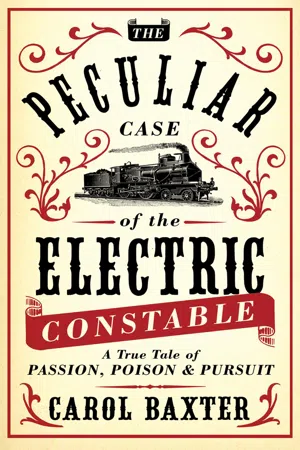
The Peculiar Case of the Electric Constable
eBook - ePub

The Peculiar Case of the Electric Constable

A True Tale of Passion, Poison and Pursuit

  1. 336 pages
  2. English
  3. ePUB (mobile friendly)
  4. Available on iOS & Android
eBook - ePub

The Peculiar Case of the Electric Constable

A True Tale of Passion, Poison and Pursuit

About this book

John Tawell was a sincere Quaker but a sinning one. Convicted of forgery, he was transported to Sydney, where he opened Australia's first retail pharmacy and made a fortune. When he returned home to England after fifteen years, he thought he would be welcomed; instead he was shunned.Then on New Year's Day 1845 Tawell boarded the 7: 42 pm train to London Paddington. Soon, men arrived chasing a suspected murderer – but the 7: 42 had departed. The Great Western Railway was experimenting with a new-fangled device, the electric telegraph, so a message was sent: a 'KWAKER' man was on the run. The trail became a sensation, involving no apparent weapon, much innuendo, and a pious man desperate to save his reputation – and would usher in the modern communication age.Told with narrative verve and rich in historical research, this is a delicious true tale of murder and scientific revolution in Victorian England.
Frequently asked questions

Yes, you can cancel anytime from the Subscription tab in your account settings on the Perlego website. Your subscription will stay active until the end of your current billing period. Learn how to cancel your subscription.
No, books cannot be downloaded as external files, such as PDFs, for use outside of Perlego. However, you can download books within the Perlego app for offline reading on mobile or tablet. Learn more here.
Perlego offers two plans: Essential and Complete
  • Essential is ideal for learners and professionals who enjoy exploring a wide range of subjects. Access the Essential Library with 800,000+ trusted titles and best-sellers across business, personal growth, and the humanities. Includes unlimited reading time and Standard Read Aloud voice.
  • Complete: Perfect for advanced learners and researchers needing full, unrestricted access. Unlock 1.4M+ books across hundreds of subjects, including academic and specialized titles. The Complete Plan also includes advanced features like Premium Read Aloud and Research Assistant.
Both plans are available with monthly, semester, or annual billing cycles.
We are an online textbook subscription service, where you can get access to an entire online library for less than the price of a single book per month. With over 1 million books across 1000+ topics, we’ve got you covered! Learn more here.
Look out for the read-aloud symbol on your next book to see if you can listen to it. The read-aloud tool reads text aloud for you, highlighting the text as it is being read. You can pause it, speed it up and slow it down. Learn more here.
Yes! You can use the Perlego app on both iOS or Android devices to read anytime, anywhere — even offline. Perfect for commutes or when you’re on the go.
Please note we cannot support devices running on iOS 13 and Android 7 or earlier. Learn more about using the app.
Yes, you can access The Peculiar Case of the Electric Constable by Carol Baxter in PDF and/or ePUB format, as well as other popular books in History & Military & Maritime History. We have over one million books available in our catalogue for you to explore.
cover.webp

Also by Carol Baxter

Captain Thunderbolt and His Lady:
The True Story of Bushrangers Frederick Ward
and Mary Ann Bugg
Breaking the Bank:
An Extraordinary Colonial Robbery
An Irresistible Temptation:
The True Story of Jane New and
a Colonial Scandal
30767.webp

Contents

s2.png
  • Prologue
  • Part 1 · Alarm
  • Part 2 · Obsession
  • Part 3 · Suspicion
  • Part 4 · Fascination
  • Part 5 · Agony
  • Epilogue
  • Author’s Note
  • Bibliography
s1.png
Really, sir, you cannot be serious in proposing to stop the escape of a thief or swindler by so small an electric spark acting on a needle. If you had talked of sending a thunderbolt or flash of lightning after him, I might have thought there was some feasibility in it.
Sceptic to would-be electric telegraph inventor Edward Davy, 1830s, quoted in J.J. Fahie’s A History of Electric Telegraphy (1884)

Prologue

s1.png
Of all the physical agents discovered by modern scientific research, the most fertile in its subserviency to the arts of life is incontestably electricity, and of all the applications of this subtle agent, that which is transcendently the most admirable in its effects, the most astonishing in its results, and the most important in its influence upon the social relations of mankind and upon the spread of civilisation and the diffusion of knowledge, is the Electric Telegraph.
Dr Lardner,
The Electric Telegraph (1867)
EVERY NIGHT, as the clock strikes midnight, a new date emerges from the wings, initially blind to the events that will transpire as the next twenty-four hours unfold, the events that will mark its place in history. Most days pass by unnoticed or are soon forgotten in a particular locality, at least. Yet pluck any date from the historical calendar and somewhere on the world’s stage something momentous happened. Perhaps it had long been marked for glory. Perhaps it exploded cataclysmically into view. Often, though, while seeming inconsequential at the time, its importance is recognised only when history’s binoculars are refocused on that particular stage.
Tuesday, 25 July 1837 was a date that Britain’s Professor Charles Wheatstone was hoping would in time be celebrated in the history books. It was late in the evening when he entered the carriage shed at Euston Station, the terminus of the London and Birmingham Railway then under construction. Hammering had ceased in time for the station’s ceremonious opening five days earlier, an occasion already marked for posterity. Yet, despite the current lack of ceremony and the dingy surroundings, Wheatstone believed that this date would be of far greater importance if all went according to plan.
Small and slight, curly-headed, bespectacled and excruciatingly shy: the mould of the eccentric scientist might have been fashioned with Wheatstone in mind. He had long been fascinated by the workings of musical instruments and by acoustics, optics and electricity, and his inquisitive mind had led him to experiment with the possibilities of a communication system driven by electricity a so-called ‘electric telegraph’.
By the flickering light of a tallow candle, Wheatstone could see his recently patented electric telegraph machine squatting on the table in front of him. The model had a simple four-needle display that allowed only twelve letters to be indicated. Its ‘clock face’ was a diamond-shaped grid, with lines heading north-east and north-west from each of the four needle bases that were positioned across a central horizontal axis. When two needles were simultaneously tilted towards each other at a forty-five degree angle from the vertical, they pointed along these lines towards a junction at which a letter was inscribed. To each needle was attached a single wire along which the electric current would pass. The wires trailed from the machine and became part of a thirteen-mile circuit wrapped around a frame sitting in the carriage shed, before heading out the door and disappearing into the shadows.
Wheatstone made a last-minute check all the wires were securely fastened to needles, all the needles moving freely like a teacher anxious for his prize student to shine. He then lifted his hands to the machine’s controls and deflected the two needles that would signal the first letter. Obligingly, the machine began transmitting his message.
A mile-and-a-half away in the winding-engine house at Camden Town sat his partner, William Fothergill Cooke, facing an identical instrument. An impecunious ex-military officer, Cooke was desperate to make money lots of money and had seen the commercial potential of an electric telegraph machine. Energetic and resourceful, he had the personality necessary to attract business but lacked the scientific ...

Table of contents

  1. Copyright Page
  2. Prologue
  3. Part 1 • Alarm
  4. Chapter 1
  5. Chapter 2
  6. Chapter 3
  7. Chapter 4
  8. Chapter 5
  9. Chapter 6
  10. Chapter 7
  11. Part 2 • Obsession
  12. Chapter 8
  13. Chapter 9
  14. Chapter 10
  15. Chapter 11
  16. Chapter 12
  17. Chapter 13
  18. Chapter 14
  19. Chapter 15
  20. Part 3 • Suspicion
  21. Chapter 16
  22. Chapter 17
  23. Chapter 18
  24. Chapter 19
  25. Chapter 20
  26. Chapter 21
  27. Part 4 • Fascination
  28. Chapter 22
  29. Chapter 23
  30. Chapter 24
  31. Chapter 25
  32. Chapter 26
  33. Chapter 27
  34. Chapter 28
  35. Chapter 29
  36. Part 5 • Agony
  37. Chapter 30
  38. Chapter 31
  39. Chapter 32
  40. Chapter 33
  41. Chapter 34
  42. Chapter 35
  43. Chapter 36
  44. Epilogue
  45. Author’s Note
  46. Bibliography
  47. About the Author