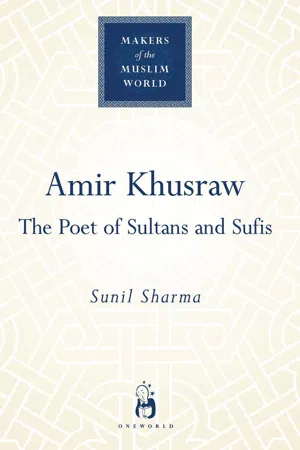
Amir Khusraw
eBook - ePub

Amir Khusraw

  1. 160 pages
  2. English
  3. ePUB (mobile friendly)
  4. Available on iOS & Android
eBook - ePub

Amir Khusraw

About this book

This book studies an important icon of medieval South Asian culture, Indian courtier, poet, musician and Sufi, Amir Khusraw (1253-1325), chiefly remembered for his poetry in Persian and Hindi, today an integral part of the performative qawwali tradition.

Frequently asked questions

Yes, you can cancel anytime from the Subscription tab in your account settings on the Perlego website. Your subscription will stay active until the end of your current billing period. Learn how to cancel your subscription.
At the moment all of our mobile-responsive ePub books are available to download via the app. Most of our PDFs are also available to download and we're working on making the final remaining ones downloadable now. Learn more here.
Perlego offers two plans: Essential and Complete
  • Essential is ideal for learners and professionals who enjoy exploring a wide range of subjects. Access the Essential Library with 800,000+ trusted titles and best-sellers across business, personal growth, and the humanities. Includes unlimited reading time and Standard Read Aloud voice.
  • Complete: Perfect for advanced learners and researchers needing full, unrestricted access. Unlock 1.4M+ books across hundreds of subjects, including academic and specialized titles. The Complete Plan also includes advanced features like Premium Read Aloud and Research Assistant.
Both plans are available with monthly, semester, or annual billing cycles.
We are an online textbook subscription service, where you can get access to an entire online library for less than the price of a single book per month. With over 1 million books across 1000+ topics, we’ve got you covered! Learn more here.
Look out for the read-aloud symbol on your next book to see if you can listen to it. The read-aloud tool reads text aloud for you, highlighting the text as it is being read. You can pause it, speed it up and slow it down. Learn more here.
Yes! You can use the Perlego app on both iOS or Android devices to read anytime, anywhere — even offline. Perfect for commutes or when you’re on the go.
Please note we cannot support devices running on iOS 13 and Android 7 or earlier. Learn more about using the app.
Yes, you can access Amir Khusraw by Sunil Sharma in PDF and/or ePUB format, as well as other popular books in Theology & Religion & Islamic Theology. We have over one million books available in our catalogue for you to explore.

Information

INTRODUCTION

In the collective cultural memory of South Asians, Amir Khusraw (1253–1325) is the “parrot of India” because he is considered the greatest Indian poet writing in the Persian language, which was the lingua franca of the eastern Islamic world in pre-modern times. For a more specialized group of scholars acquainted with the history of Indian Sufism, he is also the “Turk of India,” a sobriquet bestowed on him by his spiritual master for his steadfast devotion to Islam. For almost seven hundred years now, Amir Khusraw (also written as Khursau or Khusro) has maintained his position as a major cultural icon in the history of Indian civilization. He is probably the most popular figure of medieval Indian Islamic culture and is especially remembered as the founder of Hindustani culture, which is a synthesis of Muslim and Hindu elements. He helped to give a distinctive character to Indian Islamic cultural traditions through his contributions in the fields of Indian classical music, Sufism (Islamic mysticism), qawwali (South Asian sufi music), and Persian literature, and by his role in the development of Hindavi, the vernacular language of the Delhi area, in which both modern Urdu and Hindi have their roots. As a courtier, sufi, writer, poet, composer, and musician, he was a personality to whom few figures in history can be compared.
Amir Khusraw’s legacy is immense and far more widespread than many people realize, from the vast corpus of Persian poetry that is read to this day in Iran, Afghanistan, and Tajikistan to the devotional qawwalis that are performed and listened to in the world beyond India and Pakistan. Although he is acknowledged as the best Indian poet in Persian, he does not find his due place in the Iranian national literary canon because he was not Iranian. In South Asia, he is revered for his music and mystical contributions, but most people are only familiar with a small portion of his vast corpus of poetry and prose in Persian, or have no access to these works due to the language barrier. This has not been Amir Khusraw’s fate alone. The cultural area in which he lived no longer exists. In the thirteenth century the entire area from Anatolia (now Turkey) to India formed a single belt of what are now called Persianate societies. Though the ruling elite of these lands was Turkish, the high cultural language was Persian, along with Arabic. Once Persian ceased to be a language of learning in South Asia some time in the twentieth century, and the Persianate world was broken by the forces of modern nationalism, many poets, including the eleventh-century Mas‘ud Sa‘d Salman and the nineteenth-century Ghalib, who wrote prodigiously in Persian as well as in Urdu, have suffered a similar fate. However, Amir Khusraw’s compositions in the vernacular sufi and folk literature of north India are still part of a living and dynamic tradition.
Yet Amir Khusraw’s personality is shrouded in mystery and those who attempt to understand his biography find it hard to reconcile the facts of his life: How could he have been a courtier and a sufi at the same time? How could all the works that are commonly attributed to him be authentic? Did he really write poetry in Hindavi and invent so many musical instruments? These questions are justified to a large extent because although there is quite a bit of autobiographical information in Amir Khusraw’s own writings, and numerous poetic and sufi biographical traditions about him exist from throughout the medieval period, the information is not always reliable and the resulting picture of the poet either remains one-dimensional or appears larger than life.
However, getting to the “real” Amir Khusraw provides many challenges, in the form of sorting through an overwhelming number and variety of original sources and unraveling the layers of cultural myth and legend that his personality has been draped with over the centuries. There are all kinds of hagiographical and biographical traditions about Amir Khusraw in the form of apocryphal anecdotes about his life, especially connected with his relationships to his friend, the poet-sufi Hasan Sijzi, and their spiritual master, Nizamuddin Awliya, which though invaluable for the history of the poet’s reception in the popular imagination tend to obfuscate what we can glean directly from the poet’s own writings and those of his contemporaries. In academic circles, Amir Khusraw is known in three separate fields: to historians of medieval India and Persian literature as a writer of Persian poetry and prose; to ethnomusicologists and Islamists as a mystic whose Persian and Hindavi verses form the core of qawwali performance; and to art historians as a skillful story-teller whose quintet of narrative tales (khamsah) has a rich illustrated manuscript tradition from all over the Persianate world. How can these three personalities be brought together? In trying to present the totality of the life and works of Amir Khusraw a reader is overwhelmed by historical tidbits of information and the large body of the poet’s works.
Amir Khusraw’s literary achievements form a seminal part of the literary canon, not just of Indo-Persian, but of a universal canon that includes the works of classical poets such as Nizami, Sa‘di and Hafiz, and his poetry can help to expand our knowledge about the culture of medieval Persian literature. He also offers us access to the culture and history of pre-Mughal north India, which though the object of study in a thriving academic discipline is sometimes viewed by non-experts as an age of nothing but conquest and conversion, devoid of artistic and humanistic achievements. This was actually a formative period for the establishment of the institutions of Indian Islam and the genesis of various Indian cultural traditions that endure to our day. Perhaps this age of Indian history appears less grand to us today because the earliest rulers of Delhi, the Ilbarids, the Khaljis, and the Tughlaqs, were not celebrated in the accounts of European travelers as were the Mughals, and because the material remains from this time are not as numerous. However, it is useful to bear in mind that the Mughals, the rulers of the Deccan and other regional kingdoms in India, continued political and cultural institutions set up much earlier, albeit with new strains of influence from other sources. There is no doubt that Amir Khusraw with his involvement in the court of Delhi and in the local sufi order, both centers of power that affected the lives of ordinary people in the thirteenth and fourteenth centuries, is a key figure in understanding the complexities of the social and political order of that time.
The present work is an attempt to present Amir Khusraw in the context of the society he lived in, which was complex and unique in many respects, rooted in local traditions but also remarkably cosmopolitan because of the use of Persian in courtly and literary circles. However, he is not just part of the South Asian past. In our time, the figure of Amir Khusraw takes on a particular relevance due to the volatile political and communal situation in South Asia. Contesting views exist today on the definition of “Indian” culture and who are the rightful heirs to the medieval past. Another arena for this conflict is the linguistic one of the modern languages Hindi and Urdu, which have shared origins in Amir Khusraw’s Hindavi but have drifted apart culturally. It is hoped that an introduction such as this one will prove to be useful to students as well as to specialists in the field. Despite the problems involved in translating pre-modern poetry and prose, translations of some original texts in the appendices, one a biographical account of Amir Khusraw by one of his contemporaries and the other a translation of one of his tales, are provided to bring the reader one step closer to the world of Amir Khusraw. All translations are the author’s except where otherwise indicated.

IN A CITY OF SULTANS, SUFIS, AND POETS: AMIR KHUSRAW AND DELHI

MUSLIM INDIA IN THE THIRTEENTH CENTURY
Communities of Muslims were already established in India in the early years of Islam, primarily in western India, on the Malabar coast, and in the regions of Sindh and Gujarat, but it was the conquest of northern India by Sultan Mahmud (d. 1030), the ruler of a vast empire, that brought about the inclusion of India in the world of Islam. The Ghaznavids were Turks based in Ghazni (in present-day Afghanistan) and they were the cultural and political heirs of the Persian Samanid dynasty based in Bukhara (in present-day Uzbekistan). The Samanids had established themselves in the early ninth century and their institutions and courtly culture had a Persian orientation, as was true of the eastern Islamic world in general. As the Turks of Central Asia were converted to Islam and served as slaves in the courts and armies of the Muslim rulers, they in turn became empowered and began new dynasties. The Ghaznavids and Seljuqs were two such ruling houses in this period, and the institution of rulers of slave origins continued in Delhi.
By the later part of the eleventh century, the rule of the Ghaznavids had been established in northwestern India, with the frontier city of Lahore becoming a thriving cultural center. At this time, the city was home to court poets such as Abu al-Faraj Runi (d. c. 1102) and Mas‘ud Sa‘d Salman (d. 1121), and the sufi al-Hujviri “Data Ganj Bakhsh” (d. 1071), who wrote the first Persian sufi manual, Kashf al-mahjub (Unveiling of the Veiled) and whose shrine in Lahore is a center for mystics and pilgrims to this day. The Ghaznavids increasingly turned eastwards as they lost their Iranian possessions to another Turkish dynasty, the Seljuqs, but even in the east they eventually lost out to a ruling house known as the Ghurids, based in Ghur, in the hilly regions of western Afghanistan. As successors to the Ghaznavids, the Ghurids shifted the centers of power and culture closer to the Indian heartlands and away from the frontier, to the cities of Uch, Multan, and Delhi.
At the same time that Muslims were reaching the Bengal frontier, in 1192, at the battle of Tarain under the leadership of Mu‘inuddin Muhammad, the Ghurids won a decisive victory over the Hindu rulers, the Chauhans, and the Turkish slave Qutbuddin Aybek was appointed as deputy in Delhi, which became the seat of a new polity. In the next few decades, Muslims began to consolidate their power under the rule of sultans such as Iltutmish (r. 1211–36), who was succeeded by his formidable daughter, Raziya (r. 1236–40), one of the few women rulers in the Islam world, Nasiruddin (r. 1246–66), and Balban (r. 1266–87). These rulers of slave origins were followed by the Khalji and Tughlaq dynasties whose rule lasted until the fourteenth century.
Meanwhile, the Mongol foray into Central Asia and Iran in the early thirteenth century had set forth a large wave of migration: many scholars, poets, artisans, and religious figures left for India and settled in and around Delhi, which as a place of refuge had come to be known as the Dome of Islam (qubbat al-Islam). These émigrés brought with them their skills, institutions, and religious and literary traditions, which came into contact with local cultural practices, thus resulting in the flowering of a uniquely Indian form of Islamic civilization. The Delhi of that time was not the Delhi of today: even old Delhi is largely a Mughal construction and remains so in popular imagination. Rather, the thirteenth-century city was an amalgamation of several cities whose traces have not completely disappeared from the topography of the land. The foundations of this city were laid near the Hindu citadel of Lalkot, in the present-day area of Mehrauli, and soon the villages of Kilokhri, Siri (modern-day Shahpur), Ghiyaspur, and Jahanpanah all formed part of this thriving metropolis. The architectural monuments built over the course of the thirteenth and fourteenth centuries, such as the tombs of the early rulers, the victory tower Qutb Minar, the Qubbat al-Islam mosque, the water reservoirs Hawz-i Shamsi and the Hawz-i Khass, the city of Tughlaqabad, attest to the existence of a powerful and centralized ruling house that was conscious of its unique position in the world of Islam and in South Asia.
By the time of Amir Khusraw’s birth in 1253, in half a century under a succession of Turkish rulers, Delhi had become a cosmopolitan city renowned throughout the Islamic world for its institutions of learning and as a haven for wandering scholars and poets. In the early days of the slave rulers, the city was administered by an elite corps of Turkish nobles known as the chihilgan (the Forty) whose power declined over time as Indians began to participate in the government. The indigenous population consisted chiefly of Hindus, Jains, and two broad categories of Muslims: Indian converts and immigrants from Central Asia who had settled there as refugees or were simply drawn by the centers of learning, such as the Mu‘izzi madrasah, and by the generous patronage of the rulers. Sufis also passed through the city, as did merchants since it was also a flourishing commercial center. The Moroccan traveler Ibn Battuta reached Delhi in 1333, a few years after Amir Khusraw’s death, and describes the society in great detail. According to Ibn Battuta, “Dihli [Delhi], the metropolis of India, is a vast and magnificent city, uniting beauty with strength. It is surrounded by a wall that has no equal in the world, and is the largest city in India, nay in the entire Muslim Orient” (Ibn Battuta, 1957: 194). A contemporary source, the historian Ziyauddin Barni (d. fourteenth century), states that the presence of so many luminaries, among whom was the sufi master Nizamuddin Awliya and others, had made Delhi the envy of Baghdad and Cairo, and the equal of Constantinople and Jerusalem!
A description of the entry of Qutbuddin Aybek into the city of Delhi from an early historical source, Hasan Nizami’s Taj al-ma‘asir, conveys the pomp and grandeur of the military court in the usual hyperbolic style of the time:
Men of letters and soldiers along with attendants and servants of all categories presented themselves at the court and discharged the obligation of showering encomiums and offering prayers for the king. The city and its suburbs appeared fresh and adorned like the garden of paradise. Its doors and walls were embellished with the brocade of Rum and gold cloth of China. They made elegant domes from the top of which even a fast flying bird could not pass, and the height of which could not be measured by the engineer of thought and mind. Its battlements were so high that they [touched] the circle of blue heaven, in fact, they rose beyond the pinnacle of the silver coated palaces and the golden court (sky).
The brightness of the flash of swords and other arms that were hanging about that place dissolved the sense of vision and the glare of their reflection was as dazzling to the eyes as the sun. They shone like a casket full of gems and the zodiacal sign with all its stars. Or you would say that luminous heavenly bodies had descended on the earth, or maybe dark substances had acquired the gloss of pure gems. (Hasan Nizami, 1998: 135)
Despite achieving such a status within a short time, throughout the thirteenth century the capital city of the Sultanate was beset with political upheavals and instability, on the one hand due to the repeated Mongol raids in the northwest, sometimes right into the environs of Delhi, and on the other to the ruthless battles of succession for the throne and the short-lived and unstable rule of usurpers. Nevertheless, there were prolonged periods of stability during which many artistic and cultural endeavors were undertaken and creative energies were allowed to flower, as witnessed by the architectural and literary monuments that survive from this period.
Arabic was the language of the religious sciences and technical disciplines, while Persian was more widely used, both in its written and spoken form. It was the literary and cultural language of the eastern Islamic world and the literature written in it circulated in a large cosmopolitan literary world often described as Persianate, which extended from Anatolia and the Caucasus to Bengal at this time. The Samanids and Ghaznavids had been the earliest patrons of Persian court literature, and even though the Ghaznavid sultan Mahmud and some of the ...

Table of contents

  1. Cover
  2. Title page
  3. Copyright page
  4. Contents
  5. Acknowledgments
  6. Map
  7. 1 INTRODUCTION
  8. 2 IN A CITY OF SULTANS, SUFIS, AND POETS: AMIR KHUSRAW AND DELHI
  9. 3 AMIR KHUSRAW AND THE WORLD OF PERSIAN LITERATURE
  10. 4 AMIR KHUSRAW AND INDIAN CULTURAL TRADITIONS
  11. APPENDIX I: Biographical account of Amir Khusraw from Amir Khurd’s Siyar al-awliya
  12. APPENDIX II: Tale of the Tatar princess Gulnari, narrated on Tuesday in the Red Pavilion, from Amir Khusraw’s Hasht bihisht
  13. Chronology
  14. Glossary
  15. Bibliography
  16. Index