Metamorphosis
eBook - ePub

Metamorphosis

  1. 320 pages
  2. English
  3. ePUB (mobile friendly)
  4. Available on iOS & Android
eBook - ePub

Metamorphosis

About this book

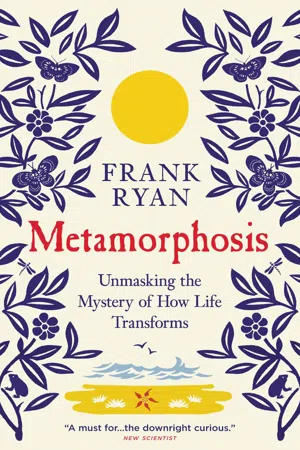
In this enchanting work of scientific exploration, acclaimed science author Frank Ryan explains how metamorphosis - the intricate trick of nature by which caterpillars transform into butterflies - reveals secrets that are shaking the scientific world. Ryan brings to life the work of pioneering naturalists who have traced metamorphosis in myriad species, from amphibians to marine creatures, even human puberty, to rewrite some of our longest-held beliefs about evolution. Lyrical and provocative, The Mystery of Metamorphosis offers a new understanding of some of the most ancient miracles of the nature.

Frequently asked questions

Yes, you can cancel anytime from the Subscription tab in your account settings on the Perlego website. Your subscription will stay active until the end of your current billing period. Learn how to cancel your subscription.
No, books cannot be downloaded as external files, such as PDFs, for use outside of Perlego. However, you can download books within the Perlego app for offline reading on mobile or tablet. Learn more here.
Perlego offers two plans: Essential and Complete
  • Essential is ideal for learners and professionals who enjoy exploring a wide range of subjects. Access the Essential Library with 800,000+ trusted titles and best-sellers across business, personal growth, and the humanities. Includes unlimited reading time and Standard Read Aloud voice.
  • Complete: Perfect for advanced learners and researchers needing full, unrestricted access. Unlock 1.4M+ books across hundreds of subjects, including academic and specialized titles. The Complete Plan also includes advanced features like Premium Read Aloud and Research Assistant.
Both plans are available with monthly, semester, or annual billing cycles.
We are an online textbook subscription service, where you can get access to an entire online library for less than the price of a single book per month. With over 1 million books across 1000+ topics, we’ve got you covered! Learn more here.
Look out for the read-aloud symbol on your next book to see if you can listen to it. The read-aloud tool reads text aloud for you, highlighting the text as it is being read. You can pause it, speed it up and slow it down. Learn more here.
Yes! You can use the Perlego app on both iOS or Android devices to read anytime, anywhere — even offline. Perfect for commutes or when you’re on the go.
Please note we cannot support devices running on iOS 13 and Android 7 or earlier. Learn more about using the app.
Yes, you can access Metamorphosis by Frank Ryan in PDF and/or ePUB format, as well as other popular books in Biological Sciences & Science General. We have over one million books available in our catalogue for you to explore.

Part I

Anomalies in the Tree of Life

Those strange and mystical transmigrations that I have observed in silk-worms turned my philosophy into divinity ... Ruder heads stand amazed at these prodigious pieces of nature, whales, elephants, dromedaries and camels … but in these narrow engines there is more curious mathematics. Who … wonders not at the operation of two souls in those little bodies?
Thomas Browne,
‘Religio Medici’1
image
Sponge crab larva

1

The Birth of an Idea

THE NORTHUMBERLAND COAST is as lovely as it is sparsely populated. Here, in the early 1930s, the youthful Donald Williamson would explore the lively fishing town of Seahouses, population little more than a thousand, where his father was a schoolteacher and amateur naturalist. At a time when the oceans had not yet been over-fished and polluted as we find them today, the herring boats would chug out to sea from the old harbour and return so overladen with catches that MacKay’s fish shop would sell fresh herrings for a penny. To the north and south lay the great windswept beaches of Bambrugh, Beadnell, and Embleton Bay, where the lobster creels would be piled high on the harbour. On his walks, he came across bladder wracks to pop, or he collected the whorled shells of sea snails, some lined with brilliant mother-of-pearl inlays, and sea urchins and starfish, with their exotic prickly shapes and colours. But it was the sea birds that most fascinated the boy. His greatest treat, once a year, was a trip with his father to visit the bird sanctuaries in the neighbouring Farne Islands. Here he gazed spellbound at the masses of squawking gulls, ducked his head to avoid attacks by the dive-bombing terns, or was deafened by the hundreds of kittiwakes, all announcing their names with their songs in counterpoint. In these surroundings Don Williamson fell in love with nature, and with the marine aspects of nature in particular.
In 1940, at the age of eighteen, he enrolled for a degree in zoology at King’s College, Newcastle upon Tyne, then part of Durham University. The Second World War had begun and his first two years there included some aspects of military training in addition to conventional lessons in zoology, botany, and chemistry. In June 1942, he enlisted in the Royal Navy as a Probationary Sub-Lieutenant, leading to training as a RADAR officer before serving in the Mediterranean theatre on HMS Abdiel and HMS Antwerp. It was an eventful experience, ending in March 1944, when he suffered a pulmonary haemorrhage en route to Taranto, Italy. He was taken to a military hospital where he was invalided out with the worrisome diagnosis of pulmonary tuberculosis, a disease that still awaited modern treatment with chemotherapy.
After brief spells in several military and naval hospitals, Williamson was dispatched far from his beloved sea, to Wooley Sanatorium, near Hexham, in Northumberland. Here, in the sanatorium library, he came across a copy of Darwin’s On the Origin of Species by Means of Natural Selection. ‘It was the first time I ever had the opportunity of reading it’, he recalled.1 Inspired now more than ever to return to his biological studies, Williamson defied medical advice and returned to Newcastle, where he completed his degree while breathing on one lung, his other lung kept out of action through a surgically induced deflation, known as an artificial pneumothorax. Supported by a disability allowance from the Royal Navy, he went on to complete his PhD. The subject of his research was inevitably marine: a tiny crustacean known as a sand hopper, which, as its name suggests, hops about beaches in between tides.
Sand hoppers can easily be recognised from their small size and their shrimp-shaped bodies bent into a C-shape, with their long antennae continuing the curve. In Australia these include the bush fleas and leaf hoppers, which are common in gardens and undeveloped bush – “small brown critters” that leap up when disturbed. In Britain, the land-based varieties are confined to beaches, with the exception of a single species that has invaded household greenhouses.
One species of sand hopper, known as Talitrus saltator, particularly intrigued Williamson and would become the subject of his doctoral research. He observed how it spent the daylight hours above the high-water mark, avoiding desiccation by hiding under the sand or decaying debris and only coming out at night to feed on washed up wrack. He set out to explore the sensory cues behind their interesting behaviour. At this time biologists believed sand hoppers found their way using a kind of position sense that enabled them to detect the slope of the beach. Choosing a time when the tide was out, Williamson ferried his hoppers from the high-water mark to the low-water mark, then monitored them as they made their way back up the shore. How speedily and accurately they managed this, travelling upslope in what appeared to be straight lines! If they navigated using a sense of gradient but no sense of vision, this was an extraordinary feat. When he covered up their black multi-faceted eyes, he discovered that the sand hoppers completely lost their way. He tested this further by showing them lantern slides of simple shapes and shades and confirmed they were attracted by boundaries where dark met light. It was clear that the prevailing views were wrong. Sand hoppers navigated the beach not through sensing the gravitational pull of its slope but through visual cues.
Two years later, his PhD dissertation complete, Williamson needed to find a job. He was offered a post in Jamaica, but it would oblige him to become an entomologist. The University of Sheffield offered an alternative, but the city was land-locked and he would have to sacrifice any possibilities of working with the sea. He opted for the Isle of Man, where a post was open in marine zoology, and specifically that of planktologist with lectureship duties to Liverpool University. ‘Of course, I was not a planktologist, having conducted my research on hoppers, which were semi-terrestrial. But nevertheless I applied for the job and I got it. I now had to learn about plankton’.
The word “plankton” is evocative: it derives from the ancient Greek for wanderer. And how wonderfully apt it is. Imagine a planet where ninety-nine per cent of the living space is ocean: of course, we’re living on it. While we rightly assume that only two-thirds of the Earth is covered by water, any true comparison must take into account biospheric volume: the terrestrial habitat is largely two-dimensional, while the oceans are three-dimensional and, in places, miles deep. The surface waters are inhabited by tiny open-water algae, known as phytoplankton; minuscule animals, known as zooplankton; as well as a multitude of different bacterial forms that conduct their lives in a veritable zoo of unknown viruses. Plankton, in this small plant, animal, and bacterial form, are the foundation of the oceanic food web, providing food for larger creatures, such as fish and whales. Plankton also make an important contribution to life in general. Phytoplankton, such as algae, live close to the surface where, like plants on land, they capture the energy of sunlight, taking carbon dioxide out of the atmosphere and releasing oxygen back into it. In this way they play a crucial role in two of the great cycles of life, Earth’s oxygen and carbon cycles, while also reducing the tendency to global warming. Others are involved in the nitrogen cycle, capturing nitrogen from the atmosphere, incorporating it into more complex organic chemical compounds, which are then fed back into the web of living interactions that create the basis of life on Earth by providing essential nutrients for all plants and animals. Zooplankton do not necessarily need light and so can live at any depth in the so-called pelagic, or upper reaches, of the oceans. They include an extraordinary diversity of forms, many of which display a spectacular if eerie beauty, best seen at low magnification and in conditions where they transilluminate light. A major component of zooplankton is the larvae of marine invertebrates, including those same sea urchins and starfish Don Williamson had collected on the Northumberland beaches.
Marine larvae are an integral stage in the metamorphoses that encompass a wide variety of marine invertebrate animals, the oceanic equivalent of the caterpillars of insect metamorphosis. In his role as planktologist, Williamson would conduct many original research studies on these larvae. But one group of marine creatures in particular would come to delight him: the crustaceans. The crustaceans constitute a major division of the animal kingdom known as a phylum, which, together with two other groups, the mandibulates (which have antennae and jaws, and includes the insects) and the chelicerates (which lack antennae and jaws) make up the superphylum of the arthropods – invertebrate animals with jointed legs.
All crustaceans have a hard outer shell and two pairs of antennae adorning their heads. They include crabs, lobsters, and shrimps as well as a bewildering variety of less familiar creatures, varying from barnacles to water fleas. When, in the 1950s, Williamson first began to study crustacean plankton, he learned that many areas remained to be explored. For example, the larvae of many of the hermit crabs found in British waters had never been described. Teaming up with a colleague, Richard Pike at the Millport Marine Biological Station on the Isle of Cumbrae, he set about filling in the gaps. In time, Williamson became a globally acknowledged expert on marine metamorphosis and, in particular, on the larvae of crustaceans. But again and again, in describing such metamorphoses, he was confronted by mysteries.
Take, for example, the life histories of sponge crabs and hermit crabs.
Sponge crabs carry living sponges above their carapaces as a means of protection, akin to the way we protect ourselves with umbrellas against the rain. The sponges provide the crabs with protection of a different sort, as a mixture of camouflage and protective shield in times of danger. If a predator threatens, the crab remains motionless under its living umbrella. If a determined predator still takes a bite, all it gets is an unappetizing mouthful of sponge, filled with prickly spicules. Sponge crabs are true crabs, slotting appropriately into the crab section of the tree of life – in scientific jargon, the evolutionary or “phylogenetic” tree. But the larvae of sponge crabs don’t look like the larvae of other true crabs. Instead they closely resemble the larvae of hermit crabs, which are not true crabs but are more closely related to lobsters. It struck Williamson as peculiar that, in spite of the considerable evolutionary separation between sponge crabs and hermit crabs, their larval stages were virtually the same. He racked his brains to find a conventional explanation, but could not find one. It became something of a challenge. ‘From then on’, as he would subsequently recollect, ‘I wanted to solve the sponge crab paradox’.
Conventional explanations of these unexpected larval similarities rested upon a principle known as convergent evolution. Consider dolphins and whales. In their streamlined shapes and the use of their tails for locomotion, these marine mammals resemble fish. This is an example of convergent evolution. Moreover, it is easily explained. These marine mammals are rapid swimmers living in the same environment as fish, the oceans, and so natural selection, which ultimately dictates the shape and movement of fish, has adapted the shape and movement of marine mammals along similar lines. However, when one contrasts and compares marine mammals and fish, the convergence is seen to be superficial. In their internal anatomies and organs, dolphins and whales bear little resemblance to fish. Like all mammals, they are warm-blooded and use lungs to breathe oxygen from the air rather than using gills to extract it from the water. In many other aspects of their internal anatomy, their separate evolutionary histories are obvious, despite the convergence of superficial body shape.
Another striking example of evolutionary convergence is the similarity between the eyes of molluscs, such as squids and octopuses, and those of vertebrates, such as fish and humans. Both are camera-type eyes in which an image is captured by a lens and focused onto a light-sensitive retinal layer. The eyes are also remarkably similar in many other aspects of their appearance and organisation. The commonalities extend to a developmental gene, known as Pax-6, which plays a key role in constructing the eyes of squids and fish during their embryology. Pax-6 appears to play a similar role in eye development throughout the entire animal kingdom, from the simple eye spots of earthworms to the multi-faceted eyes of butterflies to the eyes that enabled the genius of Rembrandt. This would suggest that all visually endowed animals share a distant, likely very basic, common evolutionary ancestor that first discovered a means of responding to light. But does that mean Rembrandt shares the detailed evolution of his remarkable vision with octopuses and squids? A previous generation of biologists refused to believe so. They saw the present-day similarity in the eyes of molluscs and humans as a classic example of convergent evolution. And time has proven them right, though the proof involves degrees of subtlety that were only revealed with modern tools of molecular biology coupled with the precise study of development, which led to the discovery that specific components of the eyes of vertebrates and squids develop through quite different mechanisms and from different embryonic sources. While we may well share a very distant common ancestor with molluscs, which might explain the common use of the Pax-6 gene, the more overt similarities of our camera-type eyes are actually the result of much later convergent evolution.2
Convergence is thus an important, occasionally compelling, explanation of some parallel forms seen in nature. So Williamson asked, ‘Was convergence a convincing explanation of the striking similarities between the larvae of the sponge crab and the hermit crab?’
Anyone who has studied marine larval forms cannot fail to be impressed by their amazing diversity of shapes and patterns. Fast swimmers, such as fish and whales, may have evolved a streamlined shape as a result of convergence through the need for locomotion in the same ecologies, but there is no discernible convergence of shape among the myriad larvae that inhabit the same streams of the oceans. This suggested to Williamson that similarity of ecological needs and constraints was unlikely to explain the similarities he was observing in larvae from two widely divergent places on the evolutionary tree. Indeed, the harder he probed the relationship between marine larvae and their place on the conventional tree of life, the more anomalies he identified.
In the late nineteenth century, scientists believed the embryonic development of any creature captured its evolutionary history, a concept first proposed by the German naturalist Ernst Haeckel as a biological law. Today developmental biologists no longer hold to this “recapitulationist” theory in an absolute sense – we now believe evolutionary adaptation can occur at any stage, including the embryo and larva – but the theory still can be useful, if treated cautiously. For example, the fertilised human egg develops into an embryo equipped with a tail and fish-like gills. Evolutionary biologists posit that a distant ancestor of mammals, including humans, was a fish-like animal that possessed gills and a tail. The human embryo could be portrayed as recapturing this stage of our evolutionary past. Many evolutionists invoke Haeckel’s law to some degree in attempting to explain the changes of metamorphosis. However, Williamson saw a flaw in such evolutionary thinking when it came to the important marine phylum of prickly-skinned animals, such as sea urchins and starfish, known as echinoderms.
Part of the allure of these exotic creatures lies in their rounded and starry shapes, which, like flowers, imbue them with an aesthetic beauty so unlike most of the animals we see on land. We humans have a left and a right side. We are bilaterally symmetrical. Echinoderms don’t have a left or right side; rather, like the petalled heads of the majority of flowers or like oranges, they are radially symmetrical. How strange, then, that radially symmetrical sea urchins and starfish begin their lives as larvae that are bilaterally symmetrical. This change during development, from bilateral to radial symmetry, involves one of the most spectacular metamorphoses in all of biology and it necessitates an almighty reorganisation of the larval anatomy, including skin, skeletal structures, the vascular circulation, and the structure of the nervous system. We shall look at the metamorphoses of starfish and sea urchins in more detail later, but for the moment it is only necessary to grasp the general principles.
Williamson found it difficult to imagine how a radial starfish could possibly have evolved from a bilaterally symmetrical ancestor. To his mind i...

Table of contents

  1. Cover
  2. Title Page
  3. Copyright
  4. Contents
  5. Prologue: The Beautiful Mystery
  6. Part I. Anomalies in the Tree of Life
  7. Part II. The Butterfly’s Tale
  8. Part III. New Perspectives
  9. Part IV. The Molecular Age
  10. Part V. The Neverending Story
  11. Epilogue: A Sting in the Tail
  12. Bibliography and Further Reading
  13. Notes
  14. Acknowledgements
  15. Index