Travels with Epicurus
eBook - ePub

Travels with Epicurus

Meditations from a Greek Island on the Pleasures of Old Age

  1. 176 pages
  2. English
  3. ePUB (mobile friendly)
  4. Available on iOS & Android
eBook - ePub

Travels with Epicurus

Meditations from a Greek Island on the Pleasures of Old Age

About this book

Our society worships at the fountain of youth. Each year, we seek to avert the arrival of old age using everything at our disposal, from extreme exercise and botox to pilates and cosmetic dentistry. But in the process, are we missing out on a distinct and extraordinarily valuable stage of life?

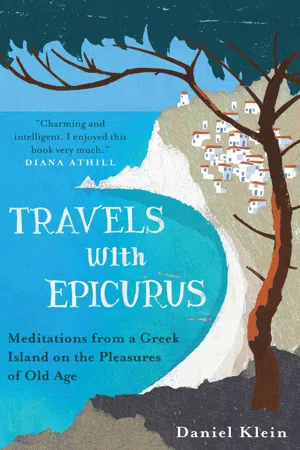
Daniel Klein ponders whether it is better to be forever young or to grin toothlessly and live an authentic old age. He journeys to the Greek island of Hydra to discover the secrets of ageing happily. Drawing on the lives of octagenarian Greek locals, as well as philosophers ranging from Epicurus to Sartre, he uncovers the pleasures that are available only late in life. An escapist travel book, a witty meditation, and an optimistic guide to living well, this is a delightful jaunt through the terrain of old age, led by a funny and uniquely perceptive modern-day sage.
Frequently asked questions

Yes, you can cancel anytime from the Subscription tab in your account settings on the Perlego website. Your subscription will stay active until the end of your current billing period. Learn how to cancel your subscription.
No, books cannot be downloaded as external files, such as PDFs, for use outside of Perlego. However, you can download books within the Perlego app for offline reading on mobile or tablet. Learn more here.
Perlego offers two plans: Essential and Complete
  • Essential is ideal for learners and professionals who enjoy exploring a wide range of subjects. Access the Essential Library with 800,000+ trusted titles and best-sellers across business, personal growth, and the humanities. Includes unlimited reading time and Standard Read Aloud voice.
  • Complete: Perfect for advanced learners and researchers needing full, unrestricted access. Unlock 1.4M+ books across hundreds of subjects, including academic and specialized titles. The Complete Plan also includes advanced features like Premium Read Aloud and Research Assistant.
Both plans are available with monthly, semester, or annual billing cycles.
We are an online textbook subscription service, where you can get access to an entire online library for less than the price of a single book per month. With over 1 million books across 1000+ topics, we’ve got you covered! Learn more here.
Look out for the read-aloud symbol on your next book to see if you can listen to it. The read-aloud tool reads text aloud for you, highlighting the text as it is being read. You can pause it, speed it up and slow it down. Learn more here.
Yes! You can use the Perlego app on both iOS or Android devices to read anytime, anywhere — even offline. Perfect for commutes or when you’re on the go.
Please note we cannot support devices running on iOS 13 and Android 7 or earlier. Learn more about using the app.
Yes, you can access Travels with Epicurus by Daniel Klein in PDF and/or ePUB format, as well as other popular books in Philosophy & Philosophy History & Theory. We have over one million books available in our catalogue for you to explore.
Chapter One
The Old Greek’s Olive Trees
ON EPICURUS’S PHILOSOPHY OF FULFILLMENT
Epicurus grew up on another Aegean island, Samos, two hundred miles east of here, nearer to Anatolia, or Asia Minor. He was born in 341 BCE, only eighty years after Plato, but was little influenced by him. What Epicurus mainly had on his mind was the question of how to live the best possible life, especially considering that we only have one of them—Epicurus did not believe in an afterlife. This seems like the most fundamental philosophical question, the question of all questions. But students of the history of Western philosophy are often disheartened to find that as the centuries went on that question began to take a backseat to philosophical questions that were considered more pressing, like Martin Heidegger’s mind-blower that used to make me laugh out loud with incomprehension, “Why are there things that are rather than nothing?” and the epistemological problem, “How do we know what is real?” Epicurus certainly speculated about the nature of reality, but he did so fundamentally in service of his ultimate question, “How does one make the most of one’s life?” Not a bad question.
Epicurus’s answer, after many years of deep thought, was that the best possible life one could live is a happy one, a life filled with pleasure. At first look, this conclusion seems like a no-brainer, the sort of wisdom found in a horoscope. But Epicurus knew this was only a starting point because it raised the more troublesome and perplexing questions of what constitutes a happy life, which pleasures are truly gratifying and enduring, and which are fleeting and lead to pain, plus the monumental questions of why and how we often thwart ourselves from attaining happiness.
I have to admit that I experienced a pang of disillusionment when I first realized that Epicurus was not an epicurean, at least not in the way we currently use that term—that is, to mean a supreme sensualist with gourmet appetites. Let me put it this way: Epicurus preferred a bowl of plain boiled lentils to a plate of roasted pheasant infused with mastiha (a reduction painstakingly made from the sap of a nut tree), a delicacy slaves prepared for noblemen in ancient Greece. This was not the result of any democratic inclination but rather of Epicurus’s hankering for personal comfort, which clearly included comfort foods. The pheasant dish titillated the taste buds, but Epicurus was not a sensualist in that sense: he was not looking for dazzling sensory excitement. No, bring on those boiled lentils! For one thing, he took great pleasure in food he had grown himself—that was part of the gratification of eating the lentils. For another, he had a Zen-like attitude about his senses: if he fully engaged in tasting the lentils, he would experience all the subtle delights of their flavor, delights that rival those of more extravagantly spiced fare. And another of this dish’s virtues was that it was a snap to prepare. Epicurus was not into tedious, mindless work like, say, dripping mastiha onto a slow-roasting pheasant.
Some Athenians saw Epicurus and his ideas as a threat to social stability. A philosophy that set personal pleasure as life’s highest goal and that openly advocated self-interest could dissolve the glue they believed held the republic together: altruism. Epicurus’s brand of self-centeredness, they argued, did not make for good citizenship. But Epicurus and his followers could not have cared less what these detractors thought. For starters, Epicureans had little interest in the political process. Indeed they believed that to enjoy a truly gratifying life one should withdraw completely from the public sphere; society would function remarkably well if everyone simply adopted a live-and-let-live policy, with each man seeking his own happiness. This followed naturally from one of Epicurus’s basic tenets: “It is impossible to live wisely and well and justly without living a pleasant life.”
Epicurus was a man who lived his philosophy, and this entailed forming a protocommune, the Garden, on the outskirts of Athens, where he and a small and devoted group of friends lived simply, grew vegetables and fruit, ate together, and talked endlessly—mostly, of course, about Epicureanism. Anyone who wished to join them was welcome, as evidenced by the words inscribed on the Garden’s gate: “Stranger, here you will do well to tarry; here our highest good is pleasure. The caretaker of that abode, a kindly host, will be ready for you; he will welcome you with bread, and serve you water also in abundance, with these words: ‘Have you not been well entertained? This garden does not whet your appetite, but quenches it.’”
Not exactly a gourmet menu, but the price was right and the company intriguing.
Remarkably, contrary to the prevailing mores of Greece in Epicurus’s era, women were well received in the Garden, where they were treated as equals in philosophical discussions. Even prostitutes were occasionally present at the table, feeding Athenian gossip that Epicurus and his followers were wanton hedonists. But this was clearly not the case: Epicureans much preferred tranquil pleasures to wild ones. The simple truth was that, unlike the other Hellenistic philosophies of that period, Epicureanism espoused and practiced a radical egalitarianism of both gender and social class.
Although most of Epicurus’s original manuscripts have now been lost or destroyed (it is believed that he wrote over three hundred books, yet only three letters and a few sets of aphorisms survive intact), his philosophy spread throughout Greece in his own time and later took Italy by storm, particularly when the Roman poet Lucretius set down the basic Epicurean principles in his magnum opus, The Nature of Things. In no small part, the perpetuation of Epicurus’s philosophy was due to his own foresight and pocketbook: in his last will he endowed a school to carry on his teachings.
ON OLD AGE AS THE PINNACLE OF LIFE
Epicurus believed that old age was the pinnacle of life, the best it gets. In the collection known as the “Vatican Sayings” (so named because the manuscript was discovered in the Vatican library in the nineteenth century), he is recorded as stating: “It is not the young man who should be considered fortunate but the old man who has lived well, because the young man in his prime wanders much by chance, vacillating in his beliefs, while the old man has docked in the harbor, having safeguarded his true happiness.”
The idea of being an old man safe in the harbor buoys me up as I sit under Dimitri’s awning, pondering the best way to spend this stage of my life. It is the notion of being free from vacillating beliefs that gets to me. My understanding from Epicurus’s other teachings is that he also is referring to the young man’s vacillating pursuits, the ones that follow from his vacillating beliefs. Epicurus is pointing to what the Zen Buddhists call the emptiness of “striving,” and in our culture striving is the hallmark of someone still in his prime.
The same goes for those of us who embrace the “forever young” credo: we don’t give up setting ever new goals for ourselves, new ambitions to fulfill while we still can. Many forever youngsters are driven by the frustration of not having fully achieved the goals they dreamed of attaining when they were younger; they see their final years as a last chance to grab some elusive brass ring.
I became particularly aware of this phenomenon recently when the fiftieth-anniversary report of my university class arrived in the mail. One classmate, a highly successful lawyer and part-time theater and culture reporter for the Wall Street Journal, wrote: “Every day I think about what I haven’t done and get anxious. That I remain in relatively good health is a great blessing, but it’s also part of why I’m not sufficiently driven to finish the novels, plays, and nonfiction stewing in my head. . . . But there’s time, I hope. We all hope, don’t we?”
This man drew inspiration from Henry Wadsworth Longfellow’s “Morituri Salutamus,” the poem he wrote for the fiftieth anniversary of the class of 1825 of his alma mater, Bowdoin College. In the poem Longfellow urges his elderly classmates to keep busy, very busy.
Ah, nothing is too late
Till the tired heart shall cease to palpitate.
Cato learned Greek at eighty; Sophocles
Wrote his grand Oedipus, and Simonides
Bore off the prize of verse from his compeers,
When each had numbered more than fourscore years,
And Theophrastus, at fourscore and ten,
Had but begun his “Characters of Men.”
That “nothing is too late” refrain certainly is tempting. We septuagenarians just might be at the top of our game, our creative juices overflowing. Would Epicurus have us dam them up? Would he have sacrificed the classical masterpiece Oedipus Rex just so Sophocles could sit happily in the harbor? That sounds like a terrible waste.
Still, there is no rest for the striver. Just beyond the completion of each goal on our life-achievement “bucket list” looms another goal, and then another. Meanwhile, of course, the clock is ticking—quite loudly, in fact. We become breathless. And we have no time left for a calm and reflective appreciation of our twilight years, no deliciously long afternoons sitting with friends or listening to music or musing about the story of our lives. And we will never get another chance for that.
It is not an easy decision.
ON FREEING OURSELVES FROM THE PRISON OF EVERYDAY AFFAIRS
For me, it is Epicurus’s overall assessment of the qualities of a truly satisfying life that sheds the brightest sunshine on what a good old age might be. High on his list of the ways we thwart happiness is by binding ourselves to the constraints of the “commercial world.” Epicurus may have predated Harrods by a few millennia, but he already detected the commercial world’s uncanny ability to make us think we need stuff we don’t—and, as the world of commerce keeps chugging along, to need ever newer stuff. But when shopping for the latest thing—usually something we do not really need—Epicurus’s all-important life of tranquil pleasure is nowhere to be found. One of my favorite of Epicurus’s aphorisms is: “Nothing is enough for the man to whom enough is too little.”
In Epicurus’s view, true happiness is a bargain, like, say, boiled lentils—or a yogurt dip. In a serene old age, who really feels deprived if he can’t feast on slow-roasted pheasant or, for that matter, the poached salmon with truffles my wife and I dined on just before my departure for Greece? Go with the simple pleasures, Epicurus says. They are not only less expensive, they are less taxing on an old body.
Yet when Epicurus writes, “We must free ourselves from the prison of everyday affairs and politics,” he has more on his mind than just freeing ourselves from the endless acquisition of unnecessary stuff. It is the business of dedicating our lives to business that he is warning us against, starting with the obvious restraints of having a boss who tells us what to do, how to do it, and what is wrong with the way we are currently doing it. Even if one is the boss, as many of my “forever young” friends are, one’s freedom remains constrained by the politics of having to deal with other people; one still has to tell them what to do, to negotiate with and motivate them. One is still imprisoned. And freedom—Epicurus’s brand of radical existential freedom—is absolutely necessary for a happy life.
Forsaking the world of commerce—that is, giving up one’s day job—may have been all well and good in the Garden in 380 BCE (and I do have to wonder if a frequent guest at Epicurus’s table, the financier Idomeneus, didn’t pitch in to purchase the goods that couldn’t be grown in their communal vegetable patch, like the barrels of wine they were said to have consumed daily), but it feels like a tougher choice nowadays. In today’s terms, Epicurus would advocate a kind of sixties, getting-by-on-nothing lifestyle—one that, for better or for worse, few of us were willing to fully embrace to attain perfect freedom when we were younger.
Heaven knows, I tried. Back in the late sixties when the mantra of my former professor Timothy Leary, “Turn on, tune in, drop out,” reverberated in the zeitgeist, I quit my job writing for television shows in New York and came for the first time to this very place, Hydra. Living on money I had saved, I did nothing for an entire year but sit in tavernas with locals and other dropouts, drink ouzo, chase after women, and stare off into the middle distance.
One morning, during this idyll, I was idling in the port when, astonishingly, a Harvard classmate suddenly appeared in front of me; he had just stepped off a yacht on a vacation cruise. I was deeply tanned, I had not had a haircut since my arrival on the island half a year earlier, and I was wearing well-worn clothes. The classmate was startled to find me in this place and in that condition and wanted to know what the hell I was doing here. “I’m taking my retirement early while I can still enjoy it,” I replied. It was meant to be wit but belied more defensiveness than I had realized I felt.
That long-ago year on Hydra was supremely enjoyable—I have no regrets about it—but truth to tell, I gradually became bored with myself. I yearned to get busy. I wanted to be engaged in the world. I wanted to make something of myself. And so I returned to the world of commerce, although my attraction to the Epicurean life never completely left me.
Now, sitting at Dimitri’s, I see that it is Tasso’s turn to skip a hand of prefa. He stands, cane in hand, and ambles to the seaward edge of the terrace, where he watches the ferry from Ermioni appear from behind Dokos, a stark, uninhabited, whale-shaped island that lies between here and the Peloponnese. This ferry is one of the last of the slow-moving vessels sailing here; for decades now the most popular boat has been a hydrofoil from Piraeus—a hermetic sardine can of a conveyance for getting hurriedly to a place where time slows to a standstill.
The creeping ferry from Ermioni reminds me of the two trains that circumnavigate the Peloponnese, one in each direction; these also move at a pace not much faster than a middle-aged jogger. At times these trains rattle on so leisurely that one could easily pick oranges from track-side trees through the windows. No doubt this speaks to the not-up-to-snuffness of rural Greek technology, but it also speaks wonderfully to the Greek predilection for focusing on the pleasures of the journey, rather than on the destination.
On one of my many returns to Greece, I rode these trains around the perimeter of the Peloponnese, with my wife and daughter. It was the year 2000, and Greece, after failing to qualify for entry into the euro as currency in 1999, was trying again. My wife, who is from Holland, surveyed the scene outside our window with a sardonic eye, spotting “inefficiencies” everywhere. “Look at them!” she would howl as we passed a group of five Greeks leisurely unloading a cartload of eggplants bucket-brigade style, several with cigarettes dangling from their lips. “These people aren’t serious about the euro!” Although she was smiling, she was at least half-serious; Holland, of course, is the world capital of Calvinism. My daughter and I soon assigned her the nickname “the euro inspector.”
One morning, after a magical few days in the northern Peloponnesian village of Diakofto, we made our way to the railway station to catch the train to Corinth. My rudimentary Greek qualified me as our tour leader; I bought the tickets and found us seats on the departing train, where I immediately spread out my limbs and drifted into a pleasant snooze. Minutes later I was awakened by my wife—we were going in the wrong direction! We had gotten on the train circling the Peloponnesian peninsula counterclockwise instead of the one circling it clockwise. My wife realized this when our train passed a bench holding the same three old men we had passed when we’d come from the other direction a few days before. “It’s as if they never moved,” she said. My whimsical daughter chimed in that we must be on a time-traveling train and were rolling back into the past. Indeed.
Clearly it was my responsibility to rectify the situation. I found the conductor seated at the front of our car, where he wa...

Table of contents

  1. Cover
  2. Title page
  3. Copyright page
  4. Dedication page
  5. Epigraph page
  6. Contents
  7. Prologue – The Table at Dimitri’s Taverna
  8. Chapter One – The Old Greek’s Olive Trees
  9. Chapter Two – The Deserted Terrace
  10. Chapter Three – Tasso’s Rain-Spattered Photographs
  11. Chapter Four – A Sirocco of Youth’s Beauty
  12. Chapter Five – The Tintinnabulation of Sheep Bells
  13. Chapter Six – Iphigenia’s Guest
  14. Chapter Seven – The Burning Boat in Kamini Harbor
  15. Epilogue – Returning Home
  16. Acknowledgments